


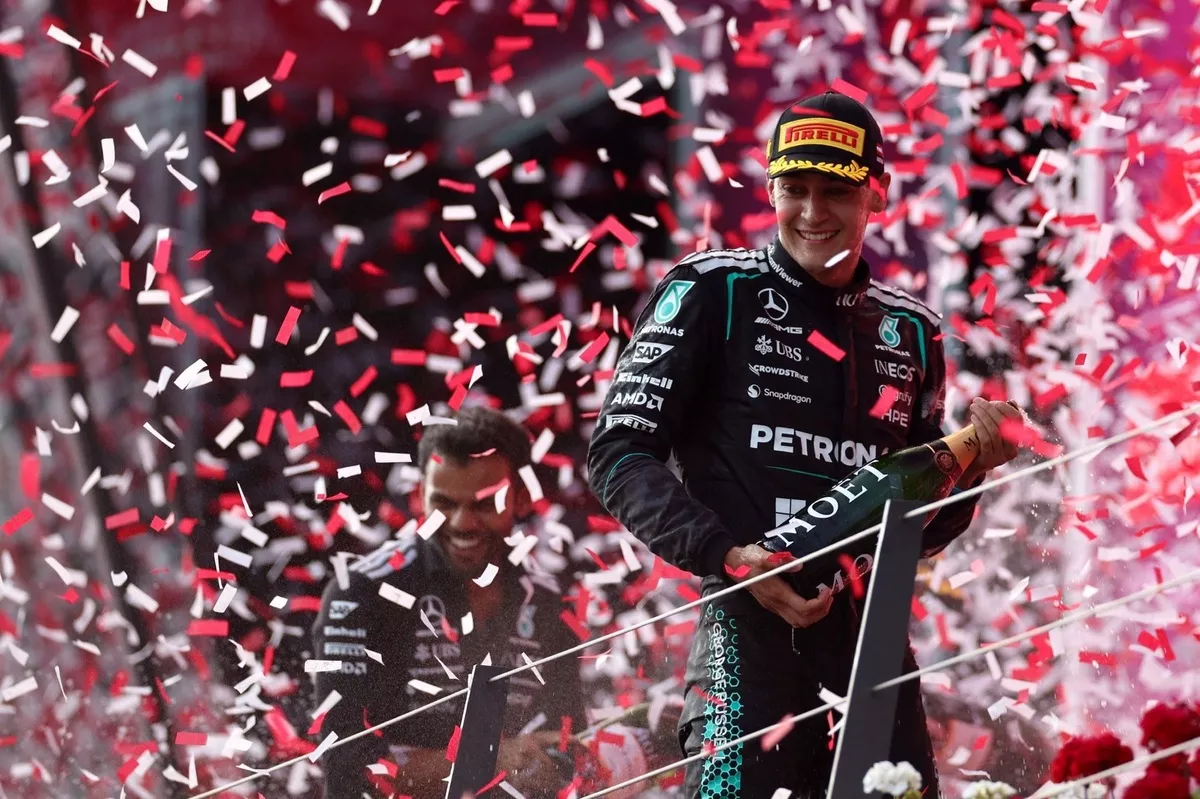
Russell claimed a much-needed win in Austria, but could Verstappen - or Antonelli - have won?
Kimi Antonelli's championship lead is now down to 40 points as George Russell captured victory at the Red Bull Ring, fending off a resurgent Max Verstappen. But did Red Bull squander a chance to win?

Autosport Explains
Our experts decode the most important stories in motorsport.
A dog-day afternoon in Austria hardly presents the ideal conditions to lose the use of one's water bottle, particularly when patience with the European heatwave has already run thin. Yet, this was the situation in which George Russell found himself in as he took his place at the front of the grid for the Austrian Grand Prix, albeit with a soupcon of controversy.
It wouldn't be unpopular to suggest that Max Verstappen's qualifying crash should have been given the double-yellows from the get-go, but Russell dealt with the single yellow flag presented to him: he lifted enough to satisfy the stewards, still went quicker than Charles Leclerc (gaining the time he'd lost through lifting in the final corner) and had done enough to argue the toss later.
Leclerc, and his Ferrari team-mate Lewis Hamilton, were chomping at the bit to put Russell under scrutiny on the opening lap. Were this race to fall before Miami, there's every chance that the two Rosso Corsa machines could have left the Briton for dust off the line, but Mercedes has made significant progress with its starting procedures since the start of the year. Back then, Russell and Kimi Antonelli were haemorrhaging positions; now, even with mistakes into the opening corner (as Antonelli demonstrated with a couple of wide moments on lap one), they've got enough in the tank to preserve position.
Although Russell had a small fright from the Ferraris on the opening lap, he prevailed and held the lead and had been able to take care of the chance that Hamilton could come back at him with the overtake button when he broke the one-second barrier. This was the extent to which Ferrari challenged in Austria; although it attempted to reprise its three-stop exploits from Barcelona, a gambit that bestowed a race win upon Hamilton, the race pace of the SF-26 was nowhere near sufficient to make this work again.
Instead, the challenge of unseating Mercedes from the front fell to Red Bull and Verstappen. With his car fixed after his journey into the wall at Turn 9 on Saturday, the Dutchman looked happy with his lot and with a vastly improved RB22 chassis. A series of updates to inject much-needed downforce into the often light-handling Red Bull provided Verstappen with the means to pounce on Leclerc and Antonelli on the second lap, buying into the battle between the two cars ahead as Leclerc held up the Italian driver through Turns 3 and 4.

Ferrari helped Verstappen's cause somewhat at the end of the 12th lap; after losing a hard-fought battle against Hamilton for second place, the Briton was pulled into the pits as Ferrari enacted its three-stopper - somewhat expecting Verstappen to do the same. The road ahead was clear, and the Dutchman had been able to cut a second out of Russell's lead over the next few laps before making his own stop six laps later.

Russell did enough to ward off the threat of a rapid Verstappen
Photo by: Andy Hone/ LAT Images via Getty Images
Russell responded pretty much immediately to counter any undercut attempts from the two behind him, and Verstappen responded to Hamilton's passing manoeuvre a few laps prior - complaining that the Barcelona winner had put him in the gravel - with a move through Turn 6 that offered his 2021 title rival no chance of a riposte.
This time, Verstappen was able to scythe away at Russell's lead once back into second place. Having been 5.6s back at the conclusion of the virtual safety car, brought out as Carlos Sainz's Williams gave up the ghost, Verstappen took 14 laps to hack the arrears down to just 1.4 seconds. But, facing the dirty air from Russell's car, the gap seemed to stabilise somewhat, and floated around at 1.3-1.4s before Russell called in to stop for a second time at the end of lap 43.
Verstappen, however, did not respond on the following lap. Instead, he spent the next six laps trying to gather an offset for the final stint, hoping to use that to clear Russell in the final stages of the race. After his own stop, the four-time champion was 11 seconds shy of Russell and took no time to chop away at the gap consistently over the final 20 laps. Yet, it wasn't quite enough; Russell had done enough to staunch the bleeding over the final 10 tours; instead, it became more likely that Verstappen would come under fire from a recovering Antonelli, rather than mount the last-gasp assault himself.
Speaking after the race, Verstappen noted that he was nursing a car issue that had precluded him from putting Russell under further pressure, stating that "in the middle of the second stint something happened with the car and the rear axle, which made me lose pace and it just stayed there until the end". Yet, he nonetheless felt that he had the degradation advantage over Russell. So, did the extended stint cost time - and potentially victory?
Calculating the time loss of Verstappen's longer second stint

Had things gone his way, Verstappen will feel he could have won at his team's home race
Photo by: Mark Thompson / Getty Images
Let's pick this up from the end of lap 42, when Verstappen was 1.314s behind Russell on-track. Russell did just one more lap before calling into the pits, and Verstappen stayed out until the end of lap 49 before making his final stop. From laps 42-50 (so, including Verstappen's out-lap), the extended stint cost Verstappen 9.285s in total. When Verstappen left the pitlane, this produces the gap of 10.656s, as per the table below.
Russell vs Verstappen, race laps 42-50
| Lap | RUS | VER | Delta |
|---|---|---|---|
| 42 | 72.225 | 72.168 | 1.314 |
| 43* | 76.208 | 72.087 | -2.807 |
| 44 | 87.853 | 72.414 | -18.246 |
| 45 | 70.860 | 72.356 | -16.750 |
| 46 | 71.045 | 72.380 | -15.415 |
| 47 | 70.904 | 72.630 | -13.689 |
| 48 | 71.215 | 72.681 | -12.223 |
| 49** | 70.683 | 77.001 | -5.905 |
| 50 | 70.952 | 87.513 | 10.656 |
* denotes Russell's stop lap ** denotes Verstappen's stop lap
If we assume that Verstappen pits on the same lap as Russell and logs the same laps as his first seven lap times out of the pits (deleting the second VSC-affected laps on lap 52 and 53, when Alex Albon spat a bollard onto the track), then we have a theoretical situation where Verstappen is within a second of Russell on lap 48. In this situation, Red Bull isn't likely to give Verstappen the command to stop at the same time as Russell, unless it was really confident that the Dutchman could fire up his tyres and make a move at the same rate.
Instead, let's say that Verstappen stops a lap later; again, deleting the laps under VSC and assuming the same lap times are set either side of that, Verstappen gets within a second of Russell by lap 51. So, this is very much pause for thought; Verstappen might have expedited his catch-up by almost 20 laps had he stopped sooner. Here's how that plays out in the table below.
Theoretical Russell vs Verstappen, if Verstappen stops on lap 44
| Lap | RUS | VER | Delta |
|---|---|---|---|
| 42 | 72.225 | 72.168 | 1.314 |
| 43* | 76.208 | 72.087 | -2.807 |
| 44** | 87.853 | 77.001 | -13.659 |
| 45 | 70.860 | 87.513 | 2.994 |
| 46 | 71.045 | 70.888 | 2.837 |
| 47 | 70.904 | 70.596 | 2.529 |
| 48 | 71.215 | 70.599 | 1.913 |
| 49 | 70.683 | 70.633 | 1.863 |
| 50 | 70.952 | 70.483 | 1.394 |
| 51 | 71.171 | 70.622 | 0.845 |
| 52 | 70.937 | 70.508 | 0.416 |
* denotes Russell's stop lap, ** denotes Verstappen's stop lap
Back in the real world: from lap 60, Russell drops into a pretty consistent pattern of 1m11s, but this looks like a natural progression of degradation rather than managing his lead. He sits in the high 1m10s before that, either side of that bollard-induced VSC period. Verstappen, meanwhile, is able to sit comfortably in the 1m10s until lap 65, and his dip into the 1m11s sits in arena of the 1m11.1s/1m11.2s, rather than Russell's further regression into the 1m11.6s and beyond.
Although Russell set a handful of times in this bracket before, he only consistently dips into the high 1m11s on the final seven laps - which accounts for the offset that Verstappen had gained.
There's a case to be made, had Red Bull responded to Russell more quickly, that Verstappen could have mounted an assault with at least 10 more laps to go. Of course, there's degradation and traffic to consider, but one wonders if they have a simulation on tap that might demonstrate that the extended second stint was not necessarily the way to go.
Could Antonelli have won with more fortunate VSC timing?

Antonelli's first stop was complete just moments before a VSC was called
Photo by: Guido De Bortoli / LAT Images via Getty Images
To some degree, Antonelli fluffed his own lines with a wayward approach to the opening couple of laps and thus ceded position to Verstappen - and almost to Lando Norris when the McLaren driver made a solid start to the race. The championship leader recovered, particularly through his second stint where he was able to close a 13-second gap to Russell down to 7.3s by the time his team-mate pitted.
Although Antonelli emerged from his second stop on lap 51 with a similarly sized 13.9s gap, his pace was unrelenting; he found 12 seconds on Russell over the final 20 laps to sit within two seconds of the victor at the chequered flag.
Antonelli's first stop emerged at an incredibly unfortunate moment; he was already on his way to pit when Sainz's Williams gave up the ghost, and the VSC did not trigger until the Italian was already out of the pitlane.
We have a delta, to use here, however; Hamilton used that VSC period to pit for a second time, as did the two Aston Martins, and it saved them about 10 seconds from a 21-second time loss. At the point at which Antonelli pulled into the pitlane, he was leading by 7.2s over Russell and 10.8s ahead of Verstappen. So, he'd have been neck-and-neck with Verstappen here, and with younger tyres to use once the VSC had been cleared.
One interesting aspect of this VSC is that Russell made a 1.5-second time gain over Verstappen, through nailing his deltas and gathering a quicker restart. He was about five seconds clear when the race restarted, and Verstappen would have had Antonelli potentially breathing down his neck had the cheaper pitstop put the 19-year-old right on his tail. Indeed, it might have been slightly difficult for him to resist Antonelli's attack with fresher tyres on his Mercedes.
Were Antonelli to have made similar progress towards Russell to what Verstappen had achieved over this portion of the race, he'd be around a second away from his team-mate. Since Antonelli's race pace was stronger than Russell's, it might have opened the door to a repeat of Barcelona in which the championship leader eventually broke down Russell's defences and nipped past into second (shortly before retiring).
Had those strategic decisions been made slightly differently, either one of Verstappen or Antonelli could have won in Austria; so, to confound Betteridge's Law of Headlines, the answer to the question at the top is a resounding 'yes'. But it's all about taking your chances; Russell was presented with one in qualifying, and again in the race, and he took them both with gusto.
His reward? A return to second in the championship, and now just 40 points adrift of Antonelli. It's game on.

Russell has cut his gap to Antonelli - but must find a bit of extra pace to shrink it further
Photo by: Anni Graf - Formula 1 via Getty Images


Lights, Camara, action: How Haas picked F1's latest rookie for 2027

Horner's inside story of how Red Bull built its own F1 engine

Why Mercedes' latest 2026 F1 update is no downgrade

Singapore Grand Prix Driver Ratings 2026

What we learned from the 2026 F1 Singapore GP sprint race and qualifying

The political minefield set out by F1’s recent cost-cap grievances

What caused Mercedes' pace deficit at Sepang despite upgraded W17?

Three kings: F1's generational stars shone at Sepang

Colapinto urges fans to stop online abuse: “You’re not helping me or my future”

Evans given a hero's homecoming after WRC title triumph

How an unspectacular showing in a kart race is such good reason to celebrate

Lights, Camara, action: How Haas picked F1's latest rookie for 2027
Subscribe and access Autosport.com with your ad-blocker.
From Formula 1 to MotoGP we report straight from the paddock because we love our sport, just like you. In order to keep delivering our expert journalism, our website uses advertising. Still, we want to give you the opportunity to enjoy an ad-free and tracker-free website and to continue using your adblocker.


Top Comments