


Three kings: F1's generational stars shone at Sepang
Chaos broke loose at F1's first visit to Malaysia since 2017, and it required a cool head to perform. This is where F1's current multi-time champions rather came into their own...

Fernando Alonso is a master of chaos. Not my words, Carol, the words of Oscar Piastri; the Australian indirectly bestowed Aston Martin's evergreen two-time champion with the title over the radio when informed by Tom Stallard that Alonso had finished eighth in F1's Bahrain Grand Prix in Malaysia. He's not wrong either; when a race becomes chaotic, you want Alonso on your side.
Many have said that, of Alonso's key attributes honed in his 25-year top-level career, his improvisational skills have always been impeccable. In times of trouble, you'd expect him to dig his way out with nothing but a dream and a rusty spoon. However, one might argue that this doesn't tell the full story: Alonso's strength is actually in the decision of *when* to improvise and when to sit back and let the race unfold.
His performance at Sepang contained both improvisation and restraint, as the call to start on slicks defined yet defied his final finishing position. What was especially telling was that the Aston Martin, in the slippery conditions present in the opening few laps, genuinely had solid pace in the damp weather: not enough to close up on Lando Norris' McLaren, but enough to put a move on Lewis Hamilton's Ferrari as the seven-time champion skittered around on the soft.
Alonso's concerns at this stage were closing up to the pack - which eventually was granted by the safety car - and then going deeper into the race to minimise the number of stops needed. Thus, he took the switch to the hard tyre under that safety car, and worked his way though the series of cars that had made the right call for intermediates at the start, but didn't have the legs in dry conditions. The Aston, unlike the previous outings in Monza, Madrid, and Baku, did - at least, in Alonso's hands.
Although Alonso's endeavours ground out slightly once he'd caught up to team-mate Lance Stroll, who'd also started on the medium tyre but bailed out for intermediates before the race eventually took a standing start, the two switched once they'd made their mid-race stops for a second set of the hard tyre. This bought Alonso the momentum to clear Esteban Ocon, one of those who'd fallen back after an impressive start to the race, and Arvid Lindblad with a stellar move through Turns 1 and 2.
Knowing that Lindblad would take the inside line for Turn 2 as the teenager kept hold around the outside, Alonso decided to stay wide and take the late apex for the second corner. In doing this, he could get onto the power sooner - and had the drive out of the corner to pass through Turn 3. It would be patronising to Lindblad to suggest this was the measure of experience but, with Alonso having been to Sepang several times before, he knew where the grip would be.

Alonso used all 45 years of his experience to work through a tough Sepang race
Photo by: Joe Portlock / Getty Images
That Alonso was able to hang on during the late restart to keep Norris at bay (by using Liam Lawson as an overtake delivery system) was the clincher. Remember that he'd done this all before back in 2012, when he'd just about batted away Sergio Perez in a rain-affected Malaysian GP to clinch Ferrari's first win of the year.
But it also put one in mind of his drive at 2015's Hungarian Grand Prix, an equally manic race (sans rain) in which Alonso was saddled with an equally troubled car (on that occasion, the Honda-powered McLaren), and one where he flexed both urgency and restraint in his path towards fifth in the race. He didn't push too hard, but equally did not play a completely passive role; when a pass on Carlos Sainz was on the cars with around 15 laps to spare, Alonso made it happen to upgrade his position.
"In the weekend that we can score points, the important thing is to execute well the race," Alonso said of his race last weekend. "We started with a slick, so we put ourselves in some difficulties there. But at the end, it was OK. After the safety car, we had a new race coming."
It left him with ground to make up, but there was nothing that was going to stop the Dutchman from taking his first win of 2026
Hamilton also rolled back the years in Malaysia, despite opting for a similarly fraught strategy. Where Hamilton's race differed was in staying out under the safety car, a decision which bought a couple of extra positions - but also extended the risk factor as the pre-race forecast was that the softs would wear out relatively quickly. Regardless, Hamilton looked after them well; it appeared that running with them at a slow pace on a damp track plus the safety car laps after had 'cured' them enough to last for 31 laps.
This was evident in his display once green-flag running resumed, with a series of passes that brought him back into the top five after just 22 laps. It got more difficult after that, as Isack Hadjar was up the road and Hamilton's switch to the medium tyre stalled out the battle thereafter. But once reequipped with softs for the final few laps once the second safety car had disappeared, Hamilton got the run on Hadjar with three laps remaining to take what was something of a scenic route back to a podium finish.
Hamilton's decision to resist the chance to bail on the slick-tyre start, as Leclerc had done, had brought him back into the frame. That first safety car, produced by Valtteri Bottas' off, presented the opportunity to make up ground here - and it's all about how you use those set pieces as a driver. Pirelli had stated before the race that, with a sensible approach, a driver could make a two-stopper work without ever taking the hard tyre; Hamilton managed to do just that.
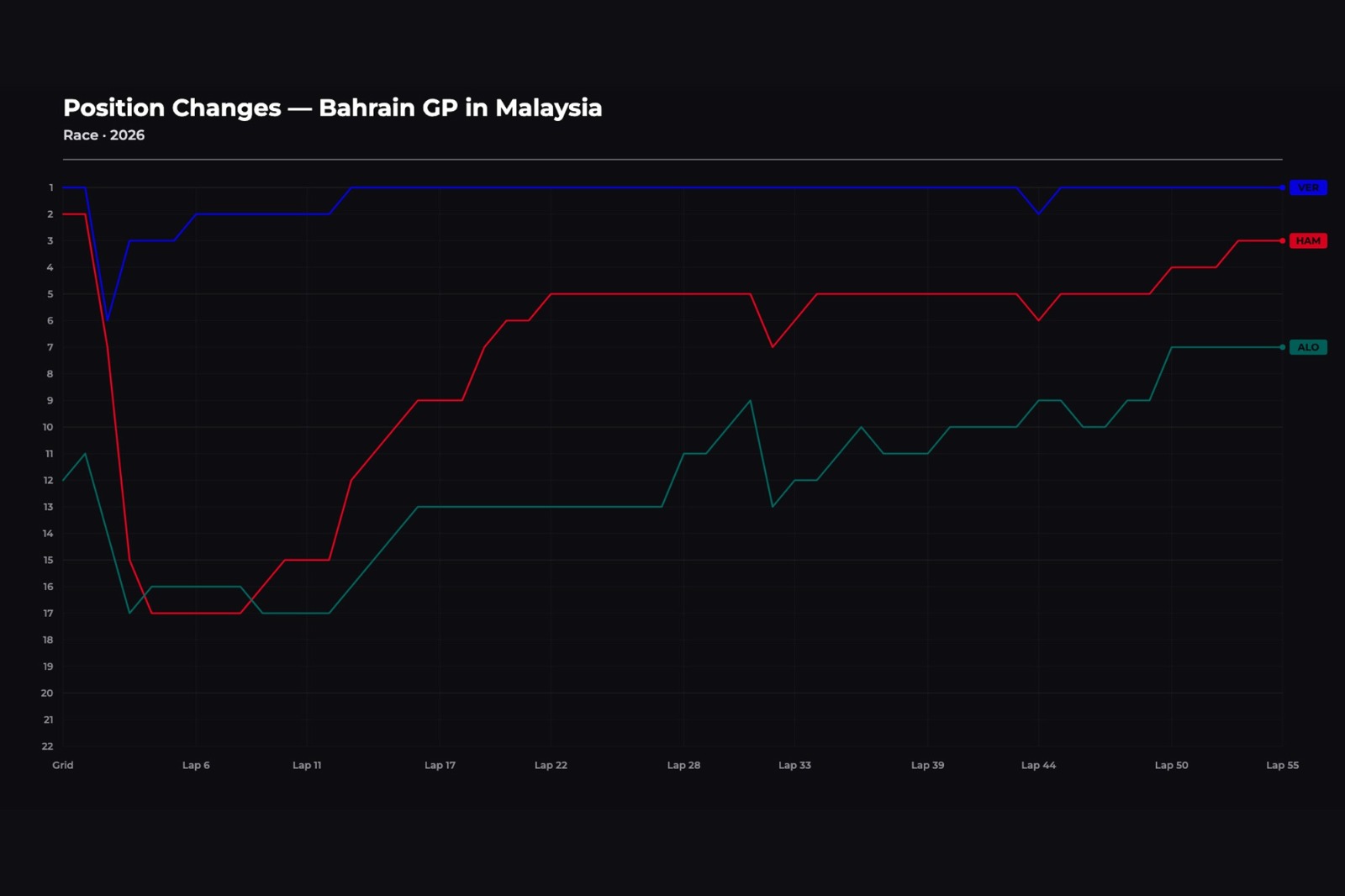
The progression of Verstappen, Hamilton, and Alonso's races at the 2026 Bahrain GP in Malaysia
Both Hamilton and Verstappen had endured the power unit glitch at the start, one that prompted the race director to abandon the first attempt at the start as the FIA sought to find a fix. With the power units running in wet weather for the first time during a race weekend, there was a bug in the code that stopped the cars from using their powertrains when below a given speed at the lower power modes. As they couldn't accelerate, the cars effectively needed a restart in order to get going once more. Thankfully, this was no longer an issue once the FIA circulated an updated software version.
The decision to restart the race with the original grid line-up was a stroke of luck for both drivers. Verstappen nonetheless suffered a bit of a hiccup at the start proper when the clutch slipped on the line, and both Mercedes tore past the Red Bull. It left him with ground to make up, but there was nothing that was going to stop the Dutchman from taking his first win of 2026.
Let's not forget that Mercedes had struggled in qualifying, and there was a pace deficit versus the Red Bulls all weekend, so Verstappen likely knew that his time would come. It helped that Red Bull had made all of the right strategic calls, and the intermediate start presented an opportunity to do the rest of the race on soft tyres.
Verstappen's restart was well managed too, having found the grip immediately on those soft tyres to leapfrog Antonelli through the opening array of corners. There was little chance of a Mercedes fightback, even with the late safety-car restart; Verstappen had Antonelli exactly where he wanted him.
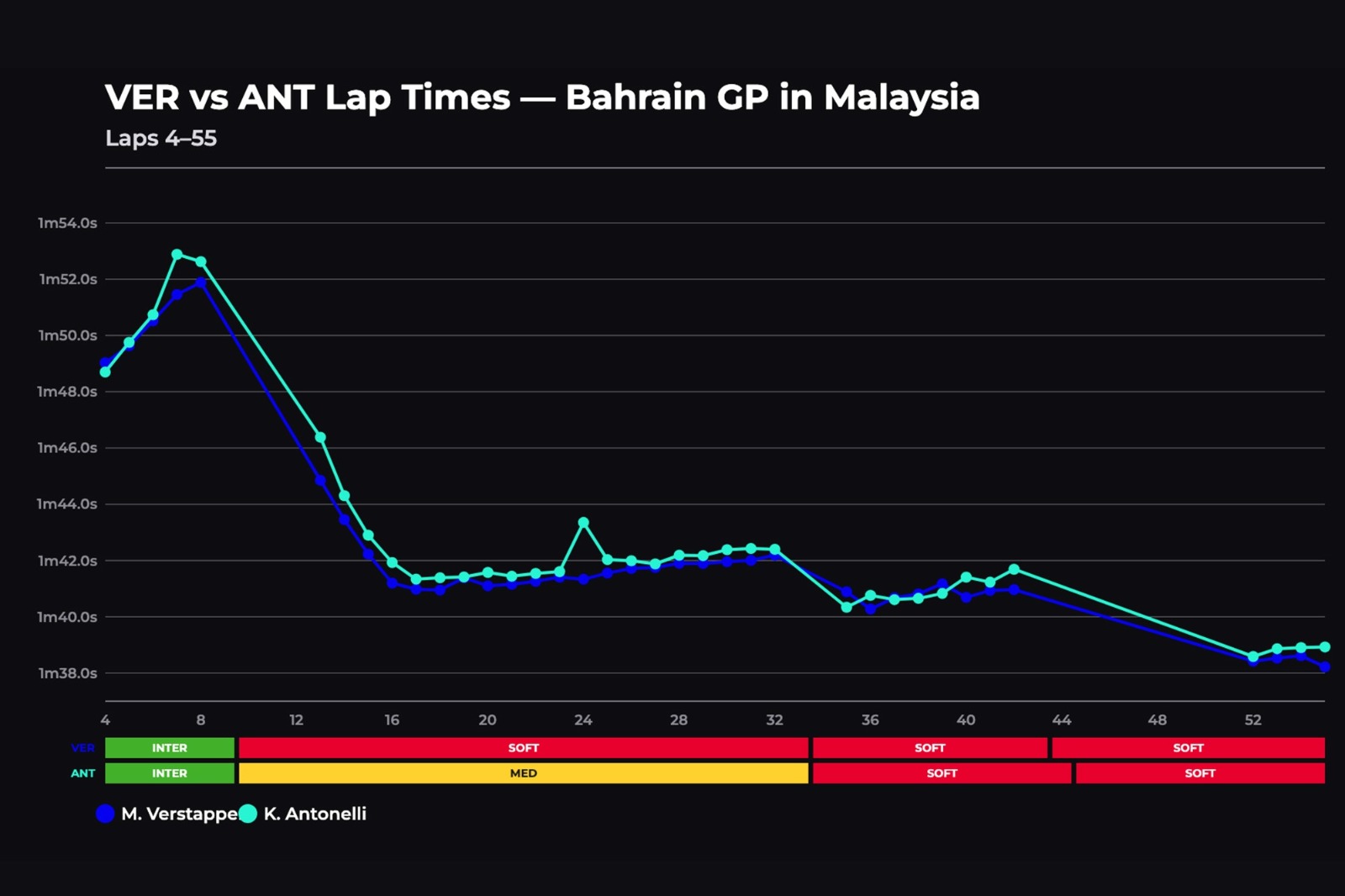
Verstappen's pace versus Antonelli at the Bahrain GP
In those sorts of chaotic conditions, where inclement weather and interruptions occur, it takes a special type of talent to cope with it and to have the mental bandwidth required to execute their races, while leaving room to take an improvisational stance should the situation require.
In Alonso, Hamilton, and Verstappen, you have the three men who perhaps defined their generations with regards to their driving talent, and who have always been excellent in those situations. You'd need more than your two hands to count all their displays of brilliance in similarly wild conditions.
Singapore will also present a tough weekend, but for very different reasons: the sheer physicality of the Marina Bay course makes it incredibly tough to stay at 100%, especially when the drivers start to lose hydration and focus starts to dip as a result.
But it's all about what you do at 90%; it was at that level where F1's generational masters could shine in Malaysia, and expect them to do so again this time around.


Sepang's podium featured the man of the 2020s, the man of the 2010s...and perhaps the man of the 2030s?
Photo by: Srinivasa Krishnan


Bahrain Grand Prix in Malaysia Driver Ratings 2026

The slick tyre gamble that hurt McLaren and Ferrari's chances in Bahrain GP in Malaysia

The wide world of strategy options expected in F1's Bahrain GP in Malaysia

McLaren explains recurring Norris straightline speed issue after Bahrain GP qualifying

How drivers waiting in the wings can still make their presence count in F1

What we learned from Friday practice at the 2026 Bahrain GP in Malaysia

Mercedes introduces new floor, sidepods for F1 Bahrain GP

The problem with Ferrari’s endless team principal speculation

Three kings: F1's generational stars shone at Sepang

Six champions crowned, new winners and lap records fall at Castle Combe

How Evans made WRC history in Hollywood blockbuster Sardinia decider

The dire consequence of Russell's Bahrain GP in Malaysia retirement
Subscribe and access Autosport.com with your ad-blocker.
From Formula 1 to MotoGP we report straight from the paddock because we love our sport, just like you. In order to keep delivering our expert journalism, our website uses advertising. Still, we want to give you the opportunity to enjoy an ad-free and tracker-free website and to continue using your adblocker.


Top Comments