



Why Mercedes' latest 2026 F1 update is no downgrade
In binary fan opinion, Mercedes' struggles to get its Sepang updates working first time out led some to declare them a "downgrade" - but after splitting its cars in Singapore, Mercedes took a considerable step in understanding them

Autosport Explains
Our experts decode the most important stories in motorsport.
Picture this: you've been working on developments for a Formula 1 car, with the intent of contributing a few-tenths-worth of lap time to pull clear of your rival teams. The simulations look good; your computational fluid dynamics (CFD) analysis is generating some pretty encouraging results, and the wind tunnel work carried out to underpin those simulations demonstrates that your concept is sound. Aerodynamically, everything is working as you expect, and so the decision is made to put those updates into production.
Of course, this is a proud moment for any engineer, but there's one thing you won't ever get: the guarantee that they'll work first time out. Sometimes, you'll pop the new parts on the car and it'll immediately function as expected with minimal change to the car's pre-existing set-up window; on other occasions, it might take a little more time to bed those developments in. This could require just a few tweaks to the set-up, or as much as a sea-change in the previous parameters to get the updates functioning.
And when you have limited time at a grand prix weekend, it's incredibly difficult to know where to start with run plans to explore those updates. Mercedes, with its Sepang-spec updates, has very much demonstrated this point.
The less charitable foghorns who reside in the Maison Internet have suggested that Mercedes had arrived in Malaysia with a downgrade package, as if the team sought to spend its valuable cost cap budget making the car worse. That said, I'm sure those who produce the updates for Windows don't intend on making it worse...it just seems to happen that way. There's much more nuance to the F1 upgrade cycle than it's often claimed; it's not as black-and-white as "this part worked" or "this part failed" - it's a science, and science relies on experimental process to prove or disprove a theory.
Mercedes had a simple and specific target for its latest round of updates: uncover more load in high-speed corners, and watch the performance benefits also trickle into the mid-speed corners. A new floor was the centrepiece here, with revisions to the floor board and rear half of the sidepod to help set off those changes top-side.
While the specifics of the aerodynamics are known only to the engineers, the overarching concepts are largely consistent with any quest for further downforce: strengthen the pressure differential between the top and bottom surfaces, reduce separation, energise and accelerate flow underneath the car (this is still vital, even with a flat-bottomed car, as strengthening the diffuser flow is a key component here), and mitigate the effect of tyre wake on the underbody flow.
This needs to be the case through a range of situations too, and simulating and testing the new aero parts across a series of different yaw angles (and with other variance in axial motion) should account for the various loading conditions expected throughout the course of a lap. In theory, the longer those updates remain in development, the more likely the team is to have the ideal range of conditions in which to run them.

Antonelli snared a podium in Singapore and captured valuable data with the updated W17
Photo by: Joe Portlock / Getty Images
But it's not a guarantee. Indeed, Mercedes had the full scope of the Malaysia weekend to run the updated parts, but it wasn't the ideal venue to do so. Even though teams have access to ballpark figures for surface roughness, friction coefficients, and other such parameters, anything as inconsistent as the Sepang road surface makes that difficult to reproduce in a simulated environment. Add that to the other variables: tyre performance, track temperature, humidity, and other such considerations, and you're soon worlds apart from "laboratory conditions".
Ultimately, it makes Mercedes' difficulties across that weekend much more difficult to establish. Deputy team principal Bradley Lord outlined the situation post-race; the drivers felt that, in the high-speed corners, the update did what it was supposed to do. However, the team also encountered more difficulty in the low-speed sections of the Sepang course, and it was unclear why: had the updates had evidently deleterious side-effects, was it a function of the car's interaction with the Sepang circuit itself, or was it a little from Column A and a little from Column B?
"We know that by adding downforce, that brings with it drag. And the calculation is that what you gain in the corners will outweigh what you lose down the straights. We've seen what we're expecting there. We're seeing the benefit in the high-speed corners and the medium speed. The drivers say they can feel it as well," Lord said in Malaysia.
The team's decision to run split specifications at the Marina Bay circuit was hence the most sensible decision that it could make: it presented Mercedes with an opportunity to run the cars back-to-back at a venue which could expose any perceived slow-speed corner deficit, and run it through a race course with plenty of historical track data available
"But there's no doubt that we've struggled in certain corners all weekend, particularly the slower ones. And what we have to unpick is whether there's anything there linked to the update itself. Or whether we're racing at very high temperatures for most of the weekend.
Obviously it was cooler today in the race. We're racing on by far the roughest tarmac and asphalt. Very open tarmac that gives the tyres a very hard time as well.
"And we seem to be suffering most in the places where the asphalt was at its most open and at its most broken. And that is something we've seen in the past at a circuit like Bahrain, which is the other comparison to this kind of track surface. So there are many things to unpick."
Disappointment or not, the weekend at least presented the team with a series of data points to bring to Singapore. The feeling was that the potential performance was lurking within the new package, but that it was difficult to evoke that potential.

Mercedes had positive signs its upgrades worked in Sepang, but there were too many variables to be confident
Photo by: Joe Portlock / Getty Images
The team's decision to run split specifications at the Marina Bay circuit was hence the most sensible decision that it could make: it presented Mercedes with an opportunity to run the cars back-to-back at a venue which could expose any perceived slow-speed corner deficit, and run it through a race course with plenty of historical track data available. A sprint weekend does, to some degree, complicate things as the ideal practice-session run plans are generally truncated - but the contra-point to that is it gets two sets of race data, assuming one driver doesn't slap the car into the wall, that is...
Why did the team not do the split-spec runs in Friday practice at Sepang, and then gravitate towards the one that worked best? This was partially explained by Antonelli in the Singapore weekend, who stated that he'd have to commit to sticking with the new-spec car regardless of early performance over free practice: it can be assumed that the time needed to convert from one specification to the other may not have been possible between Friday and Saturday, or between practice sessions.
Plus, there's the complicated subject of driver parity; if you split and leave a driver on the old spec for FP1 and FP2, they'll potentially enter FP3 at a disadvantage having not garnered experience of the later-spec machinery. With Russell sitting on an engine penalty for Singapore it was, in his words, a 'no-brainer' to split this time around.
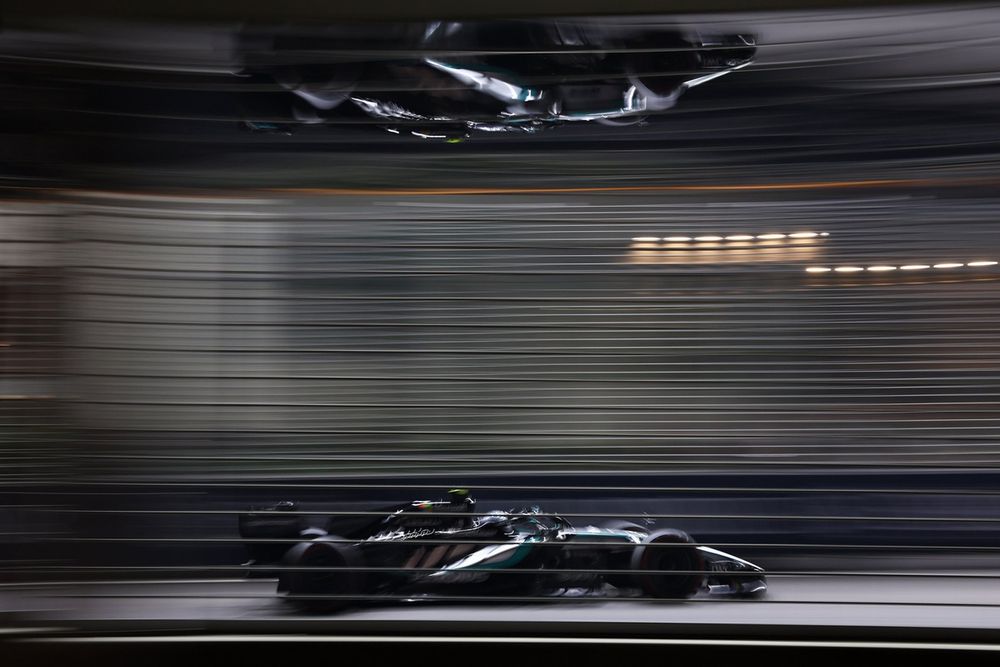
Having taken the updated car through Friday and Saturday at the Singapore Grand Prix, Antonelli's side of the garage ultimately pursued an experimental route in an effort to find progress with the car. It set up one way, then turned the car upside down and started to uncover what made the new updates tick.
"We start seeing what the package can give to us, but it's still difficult to find the right window," was Antonelli's verdict post-qualifying. "We did a big, big step in set-up today and we seem to put the car in a better place, even by giving away a bit of performance.
"But the car just seemed to work in a better way. However, the window was still very small, very sensitive, especially throughout qualifying. When you try to push more and more with the track improvement, the car was reacting quite differently to any extra pushing, braking a little bit later, combining a bit more. So the window is still very small, but the team did a great job on turning around and now we start to get some answers. If in Malaysia we were a bit lost, now we have our heads a bit more clear.

Hampered by a grid penalty, Russell offered to back-to-back the new parts against the old-spec car
Photo by: Lillian Suwanrumpha / AFP via Getty Images
"To be fair, we went completely opposite with the set-up and the car was in a happier place. However, I think we still need a bit more time. I think in Austin, obviously, we go back to a normal weekend, and I feel like we can explore a lot more. The best would be to have two cars on the same spec because at least you can try very different things on both. Because I think the team did a tremendous job on trying to bring this package and it has improved in certain areas, but definitely it has shifted the window in a different way.
"So, just need to keep working, keep exploring. But then I'm sure once we find the right window, then we're going to be able to use the potential of the package."
Although the romantic notion is that a new update package will immediately 'click' with the chassis off the bat, experimentation is king. Over previous seasons, McLaren has been painted as a team with a high success rate in its update packages, but this omits the prolonged experimental phases that the Woking team has often embarked upon. Last year, McLaren introduced a new front wing package during the Canadian Grand Prix weekend, using it in practice during the Montreal weekend before choosing to delay its race debut.
Often, uncovering the wrong solution is the only way towards reaching the correct one
The same thing happened this year, as the team chose to use practice sessions as its real-world laboratory and fed back the data to explore its ideal performance windows, or to make any further updates. That does not constitute as a failed upgrade, but rather the pitfalls of debugging a design in the public view. As we said at the top of this piece, it isn't a binary success-or-failure verdict. Even the "successful" updates can be improved...
Mercedes CEO Toto Wolff also considered the bigger picture of the yearly upgrade cycle, wondering aloud if it was it was better to focus on gathering a collection of updates into a larger package, or whether it was more sensible to trickle smaller updates through the season. This is usually a decision made at the start of the year and relates to the budgets laid out by the cost cap.
"I think that we are one of those large organisations that needs to be very careful how and when we spend our cost cap money," Wolff stated over the Singapore weekend. "We felt that the right strategic decision was to work towards a bigger one and then introduce it.
"Obviously, with the risk of if it doesn't work as you've anticipated, it's just quite difficult to dial yourself out and understand why it hasn't worked. So, it's something which we will look at in the future of saying maybe we'll do smaller steps, and then if there is a warning light saying, "OK", it's easier to undo.

Mercedes didn't have the easiest time in Sepang
Photo by: Srinivasa Krishnan
"But there is no clear way at that stage because so far it has worked [for us]. I just remember 2022, we thought we had one and a half seconds we're putting on the car at the beginning of the season, and that backfired. But since then, this year particularly, every upgrade we brought on the car, remember Montreal was a big hit, a big hit in terms of it worked very well.
"So, if [the Sepang update] didn't, why? That's the most important question. And if we come to conclusions that say this is what wasn't as expected, then we have to obviously think for the future."
There's no right way to do it; as Wolff says, it's easier to roll back on the small updates, but the production involved in a more iterative design process does mean that a team is manufacturing those smaller steps throughout the year, rather than developing that direction 'virtually' and bringing the final product out with a series of other parts.
Mercedes plans to explore those W17 updates again in Austin, albeit with more time to pick through the data and perhaps chart a course to put them through their paces further on a more 'conventional' circuit. Helpfully for Mercedes' cause, there are no more sprint events, giving it the gamut of free practice sessions at the US GP to properly draw its conclusions.
And even if it gets to the point where the team finds that it's simply too difficult to work with and chooses to switch course, the information still feeds into the design of next year's car. Often, uncovering the wrong solution is the only way towards reaching the correct one.
Mercedes turned Antonelli's set-up upside down in Singapore - and this bore fruit
Photo by: Alastair Staley / LAT Images via Getty Images


Singapore Grand Prix Driver Ratings 2026

What we learned from the 2026 F1 Singapore GP sprint race and qualifying

The political minefield set out by F1’s recent cost-cap grievances
What caused Mercedes' pace deficit at Sepang despite upgraded W17?

Three kings: F1's generational stars shone at Sepang

Bahrain Grand Prix in Malaysia Driver Ratings 2026

The slick tyre gamble that hurt McLaren and Ferrari's chances in Bahrain GP in Malaysia

The wide world of strategy options expected in F1's Bahrain GP in Malaysia

Why Mercedes' latest 2026 F1 update is no downgrade

The not-so-obvious chance Leclerc missed to usurp Verstappen

Cheshire cats de la Roche and Musgrave grin after Silverstone Historic F3 thrillers

Dramatic Mini fight goes to the wire as Ovenden wins title by a point at Brands Hatch
Subscribe and access Autosport.com with your ad-blocker.
From Formula 1 to MotoGP we report straight from the paddock because we love our sport, just like you. In order to keep delivering our expert journalism, our website uses advertising. Still, we want to give you the opportunity to enjoy an ad-free and tracker-free website and to continue using your adblocker.


Top Comments