


What we learned from the 2026 F1 Singapore GP sprint race and qualifying
After the excitement of rain and early attrition had subsided, F1's first sprint in Singapore was predictably humdrum - but a surprising amount of fallout emerged from the daytime 20-lap affair. Here's what we know going into Sunday's race...

At this point, you'd have to assume that someone in the Formula 1 paddock has found the key to open the doors to heaven and hell - and their dastardly sense of humour has seen fit to unlock them just a few minutes before a race is due to begin. Last week's Malaysia race descended into chaos when a heavy downpour gushed over the Sepang circuit; heavens opened, hell broke loose, and the FIA scurried around the red-flagged order to upload its latest software fixes after half the field was left with unresponsive throttle pedals.
And so it came to pass once again - in Singapore this time - although helpfully sans software issues this time around. The rain lashed around half of the circuit with a few minutes before the sprint race kicked off, briefly reversing some of the Marina Bay land reclamation efforts. Curiously, the western part of the circuit remained conspicuously bone dry; the rain chose not to cross Esplanade Drive, leaving the circuit half-drenched, half-parched.
It was an attritional affair, albeit one that was defined in its latter stages by the wear on the intermediate tyre as the circuit began to dry relatively quickly. George Russell had taken advantage of Max Verstappen's glacial start and pounced into the lead, but almost immediately offered it back to the Dutchman with a spin into the wall at the close of the first lap. Rule one of a wet track: be careful of the kerbs on the first lap; Verstappen knew this from Zandvoort, and now Russell was dealt a painful reminder of the perils of wet paint.
After the safety car, which actually precipitated more of that attrition as Isack Hadjar and Franco Colapinto both parked up, and Alex Albon went into Gabriel Bortoleto, it simply became a race of intermediate management. Although some might have theorised that a switch to slicks might have been worth a gamble, it was too late by the time the majority of the circuit was ready for dry tyres. Why take the risk, when you've got a qualifying session in about an hour, and why give up track position?
Verstappen had cleared off by more than four seconds over Lewis Hamilton, a gap that fell over the final few tours in the 20-lap sprint as Hamilton used up the remainder of his tyre life, but the four-time champion had already prevailed at this point. The only proper tyre-based capitulation occurred in Charles Leclerc's corner, as the Monegasque dropped off Hamilton's tail and soon found himself attempting to contain a threat from the two McLarens. The problem sorted itself out; Lando Norris and Oscar Piastri came to blows, presumably earned themselves a right royal rollicking from the management, and Leclerc managed to keep Kimi Antonelli at bay for third.
Usually we'd attempt to glean something from the sprint in terms of race pace, but this style of weekend generally offers limited insight anyway - and when the sprint only presents information on the intermediate tyre (and with no real long-runs in practice to speak of), attempting to predict how the race will go is all very lick-your-finger-and-stick-it-in-the-air.
What we do know is this: Max Verstappen has pole, but he also has two fast-starting Ferraris behind him. And, given the nature of Singapore and the difficulty involved in mounting an overtake, Verstappen has already laid the situation out: if he can't get a good start, then his chances of victory will diminish significantly.
(Red Bull) Ford versus Ferrari

Verstappen will have his hands full of Ferrari in tomorrow's Singapore GP start
Photo by: Alastair Staley / LAT Images via Getty Images
Verstappen's start to the race in Malaysia was noticeably poor, to the point where he was swamped by both Mercedes into the first corner. "I was not surprised because my start was horrendous. Again, dropping the clutch and not having power. The engine just completely died on me," he noted after the fact, in a race where he'd reclaimed those positions and taken his first victory of the season.
It was wholly unsurprising that he was perturbed by a similar occurrence at the start of the Singapore sprint, where Russell grabbed the better start and moved past Verstappen into the first corner. But, as mentioned, Verstappen found himself in control of the race less than a couple of minutes later.
“The start was horrendous again, so that's definitely something that we need to improve on”, Verstappen outlined after the sprint race. "If you have something like that tomorrow, that's your race over, if nothing crazy happens. It just doesn't go off the line. The car just doesn't go, we don't accelerate off the line.”
“The start was horrendous again, so that's definitely something that we need to improve on”
Max Verstappen
It's a bit of a puzzler, especially as Verstappen states that this isn't an issue for the Racing Bulls cars. The hardware between the two teams is exactly the same and Verstappen reckons that the software is also shared between the two cars. So, it likely boils down to operation: one of the (many) quirks of the 2026 powertrain regulations lies in how the teams prepare the battery for the start of the race, as this affects turbo spool at the start.
In the red corner, more start-line difficulties for Verstappen would leave Ferrari potentially licking its lips on the run into the first corner. Hamilton and Leclerc had ringside seats when Russell eased past during the sprint-race opening, and will be similarly motivated to sniff around for an overtaking spot into the opening corners. Of course, it might be more helpful if the two Ferraris pick the same side - lest we end up with a repeat of 2017 and another oddly described "factual version of events"...
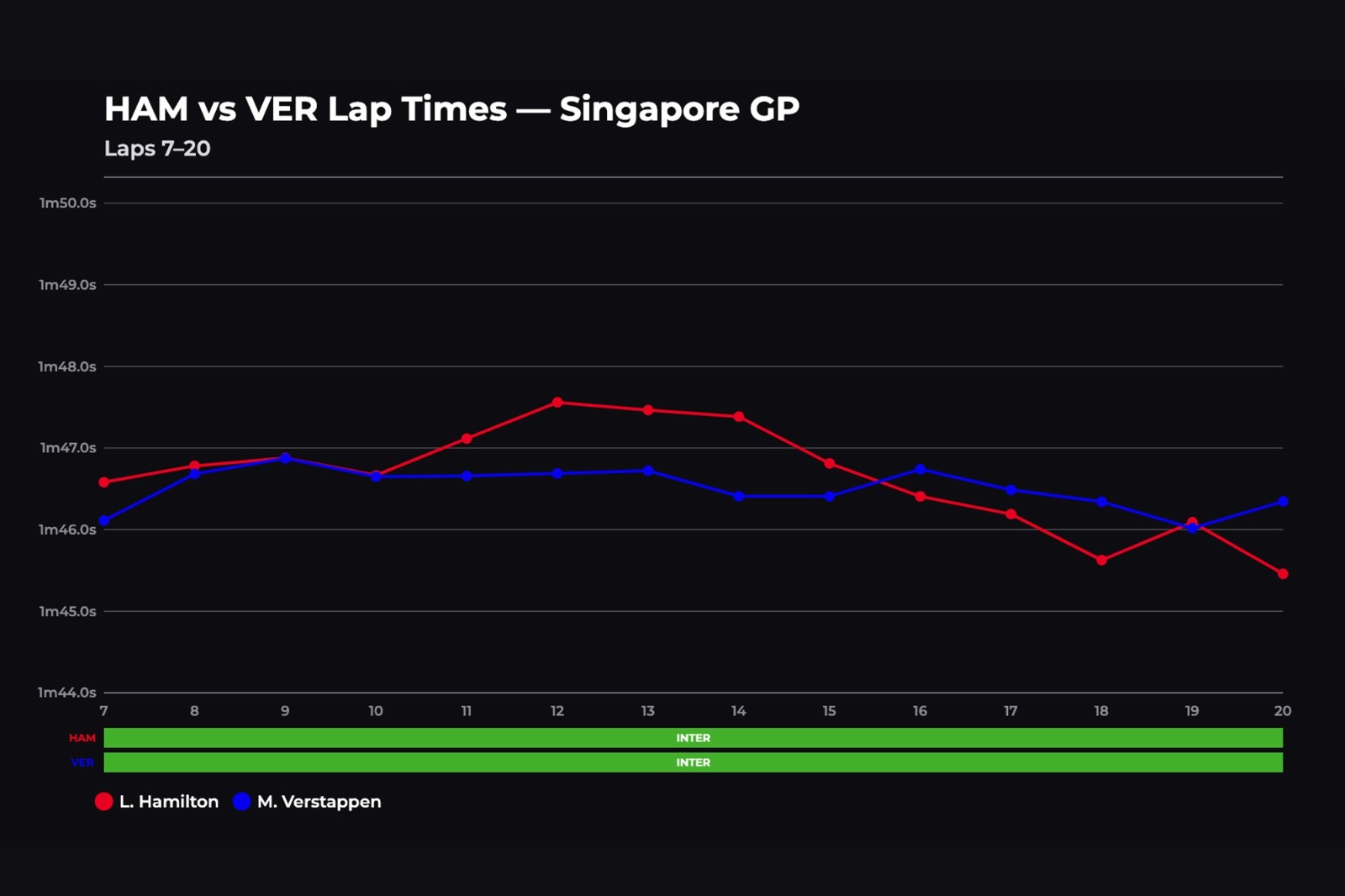
The lap times of Verstappen and Hamilton in the Singapore GP sprint
Photo by: Autosport
Since Singapore is certainly not a power circuit, it was expected that Ferrari had the opportunity to make a decent fist of the Marina Bay weekend. That's not to say that it didn't deliver in Malaysia; a 3-4 finish was pretty handy, and both Hamilton and Leclerc recovered well from the setback of starting on slicks.
Historically, the Ferraris have been designed to be compliant, giving the drivers more confidence to push within the environs of a street circuit. Hamilton had this in Q1 and Q2, but put his "snappy" car in Q3 down to an extra turn of front wing that put the car more "on the nose". This was visible in the first and third sectors, where the rear end of the SF-26 seemed more keen to step out during the course of the final stage.
Hamilton suggested that, had he been able to re-do Q3, he'd have gone without the extra flap angle and hoped the circuit evolution would buy him enough lap-time progression to beat Verstappen to pole. As it was, Leclerc found some improvement over his Q1 and Q2 efforts; he stated that his car was pulling to one side under braking in those first two stages, but this was less of an issue in the top-10 shootout. Instead, Leclerc felt that the only thing stopping him from moving ahead of Verstappen was himself.
Ferrari has pace here and, if it can get past Verstappen at the start, it would be in a very good position indeed...
McLaren has Mercedes obstacle to overcome after "unacceptable" clash

Lando Norris, McLaren, Oscar Piastri, McLaren
Photo by: Morgan Hancock / LAT Images via Getty Images
After a troubled pair of races at Baku and Sepang, McLaren needed both cars in the points during the sprint race. And it had that, until the final lap; Norris went for an ambitious move at Turn 5, Piastri's defence was a touch robust, and the two ended up making contact. Piastri was left facing the wrong way, and Norris ceded a handful of positions and scored only one point. All told, it was a silly scenario; no wonder team principal Andrea Stella was furious.
Stella pointed to the constructors' championship battles against Ferrari and Red Bull, and a "material" loss of points will be a setback. Ferrari is now 101 points clear of McLaren but, even more concerning for the Woking squad, Red Bull is just 11 points behind.
"I am, if anything, disappointed. Disappointed as a team principal for a situation that is absolutely not acceptable because it caused a material damage to the team and every member of the team knows that the team interest comes before any personal interest, but above all is the main beacon that guides our action and our instinct.
"I'm not necessarily surprised because I spent so many seasons in Formula 1 and I know that these things can happen, but we as a team need to reflect as to how we make sure that these situations do not happen anymore.
"It is serious because the damage for the team is material. We are in a close fight in the championship. We had the ambition to challenge Ferrari and this is a problem in the challenge to the second position and we have an ambition to finish ahead of Red Bull and this is a problem to finish ahead of Red Bull.
"It is also serious because we come from a few seasons in which we have reflected together, team and drivers, as to how we approach racing together and how we make sure that the interest of the team is protected. It is serious, but at the same time, like I said before, we approach it with a very constructive mindset because there's only one outcome, that the team will be more united and the team will be stronger in the way we pursue our quest, which is the drivers and the team's quest together."
Russell's engine penalty clears some of the decks for McLaren in Sunday's race, but both cars start behind Kimi Antonelli - who seemed to dig out some pace at the wheel of the updated Mercedes W17. The theory is that the latest-spec car is quicker, but with the caveat of being harder to drive and more difficult to get into the set-up 'sweet spot'. That said, the team has had less time with the new car - and not on particularly conventional circuits. For Antonelli, it'll be important to use the opportunity to extend his lead in the points over a recovering Russell - but it's also important for McLaren to make a go of racing against the Italian to minimise the damage to Red Bull in the points standings.
Back to strategy reality

Will there be much in the way of strategy in Singapore? Er, no...
Photo by: Steven Tee / LAT Images via Getty Images
After Malaysia presented a wealth of potential strategic options, altered slightly by the onset of rain at the start of the race, Singapore brings the expected strategy options down to one, maybe two at a push.
Pirelli expects a one-stop race, and for teams to opt for a soft-medium strategy. Head of motorsport Dario Marrafuschi reckons that the pitstop window for this strategy would open around lap 26, but the soft tyre could be short-stinted if a team wanted to run the hards for the second stint. Wear will be low, and track position will be important, hence the one-stop focus.
Marrafuschi adds that a medium-hard strategy is also feasible, but not recommended - but a darn sight better than a two-stop strategy. If you're looking to strategic variance to provide excitement on Sunday...you might have to keep looking.
Unless it rains again, of course.

Racing under the lights will be a gruelling experience for the 22 drivers
Photo by: Anni Graf - Formula 1 via Getty Images


The political minefield set out by F1’s recent cost-cap grievances
What caused Mercedes' pace deficit at Sepang despite upgraded W17?

Three kings: F1's generational stars shone at Sepang

Bahrain Grand Prix in Malaysia Driver Ratings 2026

The slick tyre gamble that hurt McLaren and Ferrari's chances in Bahrain GP in Malaysia

The wide world of strategy options expected in F1's Bahrain GP in Malaysia

McLaren explains recurring Norris straightline speed issue after Bahrain GP qualifying

How drivers waiting in the wings can still make their presence count in F1

A "better job" or more engine power? Verstappen's Singapore pole unpicked
What we learned from the 2026 F1 Singapore GP sprint race and qualifying

McLaren to talk internally after "simply not acceptable" Norris-Piastri clash

McLaren junior Van Langendonck secures British F4 title
Subscribe and access Autosport.com with your ad-blocker.
From Formula 1 to MotoGP we report straight from the paddock because we love our sport, just like you. In order to keep delivering our expert journalism, our website uses advertising. Still, we want to give you the opportunity to enjoy an ad-free and tracker-free website and to continue using your adblocker.


Top Comments