


How Verstappen tamed the City of Winds to deliver a warning shot to McLaren
A display of utter dominance from Max Verstappen at the Azerbaijan Grand Prix led to his second F1 win on the bounce, as the McLaren drivers faltered. But could he factor in 2025's drivers' title race, or is it too late?

As the gusting winds spilled over the Caspian Sea and broke through Baku's city streets, the high-wire act of driving a Formula 1 car around one of its most unforgiving venues had its challenge magnified tenfold. Qualifying, for example, was characterised by a sextet of shunts, as six drivers' Saturday afternoons were blown off course.
While the draught's shrill echo had been pacified slightly on Sunday afternoon, Oscar Piastri's lap-one shunt might lead one to surmise that the winds of change in the title battle could have been operating at a lower register. That didn't quite come to pass, however; Lando Norris could only chisel six points off his team-mate's advantage, having been contained by Liam Lawson's defensive masterclass in the latter stages of the grand prix.
For Max Verstappen, it was a breeze. If Monza was a choice cut from his 2023 back catalogue, particularly in the latter stages where he'd had the edge on the McLarens, his Azerbaijan exploits were very much reminiscent of the earlier stages of that year. He was at his best in qualifying and, in a weekend where his primary (yet merely notional) competition fell over itself, it compelled the Dutchman to focus on what he does best: leading and winning races.
Much of the deed was done in qualifying, in which the conditions confounded many of the other traditional frontrunners. The gusts posed one challenge, the light lick of rain in Q3 another; the stoppages were two minutes away from matching the scheduled qualifying run-time as Alex Albon, Nico Hulkenberg, Franco Colapinto, Oliver Bearman, Charles Leclerc, and Piastri all found themselves in the cold, abrasive embrace of the wall. In the case of the latter duo, it served to demonstrate just how difficult the environment was.
And yet, Verstappen merely shrugged off the elements. Neither wind nor light rain could stay the courier from delivering a masterclass.
Norris should have run Verstappen closest, but the Briton found the timing of his final Q3 effort inconvenient. He openly admitted that the call to go first following the final restart was his, in an effort to pre-empt any further 11th-hour chaos that would preclude any further laps from being set. But it didn't quite work out that way, and the difficulty of his role as track sweeper was made manifest by his light tap of the Turn 15 Tecpro barrier. He got a lap in, but it was only enough for seventh.
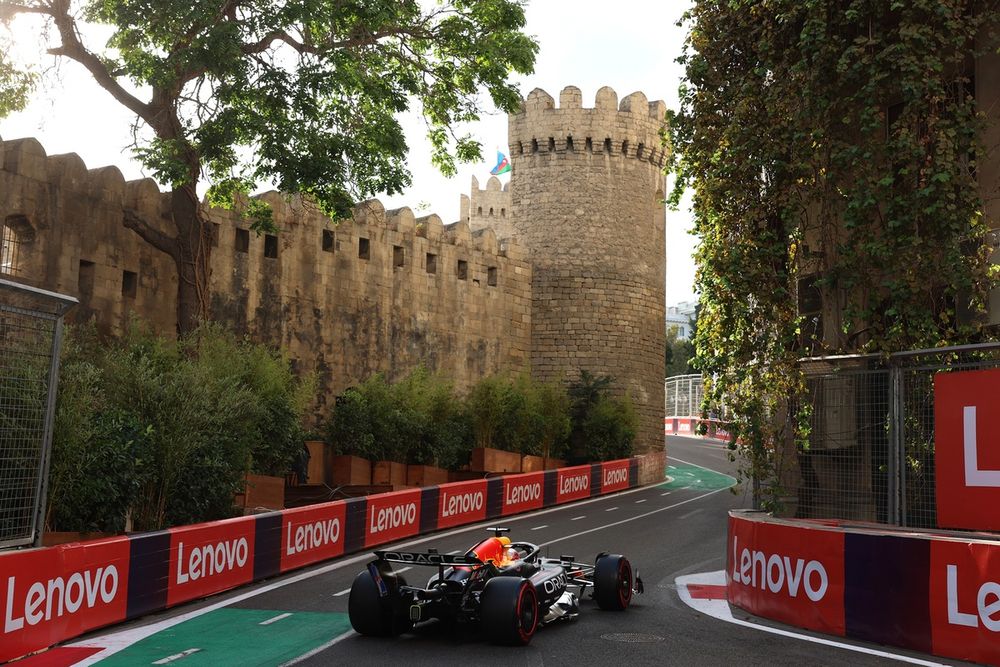
Threading the needle: Verstappen was inch-perfect in a windy Baku weekend
Photo by: Andy Hone/ LAT Images via Getty Images
Piastri, by dint of his Q3 crash at Turn 3, was also out of position in ninth. Leclerc too fell astray when his hopes of a fifth consecutive pole in Baku was swallowed up through the exit of Icherisheher - the 'Inner City', or 'Old Town'. These were the three expected challengers as the fourth horseman, Lewis Hamilton, exited in Q2 with barely a whimper having expected to contend for pole.
Verstappen was on tyres he didn't want, the Charmin Ultra-Soft C6s, but the fire-up at least ensured that any damp road markings would scarcely pose a problem. He denied Carlos Sainz, the provisional polesitter thanks to the Spaniard taking the initiative at the start of the session, a chance to secure Williams' first pole in 11 years.
With Sainz, Liam Lawson, and Andrea Kimi Antonelli around him on the grid, Verstappen probably knew that the pressure was off. As much as the unusual suspects might have craved the opportunity to prove a point and bloody the four-time champion's nose at the start, they weren't going to jeopardise a potentially healthy payday with a rogue move at Turn 1.
"Max was very clear in his mind that he wanted to exploit the pace of the car and disappear with the hard, and he has done exactly that" Laurent Mekies
As it happened, Verstappen snuffed out any idea of a threat with a strong start and covered Sainz before Turn 1, and took the reins to add another tick to his victory to-do list. The early phase was complicated slightly when Verstappen had to collect the field up for a safety car restart, however, as Piastri dumped his McLaren into the wall at Turn 5.
The Australian's miserable weekend teetered into dreadful before the lights had even gone out; he'd been over-eager in his clutch-drop off the line, checked up immediately, which then coincided with the start of the race. Having been engulfed by the second half of the field, Piastri lasted four corners before locking up his front-left while trying to battle with Esteban Ocon at the rear of the field.
As is customary along Baku's booming 2.2km stretch out of Turn 16, Verstappen pulled the pin at the last possible moment on the lap five restart, ensuring that Sainz had little opportunity to slot into his wake and make a move into Turn 1. From here, Verstappen simply hoped that no further safety cars were forthcoming and set about putting his stamp on proceedings.
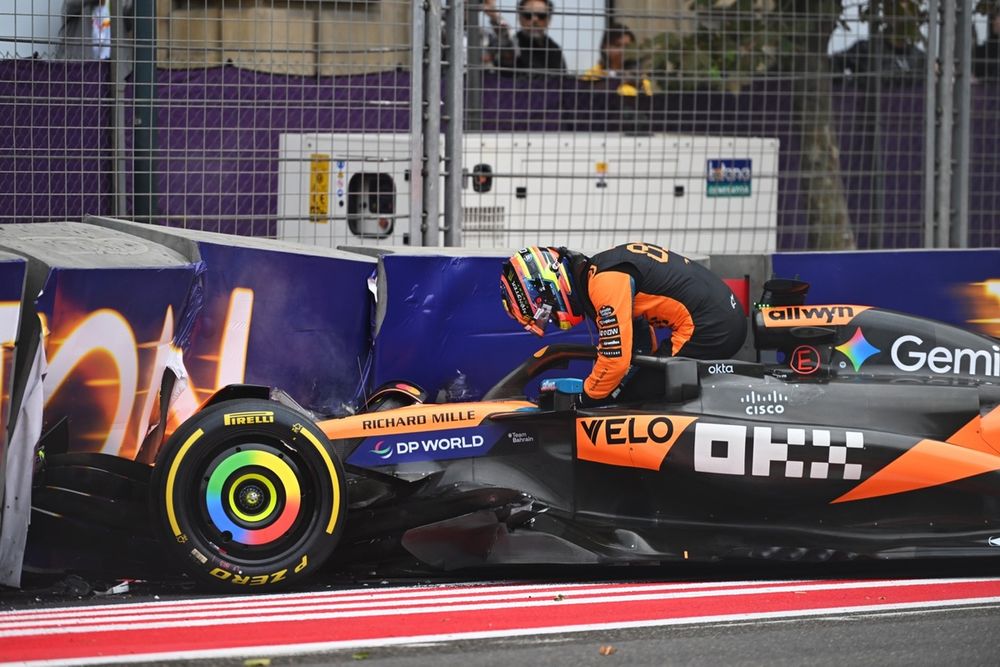
After retiring on lap one, Piastri watched from the sidelines as his championship lead came under scrutiny
Photo by: Rudy Carezzevoli / Getty Images
Starting on the hard tyre was key to this. Had Verstappen been accosted by the more traditional frontrunners on the grid, then Red Bull might have found it a more difficult call to opt for the C4 off the line, but the team knew that it would have a pace advantage over its immediate company on whatever compound it chose to use. On the hard tyre, Verstappen had a prime opportunity to run long and build a break over the cars behind, knowing that any challengers from further back would have to catch up with a more difficult strategy.
"We looked at yesterday's qualifying with the six red flags," said Red Bull team principal Laurent Mekies. "Obviously, here there is a long history of many, many safety cars. And Max had a very clear idea that it will become a race where you just drive, waiting for the safety car, where you try to wait as long as you can until the safety car comes, because otherwise somebody is going to have a cheap pitstop and it's not going to be you.
"And in some respect Monza was a bit like that as well, where we all tried to extend. And at some stage in Monza, if you recall, we had to pit because the tyres were pretty much gone. And we have been exposed for a few laps to a safety car.
"Max has pushed a lot for that. It doesn't come for free. It doesn't come for free at the race start. It doesn't come for free because it's exposing you on other parts of the race. If a safety car happens in lap 10, you will not find it funny if you have started on hard. But he was very clear in his mind that he wanted to exploit the pace of the car and disappear with the hard, and he has done exactly that."
But a challenge never truly arrived. The Mercedes duo, which was luxuriating in the cooler conditions, spent more time squabbling in the early stages as an under-the-weather George Russell was unable to find a way past Antonelli - who in turn was struggling in Lawson's wake. Piastri's shunt had left McLaren with one horse in the race in Norris, and Ferrari was not at home in the colder climes. Any hopes that they could make use of DRS and cut through the unconventional frontrunners was nullified for two distinct reasons.
These were effectively the same reasons why Monza's race was largely processional. Firstly, there was a distinct lack of tyre degradation despite Pirelli's nomination of the softest compounds for this race did little to create any deltas between the cars on top of tyre management, and those more afflicted by the effects of degradation. The medium tyres did suffer a little bit, but could be stretched out; avoiding dirty air mitigated any sliding and overheating through the corners, which can explain why Norris did not seem particularly keen to attack Tsunoda during his stint on the C5.
The second was alluded to by Mercedes' chief trackside engineer Andrew Shovlin on Friday. Shovlin stated that "generally [in 2025], people are putting smaller wings on, they create less disturbance so the tow effects are smaller, and then also with a smaller wing you've got less DRS effect. That's one of the things in Monza – there's barely any DRS effect because the wing is so efficient in its high-downforce state that there's very little drag to get rid of."

Verstappen stamped his authority on the race early, and enjoyed a serene Sunday
Photo by: Mark Thompson - Getty Images
Even opening the DRS, you need a considerable pace advantage to make use of it. Throughout the Azerbaijan race, there were moments where cars were separated by around 0.5 to 0.6 seconds - usually grounds to make a pass with the open wing - but lacked the top-end speed to make the move happen.
Ultimately, that wasn't really anything that was ever going to affect Verstappen, as he had pace in reserve; even in the unlikely case that the likes of Norris, Russell, or Leclerc had broken into second place in the opening stint, the Dutchman would have just turned on the taps and protected his lead. You play the hand you're dealt and, in Verstappen's case, he had the cards to deal with what anyone had laid upon the table.
Red Bull had also demonstrated that its performance in lower-downforce conditions was, once again, near-unbeatable. The RB21 seems to retain strong levels of downforce from the underbody when required, particularly in the Old Town-dominated sector two, but its straightline speed has been the real killer for anyone hoping to mount a challenge. When comparing Verstappen with Tsunoda, it's the Dutchman's confidence in the corners with low downforce that really illustrates the gulf between drivers. Where Tsunoda just seems to hang onto the Bucking Bronco through the twistier sections, Verstappen is completely in control of it.
"I think we probably feel today that some of the good stuff we have seen in Monza, we found here again. Certainly, in the slow-speed corners of Baku, there is only slow-speed corners here, so it's very low downforce, but only slow-speed corners and it worked very well for us" Laurent Mekies
In reality, Verstappen didn't need to grab his car by the scruff of the neck in the race, but instead let every lap come to him. His pace was where it needed to be. He kept his hard tyres well managed, ensuring that he was available for any eventuality in the race. Were there any further safety cars, or if rain had offered anything more than a handful of speckles on a single lap of the race, one would bet that he was in control of those situations too.
Thanks to Piastri's crash, Verstappen is now 'just' 69 points off the championship lead. In all probability, it's a tough ask to mount a late-season challenge to the McLaren drivers - yet, when it comes to reflecting on Verstappen's oeuvre and accolades as a driver, it would not be wholly surprising to see him close that gap to a perilous level. He just needs a couple more races like Baku to put his hat into the ring. Singapore, with its high-downforce nature, will be the test.
"I think we probably feel today that some of the good stuff we have seen in Monza, we found here again," Mekies explained. "Certainly, in the slow-speed corners of Baku, there is only slow-speed corners here, so it's very low downforce, but only slow-speed corners and it worked very well for us.

Red Bull's RB21 will face its toughest test yet in Singapore next time out
Photo by: Jakub Porzycki / NurPhoto / Getty Images
"You go to Singapore, you move a bit your equations, you keep the slow-speed corners, but you go to maximum downforce. We have been struggling quite a lot in Budapest, and before Budapest. It's also a much hotter track probably compared to that, and we know how sensitive not only us, but the whole field is to this aspect. So we take it step by step.
"We take the challenge of Singapore, it's a track that's been challenging for the team many, many years. And in the context of what we are trying to see, it's very, very important to see what suddenly doesn't work there anymore."


V for victory: Verstappen takes a second win on the bounce - but can he muster a late title fightback?
Photo by: Andy Hone/ LAT Images via Getty Images


F1 Monaco GP: Antonelli takes dominant win from Hamilton after chaotic finish

What we learned in Friday practice for the 2026 F1 Japanese GP

The scrutiny on Ferrari laid bare

Verstappen played his greatest hits at Monza, with 2023-esque dominance over McLaren

F1 Italian GP: Verstappen pips McLaren to surprise pole at Monza

Low-downforce wings headline F1 Italian GP updates

Dutch Grand Prix Driver Ratings 2025

What we learned in Friday practice for the 2025 Dutch Grand Prix

What's behind the talks between the FIA president and Alonso over ADUO?

Evans favourite to become WRC champion as Rally Saudi Arabia is cancelled

Alonso is right to sound the alarm about F1 - but history seems to be repeating itself

Ogura set to make MotoGP return in Austria
Subscribe and access Autosport.com with your ad-blocker.
From Formula 1 to MotoGP we report straight from the paddock because we love our sport, just like you. In order to keep delivering our expert journalism, our website uses advertising. Still, we want to give you the opportunity to enjoy an ad-free and tracker-free website and to continue using your adblocker.


Top Comments