


Verstappen played his greatest hits at Monza, with 2023-esque dominance over McLaren
The 2025 Italian Grand Prix was just like old times with Max Verstappen dominating from pole, only here it wasn't a repeat of exactly what had happened a week before. So how did Verstappen beat the championship-leading McLarens to victory at Monza?

It felt like this year’s race at Monza was picked straight from Formula 1’s 2023 highlights reel. Those who followed F1, whether long-time dyed-in-the-wool fans or newcomers surfing the wave of the championship’s popularity, had to get used to the weekly exhibitions of dominance from Max Verstappen – the races deviating off-script in just three of the 22 grands prix.
Back then, Verstappen’s wins mainly followed a formula. More often than not, he would get pole, then eke out enough of a lead to get through the pitstops without being leapfrogged by another contender. And, as much as Verstappen moaned about the general lack of feeling he’d got from the hard tyres, he was always excellent in that phase of the race. With that final-stint flourish he’d drop the hammer, building a winning margin north of 10 seconds.
Even when Verstappen looked like he might be under threat at the start of a race, it was always very controlled. One is reminded of 2023’s Silverstone race, where the resurgent McLarens swarmed the stage at the start of the grand prix – only to fall short as Verstappen turned the screw with escalating pace through the stint.
When Verstappen gave up the lead to Lando Norris on the second lap, as Red Bull decided to cover off the ‘left track, gained advantage’ angle, there was no chance he’d comply so easily had he not been in control of a rocket ship. His RB21 was fast, and he knew it.
It took another two laps before the positions were reversed again; Verstappen soaked up the tow from Norris with DRS, and made the move into Turn 1. Any time Verstappen got into that position early in the race during 2023, there was rarely any doubt over who would occupy the podium’s highest step; when he was leading on the fourth lap in Monza, it all felt very familiar to those who had observed Verstappen’s oeuvre that year.
This year, Verstappen has frequently been able to put the McLarens under scrutiny in qualifying, and has occasionally upset the papaya cart by hurling a pole-winning lap at it from beyond the pale. But there’s been the opposite inevitability, in that Red Bull has not been quite on McLaren’s level with tyre management across a full grand prix.

Verstappen produced the most dominating season in F1 history in 2023, but 2025 has been a different story due to the resurgence of McLaren
Photo by: Red Bull Content Pool
In Spa, for example, Verstappen’s engineers trimmed his car out for the sprint race knowing that he could afford to benefit from a full-tilt approach to the shorter Saturday race. However, the downforce had to go back on for Sunday, as the tyres would scarcely have lasted through the 44-lap race without the reassurance of a stronger rear end.
In Monza, however, the track surface installed last year has effectively mitigated the more deleterious effects of degradation. Verstappen and Red Bull deserve full kudos for digesting last year’s race, in a), avoiding the hubris of not developing a proper low-drag package for Monza, and b), exploring what was possible with the low degradation experienced in 2024. The RB21 thus began the weekend with the skinniest of wings.
Red Bull’s engineers were nervous about that solution and wanted to load the car up a bit more after FP3; technical director Pierre Wache was known to be worried by the risk. But Verstappen was adamant that he’d like to keep running with the bare minimum of wing level, and Wache accepted his star driver’s decision. It turned out to be the decisive call, all told.
“It was a little bumpy at one point but it was what I expected - close and fun racing. Tough again, as expected, but enjoyable. It was, in a way, nice to go out on top for a couple laps, but it didn't last very long and Max's pace was just far too good for us today, especially in that first stint" Lando Norris
With Verstappen’s pace being so strong, it was almost inconsequential that Norris led through laps two and three. Verstappen had come across to the right-hand side of the track to cover off Norris, who kept his foot in it despite being shown the grass at the pit-lane exit. Regardless, Norris had the inside line, while Verstappen bundled across the kerb run-off and preserved the lead. He was told to hand the reins to Norris at the start of the next lap.
“He’s put me in the grass and cut the corner,” Norris reported, although revised his opinion on their battle – and the short-lived subsequent one on lap four – after the race. “It was a little bumpy at one point but it was what I expected - close and fun racing. Tough again, as expected, but enjoyable. It was, in a way, nice to go out on top for a couple laps, but it didn't last very long and Max's pace was just far too good for us today, especially in that first stint.”
Although Norris had the lead, there was little opportunity to build the requisite one-second gap needed to evade Verstappen’s DRS-assisted threat. At the end of the third lap, Verstappen was within 0.6s of Norris – the blood was inhaled, and the Jaws refrain silently rang out in the heads of those watching. He didn’t even need to move; Norris went for the inside, and so Verstappen swung his car around the outside and forced Norris into dropping the position.

Verstappen claimed his third win of the season in the 2025 Italian GP
Photo by: Marco Bertorello / AFP via Getty Images
Battle won, Verstappen moved onto phase two: cover off the whiff of a DRS threat, before building a more significant break in front of the pack. The first tick was etched onto the checklist by the end of that lap.
From laps five to 26, Verstappen was continuing to extend the gap by an average of 0.244s per lap, and the steady gains represented the continued inevitability of Verstappen’s second Italian triumph of the year. Even if Norris got close to (or even surpassed) his laps, the Dutchman simply turned up the wick to render his rival’s efforts futile. Everything was under careful control.
McLaren didn’t have many options to beat Verstappen, because it certainly couldn’t lean on pace. Outlasting the Red Bull on the tyres wasn’t going to work; while it was true that Verstappen was losing time to Norris at the end of his stint on mediums, the drop-off was incredibly small; from laps 27-36, Norris was gaining back 0.094s per lap on average. The HMS Norris needed a gale-force wind to turn the ship away from certain defeat – but instead, only received a slight breeze.
Thus, McLaren elected to hang it out long and place its victory hopes in the hands of a potential safety car. Pirelli chief Mario Isola stated after qualifying that, if a driver could make it beyond lap 30 on the mediums, then running a soft tyre second could be an option. As it happened, the 30-lap mark did not seem like such an achievement – and even though Verstappen broke beyond this point to stop on lap 37, he still chose to close out the race on hards.
The McLaren duo carried on, knowing that following Verstappen onto the same tyre at the same time would offer zero net benefit. However, if a safety car arrived after the Red Bull crew had turned around the car in a two-second flurry of limbs, rubber, and wheelgun whirrs, the orange cars could attempt to capitalise with the soft-to-hard tyre delta. If Verstappen had about 0.3s per lap on Norris, the predicted 0.5s soft-hard delta offered a route back onto the top step of the podium.
Like a newly-delivered greenhouse beside a football stadium, the various windows came and went. Norris and Oscar Piastri – who had survived an early tussle with Charles Leclerc to reclaim a net third place – might have been in the lead, but Verstappen had already eaten beyond McLaren’s ‘cheap safety car stop’ window with his precipitous pace on hards and McLaren was hurtling towards the end of the safety car window outright before it had to concede defeat on the mediums.

McLaren attempted a different strategy, but still couldn't get close to Verstappen
Photo by: Clive Rose / Getty Images
The subsequent complications: McLaren’s decision to pit Piastri first, Norris’ slow stop, and the swap in positions afterwards to compensate, arguably detracted from the brilliance of Verstappen on the day.
Did McLaren need to put itself in that position?
When you have the luxury of two drivers who are, at their core, team players, you can get away with taking such liberties. There’s no way that Verstappen would have acquiesced to a call like that in the same way as Piastri – but equally, there’s no way that Verstappen would ever find himself in the same position.
Hyperbole and hysteria will follow, and everyone will have their opinions on whether the switch was the correct move to make. But it’s probably not going to matter either way; if Piastri loses the championship by the swing in points enacted by the Monza swap, there’s surely a more pertinent question to ask, namely how on earth he'd end up losing a 31-point lead.
Either way, the distraction arguably suits Verstappen just fine. The Dutchman doesn’t live for adulation and excess of praise; his raison d'etre is to race, and to win. He did both, let the McLaren drivers field the bulk of the questions in the press conference, and then went home to his family knowing he'd obliterated the field. It’s not a bad life, is it?

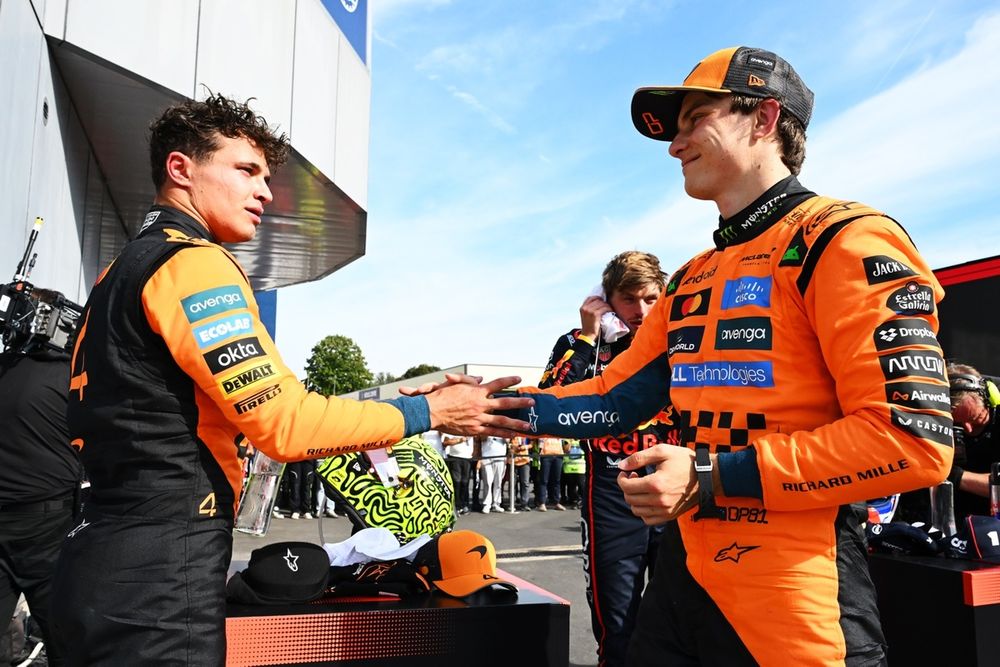
Piastri holds a 31-point lead over Norris with eight rounds remaining
Photo by: Mark Sutton / Formula 1 via Getty Images


F1 Monaco GP: Antonelli takes dominant win from Hamilton after chaotic finish

What we learned in Friday practice for the 2026 F1 Japanese GP

The scrutiny on Ferrari laid bare

How Verstappen tamed the City of Winds to deliver a warning shot to McLaren

F1 Italian GP: Verstappen pips McLaren to surprise pole at Monza

Low-downforce wings headline F1 Italian GP updates

Dutch Grand Prix Driver Ratings 2025

What we learned in Friday practice for the 2025 Dutch Grand Prix

Why Norris doesn’t buy Russell’s driving style theory

Evans: Late puncture was “harsh” but WRC title position is still “okay”

How Antonelli is proving unbeatable, even when he's beaten

F1 drivers push for Madring changes after "very poor" Spanish GP: "I almost fell asleep"
Subscribe and access Autosport.com with your ad-blocker.
From Formula 1 to MotoGP we report straight from the paddock because we love our sport, just like you. In order to keep delivering our expert journalism, our website uses advertising. Still, we want to give you the opportunity to enjoy an ad-free and tracker-free website and to continue using your adblocker.


Top Comments