


How to solve F1's overtaking problem
How can the racing be improved? Would a windtunnel ban make for more interesting designs? What parts can F1 standardise? And which direction should F1 take for its next engine formula? These questions, and more, are answered this week

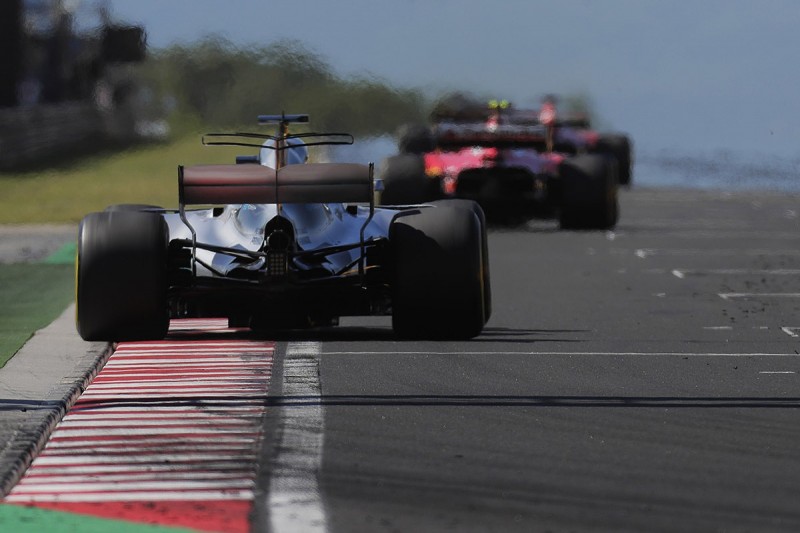
Is it possible to build a wing that works well in turbulent air?
@RJoseRazoJr, via Twitter
Building a wing that works well would be very difficult, but building a wing that works a lot better than we currently have would be reasonably simple.
Every surface on a current Formula 1 front wing is working to its maximum potential. This means that when it gets hit with dirty air the surface stalls, and to the driver that means a major loss of front downforce.
But that's not all of the problem. The dirty air being generated by the front wing airflow separation is then sent down the rest of the car and disturbs other downforce-producing devices. So, it's a double whammy.
Along with a raft of rules that were supposed to sort out all the overtaking problems for 2009, the FIA brought in a rule that allowed the driver to increase the front wing angle when following another car. Needless to say, it didn't work.
The balance loss is not the biggest issue, it is the reduction in downforce - roughly 20% - that causes the main problem. The loss of so much downforce makes a Mercedes into a Sauber, so why would anyone expect to see an overtake with that big a loss?
To overcome this, the complete aerodynamic structure of the car needs to be addressed. If the underfloor produced a significant amount more downforce and that downforce was positioned further forward, then the designers would not be so reliant on very complicated front wings to produce the front downforce.
The overall dimensions of the front wing and number of components allowed would also need to be addressed to make sure the designers made use of the potential of the underfloor. Remember, a lot of the ground effect cars of yesteryear didn't need front wings at all.

When does the benefit of a tow become the deficit of running in dirty air?
Ben Anderson, via Facebook
The tow is always of value, but the driver needs to overtake on the straight - hence the introduction of the DRS.
As an example, let's just say that the average corner speed is 180km/h. That's 50 meters per second, so to qualify to be able to use the DRS after a corner of roughly that speed, the following car needs to be within one second, or in distance 50 meters. With a car's overall length being just under five meters, that's roughly 10 car lengths.
The turbulence from the leading car starts to affect the following car at about 100 meters, or 20 car lengths, so to get to be able to use the DRS you have to suffer the turbulence problem before being close enough to use it.
The slower the corner leading up to the DRS zone, the better, but DRS is just a band aid on a problem that could be sorted with some lateral thinking when writing the rules.
If we are stuck with what we have, which is the DRS (and personally I really hope not) then why not change its usage to a certain number of times per race. You can still limit the areas and the number of times used per lap, say giving each driver 50 uses for a 50-lap race, but allowing it to be used up to twice a lap.
So, you could use that allocation quickly, allowing you to catch someone more quickly as well as attempt an overtake, while the other saves it to defend. At the moment, the DRS is either a motorway overtake or it just doesn't work.
At the same time, do away with blue flags. This means drivers would have to decide if they use DRS to pass lapped cars. A graphic could appear on the screen to tell us about each driver's usage - now that would add some spice to the racing.
The precise numbers could be varied from race to race, optimising the potential for close racing.
It would also need to be left that these numbers could be altered race to race to allow for optimising the potential for close racing.

Would we have more interesting looking cars if we banned windtunnels?
Andy Halden, via Facebook
What we see basically comes from the regulations. If you took the whole grid and painted them in each other's colours, it would take a second or third look before you could identify what is underneath that paint job.
The teams make the best of what is possible. Sometimes they look good and sometimes they look less good, but I don't think they ever look not interesting.
As a team, your responsibility is to maximise the performance from a set of regulations and if that means that you find a widget that is, let's say, less than aesthetically pleasing then I am afraid it will still get used.
The windtunnel doesn't create what you see. It is the engineers that do that - and now CFD plays a much bigger role in the looks than it did in the past.
Today, engineers can understand in detail the airflow away from the car's surface. In the past, that was all done with wool tufts and, in some really far out cases, spectrum analysis.
Doing away with any form of research tools will only lead to cars not being as efficient in design and it would separate the grid's performance. Even more so than today, the good guys would all be bought up by the big teams leaving the smaller, less-financed teams struggling.
F1 should keep windtunnels and CFD, as they are the tools of the trade, and reduce the frequency of introducing aerodynamic development components. That would save lots of money and mean that any specific component has much wider circuit specification usage. It would also mean the teams could spend a bit more time on it to make sure that when introduced it actually worked.
While on windtunnels, I was interested to hear what Christian Horner had to say about the bigger cars being a problem in Red Bull's windtunnel. I'm surprised that a team of its standing succumbed to such a simple and well-understood problem.
Simple pressure sensors on the walls and roof of the tunnel will tell you if the pressures on the walls are staying consistent. If you change a car component and the wall pressures change, you have a problem.
This problem has been around since the year dot. If the cross section of the windtunnel is too small, the airflow going past the model increases in speed and gives the wrong figures from the components you are developing. It's a bit like if the roof of the windtunnel is too low, it affects the upwards wake coming off the rear wing so wing development is a waste of time.
Every day in every way we learn something new.

What F1 car parts can be standarised? It seems every car is a unique creative engineering and aero concept nose to tail?
Josh Gliese, via Facebook
It's vitally important that what you see is kept individual. So, in reality, this covers the aerodynamic surfaces to make sure each car would still have its own team's stamp on it.
It's some of the other stuff that teams spend huge amounts of money on developing to get back very, very little in lap time that need to be looked at. Just to name a few: wheels, front and rear brake systems (Romain Grosjean would love that) front and rear upright assemblies, power steering assembly, driveshafts, fuel tank, front and rear crash structures (but allow the teams to clothe it in their own fairings).
I'm sure there is quite a lot more, but these are all things that the viewer doesn't see, so in effect it wouldn't change the overall car concept.
Each of the 'big' teams could be made responsible to design and research a couple of these components each and, if the FIA were to ask what the components currently cost each team, then find the average across the grid and halve it as a sale price to the other teams. This would do a huge amount for cost reduction.
This is sort of done with the side impact structure, but it could go a lot further and it would save money with no disadvantage to the show.

Could the next era of F1 engines be a twist of 4WD? Naturally aspirated V10 powering the rear, electrical power unit for the front?
Alex Fretwell, via Facebook
I would like to see F1 cars being able to recoup the maximum energy during braking from the front and rear axle, but I think they need to stay as rear-wheel drive.
The front axle during braking is such a huge waste of energy, and to throw that away is not buying into the direction that energy recuperation is all about.
They talk of being able to get the noise back, but still retain turbo engines. They have been talking about this since 2014 and it's better, but still confusing when the safety car is noisier that the cars following it!
I don't really see how that will happen with a turbo, so for me four-wheel energy recuperation and a normally-aspirated V8 with a minimum and maximum rev band - enough for the noise level to be what the spectator wants but not enough to put the engine risk level to an unacceptable or financially prohibitive level - makes sense.
The race fuel capacity and maximum fuel-flow valve needs to stay at more or less what we have now so that the normally-aspirated engine power output wouldn't be much different from now, but the energy recouped would go up - and in a much easier and more road car-relevant direction. So, the overall power output could be higher.
The near future is in electrical hybrid vehicles, so minimise the energy being thrown away and use it when you need positive power. Alongside that, you have a very efficient normally-aspirated engine to make sure we continue the development path of maximising combustion efficiency.

If there is a sense that future racing and road transportation should become disconnected (unless all racing is going to go electric!), then do you think that returning to 'pure racing engines' (no hybrid at all...) is more beneficial for the sport as a whole?
Guy Dormehl, via email
I think I have answered your question above but basically for the short-term future hybrid vehicles are here to stay.
Longer term, it will be something different like hydrogen fuel cells, but who knows what is in the pipeline. More importantly, who knows what the major oil companies will allow to come to the market.
The oil business is by no means a small market, so if something revolutionary pops up I'm sure they will do their level best to keep it under wraps for as long as possible.
F1 can't turn its back on it, but it does not need to be a leader. It just needs to make sure it makes best use and shows its efficiency in getting the best from what is the in thing at any time.

It seems to me that having 4-5 people sitting in a specially designed box at pit wall was no longer needed about 10 years ago. What is going on with that? It seems so silly to see folks sitting there.
Russell, via email
I agree with you, but its tradition. In the days of a lot less data, the engineers on the pitwall, of which I have been one, would take the odd look at the car as it went past mainly to see if anything was hanging off but also just to have a look at tyres.
Because of the lack of data, it made you feel that you were in there with the driver. Also, if the weather changed you were one of the first to be able to react.
I'm pretty sure most of them could do a reasonable job sitting at the back of the garage, although I think one or two who can keep an eye on things during pitstops would be handy to have.
But I'm pretty sure they are not the people that are currently in those hot seats.

How much air hits a front tyre on an F1 car?
Ross Chaplin, via Facebook
The front tyre is about 30cm wide and 65cm tall, so in F1 terms it's similar to taking one of your kitchen unit doors off and sticking it out of your car window while driving down the motorway at 70mph!
Also, consider that an F1 car travels at three times that speed. You can image the forces on your wrist. But you had better not try that at home, as it might just hurt.
Anyway, that is roughly the quantity of airflow that tyre is trying to displace and that is why so much development is put into the outer section of the front wing endplate and front brake ducts. Managing this airflow and making sure it has the minimum adverse affect on the following aerodynamic components is one of the toughest things.
Just have a look at BMW Sauber's first attempt at a fairing ahead of the front tyre in 2009 (pictured). It was very similar to a shoe box without the lid. Comparing that to what teams currently have in this area shows how far the in-depth understanding of airflow has come in the last decade.

One driver who has always fascinated me is Clay Regazzoni, who I think you worked with during his tragically short time with Ensign. What was he like as a driver and a person - he seemed to be a very different driver by then to the one who had starred with Ferrari years before?
David Taylor, via email
I did work with him at Ensign and actually helped cut him from the crashed chassis at Long Beach after the accident that left him paralysed from the waist down.
Time takes its toll on us all, but even at the age of 40, as he was at the start of 1980, he hadn't lost any of his talent.
Usually, when a driver goes from driving for a top team to a lesser team, as he did in moving from Williams in 1979 to Ensign the following season, they lose a bit of that motivation but in a new car from a much lesser team he gave his all.
It's all a long time ago, but my memories of him are fond ones. He fitted in with the team and gave us the benefit of his wealth of experience. The problem was that we were too small to actually make good use of it.
After his accident, the team fell apart and never really believed in any of the large list of drivers they ran after him.
Got a question for Gary Anderson? Send it to askgary@autosport.com, use #askgaryF1 on Twitter or look out for our posts on Facebook giving you the chance to have your question answered


Ask Gary: Is there value in crossovers like Hamilton/Rossi?

Gary Anderson: How F1's 'privateers' really fared in 2019

F1's 'big four' teams' real 2019 performance levels revealed

What F1 learned from Ferrari's fuel breach

Ask Gary: Will the 2021 rules mean a Mercedes car concept change?

Where did Red Bull-Honda's pace come from?

Will Wolff's absence affect Mercedes in Brazil?

F1's prescriptive 2021 rules will only cause design convergence

Colapinto urges fans to stop online abuse: “You’re not helping me or my future”

Evans given a hero's homecoming after WRC title triumph

How an unspectacular showing in a kart race is such good reason to celebrate

Lights, Camara, action: How Haas picked F1's latest rookie for 2027
Subscribe and access Autosport.com with your ad-blocker.
From Formula 1 to MotoGP we report straight from the paddock because we love our sport, just like you. In order to keep delivering our expert journalism, our website uses advertising. Still, we want to give you the opportunity to enjoy an ad-free and tracker-free website and to continue using your adblocker.


Top Comments