


How Larrousse's demise 30 years ago foreshadowed dwindling French F1 involvement
A small F1 team running out of money in the 1990s was a common occurrence, and Larrousse's demise after a series of failed mergers put it out of business. But, as the close of Renault's engine project ends French manufacturer involvement, perhaps the nation's fall has its genesis in 1995. We tell the tale, with the help of Autosport's archive

When Renault departs from Formula 1’s entry lists as an engine supplier at the end of the season, it will bring a close to a lengthy spell of French manufacturer interest at the top level of motorsport.
The genesis of the organised competition between various forms of motorised transportation arguably came in France with 1894’s Paris-Rouen, and later the first grand prix in 1906. Both races, of course, counted French machinery as their winners. To lose manufacturer representation from such an important country in motorsport’s history? Back then, it was surely unthinkable.
Alpine remains as a name on the FIA’s official manifest of entrants, with the Tricolore sitting next to it, but it’s effectively set to be a French-owned British race operation with a German-British power unit in the back from 2026. The last time the F1 grid had no French chassis or engine manufacturers was in 1975, before Matra rejoined as an engine supplier and Ligier came in as a constructor.
In that time, France has enjoyed and endured boom and bust periods through F1’s most recent half-century. In this millennium, for example, the departure of Peugeot and liquidation of Prost knocked out two distinct points of interest in the country, only overlapped by Renault’s return. The sale of the Renault team to private investors and its transformation into Lotus also diluted French involvement, even if by this point its pool of drivers was growing after a few barren years.
But when and where did the rot set in? If one rewinds to 30 years ago, French interest had been – by comparison – booming. Ligier still existed, albeit under the auspices of Benetton team boss Flavio Briatore, who definitely did not give the team designs to Benetton’s B195 in exchange for its Renault powerplants and this definitely wasn’t a conflict of interest.
With that move, Benetton could match Williams in the horsepower stakes, given that Sir Frank’s finest also had use of Renault’s potent V10s. Jordan, meanwhile, had assumed the supply of Peugeot engines cast off by McLaren, ensuring two French automakers were showcasing their wares in the F1 ring. Driver interest was also represented by Olivier Panis and Jean Alesi, neither yet race winners but both would eventually earn their top-step visits over the next two seasons.

French manufacturer involvement in F1 has featured boom and bust periods
Photo by: Steve Etherington / Motorsport Images
And, compared to the early stage of the 1990s, it was a nonetheless pared-back level of involvement from L’Hexagone. A glut of French drivers had since been reduced to just two full-timers, plus part-time Luxembourger Bertrand Gachot and part-time-racer-part-time-stock-cube Jean-Christophe Boullion in his substitute outings for Sauber. Ligier lost its all-French chassis-engine combination when Briatore swiped the Mugen Honda V10s from under Minardi’s nose.
F1 also lost a French team on the eve of the 1995 season in Larrousse. A team that fully bought into 1990s culture with its shell-suit-like livery of patchworked primary colours, Larrousse had not been an especially big fish in the grand scheme of things – but nonetheless was an occasional points scorer across its time in the late '80s and early '90s. It had even, thanks to Aguri Suzuki, scored a podium in the 1990 Japanese GP.
PLUS: When France's 'other' team brought colour to F1
But the death of the team was particularly protracted. Following a winter of discontent, Lotus would perish after 1994 and kept its brand in the championship by tying its flag to the Pacific Grand Prix mast – hence the skein of black and gold draped over the nose of the blue-toned PR02. But Larrousse refused to remain contorted by its impending rigor mortis and appeared on the 1995 entry list, as team principal Gerard Larrousse kept the door open for a saviour to walk in and keep the lights on. A saviour never appeared.
The team had a car designed – at least, it thought it did. Shareholder Robin Herd, who owned the Larrousse UK arm that employed chief designer Tino Belli, refused to release the drawings of the LH95 after falling out with Gerard Larrousse over unpaid bills
Even if one had, Larrousse had not enjoyed the best track record with investors during its F1 tenure. Co-founder Didier Calmels was imprisoned for killing his wife in 1989, Venturi bought a majority stake in the team in 1991 but then wanted out after less than a year, and sold part of that share to Comstock – a group headed by a German named Rainer Walldorf. The plan was for Comstock to float itself on the stock market, selling shares to finance the team.
Except, Rainer Walldorf wasn’t his name – it was Klaus Walz. According to Autosport’s report at the time, Walz was a wanted felon connected to four murders and trafficking stolen sportscars and was named on Interpol’s wanted list. French and German police attempted to arrest him at his French Riviera villa, but Walz took a police investigator hostage after pulling a hand grenade out of a drawer and escaped. He was killed in a siege with German police a month later.
Larrousse continued to struggle with money as France’s laws on advertising tobacco and alcohol made it difficult for the country to subsidise the team’s budget with state-owned companies dealing in such products. Thus began the familiar leaf through the F1 rolodex of drivers with fat wallets, hoping to supplement its income, but by the end of 1994 it had run out of money and had debts to suppliers that needed to be paid – Lamborghini being one of its creditors.

Larrousse was a regular points contender in its early days in F1 before the money dried up
Photo by: LAT Photographic
The team had a car designed – at least, it thought it did. Shareholder Robin Herd, who owned the Larrousse UK arm that employed chief designer Tino Belli, refused to release the drawings of the LH95 after falling out with Gerard Larrousse over unpaid bills. The Frenchman also underwent talks to sell a shareholding to two French businessmen, Laurent Barlesi and Jean Messaoudi, the owners of a prospective entry known as Junior F1 Team – one which couldn’t get over the line for a 1995 grid slot.
But this was put on ice when Larrousse opened contact with DAMS, as Jean-Paul Driot’s F3000 squad had been exploring an entry into F1 over the 1994 season. The situation was this: Larrousse had no car and no money, while DAMS had some money and had been developing a chassis in conjunction with Reynard – the GD-01. Although progress on the Ford ED V8-powered machinery was slow, it was nonetheless far enough along in its development cycle to be theoretically pressed into service for 1995; Larrousse, which had the all-important entry, saw this as a potential marriage of convenience.
The expected news of a merger between the two teams was set to appear in late January of 1995, with Erik Comas set to lead the team on the driving front per Driot’s request. Comas had won the 1990 F3000 title with DAMS and was published on the initial 1995 entry list with Larrousse’s entry.
But the deadline to announce the tie-up between Larrousse and DAMS came and went, and DAMS eventually announced that it was shelving its plans to enter F1 until at least 1996 in mid-February. It was said that getting the finances in place was the most difficult feat, although it was known that Driot also felt he did not hold enough control over the team. For Driot, he felt the partnership with Larrousse should essentially become DAMS in its entirety; Larrousse felt it should have an equal partnership with DAMS, given that it was putting up the coveted entry.
DAMS thus delayed its entry and continued its development of the GD-01 as a test mule, with Comas doing the driving over 1995. Despite putting up a car – albeit a distinctly bulky one with boxy sidepods - DAMS never made it to the F1 grid in 1996 either.
Larrousse was incredibly vulnerable at this juncture; it was just over a month until the season began in Brazil, it had no car to race, no money with which to build one, and no drivers to race it. The plan was thus: to rework the 1994 LH94 with 1995-spec aero and safety features, then hope to find a partner with enough cash to convince Herd to either resume work on the LH95, or at least release the designs.

Despite multiple efforts, Gerard Larrousse struggled to keep his team on the F1 grid for 1995
Photo by: Rainer W. Schlegelmilch / Motorsport Images
The talks with Junior Team resumed, and Larrousse agreed a deal in principle with Barlesi and Messaoudi to – as Autosport described it at the time - “lease” his team out. The team planned to run with an £11million budget for 1995, chickenfeed by even today’s cost cap-influenced standards, with £6m of that apparently secured in sponsorship from Petronas. The Malaysian petrochemicals giant was seeking to make its first step onto the F1 ladder, although that £6m was purely dependent on the team making it to a race.
Although the initial plan to upgrade the LH94 to race it in the Brazil and Argentina rounds was in place, before potentially switching to the LH95 if the designs could be secured, Larrousse got permission to miss the opening two events as the team found it difficult to make the 1994 car safe enough for the FIA to approve. “The fact that we can keep going is a miracle,” opined Messr Larrousse, who noted that ex-McLaren designer Steve Nichols was working on a version of Herd’s LH95 design as the American had since left Jordan.
Larrousse was likely to cop a hefty fine for missing races, but the impending deal with Junior was seemingly set to keep the squad afloat. The team had also nominated drivers for the FIA’s final entry list, putting forward former driver Eric Bernard and future Le Mans winner Christophe Bouchut for the Imola race.
With debts still outstanding and with no sign of the vital cash injection, Larrousse made the decision to close his eponymous team and apply for administration
But there was a further fly in the ointment, in that the development of the LH95 was going to take far longer than expected. If it was going to make it to Imola, it needed to reverse its decision not to update the LH94, but the extra safety devices were going to add weight to a car not designed to take it – rendering it even more uncompetitive.
For every race that the team missed, the fines would rack up – and the FIA wasn’t going to budge on them for the sake of an uncompetitive team. Although Petronas was still apparently on board, it was not going to pay a single Malaysian ringgit until a car was on the grid, and nor were other sponsors that were likely to follow.
Barlesi told L’Equipe “We are studying all options to see whether or not we can continue to participate in the championship. The penalty which would be inflicted upon us for missing the first two grands prix is enormous. On the technical side, we have reached a dead end and, as far as finance goes, we are a long way from having a full budget. What we have at the moment is a little less than 50%. My preferred option would be to pull out and concentrate on 1996.”

A return in 1996 was the new target but, with debts mounting, eventually the team folded
Photo by: Ercole Colombo
In the meantime, Bouchut had signed a deal with Joseph Le Bris’ Danielson team in F3000. And, with £3m of debts (largely to Herd) still outstanding and with no sign of the vital cash injection that Barlesi and Messaoudi had hoped to find, Larrousse made the decision to close his eponymous team and apply for administration. That left just one French team on the grid in Ligier, one that was notably no longer owned by a French consortium.
One could consider this a small footnote in French motorsports history and that, as F1 became a more professional championship awaiting its 2000s boom in manufacturer involvement, there was little chance of a team like Larrousse existing for too much longer.
But it underpins the end of an era where French teams and drivers were rife in the championship, and its manufacturer involvement began to dwindle in the meantime: Renault pulled out at the end of 1997, Peugeot left after 2000, and Ligier-turned-Prost fell off the grid on the eve of the 2002 season. Although Renault came back with its Benetton buyout to fly the Tricolore once more and enjoyed a flurry of success in the mid-2000s, it too dropped its involvement amid its part in the Crashgate scandal.
Now, Renault is dropping off the grid as a manufacturer entity entirely, as Viry-Chatillon's F1 project will be shuttered at the end of 2025. It appeared that French involvement in F1 has been one of a boom-and-bust nature but, in reality, it’s been a slow creep of death that has now reached a sense of rigor mortis.
One might argue that, perhaps, this has its roots in Larrousse’s demise 30 years ago – and the subsequent departures of France’s biggest manufacturers have merely cemented the country’s underinvestment into an industry it was formerly so prominent.
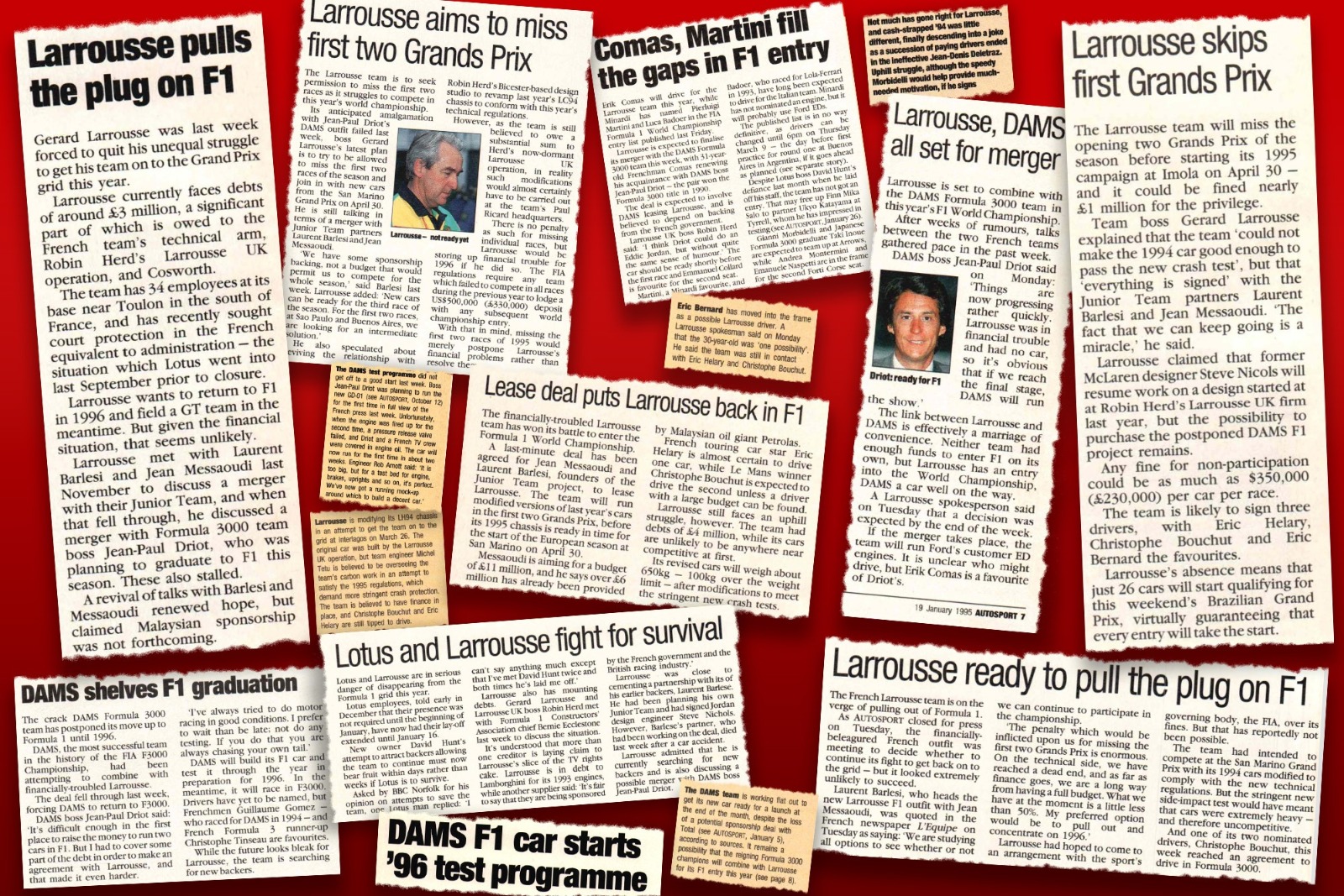
The Autosport archive on Larrousse's demise
Photo by: Autosport


The reasons behind Ferrari's US GP upgrades

Mission control: Inside the FIA and F1's remote operations centre

FIA expects F1 races in Qatar and Abu Dhabi to run as planned

Why Piastri has struggled to show his best with this year's McLaren MCL40

Lights, Camara, action: How Haas picked F1's latest rookie for 2027

Horner's inside story of how Red Bull built its own F1 engine

Why Mercedes' latest 2026 F1 update is no downgrade

Singapore Grand Prix Driver Ratings 2026

F1 United States GP live commentary and updates - Leclerc leads FP2

The reasons behind Ferrari's US GP upgrades

F1 United States GP: Leclerc beats Verstappen to top FP1 in upgraded Ferrari

F1 United States GP live commentary and updates - Leclerc on top in FP1
Subscribe and access Autosport.com with your ad-blocker.
From Formula 1 to MotoGP we report straight from the paddock because we love our sport, just like you. In order to keep delivering our expert journalism, our website uses advertising. Still, we want to give you the opportunity to enjoy an ad-free and tracker-free website and to continue using your adblocker.


Top Comments