


How Hirakawa performed on his surprise F1 debut in Mexico
On a sunny Saturday morning in Mexico City, Ryo Hirakawa was about to go for his morning run - but instead, received a call-up to replace Esteban Ocon for the rest of the weekend. Here's how the Japanese driver's F1 debut went

When was the last time a driver was swapped mid-grand prix weekend for a reason not related to illness or injury? If you cast your mind back, there was the time in 2014 where Max Chilton was due to be replaced at Marussia with future Indianapolis 500 winner Alex Rossi at the Belgian Grand Prix, only for Rossi to participate in FP1 before Chilton reclaimed his seat for the rest of the weekend. To memory, this was the most recent occasion - in this situation, the circumstances were financial. Marussia was out of cash, Rossi had some money, but it later appeared that Chilton had stumped up a bit more to help the team keep the lights on for a little longer.
Then there was Niki Lauda's abrupt retirement in 1979, having decided he didn't fancy trundling around in an uncompetitive Brabham any longer and stopped after a few practice laps at Montreal. After informing then-owner Bernie Ecclestone of his decision to quit, Lauda flew directly to California to buy a plane for his new airline, as the thought of racing had already left his mind.
Yet, these were largely amicable switches - or, in Chilton's case, a non-switch. Haas' decision to stand Esteban Ocon down for the Mexico City race, however, was not.
Ryo Hirakawa, who had taken part in FP1 for the team before Ocon stepped back into his car for second practice, was given the nod for the rest of the weekend just before he left the hotel for his morning run. It was a baptism of fire for Hirakawa in many regards, but Haas trusted him with the task at hand; Hirakawa is a two-time WEC champion, after all, and a Le Mans 24 Hours winner. Plus, he's a known quantity, given his extensive TPC and FP1 running with the team. At 32, Hirakawa became the oldest rookie driver since fellow Le Mans winner Andre Lotterer made a one-off cameo for Caterham?
So, how did he get on in his surprising promotion to an F1 drive?
Hirakawa was, initially, slightly disappointed by qualifying - but then conceded that he couldn't complain too much given the auspiciousness of the situation in which he found himself. The crux of his disappointment had lain in his approach to the second sector on his final Q1 lap, where traffic (in the form of Alex Albon) had cost him time through the sweepers and further runners ahead sapped at his time in the final part of the lap. Had he had a clean lap, Hirakawa believed he'd have made Q2 easily.

Hirakawa made his F1 debut for Haas in Mexico
Photo by: Manuel Eletto / Getty Images
Carlos Sainz fastest Q1 lap, a 1m18.521s, was the gateway to Q2. Hirakawa was only a tenth behind, but the Williams is much weaker in the middle sector given the corner profiles involved, and the newly minted Haas driver felt that - with track evolution - Sainz's time was beatable. The traffic through sector two cost Hirakawa about three tenths of a second, and another two were frittered away in the stadium section - although the Japanese driver reclaimed some of that out of the final two corners. It remained a fraction slower than his previous effort, however.
After starting 18th, Hirakawa's early race was effectively a box ticking exercise: make it through Turn 1 cleanly, complete the first lap, start massaging the medium compound, and make it to the first stop. Everything that was asked of him, he managed to do with the minimum of fuss: he held position after the opening lap, reeled off a pass on Valtteri Bottas to get up to 17th, and started to take a look at the Williams of Sainz while defending against an out-of-position Liam Lawson. He even kept a recovering Isack Hadjar behind for a few laps in the early stages, after the Frenchman had been spun around by George Russell and then took a gamble on a VSC pitstop.
"Maybe at the beginning I was a little bit overwhelmed with the others. I had a good start, but I really didn't want to make any contact because I wanted to finish 70 laps" Ryo Hirakawa
Despite the early progress, Hirakawa wasn't finding much time on the medium tyre. That's not to say that he was running glacially slow at all, but team-mate Oliver Bearman was demonstrating what the Haas could do on the soft while Hirakawa was matching the Williams pair on the harder compound.
It was one of those races, however, where the soft tyre was proving to be durable and the stronger of the two race tyres - and running the medium for longer was not necessarily the ideal scenario. Below is his medium-tyre stint, compared to Bearman's pace while battling against Hulkenberg for 10th place.
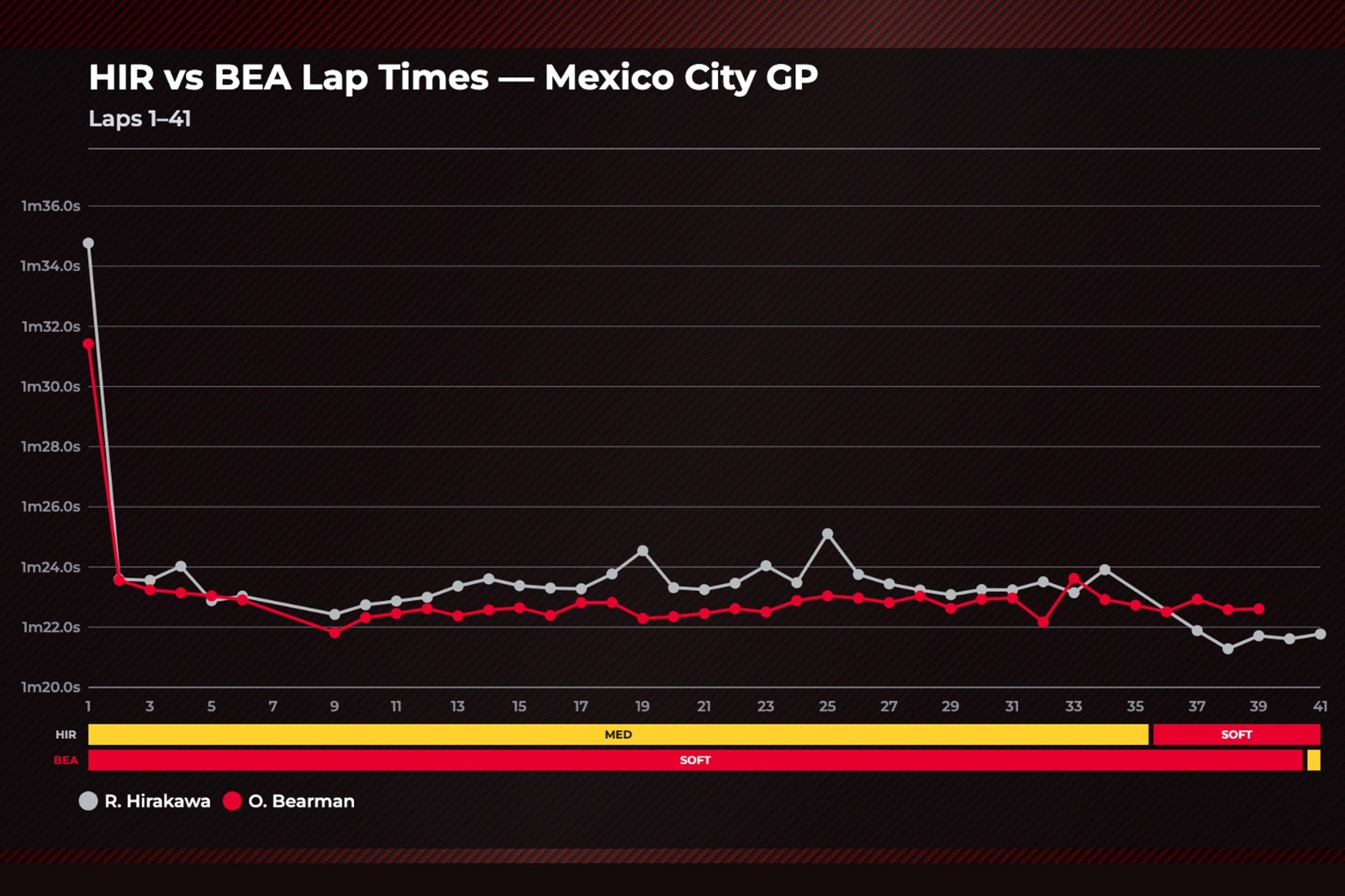
Nor was Hirakawa worlds away from Bearman either; apart from a few laps straying beyond the 1m24s mark, he was very consistently in the mid-1m23s across the medium stint. It was a good effort, and he continued to pressure the Williams pair either side of his stops - particularly once he'd picked up the soft tyre.
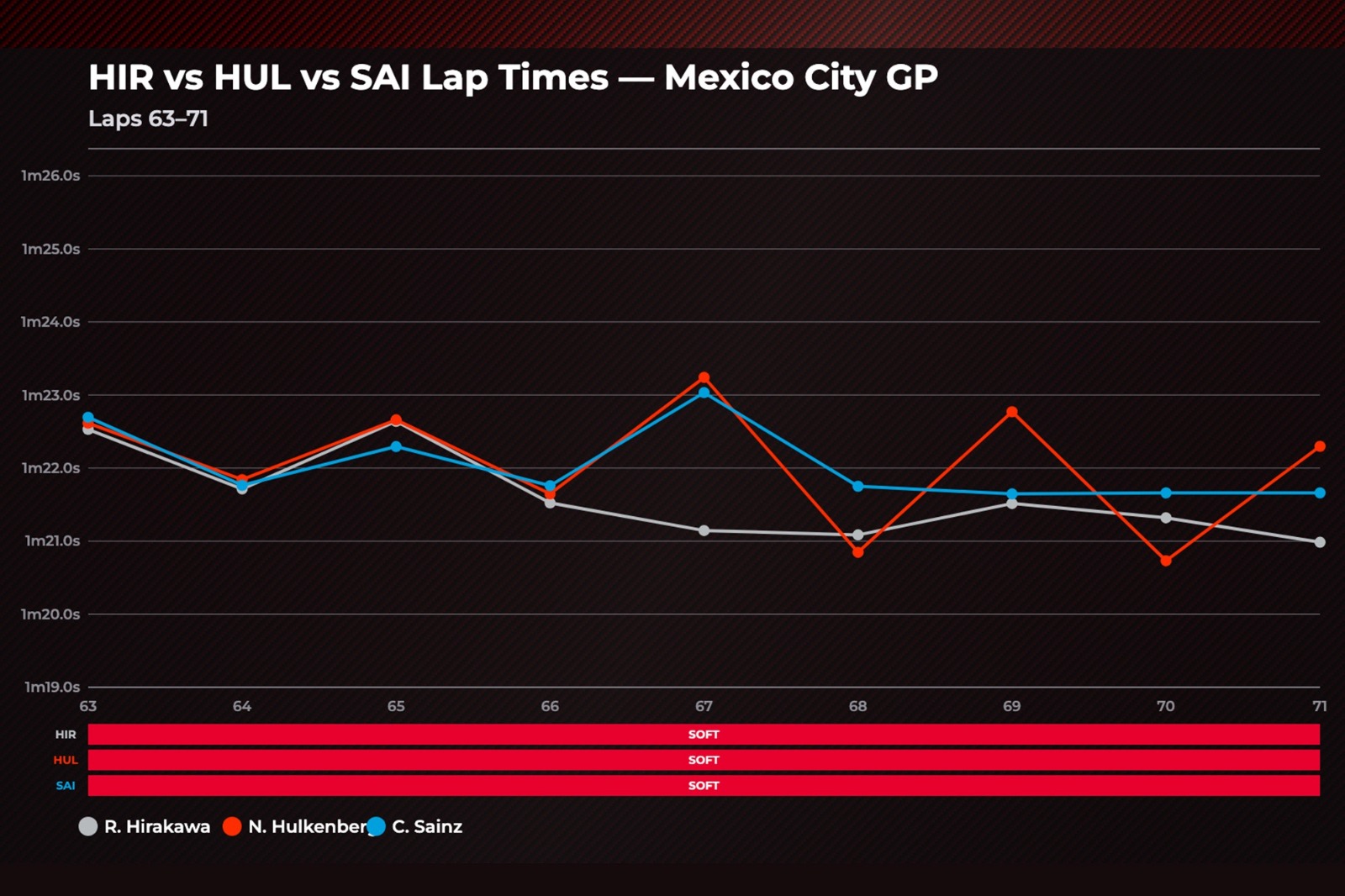
The impressive part of Hirakawa's race emerged in the final stint, after the Oscar Piastri-Arvid Lindblad clash, and his pace after making a late switch to another set of used softs under the safety car. Sure, there was a tyre advantage for doing so, but he more than made the most of it; after five laps, Hirakawa dispatched Sainz for 14th, then Albon two laps later to move up another place. Finishing 13th seemed like a good enough result as-was, but subsequent penalties for Piastri and the two Alpines ended up granting the F1 newcomer the final point on offer.
"Maybe at the beginning I was a little bit overwhelmed with the others. I had a good start, but I really didn't want to make any contact because I wanted to finish 70 laps," Hirakawa said in the aftermath.
"This made me a bit badly positioned, but then after that I was staying behind cars and trying to learn. Maybe in the beginning I was a little bit slow compared to the others, but I kept trying to learn from them, staying behind. I think after, maybe mid to end of the race, I had more confidence."
Although a short stint on those softs at the end, Hirakawa's pace over Sainz is demonstrable - and as a control, we've included Hulkenberg's up-and-down late stint as he switched tyres under the safety car too (while serving his penalty for dumping Bearman out of the race).
It was truly a whirlwind adventure for Hirakawa, who is not likely to race for the team in Brazil as he focuses on seeing out his third WEC title with Toyota, along with team-mates Brendon Hartley and Sebastien Buemi. If this ends up being a one-and-done round for Hirakawa, then it should be remembered as a quietly impressive outing in a fraught weekend for the Haas team.
Is it game over for Ocon?
Plenty of rumours have emerged in the wake of Ocon's relegation to the bench, and what really happened behind the scenes. Ocon has since denied rumours of a physical altercation but, whatever happened on Friday evening, he'd sufficiently upset the team enough to lose his drive for Mexico.
His grumbling about tyre choice in FP2 - wanting to do his long run on a soft tyre, rather than a medium - felt like small beer, but it was the latest in a series of pointy radio messages since Haas officially communicated that it would not be extending his deal. He'd already told the team to "watch my onboards" when his initial request to be let through by Bearman in Austin was denied, suggesting that he was planning to go off-piste with the team's instructions, and the Mexico scenario appeared to present the final straw that broke the camel's back.
Unsurprisingly, when Ocon was informed that he was not going to be renewed for 2027, it lit a fire underneath him - but this was no neatly controlled bonfire
So, is that it for Ocon? If so, perhaps his recent races can be explained thusly: by trying to cling onto the dying embers of his F1 dream with such force, he may well have snuffed them out for good. One can understand why: his family was not well-heeled by any stretch, and committed to selling their house to keep Ocon in karting. And, for all his title and promise: beating Max Verstappen to the 2014 Euro F3 title, winning 2015's GP3 championship, the mid-season jump to Manor in 2016 before getting onto the grid full-time with a Force India deal, Ocon's career has perhaps not consistently lived up to those early expectations.
It is forgotten how quick he was during his Force India days, those memories superseded by moments of intra-team contact with Sergio Perez, before Ocon was discarded for Lance Stroll when the Canadian's father Lawrence saved the team from oblivion. After a year on the bench, sat lurking in Mercedes' garage as Daniel Ricciardo beat him to a Renault seat in 2019, Ocon returned to Enstone - but endured myriad struggles in that return year as he took time to shake off the rust from his racing instinct.
It eventually seemed as though he'd found a home at the team, showing up well against Fernando Alonso in 2021 and 2022 - and tasting glory with his Hungary victory in the former season. But the arrival of old karting adversary Pierre Gasly for 2023 upset the apple-cart, and Ocon's time with the team ended on a sour note over 2024.

Happier times for Ocon, as he and Gasly claimed a much-needed double-podium in Brazil's 2024 race
Photo by: Sam Bloxham / Motorsport Images
This was precipitated by Ocon's lunge on Gasly at Portier in the early stages of the Monaco race, putting himself airborne and causing damage to his team-mate; Alpine's bacon was saved when the red flag emerged, allowing the team to patch up Gasly's car to contribute to his first point of the year. Then-team principal Bruno Famin was apoplectic, to the point where he informed Ocon he would not be racing for the team in 2025. Haas came calling as Ocon entertained talks with Williams, but was beaten to the drive as Sainz threw his lot in with the Grove squad.
Yet, the Haas-Ocon dynamic has never truly clicked. Ocon had worked with Komatsu during his days as a junior with Lotus, and Komatsu hoped that the Normandy-born driver would lead the team and help Bearman grow in stature during his first full season. As it happened, Bearman began to take the upper hand during the second half of the year, as Ocon was left spiralling as he reported problems with front-end braking.
After an apparent breakthrough in Abu Dhabi, the balance reverted to type over the start of 2026: Bearman was one of the star performers of the early season, as Ocon struggled to get on terms with his team-mate.
Unsurprisingly, when Ocon was informed that he was not going to be renewed for 2027, it lit a fire underneath him - but this was no neatly controlled bonfire: if left unchecked, it had the potential to scorch everything in Ocon's vicinity. It duly blazed out of control in Mexico, and Ocon's desire to find a way to stay on the grid for next season has arguably come at the cost of team harmony.
A complete split is probably best for both parties at this stage, and it's up to Ocon and his management to scout for a new opportunity - wherever that may be. He doesn't want to give up on F1 - but the harsh reality is that F1 might have given up on him.


Is a potential Aston Martin reserve gig on the cards for Ocon?
Photo by: Alex Bierens de Haan / LAT Images via Getty Images


Mexico Grand Prix Driver Ratings 2026

How Ferrari's loss became Verstappen's gain at F1's Mexico GP

The seven moments that defined Antonelli's F1 title win in 2026

Antonelli admits to driving "tense" and "tired" on cusp of F1 title

What we learned from Friday practice at the 2026 Mexico GP

What’s the state of play at F1’s smallest team?

The one aspect of the 2026 US GP that should be a blueprint for F1 2027

A strategic masterclass: How Antonelli put himself on the cusp of F1 title at the US GP

How Hirakawa performed on his surprise F1 debut in Mexico

Toyota announces WRC 2027 line-up with Rovanpera and Tanak returning
What was Antonelli’s best moment of his F1 title-winning campaign? Our writers have their say

Jenkins scores second Trucks title after 15 years as champions crowned at Brands Hatch
Subscribe and access Autosport.com with your ad-blocker.
From Formula 1 to MotoGP we report straight from the paddock because we love our sport, just like you. In order to keep delivering our expert journalism, our website uses advertising. Still, we want to give you the opportunity to enjoy an ad-free and tracker-free website and to continue using your adblocker.


Top Comments