




How Ferrari has brought the best from F1’s smooth operator
As a young boy, Carlos Sainz was schooled by his father in the special folklore surrounding Ferrari in Formula 1. Now an established grand prix ace – and a Ferrari driver to boot – Sainz opens up to BEN ANDERSON about driving for the team of his childhood hero, and of his own boyhood dreams
The 2005 Spanish Grand Prix is remembered chiefly for a crushing Kimi Raikkonen and McLaren victory over home hero Fernando Alonso. Supporting Alonso in the Renault pit that weekend was World Rally Champion Carlos Sainz Sr – a huge F1 fan in his own right – alongside his 10-year-old son.
The connections between modern Spanish motorsport’s most famous names are well known, but there was another, less well-known trip the Sainzes made that weekend which ultimately proved far more significant.
Being taken to the Ferrari garage by his father left a lasting impression on the younger Sainz, who was beginning to forge his own racing career in karting, and it became his dream to one day race in the scarlet red of the Scuderia in Formula 1.
Sixteen years later, those boyhood dreams have become reality and Sainz is now racing for the most famous grand prix team of them all…
GP Racing: You’ve made this massive, racing drivers’ dream move to Ferrari – it’s a huge thing. I’d like to start with the emotional aspect of going to Ferrari, because for every racing driver, at any level, Ferrari is a huge name. And obviously for you personally, growing up as a young Formula 1 fan, a big Fernando Alonso fan, and the big connection there between him and Ferrari. So, what did Ferrari mean to you growing up, and now you’ve become part of the Ferrari story yourself how has that move changed your life?
Carlos Sainz Jr: It goes back a long time you know. First of all, when we are all kids, when we are all in go-karting, growing up in junior formulas, we all see Ferrari as a place we want to be at some point in our careers. And for me that goes back to the fact that I went to Barcelona, to the Spanish GP when I was 10 years old, in 2005. I had the chance to meet Fernando Alonso there. I also had the chance to go to the Ferrari garage, and I met Jean Todt, I met Michael Schumacher. And immediately, I just could just feel the aura, the special feeling in that box, and my father was trying to explain to me how important this was and how big Ferrari was, and how special it was.
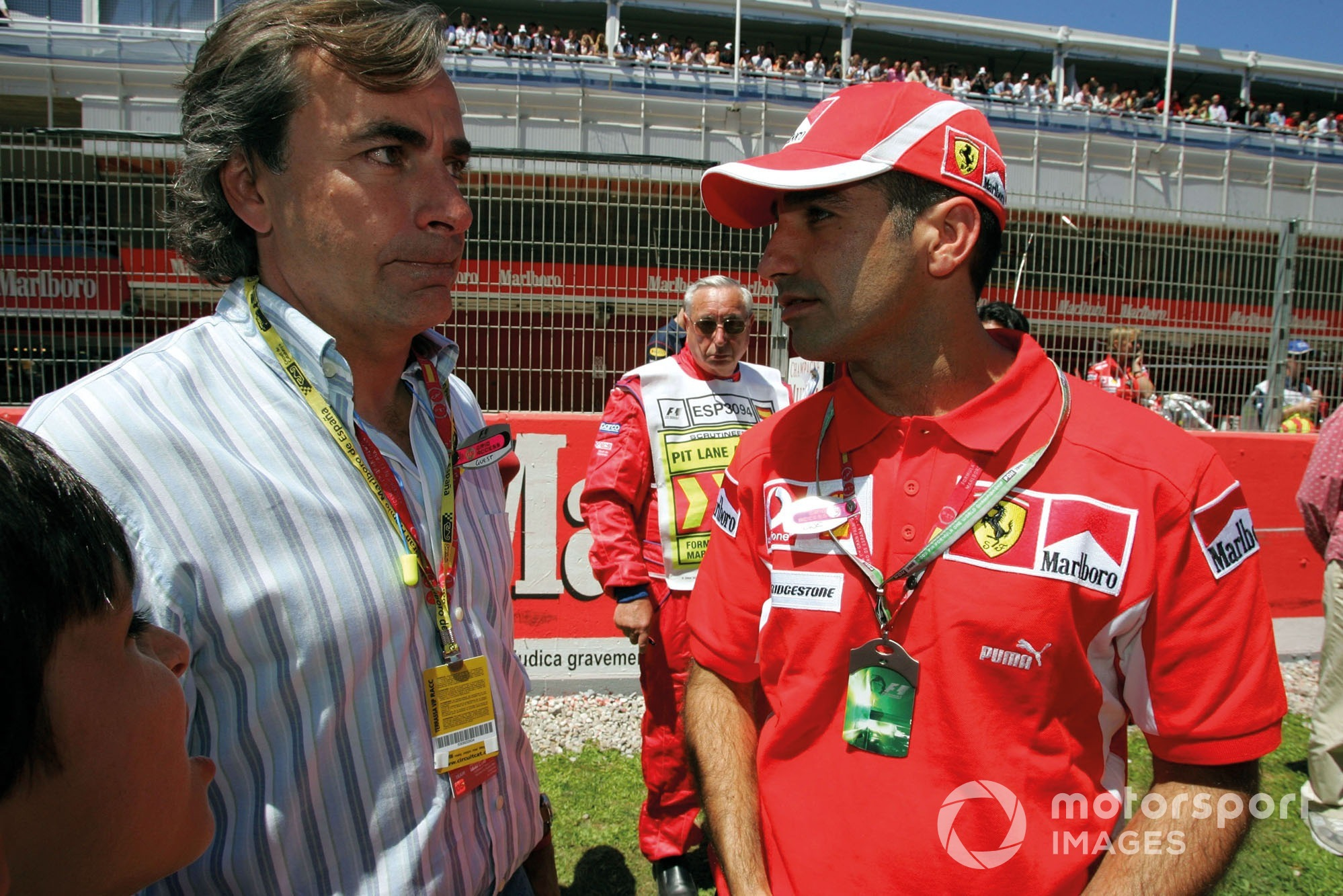
Carlos Sainz Sr and Carlos Sainz Jr speaking to Ferrari test driver Marc Gene at the 2005 Spanish GP
Photo by: Motorsport Images
GPR: And how does it feel now you’re there for yourself?
CS: I guess you mature, you grow up, and you realise what your father has told you. And as you get older, and you follow Formula 1, and you learn about the history of it, then you’re part of it, and you start to understand why this team is such an iconic brand and iconic car manufacturer. And when you start to be in the paddock and you start to see Ferrari a lot more, you get used to seeing all these people wearing red in the paddock, and it starts being a lot more normal to you. But once I got to feel like I had the chance of going to Ferrari, then everything just stopped and I said, ‘OK, it might be happening, it might be my time, and it might be a dream come true’.
"I don’t know why but I just had this good vibe going on already since my first years in Formula 1, and I always wanted to picture myself as a Ferrari driver one day" Carlos Sainz Jr
GPR: Is it a dream come true then? Did you always have that feeling that one day you wanted to race for Ferrari?
CS: It’s always been in the back of my mind. And since I was in Toro Rosso [as a rookie in 2015], every time I encountered a team member from Ferrari, I just had a good connection or a special conversation feeling with them. I was speaking Italian already in Toro Rosso. A lot of the mechanics from Toro Rosso went to Ferrari. So, I don’t know why but I just had this good vibe going on already since my first years in Formula 1, and I always wanted to picture myself as a Ferrari driver one day. What I didn’t expect is for it to happen so early in my career, in the manner it happened.
GPR: And once you arrived and you became a Ferrari driver for real, how did things change for you, and how did the whole team live up to your expectations – what did you find once you arrived in Maranello?
CS: Well, I found a team that obviously was coming from a very difficult year in 2020, hurt a bit by the year that was, but a team full of determination to fight back, and I liked it straightaway. As soon as I landed in Maranello in December I got a chance to do my first meetings there… obviously a bit surprised at first with [the scale of] their resources, with the amount of people, with the amount of departments, amount of buildings here.
PLUS: What Ferrari must do to reach the peak in F1 again
Maranello actually, the headquarters is inside a village – and then there’s the village that surrounds the headquarters and it’s super impressive the first time you come here. You see then there’s a circuit inside the village – Fiorano. So, it’s like everything is built around Ferrari here, and it’s super special, and then you start understanding a bit how big Ferrari is.
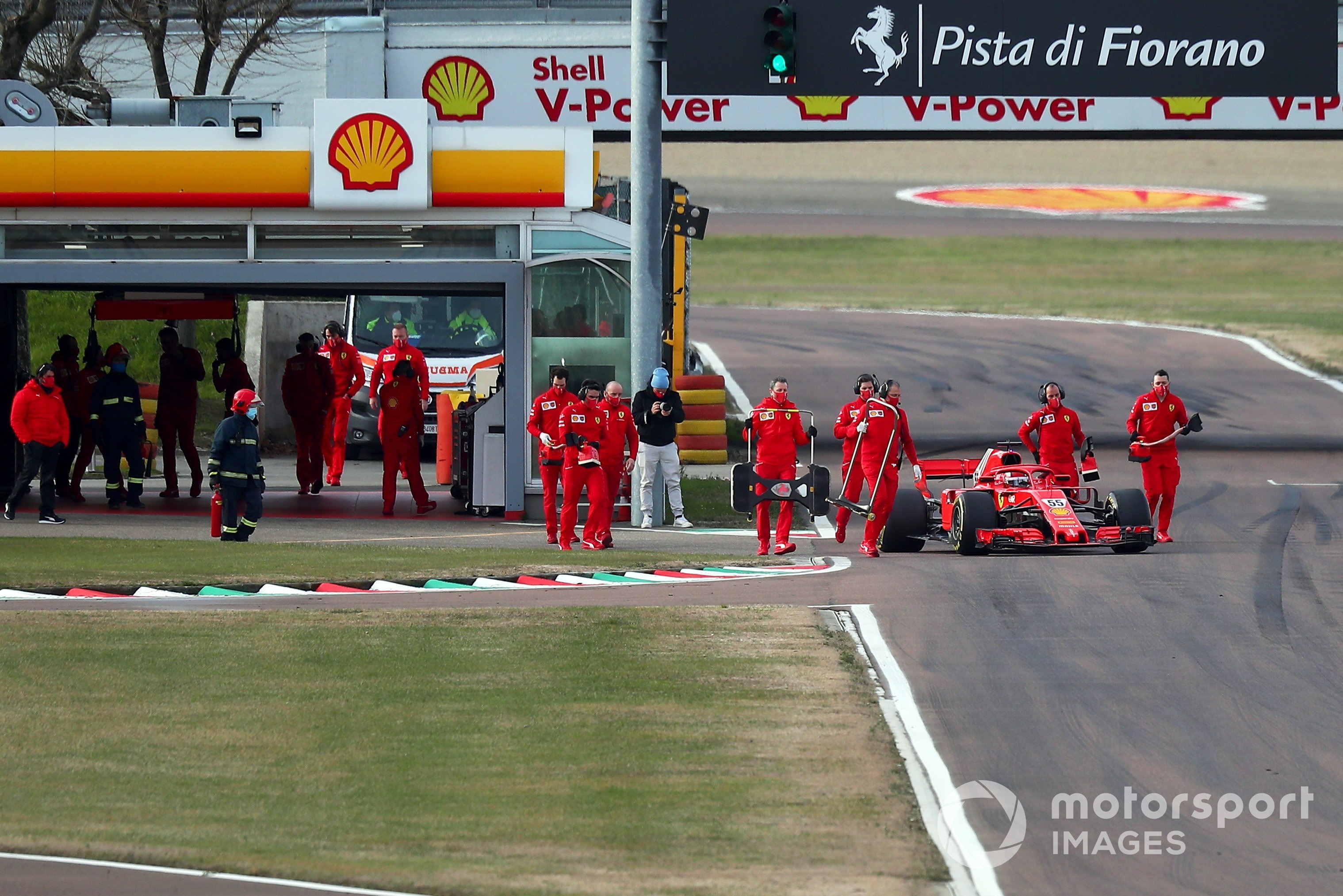
Carlos Sainz Jr testing a Ferrari Sf71H at Fiorano in January 2021
Photo by: Federico Basile / Motorsport Images
GPR: Putting this move into the context of your career, you’ve had quite a tough road to get here in terms of not being able to get the Red Bull seat you initially wanted, then the politics of the Renault situation, going to McLaren – it’s been a battle for you, so what have you learned about F1 and also yourself, given the very particular journey you’ve been on to get here?
CS: I agree, it’s been a particular journey with a lot of moments on the limit – that I was on the line of my career going one way or the other. You go through moments of very high pressure, which are very difficult to handle mentally. But I’ve always believed in my talent. I think this is the number one thing – you need to believe you are as good as anyone else in the sport. But then second, also in my way of doing things and the hard work that comes with it. It was tough – particularly 2014 in [Renault] World Series where I didn’t know if I would make it to Formula 1, then the year in Renault that was also quite demanding. In the end, it all turned out to be good. So, it has proven to me that if you keep your head down, if you keep working, if you keep following your feelings in terms of the way you go at things, it all turns out to be good. I’m going to keep pursuing this.
GPR: You’ve driven for four different teams in only seven seasons. That’s a lot of different people, ways of working, technical aspects, philosophies. How have you approached that, and how have you evolved yourself to make the most of those opportunities?
CS: This adaptation process is a topic that has come up probably more in the media this year than any other year, because four or five high-level drivers have changed teams, or have arrived back into Formula 1. It went a bit viral in the media that it was going to take us a bit of time. I was a bit surprised, because I’ve done this change three times in seven years and I remember when I moved to Renault, no one was talking about my adaptation process. Everyone was expecting me to deliver… when I went to McLaren, no one talked about whether it would take me a few races [to adapt].
This year it’s been the main topic, and I’ve dealt with it, I think nicely. I have the opportunity to learn from my past changes of teams, and I think this has allowed me to hit the ground running nicely with Ferrari. It’s a matter of having the capacity as a driver to adapt, but also knowing how to integrate yourself into a team, having the right questions to ask depending on the department that you’re chasing for performance and comfort inside the car. And this is a natural process that, if you have a good bonding with a team, it should happen. And for me it has been a smooth transition so far.

Carlos Sainz Jr., Ferrari SF21
Photo by: Ferrari
GPR: Do you feel properly comfortable in your new environment? Lewis Hamilton when he went to Mercedes, it took him the whole first season really to get fully comfortable…
CS: I fully agree with you that it might take up to a year to deliver at the highest level. When you see drivers like Max [Verstappen], when you see drivers like Lewis, when you saw Checo [Perez] at Racing Point, when you see Charles [Leclerc] in Ferrari, these are drivers who have been more than three, four years inside the team. And I’m a strong believer that on the third, fourth year of that team, they are better drivers than in the first year. It’s a process. It doesn’t mean you cannot do very well in your first year. Actually, you must do very well in your first year. But the level of delivering at 100% in every single race, I think this comes a bit later. You have the best examples with drivers that have been spending more than two, three years with the same team.
GPR: You see it with Lando Norris at McLaren now, don’t you?
CS: Third year with McLaren. And suddenly the level of consistency you reach with a team – the level of understanding with strategy, with data management, the radio communications during the race, it’s at a different level once you’ve been there more than a year.
"My philosophy is whatever the car is capable of, whatever my team-mate is doing with that car at the moment is really, really good, so I need to find a way to drive it like he’s driving it. Once I’m at that level, I’m going to steer the car balance and direction towards the things I prefer" Carlos Sainz Jr
GPR: The calibre of drivers you’ve been up against, including Charles now at Ferrari, having that level of team-mate as a reference, do you enjoy the intensity of having that pressure on the other side of the garage?
CS: Absolutely. For me, it’s going to be, and is already, a great challenge to be up against a guy like Charles. But the fact I’ve been up against guys like Max Verstappen, Lando Norris, Nico Hulkenberg – you know the level of drivers they are – makes me also not fear the challenge, embrace the challenge, and go up against another top guy like Charles. I will give it my best go.
PLUS: How Leclerc can be the galvanising figure Ferrari needs
The relationship is super good. I’m enjoying it a lot because we have this great competition between each other, a bit of banter. After every qualy, after every race, we shake hands, but we’re pushing, we’re flat out. We’re a bit crazy sometimes with some high-speed corners and the way we do them, and it’s great. I’m enjoying the battle and the camaraderie with him.

Carlos Sainz Jr., Ferrari and Charles Leclerc, Ferrari
Photo by: Charles Coates / Motorsport Images
GPR: How have you felt in terms of driving style? Because there’s a big scale. I think Fernando’s probably the best example recently of a guy who kind of can adapt to almost anything that’s thrown at him by engineers or a team. And then you’ve got guys like Kimi Raikkonen, Sebastian Vettel, who work to get the car built around their style, which is a longer process. So how do you approach this work of adapting?
CS: I’m not sure where I sit on that spectrum. But let’s say my philosophy is whatever the car is capable of, whatever my team-mate – in this case Charles – is doing with that car at the moment is really, really good, so I need to find a way to drive it like he’s driving it to get to that level. Once I’m at that level, I’m going to steer the car balance and direction towards the things I prefer. First I need to prove that I’m quick and that I can drive a car with this [fundamental] balance – and that is where you rely on your adaptation process and the talent to just feel the car and change your driving style. F1 nowadays is so complex. Every car is a completely different story, a completely different driving style. They are demanding for the drivers to adapt to – but it’s also fun trying to challenge yourself.
GPR: When it comes to specifically driving the new car, do you go in with a completely open mind, or are you looking to replicate feelings you’ve had in the past?
CS: There are the basics – getting comfortable in the seat, getting your brake pedal to your feeling, the torque map and the throttle. But then you go out of the box, in Fiorano or Bahrain, and the first laps you do in the car, I was driving the car exactly the same as I had been driving the McLaren for the last two years. And I immediately got to a very competitive lap time. And I was like, ‘OK, job done’. It’s like, ‘I’m nearly there, only a tenth or two away from where I want to be’.
Then you realise that to extract those last two tenths, once they give you five sets of new tyres in qualifying, and know to extract a tenth out of every new tyre, and how the car reacts to the wind, how the car reacts to the front wing changes that you do through qualy, what you do with the switches, the diff, the engine braking, what you do with the brake balance for each corner – those are the last two tenths, the difference between being in Q3, P5, or being Q2, P11 and a disappointing qualifying, two tenths off where the car should be.
And those two tenths are the complex ones to find. You don’t know where they are. And you have to challenge yourself as a driver, and challenge your engineers around you, to try and help you – what do you think suits this car? What is the driving style? What is your team-mate doing to extract that last couple of tenths?
And there you go back to the factory, you dig into the data, you put the hours, you challenge yourself in the simulator to try and change your driving style and drive in a completely different way to what you’re used to. And suddenly it starts happening a bit more unconsciously, because you practice and you practice and you try and you try – and that’s why I say it’s also good fun, because there’s a very long process behind it.

Carlos Sainz Jr., Ferrari SF21
Photo by: Zak Mauger / Motorsport Images
GPR: I think that speaks to your character, doesn’t it? Because you’re a hard-working guy, someone who clearly really enjoys the technical aspects of Formula 1, which not every driver does.
How have you found Ferrari’s way of working, because on top of this normal process you’ve got the biggest team in F1, with this metropolis at Maranello, and this scale of people, a different culture, a different way of going racing, different resources. How do you gather all that together to work for you?
CS: Well, it’s a difficult process, because you need to know which departments and which people to click with to try and help you in these different areas. The modern F1 driver nowadays works hard, as a default. I can tell you, from all my team-mates I’ve had in F1 – Verstappen, Nico [Hulkenberg], Charles, [Daniil] Kvyat, Lando – I see these guys working very hard, putting a lot of hours in. In the end, it’s up to the fine detail, and also seeing who is more adaptable. But as I said, if you click and you know where to go to chase the things you want to chase – it’s still human beings, they still react, they still come to you, you still work hard with them. And there’s actually a very good team spirit [here] that I’m enjoying a lot.
"Inside the team there is a massive push to evolve. You can see all the effort that Mattia [Binotto] and Laurent Mekies are putting on this team to try and steer it in that direction" Carlos Sainz Jr
GPR: Ferrari has had difficult periods, and obviously has been political, but I get the feeling the Ferrari of now is not so much like the Ferrari of yesteryear – there was always this sense of a blame game going on. The team seems very pragmatic now, coming from the top when you hear Mattia Binotto talk – he’s very honest about the limitations and how the team will progress back. That must be quite encouraging, to come to a team that seems to be very unified, and very focused on its goal.
CS: I’m glad you’re seeing it from the outside. Because inside the team, there is a massive push and a massive effort to evolve in this direction. You can see all the effort that Mattia and Laurent Mekies are putting on this team to try and steer it in that direction, and I’m glad that you guys are picking it up. I’m finding a very strong team spirit right now. And I’m coming from a team that was also on the way up, like McLaren, with a very good team culture, like McLaren.
PLUS: How Ferrari got its F1 recovery plan working
So far what I’m seeing is Ferrari doesn’t have a lot to envy from McLaren. It’s not easy to change – such a big boat like this, to steer it in one direction or another. It takes a lot of time, and effort. I’m glad you see it, because I’m seeing it too. And I’m enjoying the process of also seeing this little cultural change that is going on and the way it’s being approached.
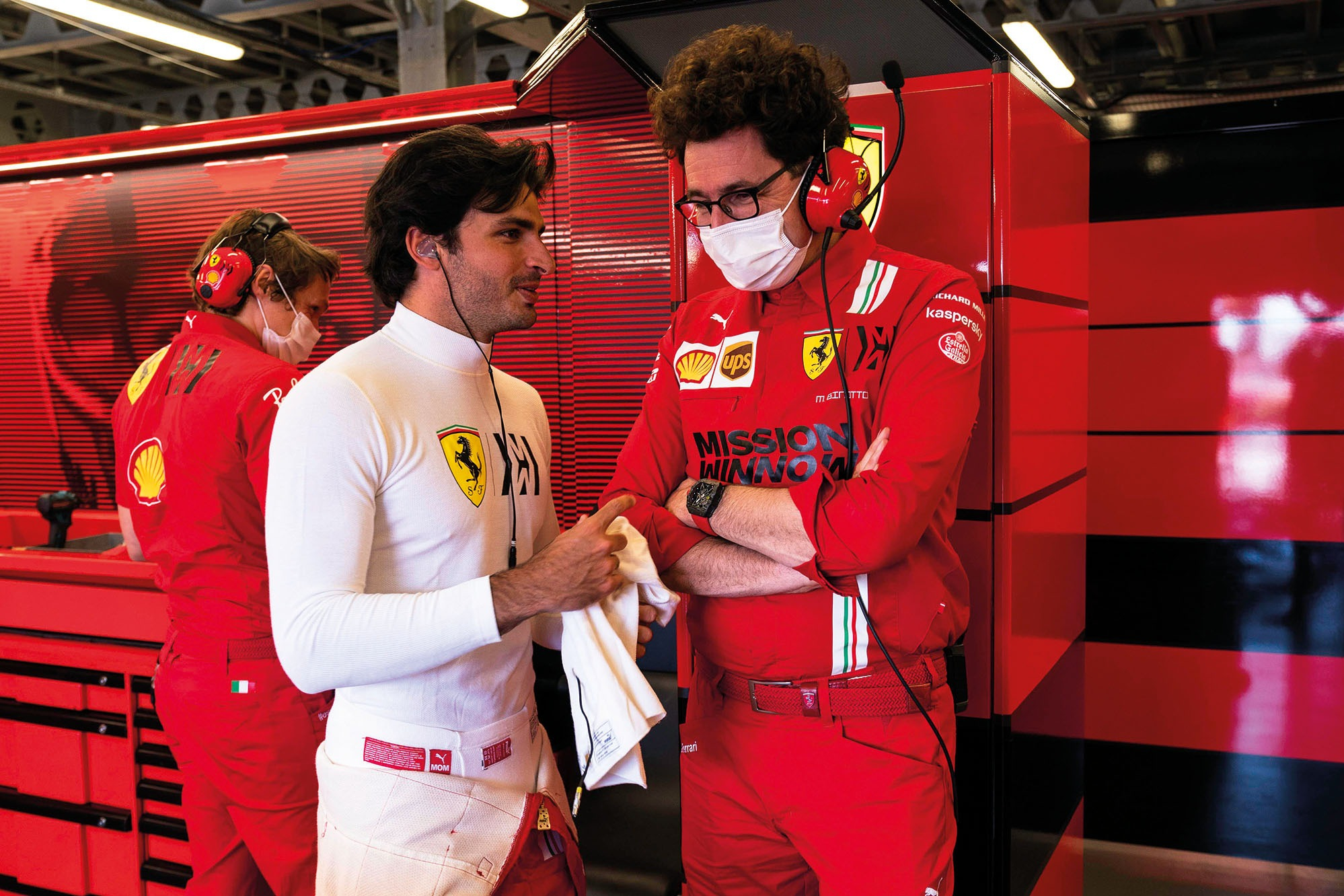
Carlos Sainz Jr and Ferrari team principal Mattia Binotto at the 2021 Azerbaijan GP
Photo by: Ferrari
GPR: How is that manifesting in terms of your progress this season? Ferrari’s obviously got some very specific problems to address to get back to the front. That must mean a lot of work is thrown at you guys. Car development is different because of the 2022 regs, but there’s a lot of effort that still needs to go in to make sure that processes are right and previous mistakes have been learned from, so how are you finding that process?
CS: It’s a fun process. It’s not easy, because obviously there’s the pressure of being in Ferrari, there’s a lot of pressure coming from the outside, so it’s difficult sometimes to react to things [in the right way]. But I think a very good example is Austria – the fact we decided to try to go through [Q2] with a medium [compound tyre] and not overreact to try and go into Q3 with a soft, like maybe other teams did, because we believed not going into Q3 with a soft was the right call.
Maybe in the past, with the outside pressure, you need to put at least one Ferrari in Q3, and split the strategies. But no, this time we stuck to our plan, and recovered in the race. It’s not where we want to be – we want to be in Q3 with a medium, first of all, we acknowledge that – but for the car we had that weekend, we realised our plan. I really liked the way the team kept it cool, didn’t overreact, stuck to our processes, a lot more pragmatic, as you said, and we made it happen. This is a sign of a team trusting their processes and going in the right direction.
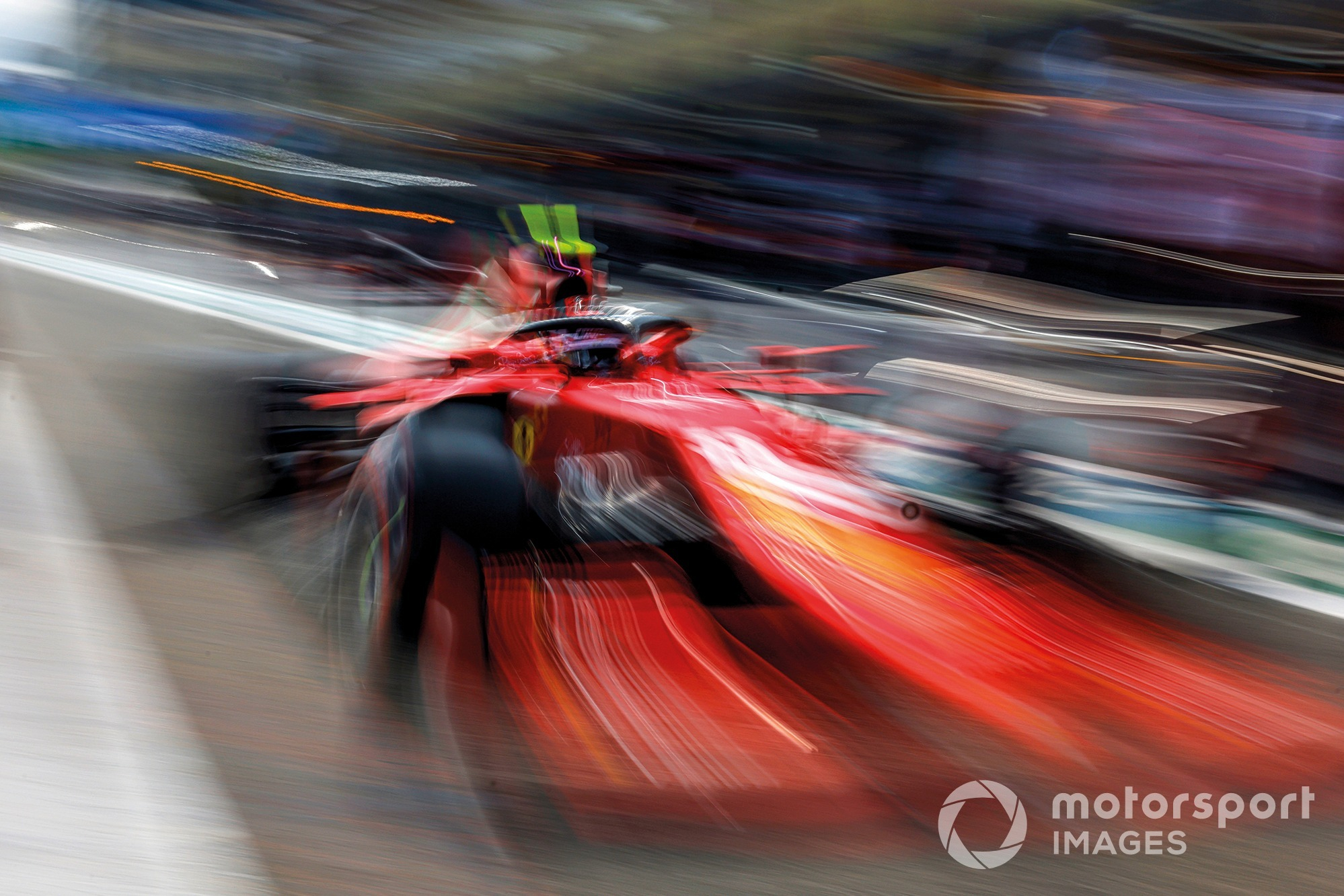
Carlos Sainz Jr at the 2021 Austrian GP
Photo by: Motorsport Images

How Ratzenberger beat the odds to realise his cruelly short-lived F1 dream

F1 uncovered: A weekend behind the scenes with a chief mechanic

When McLaren was pipped by Red Bull in a modern F1 classic

The big opportunity Sainz’s Williams switch affords to F1’s latest centurion

Inside the science of F1 fuel

How F1’s plan for rotating races could look in practice

The early decisions that set Sauber’s rookie for success

How F1 media coverage has evolved in line with its subject

F1 United States GP live commentary and updates - FP3 starts

James Hunt’s 10 greatest races

The intrigue caused by Cadillac's F1 boss dodging driver market question

How Marquez changed his approach to launch late MotoGP title challenge
Subscribe and access Autosport.com with your ad-blocker.
From Formula 1 to MotoGP we report straight from the paddock because we love our sport, just like you. In order to keep delivering our expert journalism, our website uses advertising. Still, we want to give you the opportunity to enjoy an ad-free and tracker-free website and to continue using your adblocker.


Top Comments