


How Ferrari got its F1 recovery plan working
After its worst campaign in 40 years, the famous Italian team had to bounce back in 2021 – and it appears to be delivering. Although it concedes the pole positions in Monaco and Baku paint a somewhat misleading picture of its competitiveness, the team is heading into the 2022 rules revamp on much stronger footing to go for wins again

“Guys, this is only the first qualifying but, compared to where we were last year, it’s quite a big step forwards. We hope to fight for poles, but I think we should be satisfied with the step we’ve done – at least here. And congratulations to Carlos – he pushed me massively.”
Charles Leclerc’s team radio words to Ferrari as he toured in after sealing fourth place in qualifying for the 2021 Bahrain Grand Prix rather neatly summed up both the team’s position at that point, and how its campaign has played out since.
After the nadir of 2020 and the team’s worst F1 season since 1980, 2021 has been better. Ferrari currently sits third in the constructors’ championship. It’s still not fully back, not anywhere close to fighting Mercedes and Red Bull across a season or claiming what it feels is its natural place at the head of the Formula 1 pack, but Ferrari has made progress.
It’s tempting to assert that things couldn’t have got much worse for the Italian marque after 2020, but then former title rival and current midfield foe McLaren has shown exactly how far and how quickly the mighty can fall.
Ferrari came into 2021 with perhaps the most unfortunate consequences of the carryover rules requirements of any team aiming for F1’s top spots: having to keep going with the essentials of a package that had put it on a sharp downward trajectory. It could rework the main problem with the SF1000 – the engine, which lacked its previous power punch advantage after the controversial ‘settlement’ with the FIA ahead of last season.
Indeed, Ferrari redesigned parts of the power unit’s internal combustion engine and made small tweaks in the thermal and electrical elements, including introducing a smaller turbine for this season. But, like all manufacturers, it cannot now upgrade the engine again this year. Further and more major developments are planned for 2022, but as it stands the Ferrari powerplant’s output is thought to remain somewhere in the region of 20bhp down on Mercedes and Honda.

Ferrari has made improvements, but still lacks power of the Mercedes and Honda units
Photo by: Mark Sutton / Motorsport Images
Ferrari spent its 2021 development tokens adapting the rear of the SF1000 into the SF21, which included a redesigned gearbox. A rear handling weakness was another part of the 2020 package that had hurt the team, and so it tried to address this while also incorporating the mandatory rear floor changes, recouping as much downforce as possible in this area being a key consideration. Ferrari initially trialled a tapered floor concept that was perhaps more in keeping with the spirit of the intended rule change, before switching to the ‘Z-floor’ solution now widely implemented across the grid.
The result was the SF21, which, other than a few new aerodynamic parts at the front of the car standing out, looks largely similar to its much-maligned predecessor. Albeit with a slightly questionable blended livery covering the rear of the car…
Ferrari typically must go with set-ups more compromised than would be ideal for any team as it sheds peak downforce to try to keep up with the more powerful engines on the straights. This could be seen most noticeably last time out in Baku
It has a positive front end, rides bumps and kerbs superbly and excels in slow-speed corners, which could be seen in Ferrari’s pace in the final sector at Barcelona and, most prominently, two weeks later around Monaco. The SF21 appears to be able to get the tyres working as needed for its drivers, although keeping them alive over a race distance remains a challenge. Apart from the remaining straightline speed deficit, the 2021 Ferrari has returned to many of the strengths its 2019 package possessed, as the team has also worked to reduce the drag that hampered the SF1000.
“With how much aero we [still] have on the car, it’s actually quite powerful,” Leclerc explained when discussing the SF21’s low-speed strengths after his shock Monaco pole and before his surprise Baku follow-up.
“In the low-speed corners, it’s a combination of chassis and aero that makes it quite nice. The balance is also quite nice in the low-speed corners, which helps us. So, it’s a combination of things that makes our car quite strong in the low-speed. We were even stronger on the low-speed in Monaco than we were basically in the low-speed of all the tracks before, so I think there was maybe something more in Monaco that we need to understand.”
So far, so encouraging, but the SF21’s remaining problems – again, essentially with the power deficit – are causing knock-on effects. Ferrari typically must go with set-ups more compromised than would be ideal for any team (this is the game up and down the grid at every track, of course) as it sheds peak downforce to try to keep up with the more powerful engines on the straights. This could be seen most noticeably last time out in Baku, with that track’s long straights and acceleration zones, but such an approach has a negative impact on tyre life, particularly at the rear.

Leclerc claimed second pole of 2021 in Baku, but compromised set-up to negate engine deficit hurt tyres
Photo by: Mark Sutton / Motorsport Images
In 2020, Leclerc in particular was able to grab excellent qualifying results for Ferrari, four fourths the highlights. But the SF1000 would inevitably drop back rather dramatically in races – if Leclerc was still in the fight, given his three first-lap shunts last year.
Overachieving in qualifying and then struggling more for race pace is arguably still a trait that the SF21/Leclerc combo shares with last year’s Ferrari package, but the race results have been better. And the Monegasque is yet to be involved in a race clash, even if he showed in Bahrain and Spain with his bold passes on Valtteri Bottas that he’s not going to shy away from a fight he can’t ultimately win.
Bahrain and the Algarve Circuit are Ferrari’s lowlights of 2021 so far. In the former, the team struggled to keep its rear tyres alive on the highly abrasive surface, with Leclerc slipping back to sixth in the race. New team-mate Carlos Sainz Jr was eighth. In Portugal, both drivers struggled with tyre management, sixth and 11th in the grand prix, although Leclerc did gain places while Sainz tumbled out of the points. But the team worked hard to improve this before the next event in Spain, and the results were very encouraging.
After sensationally nipping around Bottas at Turn 3 on the first lap at Barcelona, Leclerc took his equal best finish of 2021 in fourth (the others came at Imola and Baku). Sainz finished seventh in his home race, and engaged in battle with McLaren as Ferrari beat the orange team for the first time in what is becoming an engaging subplot fight for the best-of-the-rest spot behind Red Bull and Mercedes.
Then came Monaco, where Leclerc claimed pole in bizarre and ultimately very painful circumstances, as the driveshaft hub damage sustained in his Q3 crash prevented him starting the race. Sainz showed well in the race to end up second, demonstrating strong pace against dominant winner Max Verstappen once Bottas had been removed by Mercedes’ latest pitstop calamity. Sainz did not threaten the Red Bull, but he was fast enough to suggest that Leclerc would have had a strong chance of winning if he’d been able to take up his pole and hold the lead through Ste Devote.
In Baku, another Q3 red flag, this time with Sainz going off in sympathy behind Yuki Tsunoda, helped Ferrari double up on poles. But Leclerc was easily overcome by Lewis Hamilton and the Red Bull duo in the race’s early stages. The red flag helped him get racy again in the final laps, but Pierre Gasly held on to deny him a podium.
“I think it was still a good weekend, and we should keep our heads up and be positive,” team boss Mattia Binotto said after Leclerc had finished fourth and Sainz eighth in Baku.

Charles Leclerc's Ferrari is craned away after his Monaco Q3 crash
Photo by: Motorsport Images
“Obviously there are two cars ahead of us, which are still stronger [Red Bull and Mercedes], no doubt. It was great to have pole position both in Monaco and in Baku, but I don’t think that is reflecting our true performance overall. There are two cars which are stronger. But I think we are progressing.
“We are progressing because eventually we are learning the car, we are exploiting it better compared to the start of the season. And we know that there will be some developments coming in the future. So overall, that’s where we are.”
If a future F1 observer were to take a somewhat lazy glance at the history books and compare Ferrari’s very early 2020 to early 2021, they would likely spot something missing year on year. Ferrari immediately took silverware last year, with Leclerc second first time out in the pandemic-delayed campaign. That says a lot about the chaotic, controversial circumstances of the 2020 Austrian GP’s ending, but it also skates over the 2021 Emilia Romagna GP.
Using supertimes calculations from the six 2021 races, Ferrari has the third fastest car with an average pace deficit of 0.368%, whereas in 2020 it was fourth fastest, with an average deficit of 1.354%
At Imola for this season’s second event, Leclerc had run commandingly early on, well ahead of Sergio Perez in the wet early stages, and was comfortably in third behind runaway leaders Verstappen and Hamilton. The red flag robbed him of what was surely a nailed-on podium, as it allowed Lando Norris to bring McLaren’s power advantage with its Mercedes engine to bear, while Hamilton was gifted back a lap and set on a charge to rescue second after his first of two major errors so far this year.
There are tangible ways to track Ferrari’s progress back towards the ‘Class A’ fight. For a start, the team is two places higher in the constructors’ championship than it was after six races in 2020 (it ended the campaign sixth).
Then there’s its year-on-year pace relative to the front of the grid. This can be seen in two areas. For a start, looking back to the season opener in Bahrain, all the teams set slower times in qualifying than they did in 2020, largely thanks to the rear floor changes and new tyres, but Ferrari only lost 0.541 seconds – the least of all. That’s compared to 2.121s for Mercedes and 2.279s for Racing Point/Aston Martin – the most (not including the undeveloped, rookie-piloted Haas cars).
Plus, using supertimes calculations (based on the fastest single lap by each car at each race weekend, expressed as a percentage of the fastest single lap overall – 100.000% – and averaged over a number of events), from the six 2021 races, Ferrari has the third fastest car with an average pace deficit of 0.368%, whereas in 2020 it was fourth fastest, with an average deficit of 1.354%. That is real progress and in very difficult circumstances, given the carryover rules restrictions in place mean that normal, wholesale development can’t be done.

Ferrari has the third quickest car when studying the Supertimes, behind only Red Bull and Mercedes
Photo by: Steven Tee / Motorsport Images
“It was important for us to show our capacity of developing and addressing weaknesses,” Binotto said in Monaco. “When coming to Bahrain for winter testing, I think the car behaved at least as we were hoping and expecting. That was the first good result, and after Bahrain we knew we had a car that was certainly better than last year, which was a minimum objective.
“We knew that somehow we could have done well during the race [there], but we know as well that Bahrain is a very specific circuit and I think we said we should first wait for five races in the season to understand our true potential.
“But I think that the car has been behaving consistently since the start. The entire team as well is dealing well through the race weekends. Solid race weekends from the pitcrew, from engineering. We had some difficult races, like in Imola with the wet race. But not only Imola. I think that overall in terms of strategy, pitstops, it has been a solid start to the season and for that we are pretty happy.”
Another part of Ferrari’s positive progress in 2021 concerns its drivers. With Sainz on board in place of Sebastian Vettel – who it must be acknowledged is currently enjoying a renaissance at Aston Martin despite a tough start to life in green – Ferrari boasts the highest average combined driver grid spots of any team outside Red Bull and Mercedes, on 5.05 (McLaren is next on 8.65, with Mercedes leading the way with 3.55).
Sainz appears to be pushing Leclerc to new heights. It’s still probably too early to say this for sure, but there has been a pattern since Bahrain qualifying for the Spaniard to generally lead the way for Ferrari in practice and Q1/Q2 before Leclerc rockets up the order with his fearsome qualifying speed when it really matters. The only thing preventing a Leclerc 6-0 lead on head-to-head qualifying was his unsettling by the rather random, blustery conditions around Portimao, where he’d done magnificently to get through Q2 on the slower medium tyres.
But Sainz has proved his worth to Ferrari. He has scored its only podium so far this year, and has only qualified outside the top 10 once, in Portugal – Vettel did that for the final 13 races of last year.
“We are enjoying the interaction he has with Charles,” Ferrari racing director Laurent Mekies said of Sainz in Portugal. “They are pushing each other, they are listening to each other in terms of where the car needs to go for its development. It’s certainly a strong point for us right now, the interaction between our drivers, and it’s not something we want to leave here. It’s something we want to further develop with them and with their engineers.”

Sainz claimed maiden Ferrari podium in Monaco and has pushed Leclerc hard
Photo by: Andy Hone / Motorsport Images
After two street-track races, F1 is now heading back to more traditional ground with the higher-speed events in France, Austria and Britain. There are some in the paddock who believe that the low-speed strengths required to excel in Monaco and Baku have flattered Ferrari compared to how it really stacks up in 2021, and there is surely a grain of truth to this. But then, the team was expecting Monaco to be a one-off, before getting into the fight for Baku pole and the early race lead.
"We have made our choice and we are pretty much on full push on 2022. It doesn’t mean that you will not see things coming here and there, but certainly the vast majority of the effort has switched already" Laurent Mekies
But with Singapore now removed from the calendar, Ferrari’s best chance to return to race-winning glory has surely passed thanks to Leclerc’s latest home-town heartbreak. It will surely be strong at the tight Hungaroring, but, before getting there, Paul Ricard and particularly Silverstone may well be a struggle, even compared to 2020, with the SF21’s slimmer aerodynamics not working as well in the high-speed stuff.
This may hurt Ferrari in its fight with McLaren, which relies on good straightline speed and better high-speed corner performance to gain lap time. But if Ferrari can edge ahead and seal third in 2021’s final results reckoning – and both it and McLaren are having to fight something of a rotating cast of other midfield runners for the best non-podium results as the year progresses – then that would still be an excellent turnaround from 2020. It would put Ferrari on a firm upward trajectory and make the previous year a mere blip, assuming of course that it can continue gaining pace and places through the rules reset coming for 2022.
“It’s very clear for us – the vast majority of our resources are on 2022,” Mekies explained back in late April. “It’s an efficiency race now. We had to choose – and we have made our choice and we are pretty much on full push on 2022. It doesn’t mean that you will not see things coming here and there, but certainly the vast majority of the effort has switched already.”
So, Ferrari is heading back, but isn’t quite there yet. And it’s still trying to win a close fight in 2021 while at the same time attempting to avoid this impacting its potential in 2022. The same is true up the grid at Red Bull and Mercedes – exactly where Ferrari wants to get back to fully next year. But we’ll only know if it has succeeded come this time next year.
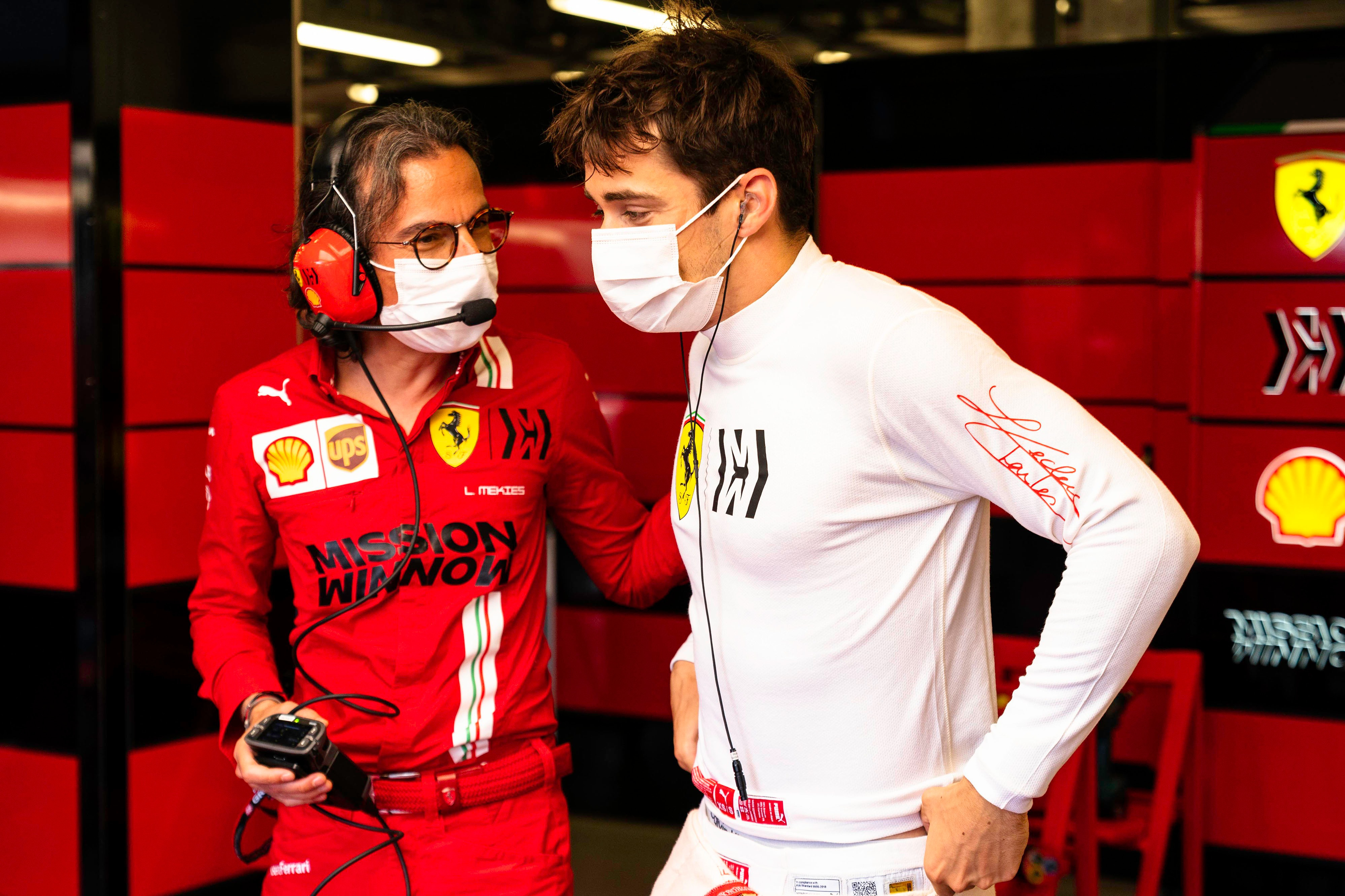
Laurent Mekies, Charles Leclerc
Photo by: Ferrari


Why Britain’s role in Formula 1 endured a troubled start

Why Bottas believes his F1 reserve driver role is the fastest route back to a race seat

Why Norris is now ready for his final exam

The key advantage for Bottas vs Perez in the 2026 F1 return race

Why Ferrari's management is under pressure after its bad start to F1 2025, not Hamilton or Leclerc

Why Red Bull can’t solve its second F1 car problem with a simple paint job

Hirakawa replaces Doohan at Alpine for Japanese GP FP1 outing

How Alonso and Bortoleto can be F1 rivals in a unique driver management deal

F1 United States GP live commentary and updates - Hamilton leads FP3

F1 United States GP: Ferrari completes perfect practice record as Hamilton tops FP3

James Hunt’s 10 greatest races

The intrigue caused by Cadillac's F1 boss dodging driver market question
Subscribe and access Autosport.com with your ad-blocker.
From Formula 1 to MotoGP we report straight from the paddock because we love our sport, just like you. In order to keep delivering our expert journalism, our website uses advertising. Still, we want to give you the opportunity to enjoy an ad-free and tracker-free website and to continue using your adblocker.


Top Comments