


How far can Ferrari recover in 2021?
A new driver combination, a refreshed mentality and winter developments targeted at the weaknesses of its 2020 Formula 1 car puts Ferrari in a much stronger position heading into the new season. After a quiet but encouraging pre-season test, the rate of its recovery will soon become clear

As Ferrari began to come to terms with the severity of its plight in the early part of 2020, there was a “strange” atmosphere at the team, says Charles Leclerc.
“We realised the reality of things was quite a lot worse than what we expected,” he recalls, harking back to the end of pre-season testing as the limitations of the SF1000 car and Ferrari engine became painfully clear to the whole paddock. That set the tone for Ferrari’s worst season in Formula 1 for 40 years as the Prancing Horse slumped to sixth in the constructors’ championship, and scored just three podium finishes.
Fast-forward 12 months, and the mood in the red camp is markedly improved. After coming to terms with its drop in performance, Ferrari began to plot its rebuild and revival, knowing there would be no magic bullet to quickly catapult itself back to the top. But with the status of being F1’s most famous team comes expectation.
Ferrari might not be ready to fight for the championship again, yet the bare minimum will be for it to return to the front of the midfield and show signs that its recovery is well under way, otherwise 2021 will be deemed a failure.
PLUS: The spectacular peaks and troughs of Ferrari's cyclical history
Plenty has changed over the winter at Ferrari. Carlos Sainz Jr has arrived to refresh the driver line-up, replacing four-time world champion Sebastian Vettel after two outstanding years with McLaren. A restructuring has taken place within the various technical departments in a bid to simplify and streamline processes under team principal Mattia Binotto’s stewardship, all intended to put Ferrari back on the path to the front.
“Last year was a big, big disappointment,” admits Binotto. “We know that we cannot repeat such a bad result. We know that we need to do better in 2021. I’m not saying that we will win. I think that we need to be realistic, but our will to win is our commitment.”
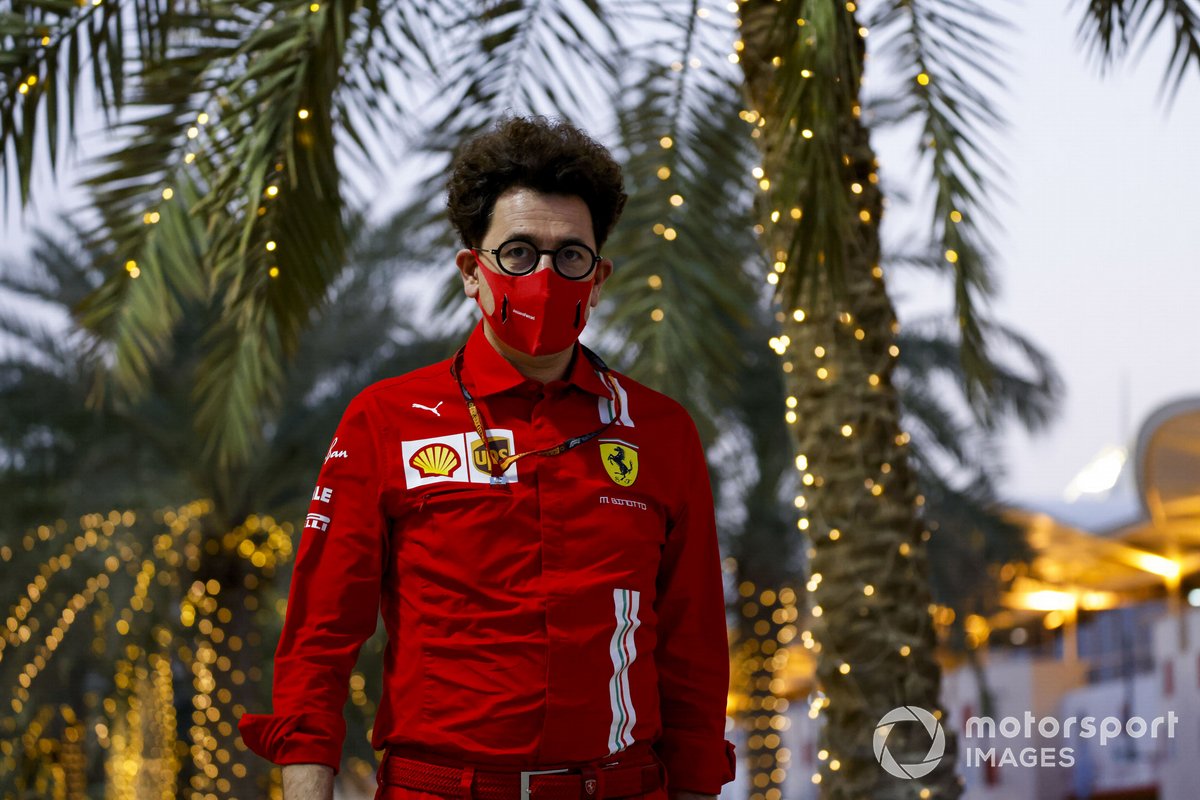
Mattia Binotto, Team Principal Ferrari in the paddock
Photo by: Glenn Dunbar / Motorsport Images
By the time Sainz makes his Ferrari debut in Bahrain, 10 months will have passed since it was announced that he would be joining the team. The exit of Vettel puts an end to any awkwardness or lingering frustration after seeing Leclerc become the new darling of the tifosi, and helps inject some fresh life into the team as Sainz finally gets his long-awaited chance with a true F1 powerhouse.
Sainz spent the winter getting up to speed with Ferrari, completing tests in its 2018 and 2019 cars to help understand the team’s processes and to get to know his new race crew. Although Binotto thought it would take time for the Spaniard to get fully integrated at the team, he’s impressed with how he has assimilated through testing.
“Carlos is fitting very well, not only at the track but outside of the track,” says Binotto. “He’s very well integrated, I have to say, also with Charles. It’s very encouraging, so I’m very happy.”
"If I look at the data, I think at least on the speed, on the straight, the speed is all right. There does not seem to be such a disadvantage as it was last year" Mattia Binotto
Sainz always craved stability through the early days of his F1 career with Toro Rosso and Renault, and really flourished when he found it at McLaren on a multi-year deal. He’s already feeling at home at Ferrari, getting a feeling he hopes can bring out the best in him on track.
“The first couple of months have been very good,” he says. “I’ve found the stability. The team has welcomed me in a really nice manner, and I’m feeling really comfortable.”
In the months that followed Ferrari’s announcement, Sainz faced a barrage of questions over whether he regretted his decision in light of the team’s struggles. He told Autosport late last year that he found such suggestions “annoying”, and hailed his confidence that if any team is capable of turning things around, it’s Ferrari.

Charles Leclerc, Ferrari, Carlos Sainz Jr., Ferrari
Photo by: Ferrari
The freeze in the technical regulations for 2021 makes it hugely challenging to turn things around short-term, yet the Ferrari SF21 offers a number of steps forward on last year. The biggest weakness last year was Ferrari’s power unit, which was significantly down on performance following the controversial private settlement with the FIA over its 2019 engine.
Ferrari said it took a “systematic” approach to improving its power unit, and was encouraged by the initial findings when running the engine on the dyno at Maranello ahead of pre-season testing. Once the cars hit the track, its encouragement was justified, with Binotto believing the team has lost its great weak spot from last year.
“When we were here last year in Bahrain for the race, in quali, we were very slow on the straights,” explains Binotto. “We didn’t enter into Q3, and we were very distant from pole. Now if I look at the data, I think at least on the speed, on the straight, the speed is all right. There does not seem to be such a disadvantage as it was last year. We know it’s not only power – it’s the drag of the car as well, as we often said last year. But let me say that [fixing] both contributed in improving our speed on the straights. Today we feel it is not a disadvantage anymore.”
PLUS: How Ferrari plans to recover from its 2020 F1 nightmare
Both Leclerc and Kimi Raikkonen of Ferrari customer Alfa Romeo also noted the power unit improvements, while the numbers supported the growing confidence: on day one of testing alone in Bahrain, Leclerc went 3km/h (1.9mph) faster in the speed trap than he managed in qualifying last year.
Leclerc’s enthusiasm extended to much of the SF21 itself, where a great deal of focus has been placed on the rear end of the car through a token spend for development. Head of chassis Enrico Cardile says Ferrari wanted to make a “radical change” at the rear of the car in a bid to cure much of the instability that blighted its drivers last year.
“At the rear we created a new transmission and suspension,” explains Cardile. “This, along with the work done by our power unit engineers, gave us a much more tapered rear end compared to the SF1000.
“Aerodynamics was one of the areas impacted by the changed regulations, intended to reduce the capacity of developing vertical downforce, making sure the tyres remain intact. This is why, when we started working on the car’s aerodynamics, we gave ourselves two objectives: increasing the aerodynamic charge lost due to the regulations; and reducing drag.”

Charles Leclerc, Ferrari SF21
Photo by: Charles Coates / Motorsport Images
The reduction in drag combined with the improved power unit has cured the SF1000’s major weaknesses. Leclerc was left pleased with the step forward, explaining that it matched up with the expectations the team had coming into the season: “The data that we have seen on-track is correlating with what we had back in Maranello before these tests, so this is already positive. But to give a feedback or a feeling on the car now in those [hot] conditions is very, very difficult.”
‘Correlation’ has been a big buzzword throughout pre-season for Ferrari as it seeks to fully understand where it went wrong with the SF1000. The fact that the team is happy with its initial findings is good news at least in-house, but is no guarantee that it will be able to haul itself back even to the front of the midfield.
The crowded fight to be the best of the rest was something in which Ferrari played only a bit-part role last year, but it really must pull clear of this if it is to deem 2021 a resounding success. The carryover of the cars from last year naturally tempers expectations, yet with no limits on power unit development, and given the facilities at its disposal even in the first year of the budget cap, it is surely best placed to make a big stride forward this year.
"It’s very difficult when you are not performing as you’re expecting. As Scuderia Ferrari, the ambition and objective is for the maximum, to be the best" Mattia Binotto
But the three days in Bahrain didn’t offer a super-convincing testing display to generate great excitement or fervour around Ferrari. The impressive showings from McLaren and AlphaTauri in particular through testing meant that they were gaining the spotlight in relation to the midfield fight as the chequered flag fell. Ferrari may have progressed, but its rivals were hardly standing still.
Nevertheless, the green shoots of recovery at Maranello are encouraging. The team has made clear that its view is long-term, meaning the SF21 won’t be developed a great deal as it puts attention firmly on the new regulations for 2022. Last year may have been sobering, but it has also bred a certain degree of humility and unity.
“It’s very difficult when you are not performing as you’re expecting,” adds Binotto. “As Scuderia Ferrari, the ambition and objective is for the maximum, to be the best. But the team remains united. It continues to improve. We are now at the start of a new season. You’ve got different cars, so you’ve got new hope. It’s normal that the atmosphere is better.”
The hope will be that 2021 offers some kind of step forward, but every member of the team at Ferrari will be aware that, barring a freak race or shock result, it is likely to face another winless season. This year is about recovery. By accepting that, and by getting new thrills out of the close midfield tussle, Ferrari can still make 2021 a fruitful year, before the real chance to become a major force arrives again.

Carlos Sainz Jr., Charles Leclerc, Ferrari
Photo by: Evgeniy Safronov
How will Sainz and Leclerc fare as team-mates?
When Charles Leclerc ascended to a Ferrari seat for what was only his second Formula 1 season, the team seemed to underestimate how rapid he would be from the word go.
An expectation that Sebastian Vettel would remain its leader and act as more of a mentor to his new young team-mate was quickly dispelled. Leclerc almost won his second race with the team, and then outclassed his four-time world champion colleague across the course of their first season together.
As frustration between the drivers bubbled and occasionally boiled over on track, Ferrari began to gravitate around Leclerc. It paved the way for a new long-term contract and, ultimately, Vettel’s departure. Leclerc became the future.
The arrival of Carlos Sainz Jr therefore raises questions about what role he will play within the team. Is he going to be allowed to push Leclerc in the same way Leclerc did Vettel? Or is his role more as an abiding number two intended to support Maranello’s new star?
Team principal Mattia Binotto is clear that the drivers will be given equal treatment: “There is not a single individual that counts more than the team itself. Something that we discussed all together, to become world champions, first we need to beat all the other cars and the other drivers. Only by the time that eventually we have the fastest car and we have the fastest drivers may they fight between them.”

Carlos Sainz Jr., McLaren, and Charles Leclerc, Ferrari, on the grid
Photo by: Mark Sutton / Motorsport Images
It’s a situation that suits Leclerc. “I am here in F1 to fight against the best, and I think Carlos is extremely talented,” he says. “We’ll just push each other to perform better every time we are on track. There’s no clear number one or number two.”
A repeat of Sainz’s ‘bromance’ with Lando Norris at McLaren might be hard to expect, but the early working relationship has been good.
“He’s a great guy,” adds Leclerc. “I’ve never spent as much time as I did with him before the start to the season with other team-mates. So yeah, we are getting on very, very well.”
It’s a further sign of the changing atmosphere at Maranello. Greater harmony between team-mates should help Ferrari’s on-track fortunes, but the more telling sign of how good relations are will come in how the inevitable frustrations are handled during the heat of the season.

Charles Leclerc, Ferrari SF21
Photo by: Mark Sutton / Motorsport Images


1998 Belgian GP: When the Schumachers went to war

F1 Monaco GP 1982 retrospective: Remembering F1's craziest finish

Has Alonso made the right choice gambling on Aston Martin F1?

Hamilton in the process of selecting Brad Pitt’s co-star for F1 movie

How ‘demanding’ Alonso has started life with Aston Martin

Ocon got "very sick" in F1 off-season due to bad lung virus

Brown: No reason not to expand F1 grid if new teams pay "fair" fee

Hamilton: Nothing will stop me speaking up on important issues in F1

Red Bull no longer falls away on difficult days: What Austin qualifying reveals about its progress

Verstappen responds to COTA boss and proposes drastic measures to tackle bumps

Supercars Gold Coast: Feeney converts Race 2 pole to win after Saturday defeat

MotoGP's final Australian GP at Phillip Island cancelled due to poor weather
Subscribe and access Autosport.com with your ad-blocker.
From Formula 1 to MotoGP we report straight from the paddock because we love our sport, just like you. In order to keep delivering our expert journalism, our website uses advertising. Still, we want to give you the opportunity to enjoy an ad-free and tracker-free website and to continue using your adblocker.


Top Comments