


How F1 teams tackled 2021's unique development war
The pandemic-induced delay of F1’s design reset until 2022 meant teams had to run tweaked versions of their 2020 cars, restricted by a token system for updates. Here's how the teams responded to the challenge of developing their carryover machines, in the knowledge any improvements faced a limited shelf-life
The immediate impact of the COVID-19 pandemic affected the 2020 Formula 1 calendar, necessitating circuits to double up on races to get in a full 17-round season within the space of six months. And its effects lingered into 2021; the calendar was largely back to normal, but the mandatory shutdowns for F1 teams to simply survive the March to June 2020 lockdown prompted the delay of the expected ground-effect regulations to 2022.
Instead, teams were effectively railroaded into producing a field of B-spec cars that were heavily restricted in their development from 2020’s machinery. The FIA introduced a token system, with teams handed two tokens to spend on updating their cars for the new season. Although aerodynamic parts were largely unrestricted, larger areas – such as crash structures, geometry changes and the like – were each given a token value to stop teams throwing money they couldn’t afford to spend on big-ticket items.
In the meantime, F1 introduced a change to the floor design to reduce the overall downforce, cutting a triangular section out of the floor ahead of the rear wheels while simultaneously reducing the size of the diffuser. This was in a bid to peg back the loads faced by the Pirelli tyres, which effectively retained the same construction as in 2019 and were therefore not designed to cope with the ever-increasing downforce outputs. Pirelli eventually beefed up the internals to curb delaminations under load, but the floor changes remained in place, and arguably contributed to one of the best title battles in years.
There were plenty of key plot points in this year’s tech war too, even though a number of teams signed off 2021 early and planted their focus into getting the switch to 2022’s all-new formula right. Let’s look at how each team developed over the course of the year.
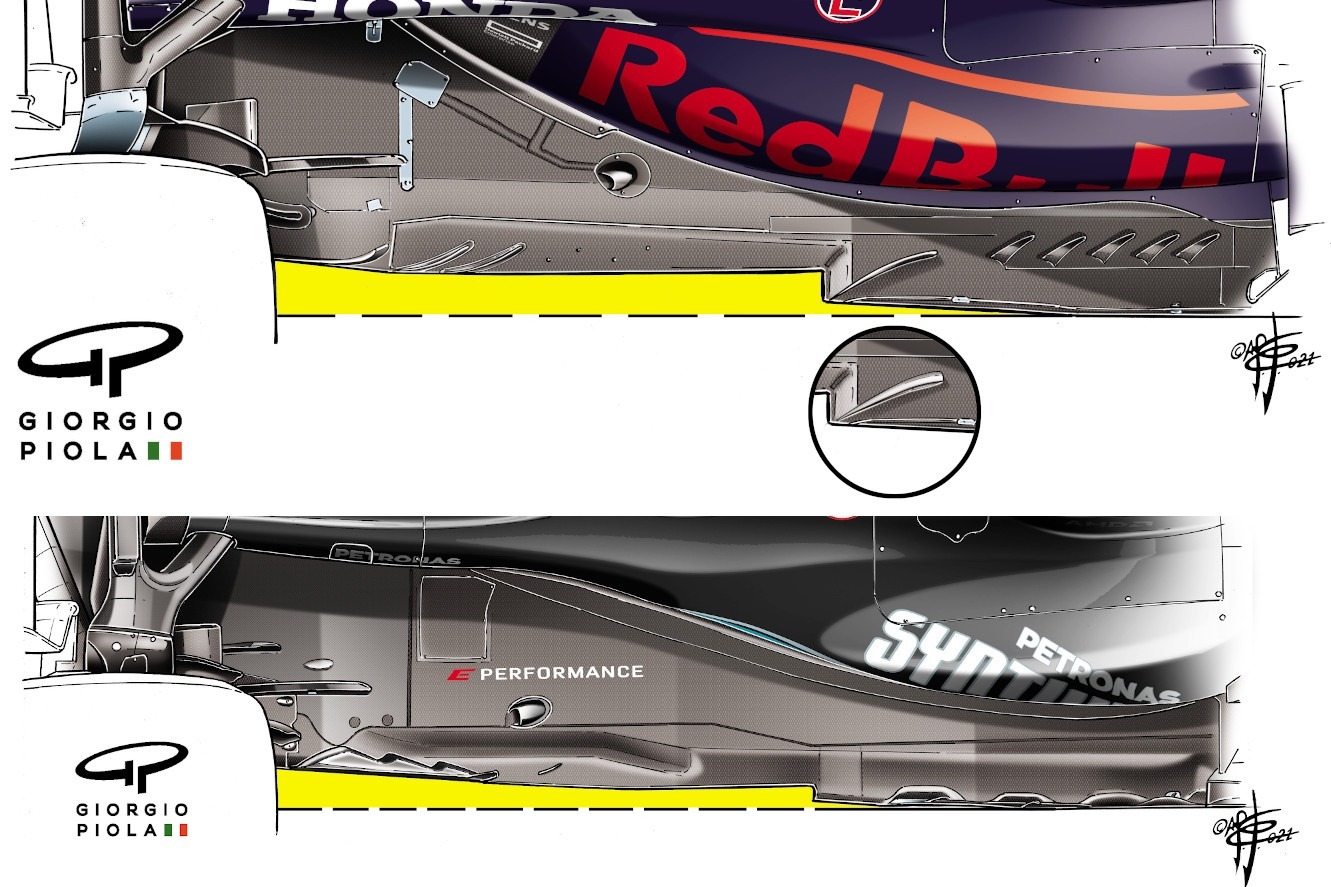
Both Red Bull and Mercedes had converged on a Z-shaped floor by the end of testing
Photo by: Giorgio Piola
Mercedes vs Red Bull - A title battle for the ages
Perhaps the most compelling storyline at the beginning of 2021 concerned the floor changes and how they affected each team. Mercedes, famed for its low-rake design ethos, looked to have ended up in a precarious position as Red Bull, running the most extreme high-rake concept, suddenly cemented its place as a title contender after years on the periphery. Lewis Hamilton, for the first time in a few seasons, was going to have outside competition, as Mercedes bravely elected to spend none of its allotted tokens on updating last year’s W11 into 2021’s W12 contender.
Although Mercedes and Red Bull both began testing with a floor that perhaps the rules had intended, with a simple diagonal cut from its edge to the part in front of the rear wheel, it was clear that limiting the deficit intended by those cuts would be both teams’ early-season focus. Red Bull had less to find, as the higher positioning of the rear end naturally creates more downforce at the expense of more drag, while Mercedes had to rebuild the protection it had lost over the underbody flow.
Red Bull upped the ante for May’s Portuguese GP weekend, with upgrades focused on extracting more performance from the diffuser, floor and bargeboards to ladle in a few extra points of downforce
Mercedes and Red Bull decided not to show off their floors at their respective launches, avoiding the chance of giving their rivals something to put in the windtunnel before the opening race. But by the end of testing, the two teams ended up with a ‘Z-shaped’ floor (pictured above).
It sounds counterproductive to cut more of the floor off than needed, but the exposed corner appeared to generate a stronger vortex that could be employed as a prophylactic measure to keep the underbody flow protected. This also gave the two teams opportunities to mount fins on top of it to help drive airflow outwards, and the floor space directly in front of the rear tyre also offered an opportunity to do that.
As the two teams with the most resource, Mercedes and Red Bull continued to hone their floors. Red Bull reworked the Z-floor corner into a halfpipe design to improve the channelling of airflow in that area (below). But with an anticipated stop point for 2021 developments, with everyone keenly aware of the need to pin focus on 2022, Mercedes principal Toto Wolff announced that the team had ended its design of new parts for the current season. Tech chief James Allison added that only parts already in the pipeline would later appear on the car.
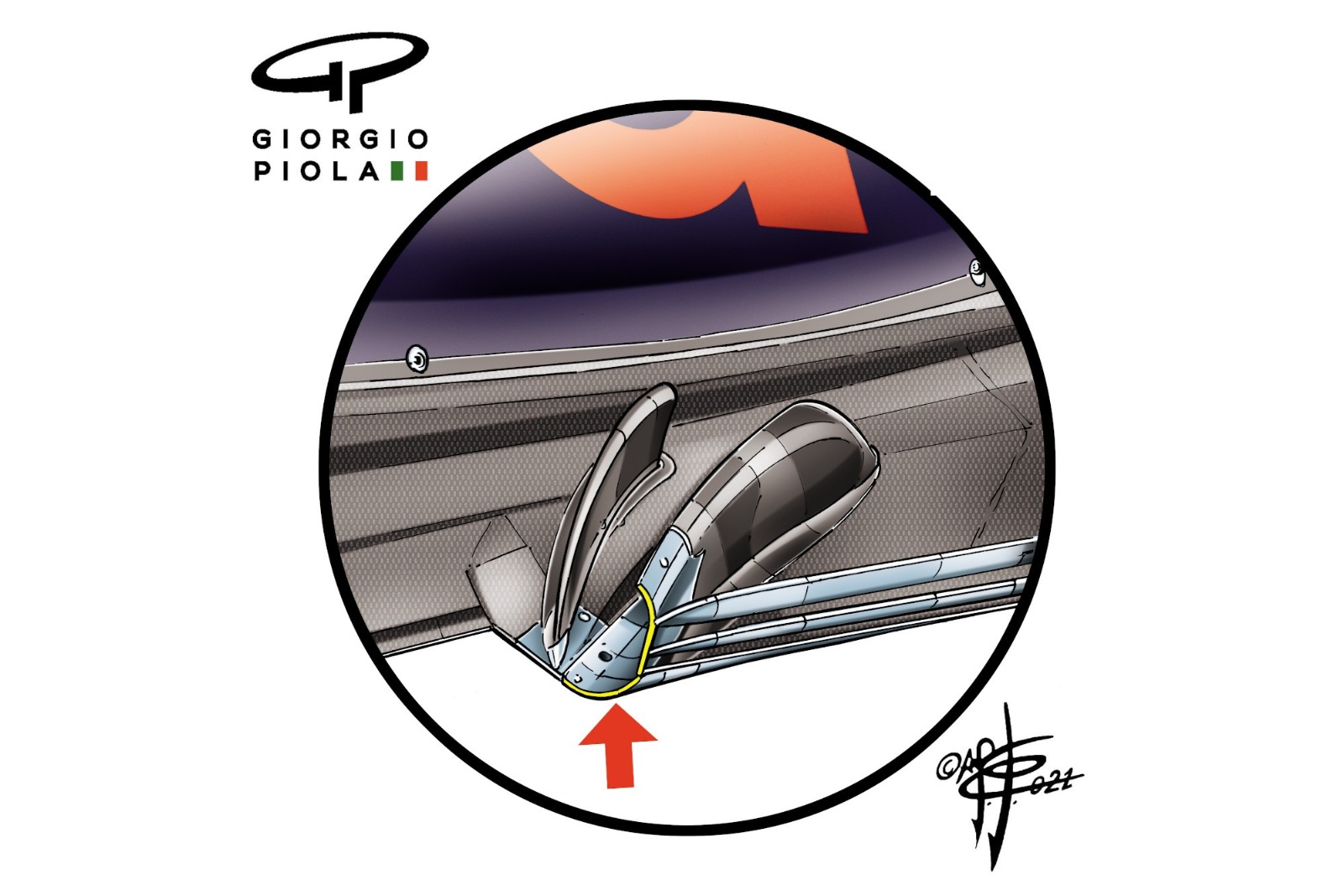
Red Bull developed half-pipe design to improve the channelling of airflow in the floor
Photo by: Giorgio Piola
This emerged at Silverstone when Mercedes introduced a new floor design for July’s British Grand Prix that omitted the wave-shaped ridge to the part of the floor parallel to the sidepods. Instead, the design was more in line with its rivals within the field as the floor developments began to converge.
It also reworked the bargeboards, splitting the vertical and horizontal parts of the loop around the sidepod inlet, and extending that vertical part to the floor. Those changes seemed to be affecting the mid-corner downforce of the Mercedes, an area where it lacked compared to Red Bull in the opening half of the season.
Meanwhile Red Bull was, ahem, bullish with its own developments throughout the year, especially in the early season. It upped the ante for May’s Portuguese GP weekend to keep pace with Mercedes in the championship battle. These focused on extracting more performance from the diffuser, floor and bargeboards to ladle in a few extra points of downforce and give Verstappen some more ammunition.
The side of the car looked increasingly like a set of Venetian blinds, as Red Bull’s aerodynamicists saw fit to increase the quantity of the horizontal components attached to the sidepod-mounted collection of aero devices. This was to pick up the airflow from the bargeboards and offer the car a little extra downforce, while also assisting with the two vertical elements sandwiching them to clean up the airflow directed at the sidepods.
But the most intriguing undercurrent of the Mercedes and Red Bull tech war was arguably fought in the stewards’ room, particularly within their respective rear-wing designs. To counteract the drag of running with a larger rear-wing geometry, Red Bull delved into a time-tested method of clawing back extra speed on the straights by adding the ability for the wing to flex.
Every now and again, F1 teams find new ways to ensure their wings can flex to dump a bit of drag – at least, until another team picks up on it and either grasses them up to the FIA, or lets the cat out of the bag in a more public arena. Following qualifying at May’s Spanish GP, Hamilton drew attention to Red Bull’s “bendy wing” after spotting it tilt backwards along the straight, and thus the can of worms was opened.
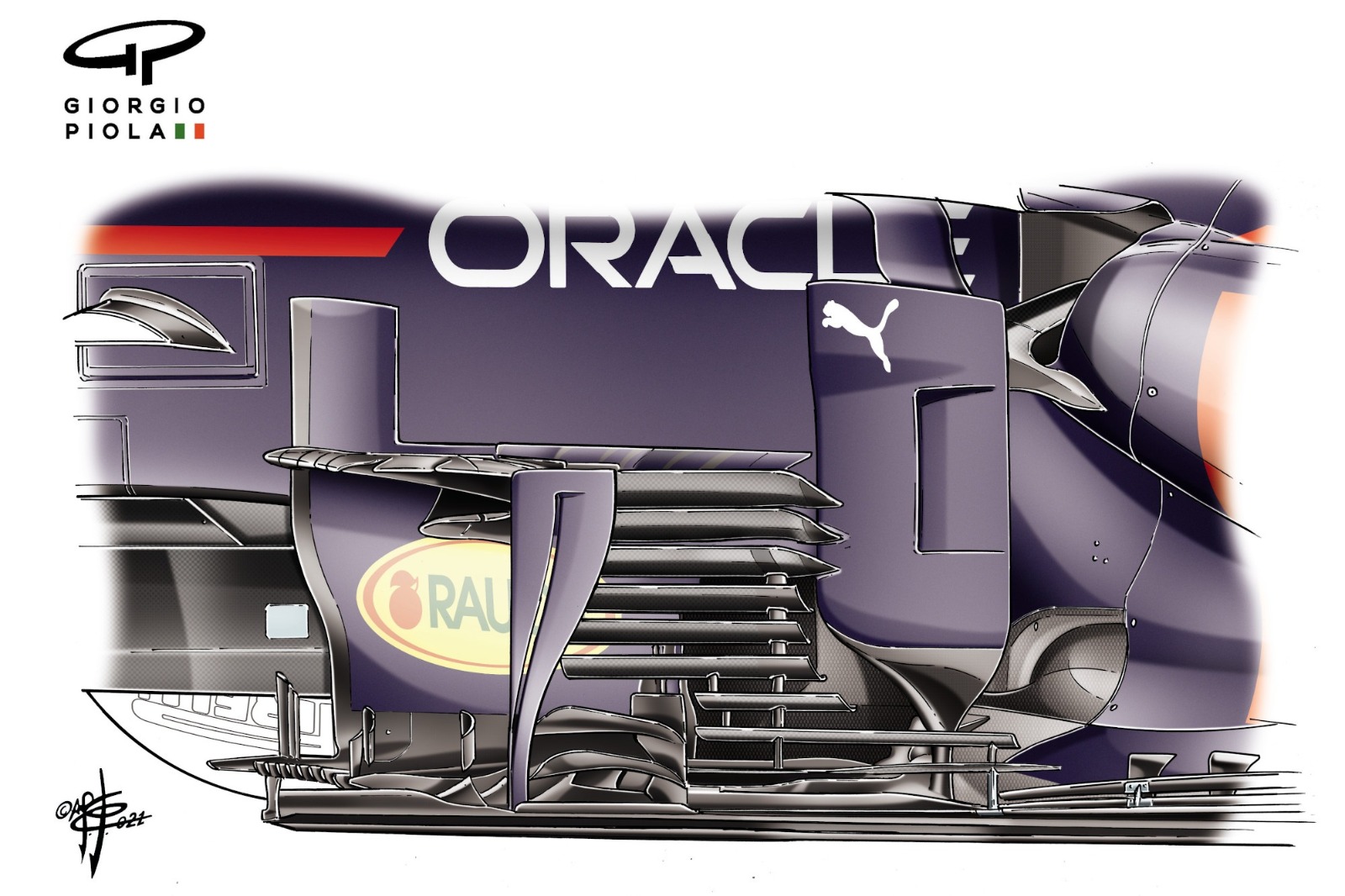
Red Bull's bargeboards resembled Venetian blinds with an ever-increasing array of horizontal components designed to improve downforce and airflow
Photo by: Giorgio Piola
Ferrari and Alfa Romeo also admitted to introducing aeroelasticity into their rear wings, leading the FIA to strengthen its flex tests to stamp it out ahead of the French GP in June. Mercedes, naturally, wanted the revised tests to be available as early as the race before in Baku, if only to stop Red Bull from gaining a further advantage on the long straight…
Red Bull considered the matter closed thereafter, having initially declared itself ready to protest Mercedes’ design, but where the truth lies is unclear
Despite those improved tests, flexi-wing controversy again reared its head at the Sao Paulo GP, where Red Bull alleged that Mercedes was indulging in the practice. Max Verstappen, caught playing with the Mercedes rear wing in parc ferme in Brazil, was fined €50,000 for fondling a rival’s car, as Red Bull boss Christian Horner pointed to “score marks” on the Mercedes endplate that denoted a trailing edge that shifted back to reduce the drag on the straights. Mercedes denied the allegations, although the FIA introduced a further check as a “fact-finding mission” to determine whether the Brackley squad was bending the rules.
Red Bull considered the matter closed thereafter, having initially declared itself ready to protest Mercedes’ design, but where the truth lies is unclear. In the context of the season, it was yet another example of off-track toxicity tarnishing the title fight on the road, and even the technical battle could not remain uncorrupted.
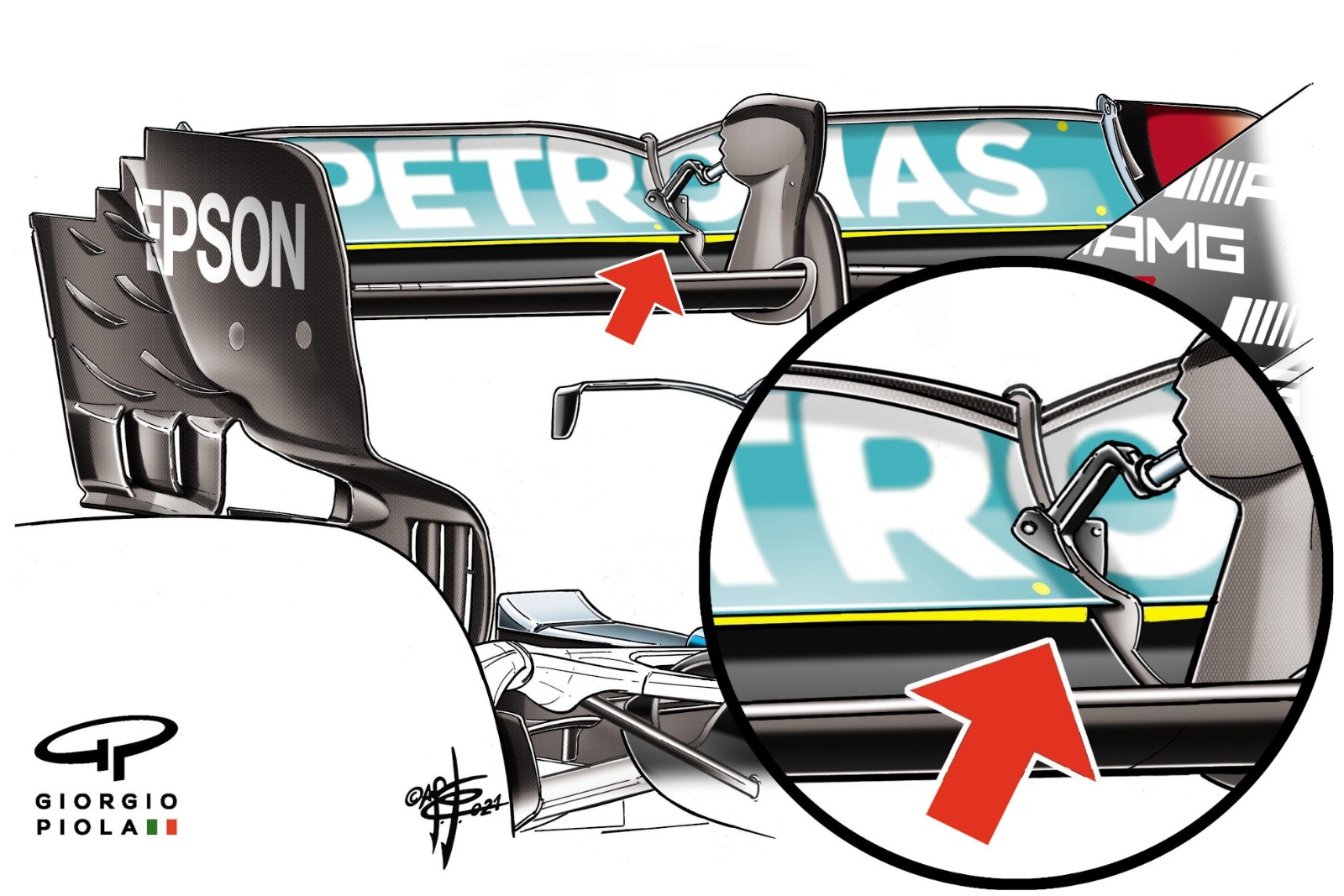
Red Bull alleged marks on Mercedes’ wing were sign of shifting trailing edge
Photo by: Giorgio Piola
Ferrari vs McLaren - Close encounters of the third kind
Two of the teams somewhat restricted by the token requirements, for very different reasons, spent the year embroiled in an excellent scrap over third place in the constructors’ championship. McLaren, the incumbent ‘best-of-the-rest’ squad, had to enact a switch to the Mercedes power unit after bringing its Renault deal to an end, which required a redesign to its chassis to accept the new fixtures and fittings from the German manufacturer.
Ferrari, meanwhile, sunk its tokens into a new gearbox and suspension as it sought to overcome a miserable 2020 season. The fallout from the controversial powertrain arrangement it ran in 2019, during which it was alleged that the Italian team was circumventing the regulations on fuel-flow restrictions, meant that it was stuck with a higher-drag car for 2020 that had been designed to heap more downforce into a powerful package. With a neutered engine, Ferrari had to deal with the worst of both worlds.
Although it spent no tokens on changing the nose’s crash structure, Ferrari did give its SF21 a facelift with a new front end to open up the transit of air to the underside. It also experimented with different floor options at the start of the year, using a number of teeth at the corner ahead of the front tyre and alongside the top of the diffuser to recapture the downforce lost to the off-season regulatory changes.
Ferrari made the switch to the Z-floor quite early, tested it during practice on one car at Imola in April, and had floors for both Charles Leclerc and Carlos Sainz Jr ready for the Portuguese GP as it sought to take on McLaren, which had staked its claim for third in the standings early on thanks to Lando Norris’s impressive form. Ferrari’s switch to the Z-floor design gave the team the option to work the airflow earlier, sealing the floor with the additional exposed corner of the new design.
Like the other Z-floors on the grid, it also featured a fin along the top, helping to strengthen and direct the position of the vortex produced. Ferrari later added to the collection of teeth at the rear corner of the floor, reducing their chord length to squeeze more in and strengthen their placement of airflow around the rear wheel.
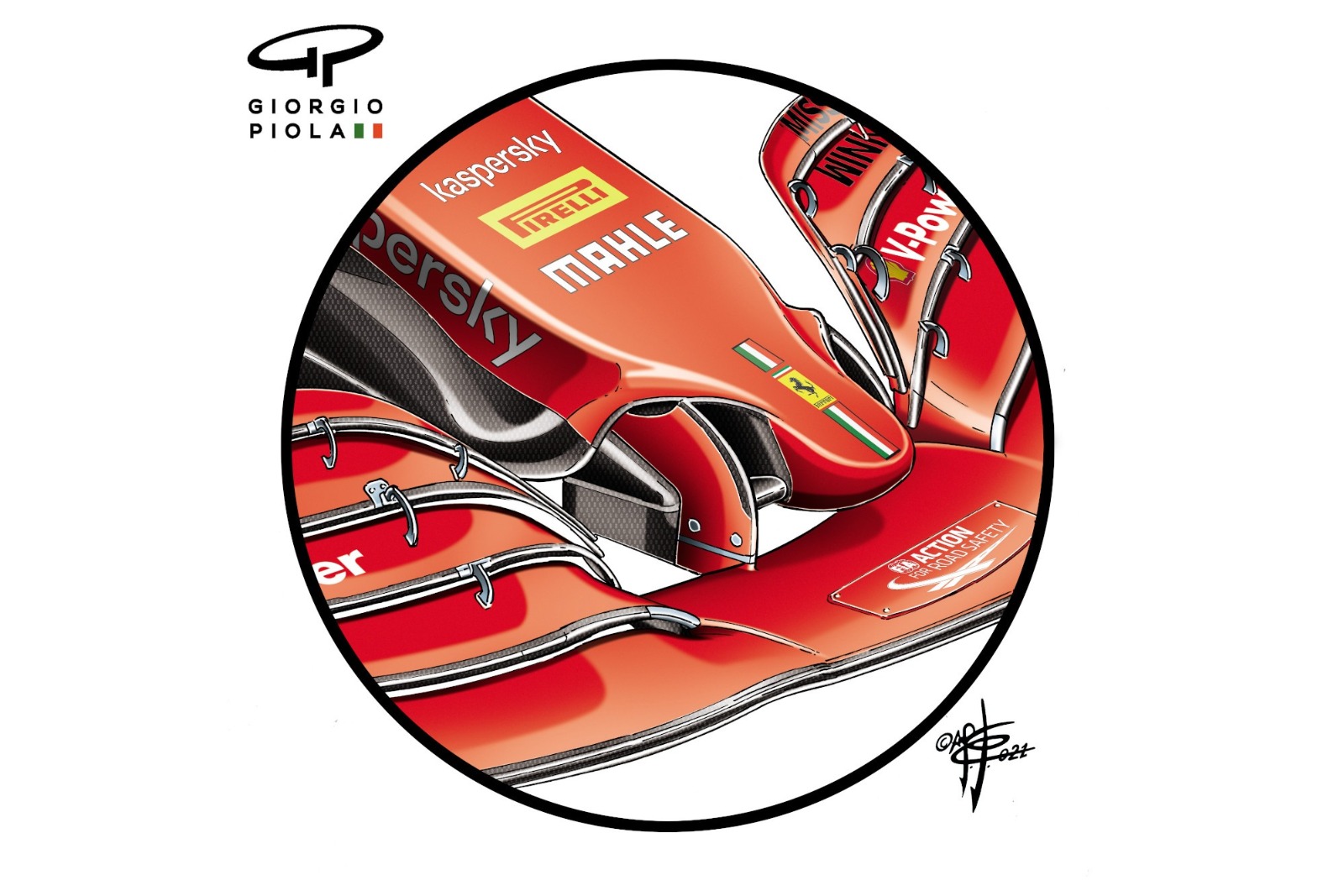
Among the noteworthy changes made by Ferrari to its carryover car was a revamped nose section
Photo by: Giorgio Piola
McLaren, meanwhile, had found a workaround to the 2021 diffuser restrictions at the start of the year. The FIA had made the decision to trim the fences within the diffuser by 50mm to reduce its overall effectiveness, pairing that with the floor-size reduction to inhibit downforce. McLaren thus embedded the fences in the central part of the diffuser (pictured below), dropping below the 50mm cut-off to find extra performance. Curiously, it remained an innovation that few copied.
McLaren introduced a new set of bargeboards for August’s Hungarian GP, with the positioning of the main boomerang element revised for the new development
The team developed its own Z-floor to join its rivals, although many of its mid-season updates focused on working with the bargeboard package to cover off a hole in its performance. Although strong at the slow-speed and high-speed circuits, as evinced by its Monaco podium and Monza 1-2, McLaren endured greater variability at circuits with long medium-speed corners.
It introduced a new set of bargeboards for August’s Hungarian GP, with the positioning of the main boomerang element revised for the new development. The leading edge was moved lower and further forward to pick up airflow from the front sooner to play with the elements further downstream.
Heading into the summer break, Ferrari and McLaren were level on 163 points but, despite McLaren’s bright start on the return to action, Ferrari’s greater consistency overturned the initial gap – rewarding it with a return to the top three.
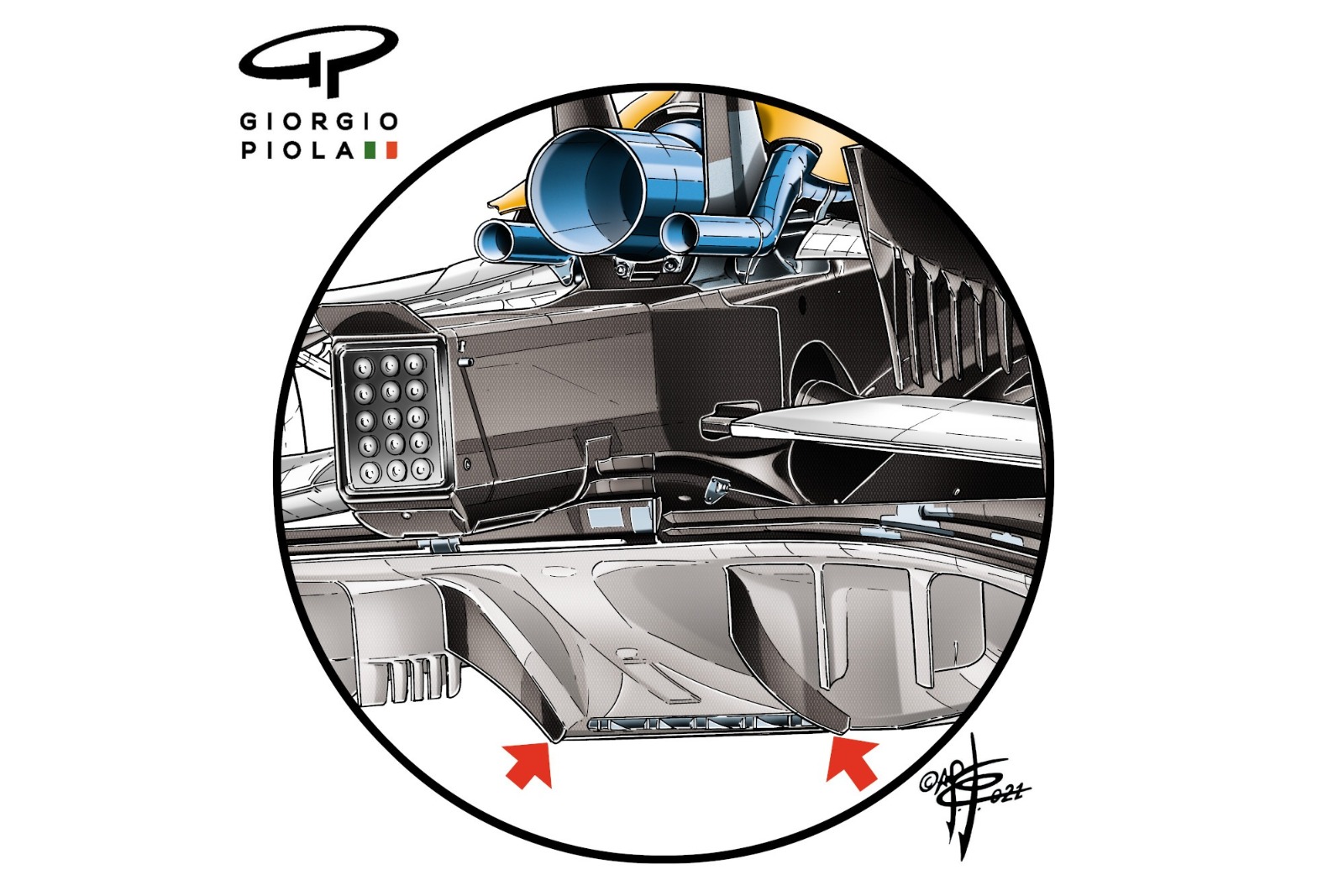
McLaren's diffuser innovation wasn't extensively copied by other teams
Photo by: Giorgio Piola
Alpine and AlphaTauri
‘Team Enstone’ was furnished with another new identity, the Renault Group electing to remove its own name from above the factory doors and transpose it with that of Alpine. Now enrobed in a blue, white and red livery to accentuate the Frenchness of the team, the first appearance of the A521 F1 car drew immediate comparisons with that of another French icon – namely, the 1976 Ligier JS5.
The Alpine was nowhere near as lumbering as the bulbous Ligier, but their respective air intakes were notably larger than their counterparts on the grid. Alpine elected to shrink the sidepods and use more of the overhead intake for cooling, aiding the flow of air towards the back of the car to maximise the use of the restricted floor size.
Although Alpine secured victory in the Hungarian GP, courtesy of Esteban Ocon’s excellent defence from Sebastian Vettel, the team was dogged by consistency issues, but had just enough in hand to bat away AlphaTauri as the Italian team tried to secure its highest constructors’ placing in F1 in any of its guises.
AlphaTauri elected to spend its 2021 tokens on a redesign for its nose, doing away with the thumb-tip crash structure for something altogether more elegant. It was also able to update some of its internals, namely suspension and steering geometry, to Red Bull’s 2020 designs without using up any tokens, giving it a proven set of components to work with in its own package. It was also one of the first teams to unveil a Z-floor at its launch, instead choosing to hide the nose in its launch renders.
Although the AT02 proved potent, especially in the hands of Pierre Gasly, who frequently battled with the Ferraris and McLarens, it could not repeat the heroics of 2020, when Gasly sensationally picked up victory at Monza. Despite bringing a tailor-made front wing to the Temple of Speed (pictured below), the team’s race lasted a mere five laps when Yuki Tsunoda failed to start with a brake issue and Gasly’s car suffered from a hangover after his sprint-race crash.
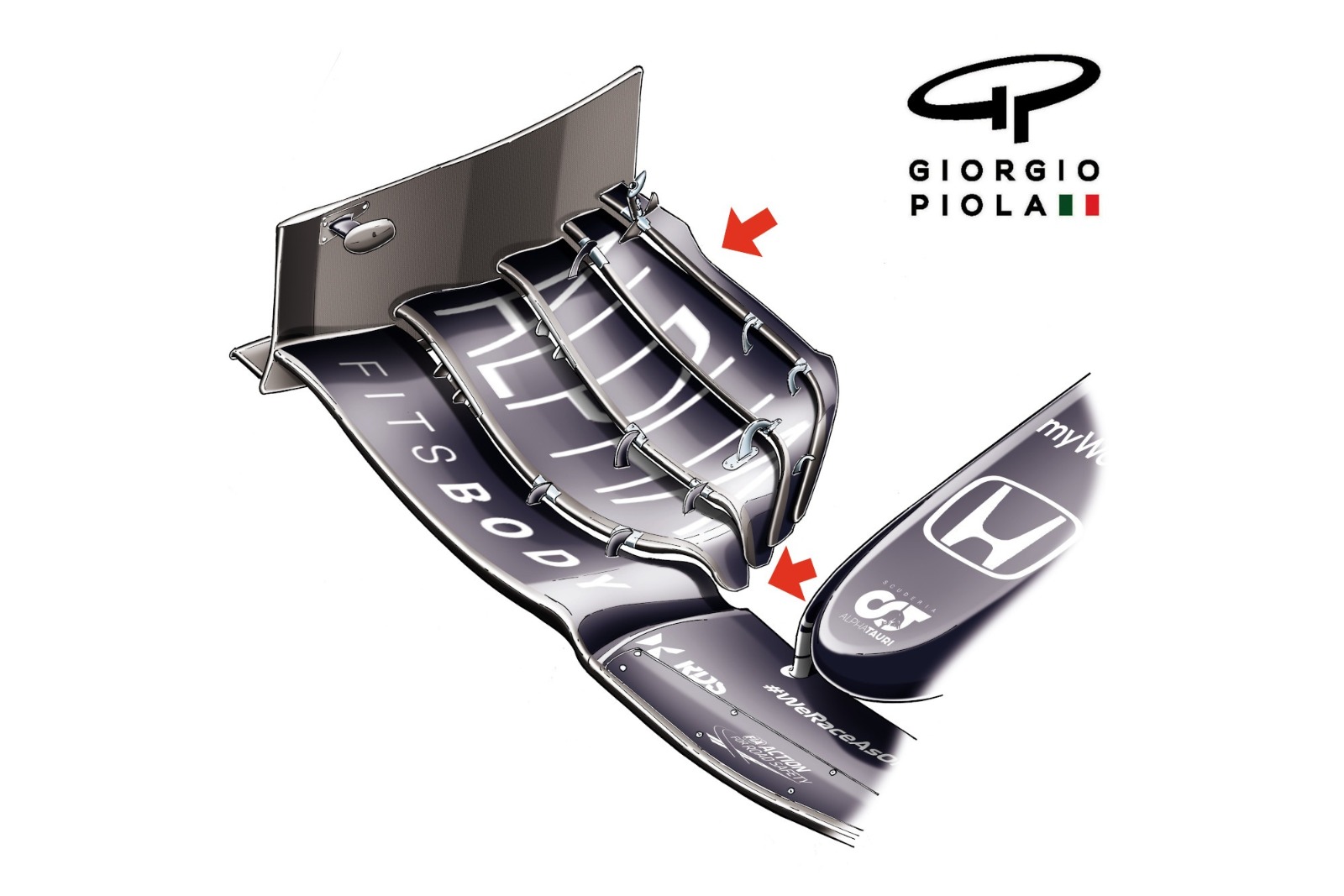
AlphaTauri brought a bespoke Monza wing to the Italian Grand Prix, but it didn't yield the hoped-for result
Photo by: Giorgio Piola
Aston Martin vanquished by early season disad-Vantage
After Racing Point controversially borrowed a number of key design cues from Mercedes for the 2020 season, it elected to switch to the low-rake inclination to fall in line with its technology partner. Retaining that concept for the AMR21, newly submerged in a British Racing Green livery following the team’s metamorphosis into Aston Martin, the Silverstone squad hoped to pick up from Sergio Perez’s late-season victory at the Sakhir outer loop and move further to the front in 2021.
But, like Mercedes, Aston had its wings clipped by the change in floor regulations, and initially resorted to a similar tactic of introducing a rippled floor [2] to try to control airflow earlier and find more downforce during the mid-corner when the car is in yaw. After a difficult start to the year, in which the team was struggling to find its way into the top 10, Aston asked the FIA to relax its limits on the token system so that the team could recover.
Aston then brought a new floor, with revised ripples along the edge to improve the diffusion of air and introduce more suction underneath
When that wasn’t granted, the team put pen to paper on a collection of new updates for round four at Barcelona. It changed the shape of its sidepods, which now featured a more distinct slope down to the floor to guide air more cleanly around the rear of the car. It then brought a new floor, with revised ripples along the edge to improve the diffusion of air and introduce more suction underneath. The team had also been introducing different fin arrangements on top of the floor to compensate for its off-season losses.
By the Austrian races in June/July, the team had also developed a new bargeboard package ahead of a final push to keep its car competitive, realigning the two boomerangs to mount to the bargeboard independently. These converged at the outer part before attaching to the outer elements, perhaps opting for greater flow control down the centre of the car.
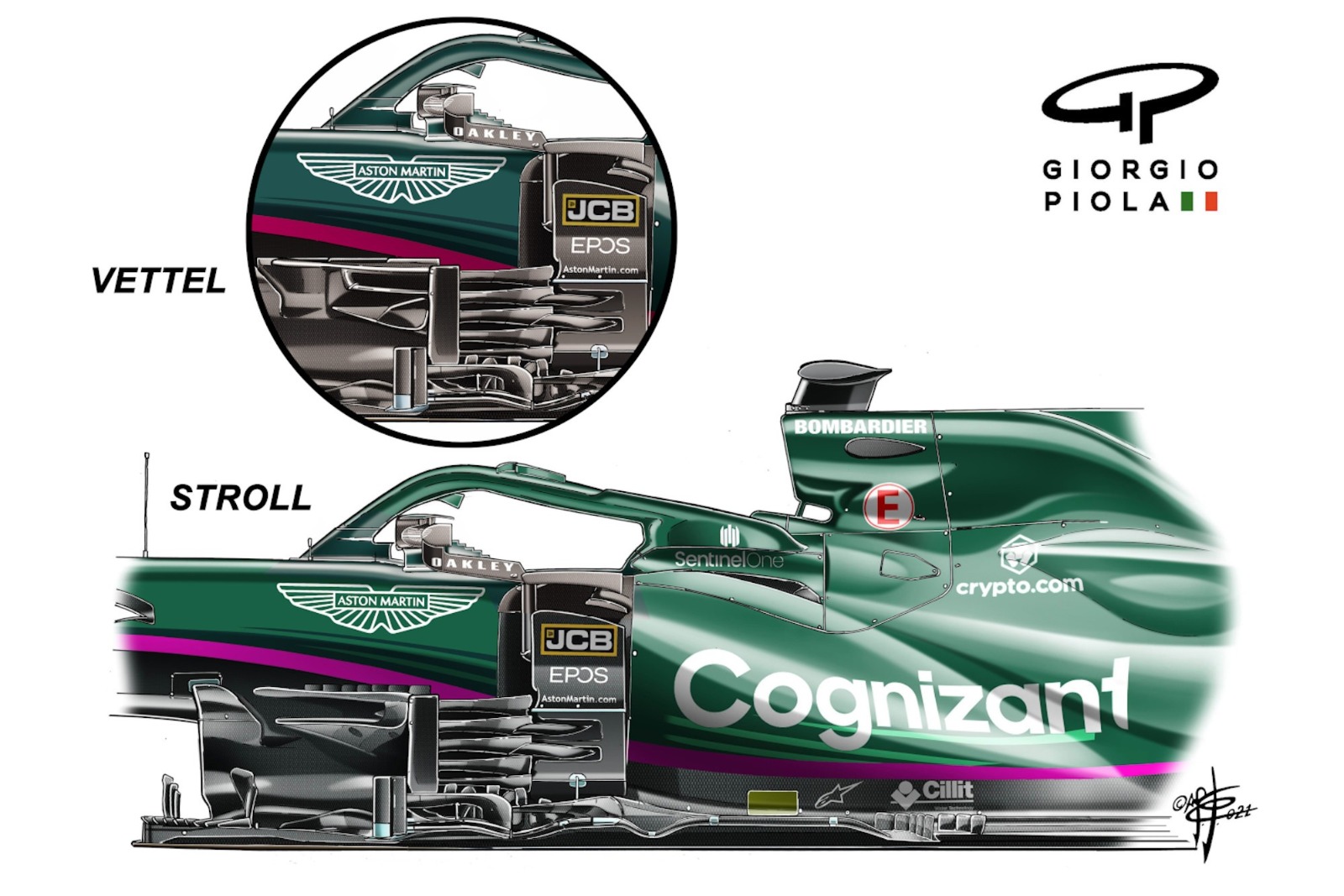
Aston introduced new bargeboard package for the Austrian double-header
Photo by: Giorgio Piola
Williams picks up the pieces of eighth
Locked into updating a car that scored zero points last season, Williams could be forgiven for knocking 2021 on the head and throwing its entire focus into next season. Instead, the team ended the season on an upward swing in form after giving the FW43 an overhaul and reaping the rewards.
Williams’s FW43B was much more effective at producing downforce compared to its predecessors, albeit at a price: the car was somewhat trickier to drive in high-wind conditions. The team picked up on the Z-floor craze for round two at Imola, around the same time as Ferrari. It employed a trio of small fins on the edge of the added corner to strengthen its defence of the underbody airflow, and used multiple smaller fins (pictured below) to allow the flow to be turned outwards without detaching within a shorter space of time.
But unlike the past two seasons, Williams was able to make the most of the bigger chances that came its way, bagging a double-points finish in Hungary for the first time since the 2018 Italian GP, and assuming a podium finish in the washout ‘race’ at Spa. After hitting rock bottom in the previous two seasons, the team’s new management will hope that 2021’s heroics will provide the impetus for a rebirth in fortunes.
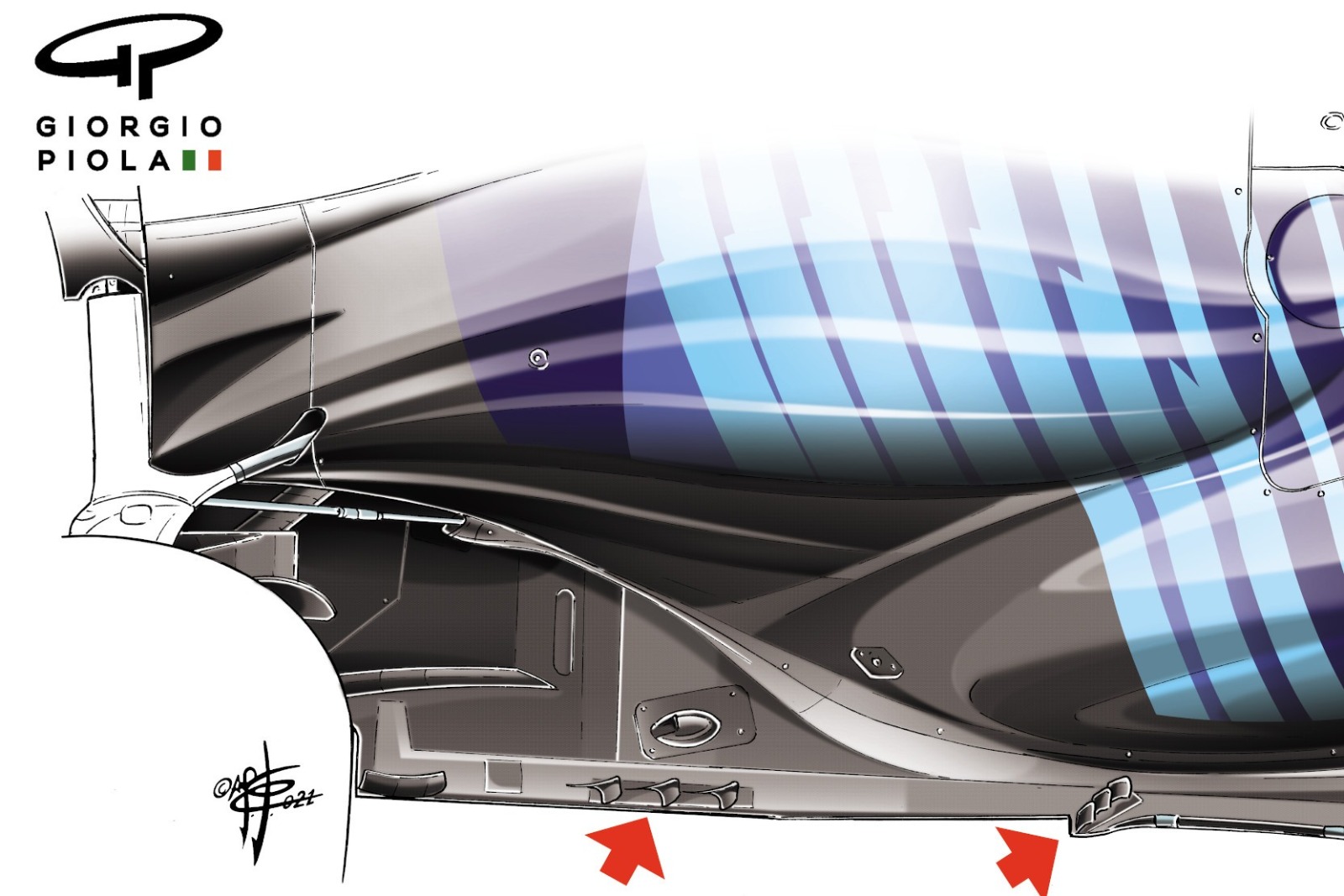
Williams also joined in the Z-floor craze at Imola
Photo by: Giorgio Piola
Wherefore art thou, Alfa Romeo?
Alfa Romeo effectively begins next season with a clean slate, especially as the past two seasons have been ones of toil, and the team switched its focus early to 2022, when it welcomes Valtteri Bottas and Guanyu Zhou into the fold.
One of Alfa’s early focuses was on the front wing, introducing a slotted endplate to strengthen its control over the vortices produced by the footplate, bleeding off any airflow passing over the top to be directed outboard.
Given the issues that the team faced with its 2020 car, Haas decided to merely update the VF-20 for the new floor rules and effectively leave the development there
The team also bought into the Z-floor trend at May’s Monaco GP, augmenting it with a quartet of fins further forward to exert more control over the airflow passing over the top of the floor [8]. Although Alfa managed to score more points than it managed in 2020, it dropped to ninth overall owing to the improved form of Williams in 2021, and thus will be hoping its early focus on the all-new aero regulations next year pays dividends.
Haas puts all its hopes on 2022
It’s been a difficult few seasons for the Haas team. The Anglo-American squad has been unable to resist the pull of the wooden spoon at the back of the field and, given the issues that the team faced with its 2020 car, it decided to merely update the VF-20 for the new floor rules and effectively leave the development there. The team spent none of its tokens, electing to throw all its eggs into the 2022 basket.
PLUS: The long-term F1 vision causing Haas’s short-term pain
The floor it produced for the 2021 regulations was heavily based on the prototype designs that the team ran in practice sessions towards the end of the previous year.
But the lack of downforce that the VF-21 had relative to the other cars tethered new driving line-up Mick Schumacher and Nikita Mazepin to the back of the grid, leaving the team to record a pointless season for the first time.
Autosport's in-depth 2021 Formula 1 season review supplement will be available on Thursday 23 December, free with our 124-page Christmas double issue
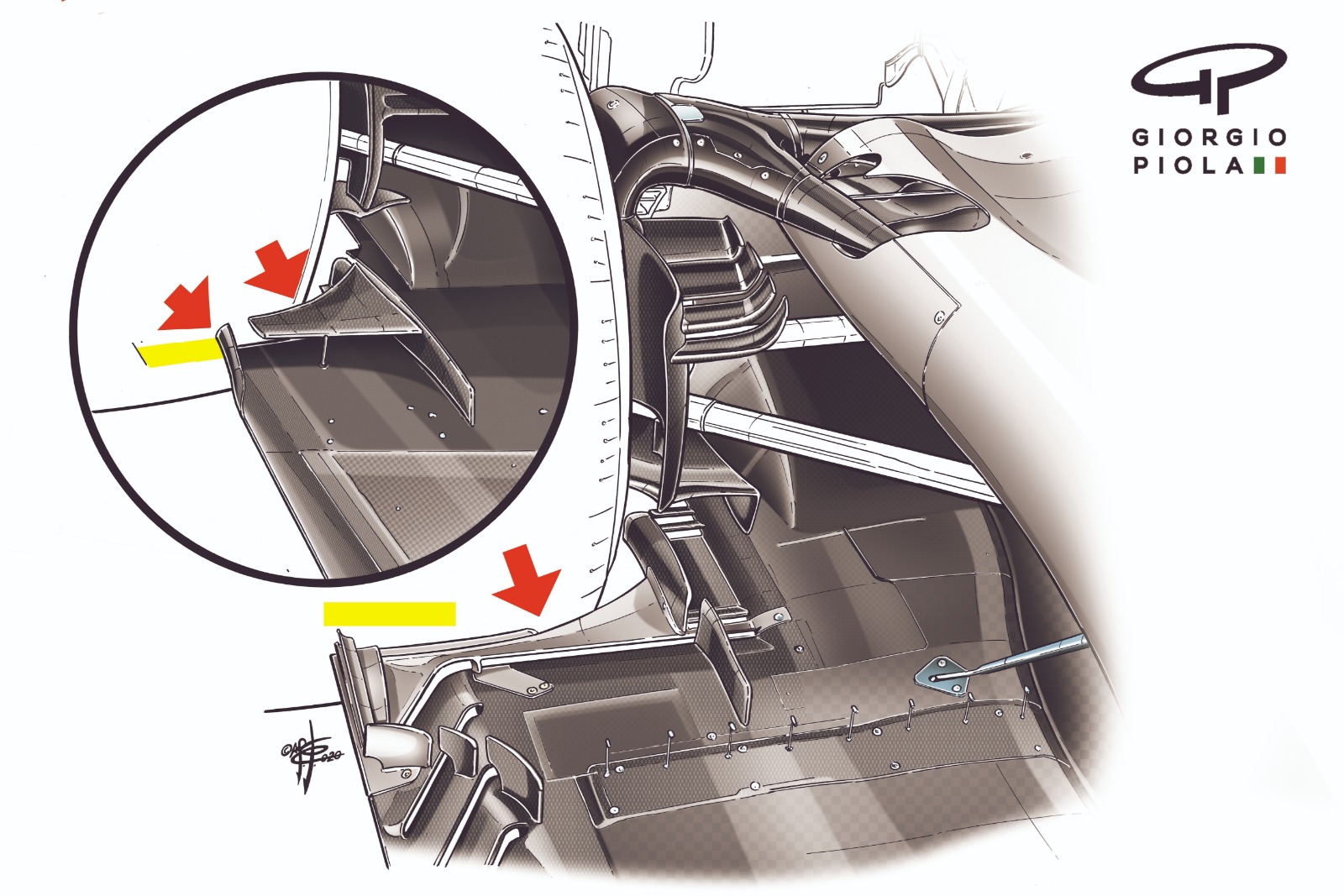
Haas didn't spend any of its allotted tokens, merely updating its floor to meet the new regulations
Photo by: Giorgio Piola


How to make F1's 2026 rules simpler - and why Horner was half-right

Are F1's technical changes for Miami enough to ease 2026 concerns?

The remnant of the V10 era in F1's previous switch to V8 engines

Is Pierre Gasly underrated?

How Ferrari must step up its efforts to end its long F1 championship wait

The biggest surprises and disappointments of F1's 2026 field so far

The pros and cons of F1's enforced break and cancelled races

How F1 teams are exploring 2026's bargeboard reforms

Top five roles on Motorsport Jobs this week

Relationship between F1 driver and race engineer more crucial than ever

Formula E launches innovative Gen4 car at Paul Ricard

How to make F1's 2026 rules simpler - and why Horner was half-right
Subscribe and access Autosport.com with your ad-blocker.
From Formula 1 to MotoGP we report straight from the paddock because we love our sport, just like you. In order to keep delivering our expert journalism, our website uses advertising. Still, we want to give you the opportunity to enjoy an ad-free and tracker-free website and to continue using your adblocker.


Top Comments