


McLaren's latest tech experiments with its troubled 2018 F1 car
McLaren arrived at the Austrian Grand Prix determined to evaluate several key areas of its MCL33 in its effort to unlock the full potential of its 2018 Formula 1 design

Progress for McLaren has been slow going this year, as the team has struggled to understand an issue that doesn't translate the performance it is seeing on its simulation data (via CFD and in the windtunnel) to what it is experiencing on track.
In recent races, this has led it to experiment with different aerodynamic configurations during free practice sessions as it tries to work out where it is missing performance.
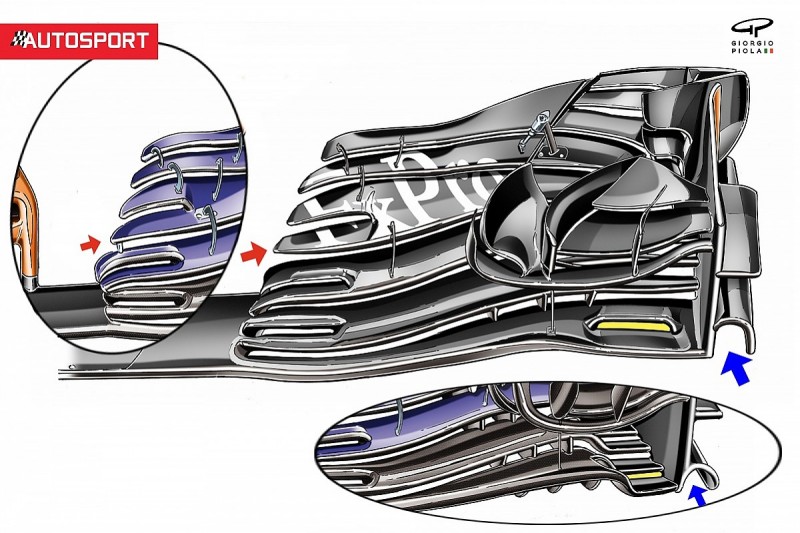
A prototype front wing was the centrepiece of its experiments in Austria, with numerous changes made in order to feel out exactly where their current weaknesses lie.
The wing had several key changes.
* The archway that ordinarily transitions steeply in the outer portion of the wing was reduced significantly, leaving just a gentle upturn on the wing's leading edge
* The strakes on the underside of the wing were retracted as they could no longer extend as far forward given the above
* A fully enclosed hole was used in the outer section of the wing to feed the underside, in lieu of the edge slot that has been usually favoured (highlighted in yellow)
* A taller footplate arc was present (blue arrow)
* The tip of the first flap had an upward curvature to it, rather than a downward one - altering the rotation of the Y250 vortex shed below (red arrow)
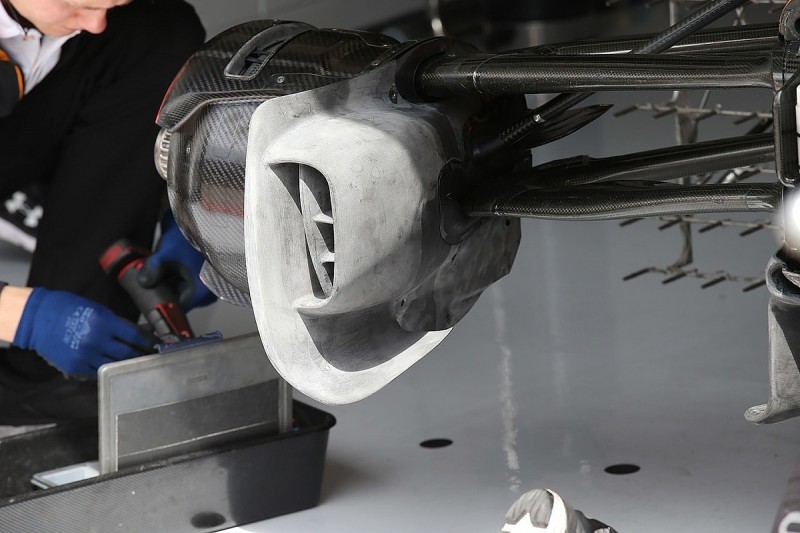
Along with testing other revised 3D printed parts, such as the brake ducts (above), the team also mounted more pressure sensors, kiel probe arrays and sprayed the MCL33 with copious amounts of flo-vis paint as it hoped to understand with more clarity where things were going wrong.
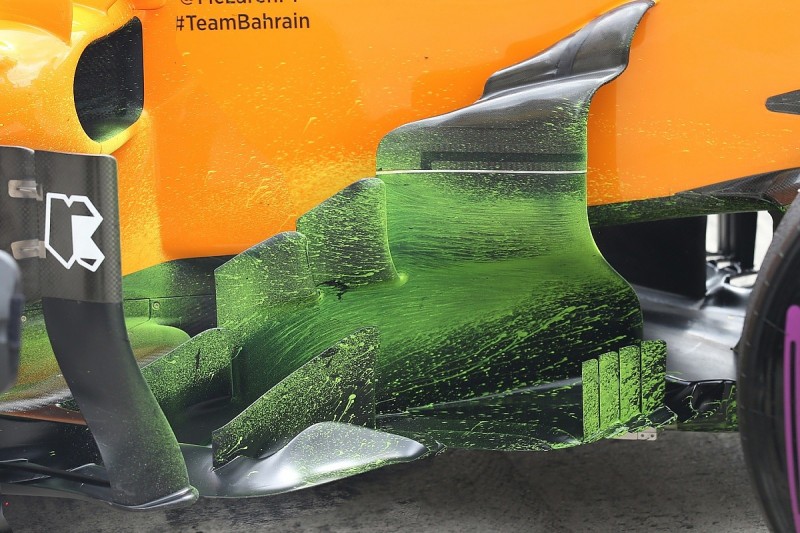
While the new parts might not solve the MCL33's design problems, the vast range of experiments should at least help McLaren understand what it needs so it can choose the right modifications to make progress.
Share Or Save This Story

The downforce choices that proved key at the Saudi GP

Revealed: Ferrari’s radical 2022 F1 nose idea

Piola: How new parts will influence 2020 designs


Norris apologises to Colapinto over F1 race ban comments

Why McLaren was so much slower than Mercedes on Baku's straights

Why Mercedes is still quicker than McLaren

Azerbaijan GP was a step forward for upgraded Williams - but real test is still to come

What next for record-breaking BTCC champion Sutton?

Smyth sweeps to Martin Donnelly Trophy glory at Kirkistown

The problem with Ferrari’s endless team principal speculation
Subscribe and access Autosport.com with your ad-blocker.
From Formula 1 to MotoGP we report straight from the paddock because we love our sport, just like you. In order to keep delivering our expert journalism, our website uses advertising. Still, we want to give you the opportunity to enjoy an ad-free and tracker-free website and to continue using your adblocker.


Top Comments