


Renault's aggressive 2018 F1 S-duct development
The 'S-duct' is not a new technical development in Formula 1, but frequent regulation changes do allow new opportunities for teams to fine-tune ideas in the search for added performance

This year, Renault has adopted a much more aggressive solution to the placement of the front inlets, which has improved the performance of its entire nose.
Having used a more conventional and compact S-duct design in 2017, Enstone design chiefs took the opportunity to make changes for '18 based on what they had learned from rivals over the course of last year.

In 2016, Mercedes (above) and Toro Rosso gave this new S-duct style solution first outings, although Mercedes had dipped its toe in the water in 2015 when it conducted a brief test during Brazilian Grand Prix practice.
The solution cast aside what had been considered the conventional method of achieving the aerodynamicist's objectives.

That was for a short S-shaped duct (see Red Bull from 2015, above) sat in a 150mm free zone ahead of the chassis bulkhead.
But regardless of the length of the pipework inside the nosecone, the purpose of the S-duct remains the same - to reduce boundary layer separation under the nose and draw airflow back to the surface of the chassis that would ordinarily detach as it ramps over the nose incline.
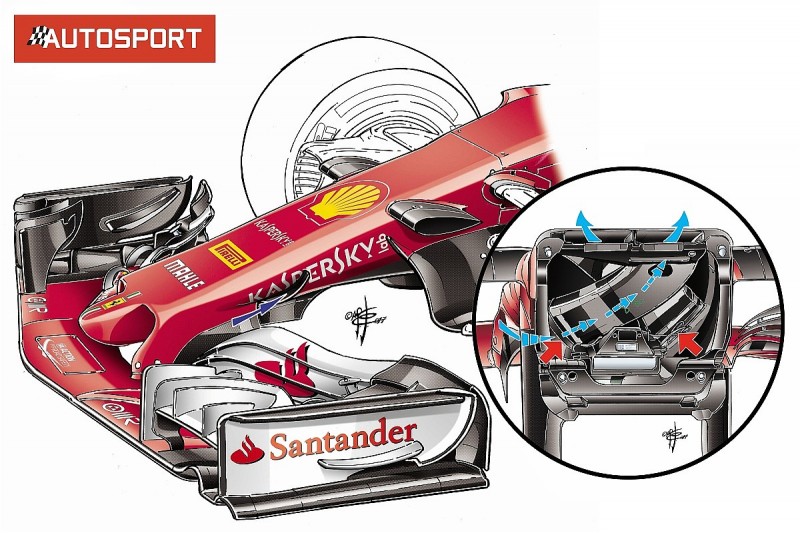
Having elongated pipework not only allows for a more precise placement of the inlets, but also makes for a less tortuous route for the airflow to follow too.
This is something that has been capitalised on by Ferrari, which since 2017 has opted to crossover its pipework inside the nosecone to improve flow conditions further.
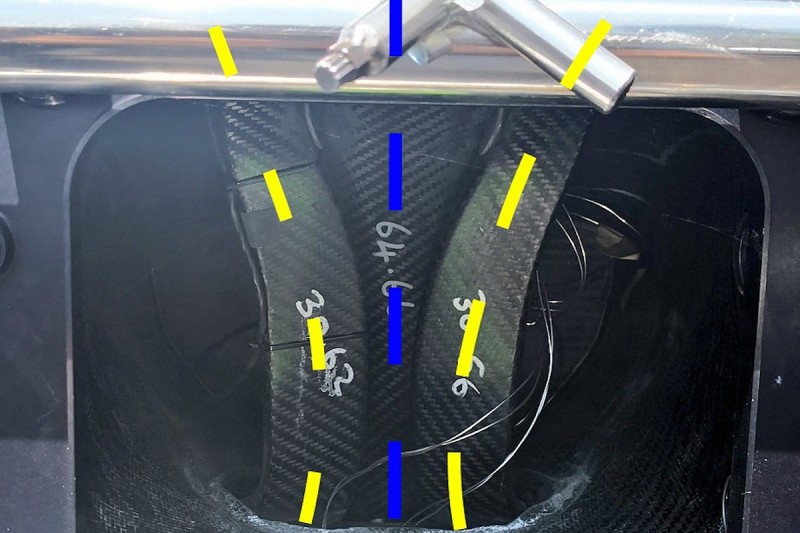
Renault has opted to further compartmentalise this flow with three distinct pipes inside the nosecone, separating flow left, right and centrally.
Share Or Save This Story

The downforce choices that proved key at the Saudi GP

Revealed: Ferrari’s radical 2022 F1 nose idea

Piola: How new parts will influence 2020 designs


You Ask The Questions: Robert Kubica

Eight shock Formula 1 team principal changes

The key moments in Renault's F1 history as it bids farewell

Why Verstappen and Hadjar urge Red Bull to "make all the mistakes now" for 2027

F1 Bahrain GP in Malaysia: Leclerc tops FP2 with Mercedes seventh and eighth

Vasseur calls for Ferrari unity: Pointing fingers would be "big mistake"

F1 Bahrain GP in Malaysia: Leclerc leads second practice from Hadjar
Subscribe and access Autosport.com with your ad-blocker.
From Formula 1 to MotoGP we report straight from the paddock because we love our sport, just like you. In order to keep delivering our expert journalism, our website uses advertising. Still, we want to give you the opportunity to enjoy an ad-free and tracker-free website and to continue using your adblocker.


Top Comments