
The green light shining for the BTCC's hybrid future
The Cosworth Electronics-developed BTCC hybrid system made its public debut in the most recent round at Silverstone. It's simple, but could significantly change the series' technical challenges for both the drivers and the teams

The push-button future is already here. The British Touring Car Championship heads into an era of hybrid power in 2022, and the series’ cognoscenti got a glimpse of it at the recent Silverstone round. There, 2013 champion Andrew Jordan drove a Speedworks Motorsport-built Toyota Corolla in free practice, qualifying and the races, using the new-for-2022 M-Sport-produced TOCA customer engine and Cosworth Electronics’ hybrid system.
Cosworth was awarded the tender by BTCC organiser TOCA in July 2019 and started development the following month on the hybrid system, which will cost £20,500 per season per car to lease. By the summer of 2020, it was running on the track. That gave Cosworth a decent lead time to get things running smoothly, even amid the COVID-19 backdrop.
“The focus with the testing we’ve done has been on the hardware validation,” says Cosworth Electronics head of support Neal Bateman. “We’ve completed over a season’s worth of mileage on all the hardware components and the kit on the Toyota. It’s been made slightly more challenging under COVID being able to rent race tracks and go out testing, but it hasn’t really impacted the timescale, just the order in which we do things. We’ve been making sure we have well-proven, reliable hardware before we distribute it to teams and get racing.”
One of the most significant aspects of the hybrid is that it brings an end to the traditional success-ballast system. Jordan used 15 seconds per lap of hybrid power – boosting engine power by 10% to approximately 440bhp – at Silverstone. Exact details on the sporting regulations haven’t been worked out yet, and are subject to testing data, but TOCA supremo Alan Gow says: “That [15s] is the maximum we would deploy the hybrid for. We may reduce it for some [shorter] circuits but maybe not. That’s all part of the challenge.”
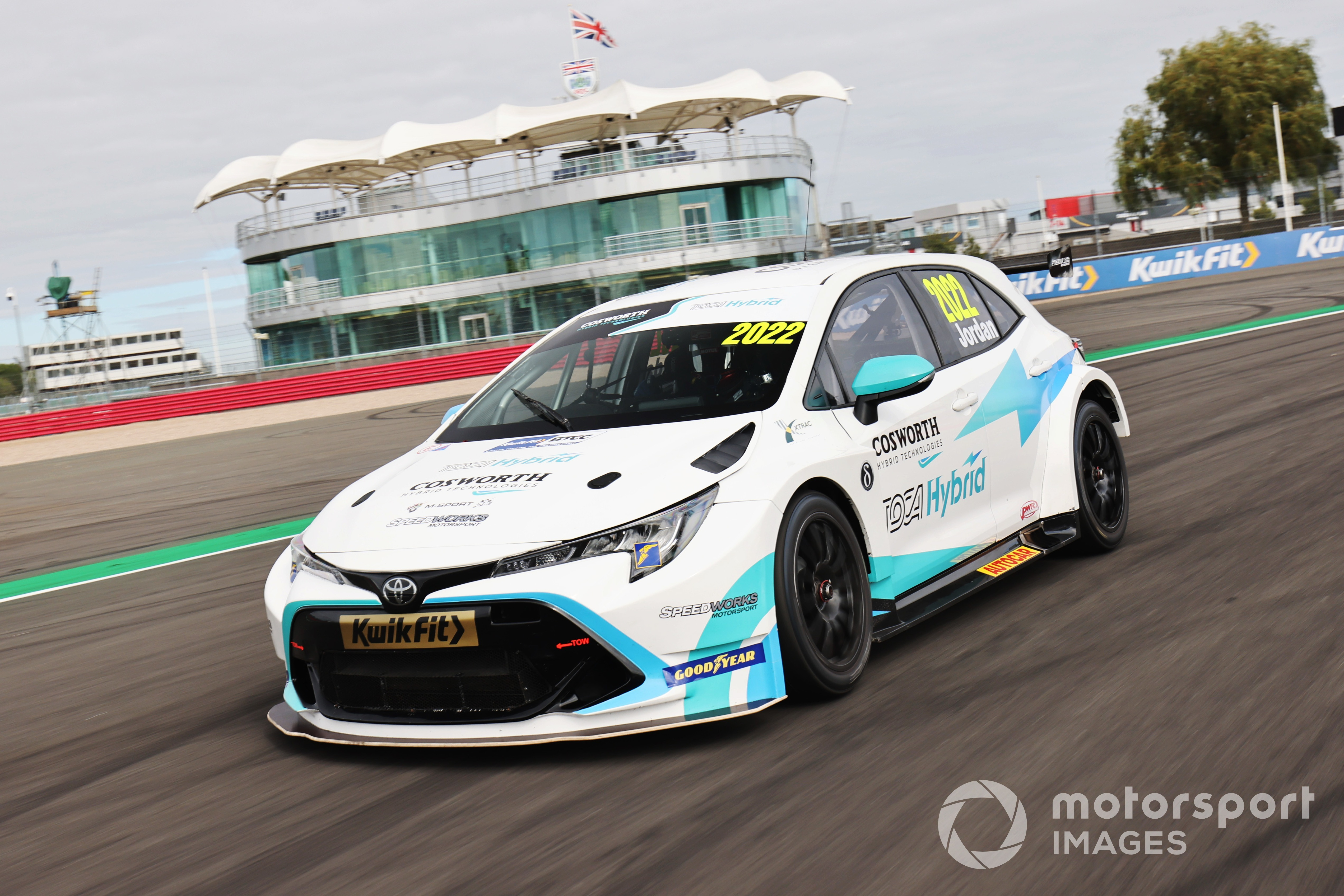
Andrew Jordan in the BTCC TOCA Hybrid Toyota Corolla at Silverstone
Photo by: JEP
Instead of success ballast, the amount of hybrid power available to the championship top 10 (or top 10 finishers in races one and two on a weekend) will be reduced from that nominal 15s on a sliding scale for qualifying, and for the number of laps you can use it in the race.
Again, this is subject to accumulation of data, and could be changed during the season. “It’s a learning year in some respects,” continues Gow. “If we have to tweak it then of course we will. That’s for the boffins to sit in front of their computers and work out on their spreadsheets, but it’s incredibly easy to adjust if we get it wrong.”
"From the teams’ point of view they’re going to get a rotary switch and a button to press for deployment, and that is it" Neal Bateman
As if to say ‘yah boo’ to success ballast, Bateman points out: “There’s a Delta battery that sits in the place where the ballast box would normally sit. There is a motor controller in front of that, so effectively an inverter, for the 60-volt system. And then going forward from that through the bulkhead, to our electric motor which sits on the side of the gearbox, are the main components and our vehicle controller, which controls both the internal combustion engine and the electric hybrid system all in one box. That bit is part of our electronics which will control the rest of the car in terms of the electrically powered parts.”
The difference between hybrid systems in the BTCC to those in Formula 1 or the World Endurance Championship is that they have to be bulletproof and affordable. “This is going into a spec series [regarding control parts], so everybody’s going to get the same,” says Bateman. “And so things like the electric motor and the power controller are off-the-shelf pieces of equipment, which is what’s driving the price down to this more palatable level. This is very much about an integration exercise of getting this kit together using our electronics, using our partners at Delta with the battery. And a lot of the control in terms of the things you’ll hear spoken about in F1, about regen and about how the battery and energy systems are being recovered, we’ve done all of the software for that. So from the teams’ point of view they’re going to get a rotary switch and a button to press for deployment, and that is it.”

Andrew Jordan, BTCC TOCA Hybrid Toyota Corolla
Photo by: JEP / Motorsport Images
Initial testing in the Toyota was carried out with the current Swindon-built TOCA engine before the M-Sport mill came on stream. “We’ve completed our validation alongside each other, so their engine is fully validated with the hybrid system on, which is important,” asserts Bateman. “And we have a great relationship with M-Sport anyway going back. We’ve been working with them for decades [primarily in the World Rally Championship], so it’s been good to develop the system with them.”
The first semi-public outing came at the Snetterton test in July 2020. Following his recent divorce from West Surrey Racing, Jordan was approached by Gow to be the test pilot. But, due to his ongoing contractual situation with WSR, he was replaced by Darren Turner for the early work. At Snetterton, this comprised mostly out-laps.
“It’s important to get confidence in the system, in some of the safety systems, in some of the code that we’ve developed as well,” explains Bateman. “So it’s very much going out and doing an out-lap, coming in and checking the system over, making sure hardware-wise, mechanically-wise it’s all functioning and behaving, and also spending a good amount of time analysing the data, making sure that all the systems we’ve got in place are functioning correctly, and then going out and basically doing it again. It’s quite repetitive but it’s incredibly important at that base level.”
Soon the ‘race runs’ began, with Jordan on board. “We did a lot of testing at different tracks, and very much it was about putting miles on it in a controlled way,” says Bateman. “So we were doing race runs effectively very early in the test programme, and then trying to replicate as best you can doing that sort of distance, and then waiting for the car to cool down, and waiting that [time] distance you get between races before going out and doing it again. So that process started very early, but there is no substitute for actually going and doing a race weekend like we did at Silverstone.”

Andrew Jordan, BTCC TOCA Hybrid Toyota Corolla
Photo by: JEP / Motorsport Images
That plan was announced just after the July 2021 tyre test at Oulton Park, where Jordan racked up the laps during the second day. But it also was the root of the lack of performance in Silverstone qualifying, although race pace was strong: Jordan pedalled the Toyota to fastest lap in race two, and was among the quickest in the other two races.
“It was a bit of a shame it rained at some unfortunate times at Oulton,” rues Bateman. “We were just getting ready to put in some quick laps and got the car ready and the tyres warm, all ready to go for a time, and it started raining, so that was a bit frustrating. But in terms of through the speedtrap I think we were one of the fastest cars, which was encouraging, so it was a really important first step towards Silverstone in terms of running in public.”
As far as performance was concerned, a dry Oulton should have shown where the car was set-up-wise using the hybrid, on which the battery weighs 25kg, and the M-Sport engine, whose dry weight is approximately 15kg below some existing BTCC units. Jordan said that overall the car was “on the weight” of other cars, but the effect of the lighter engine is to shift weight distribution to the rear.
"If you use it down the second half of a fast back straight then you don’t really feel it much; if you use it coming out of a corner then you can feel it. It’s only subtle" Andrew Jordan
“It’s never just plain sailing because it’s a big programme, big change, so it takes a bit of getting your head round in terms of what they need from me,” states Jordan of the hybrid work. “Initially it was just mileage on the whole system.”
Of the Silverstone run, Jordan adds: “I thought we should challenge for pole. But I didn’t think it was a foregone conclusion because all the people on that grid are at the top of their game, and fully up to speed with the car in terms of chassis balance and things like that, so I knew it would be tough to go in and blow them all away.”
Overnight work to deal with the effects of the shift in weight distribution paid dividends. “It’s not just a bolt-it-on-and-it’s-fine,” points out Jordan. “It takes a bit of getting your head round from the team side on what you need on the chassis compared to normal. But come race day we were very strong. I think Alan Gow was quite happy with that, because it showed the potential of it, so from my point of view it was job done really.”

Andrew Jordan, BTCC TOCA Hybrid Toyota Corolla
Photo by: JEP / Motorsport Images
Can you feel the boost? “It depends where you use it,” replies Jordan. “If you use it down the second half of a fast back straight then you don’t really feel it much; if you use it coming out of a corner then you can feel it. It’s only subtle, it’s not like a massive increase in power, but you can just feel a little bit more assistance.”
It’s not just the M-Sport engine, of course, or front-wheel drive like the Toyota. The hybrid will also be equipping rear-driven machines such as the BMW 330i M Sport and Infiniti Q50. The BMWs and Dynamics’ Honda Civics use their own bespoke Neil Brown-built motors; ditto the Fords with Mountune. To that end, work has begun on an older-spec BMW 125i M Sport belonging to Ciceley Motorsport. “That’s good experience for us in terms of the rear-wheel-drive installation,” says Bateman. “But the equipment mounts to the TOCA components anyway, so the electric motor goes onto the Xtrac gearbox, which is the same for everybody, and a lot of the equipment mounts onto the subframes, which are the same for everybody. So it’s not envisaged that each team’s installation will be wildly different to what it is on the Toyota or on the 1 Series.”
Over the past decade, Cosworth has supplied the electronics to the BTCC’s NGTC machinery, the kind of componentry that barely gets mentioned unless something goes awry. Now it will be at the forefront of the winter gossip.
“It’s nice to have something out there that people are excited about, and it’s nice to have a test car going round there with our name down the side of it,” says Bateman. “It’s a proud moment. It’s just a button that they press to get 15 seconds of deployment, so there’s not quite as much engineering work as maybe they have at the moment to try and engineer 75kg [of ballast] into the car. I think the testing for that, we’re quite confident, will all go well. We’ll be doing training sessions with the teams, we’ll do an installation manual for the kit, an operational manual as well, so there’s lots of information flowing out to the teams, which is sharing our experiences of running the test cars with them.”
And of course, we mustn’t forget the drivers. The big question, bearing in mind there are some in the BTCC who are ageing businessmen rather than refined athletes, goes to Jordan. Is the deployment of the hybrid idiot-proof? “It’s pretty simple,” he laughs. “You literally press a button when you want more power…”

Andrew Jordan, BTCC TOCA Hybrid Toyota Corolla
Photo by: JEP / Motorsport Images


A fond farewell to a few BTCC favourites

How Ingram made his mark on the 2026 BTCC campaign – before going out with a bang

BTCC Brands Hatch: Cammish handed victory after Collard penalty

BTCC Brands Hatch: Ingram doubles up to secure runner-up spot in championship

BTCC Brands Hatch: Ingram wins after wonder move on Moffat

Sutton extends BTCC deal for five more years

BTCC Brands Hatch GP: Moffat leads throughout to beat Ingram in qualifying race

Multiple BTCC winner announces retirement

Acosta proposes new idea for monitoring tyre pressure in MotoGP

Horner's inside story of how Red Bull built its own F1 engine

Exclusive video: Christian Horner interview on his Red Bull exit, Mercedes rivalry and more

Top five roles on Motorsport Jobs this week
Subscribe and access Autosport.com with your ad-blocker.
From Formula 1 to MotoGP we report straight from the paddock because we love our sport, just like you. In order to keep delivering our expert journalism, our website uses advertising. Still, we want to give you the opportunity to enjoy an ad-free and tracker-free website and to continue using your adblocker.


Top Comments