
Why there's very good reason to celebrate the WEC hitting 100 races
Initial scepticism that world championship endurance racing would survive its roller-coaster ride to reach this point is understandable. The fact that no one could have foreseen its current rude state of health makes that journey to 100 WEC races all the more gratifying

There were mixed emotions for me at the 2012 Sebring 12 Hours on the return of world championship endurance racing. At the completion of the 1992 season when the old or original world series dating back to 1953 withered and died, if someone had told me that it would take another 20 years to return, I’d have laughed them right out of the paddock.
But when it did make what for me was a belated comeback, I wasn’t a confident man. Not confident at all that the current iteration of the World Endurance Championship would stick around, let alone blossom in the way it has.
The idea that it would hit 100 races, as it will at Fuji this weekend, was unthinkable to me back then, and arguably many more times during the past 13 years. What you have to remember is that the rug was nearly pulled from under the new-look WEC before it had even begun when Peugeot announced that it wouldn’t be on the grid after all.
The Peugeot-induced wobble wasn’t the only crisis the WEC has faced over the years. The double hit it received with first Audi and then Porsche quitting the LMP1 ranks in 2016 and ’17 was biggest among them.
Just a couple of months before the born-again WEC debuted on the same Sebring grid as the American Le Mans Series in 2012, the axe fell on Peugeot’s P1 programme. The absence of another turbodiesel to carrying the 908 name, a hybrid this time, left Audi as the only manufacturer in the top class.
Toyota and Porsche, we knew, were on their way, the former in the short term that year, the latter on a longer timeframe three seasons down the line. The 2012 season was meant to be a year of development for the Japanese manufacturer with only sporadic race appearances, but it pulled out the stops to save the WEC in its hour of need.
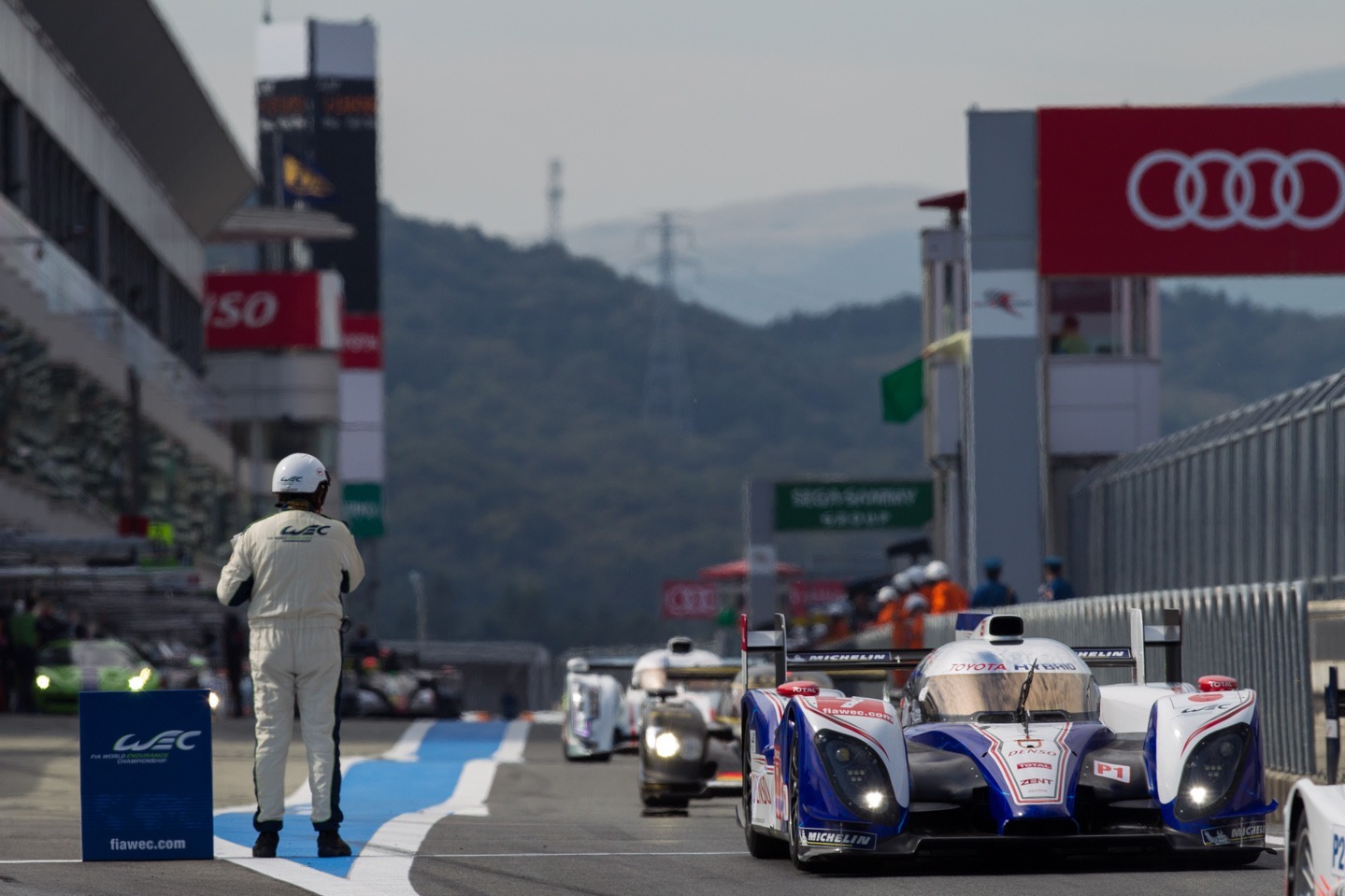
Toyota’s victory at Fuji in 2012 one of three wins that helped save the World Endurance Championship at birth
Photo by: James Holland
The TS020 HYBRID was made race-ready early. One would have competed at Spa, round two less than a couple of months after Sebring, but for a crash in testing, so we got to see the car blooded in competition at the Le Mans 24 Hours in June. Both Toyotas were out before the halfway mark, if you remember.
But lest we forget, Toyota rescued the WEC at birth twice over in that first year. Not only did it complete the second half of the season with a solo entry, but just as importantly, it proved a worthy opponent to mighty Audi, a marque that had been king of the sportscar jungle for more than 10 years.
The TS020 took the fight to the German manufacturer’s R18s (there were hybrid and non-hybrid versions that year) and it beat them three times out of five over the post-Le Mans leg of the series. Not bad for a newbie, even one with a rich sportscar pedigree coming out of Formula 1.
The WEC made it through the bad times with some hard work and decent decision making, and is reaping the rewards
Porsche joined the party in 2014 with its 919 Hybrid and we pretty much had a three-way fight every year, forgetting Toyota’s annus horribilis in 2015, the season after it had taken its first WEC title. We should never forget just how good the racing was during those years of the P1 rocket ships. But it wasn’t all quite as rosy at it looked.
The withdrawal of Audi and Porsche, both part of the Volkswagen group, could have scuppered the WEC, leaving, as it did, Toyota as the only manufacturer competing in P1. The reaction of the WEC was what the series called the “superseason”. A campaign that incorporated two editions of the 24 Hours at Le Mans and a commitment to the privateers that they would be competitive did the trick in the WEC’s hour of need. It helped save its bacon.
The superseason was also a convenient way of segueing into a winter-series format, with the first race at the back end of one summer and the last, Le Mans, early in the next. It was devised as a means of avoiding the post-Le Mans hangover from which the championship has always suffered.

The WEC aimed to avoid its Le Mans hangover by starting and finishing seasons with the blue riband event
Photo by: Rainier Ehrhardt
I could never make up my mind about the winter season concept, a long-held target of the WEC’s head honchos, but I didn’t have to procrastinate for too long. It lasted but a single season in 2019/20, albeit an elongated one that stretched even longer than what had preceded it.
We had COVID to thank for a campaign that ran from September ’19 to November ’20, more than a month longer than the superseason. It left no option but to switch back to a traditional format for the season starting in ’21.
COVID came at a bad time for the WEC, just as it was planning for new rules on the introduction of the Hypercar class. Another thing not to forget is that the LMDh cars that would eventually join the Le Mans Hypercar machinery were originally due to arrive in 2022, not 2023. What was always an optimistic timescale was derailed by the pandemic.
That meant the WEC had to endure a couple of lean years at the start of the new era. We certainly weren’t calling it golden, not through the seasons of miniscule Hypercar grids in 2021 and 2022, even if we had more than an inkling of what was to come.
But arrive, we have, in an era we are all quite happy to prefix with that word golden – one which we are prone to overuse, I have to admit. The WEC made it through the bad times with some hard work and decent decision making, and is reaping the rewards. There are now eight manufacturers on the grid in Hypercar and a further three on the way over the next two seasons.
No one would have predicted that when we gathered at Sebring for the start of it all in March 2012.
This article is one of many in the monthly Autosport magazine. For more premium content, take a look at the October 2025 issue and subscribe today.


With eight manufacturers on the Hypercar grid and three more waiting in the wings, it’s not called a golden era for nothing
Photo by: Eric Le Galliot


How Toyota destroyed the competition to seal the WEC crowns

When Can-Am made its controversial comeback

WEC Barcelona: Genesis secures maiden series pole from Toyota

How Ford is "hitting milestones" in preparation for WEC Hypercar assault

How Porsche Penske finally broke its Petit Le Mans duck

Why there’s no perfect solution to the WEC safety car conundrum

How an “informed gamble” enabled Toyota to beat Alpine in the Fuji 6 Hours

The hope for Lola’s comeback and what it could mean

How Toyota destroyed the competition to seal the WEC crowns

McLaren retains Fornaroli as F1 reserve and hands him WEC programme for 2027

How Andrew Jordan realised his teenage rallycross dream

Inside the competition building F1’s future engineering talent
Subscribe and access Autosport.com with your ad-blocker.
From Formula 1 to MotoGP we report straight from the paddock because we love our sport, just like you. In order to keep delivering our expert journalism, our website uses advertising. Still, we want to give you the opportunity to enjoy an ad-free and tracker-free website and to continue using your adblocker.


Top Comments