
Track testing an outgoing stalwart of British motorsport
The current GB3 Championship car is due to be replaced next season. Autosport got behind the wheel to discover why it's been a popular machine for drivers making their way up the junior single-seater ladder

The silence is deafening. I’m sitting broadside across the track, fumbling around trying to restart the engine. It’s not been the best of starts getting to grips with a modern single-seater.
The car in question is the Tatuus-Mountune used in the GB3 Championship, and my spin comes only minutes into the opening run, thanks to losing control under acceleration exiting the final corner at a damp Snetterton. One positive is that there is no fear of being collected by another vehicle, such is the privilege of being the only car on track for an exclusive test day.
The downside is that the Elite Motorsport squad, whose car I’m ‘borrowing’, and all the officials at the MotorSport Vision venue, can hear every tone of the two-litre engine around the track’s 300 layout. Or in this case a distinct lack of such can only mean one thing – I’ve messed up!
After restarting and been pushed back the right way, I crawl into the pits and, if there’s any panic about who they’ve allowed in the driving seat, Elite team boss Eddie Ives and his mechanics certainly don’t let it show as I offer an apology. Thankfully there’s no damage other than to my pride.
My three ‘quick’ laps have at least opened my eyes to what it’s like to drive a single-seater – brief stints in a Formula Ford at Castle Combe and some F4 machinery on Silverstone’s Stowe layout, both in monsoons, hardly being valid.
The day is intended as something of a swansong for the Tatuus MSV FA-016 chassis – fundamentally an F4 tub with significant aero and power upgrades, and which is due to be replaced next season in GB3. The current generation of car was introduced ahead of the 2016 campaign, and coincided just days before the season began with a name change from BRDC Formula 4 to the BRDC British F3 Championship.
A change in moniker proved quite apt ahead of the car’s introduction – in its final season, and courtesy of a decision by the FIA, the series was rebadged again as the GB3 Championship from the Spa round in late July onwards.

Outgoing GB3 racer started life as an F4 car, raced by George Russell, before being upgraded for BRDC British F3 competition
Photo by: Mike Hoyer/JEP
The new car is unsurprisingly set to feature a number of upgrades, but that’s not to say that the older version has outstayed its welcome. Far from it, as it’s proved popular with teams and drivers over the past six years due to its performance parity, reliability and as a proving ground for future stars – past alumni include McLaren Formula 1 driver Lando Norris and two-time W Series champion Jamie Chadwick.
Other than a small facelift ahead of the 2020 season, which included adding slightly more downforce courtesy of new bodywork, and the Duratec engine now being serviced by long-time MSV supporter Mountune, the car has largely stayed the same. Weighing 585kg with the driver included, it runs on Pirelli slicks and wets, is capable of producing 230bhp, has a six-speed sequential gearbox, plus twin wishbone suspension with two-way adjustable dampers and adjustable front and rear anti-roll bars.
"At this sort of level when you’re bringing in new kids to single-seaters, you need to be able to do the mileage having trust and faith in the package underneath. It just gives you confidence in the whole package and makes it easier to sell and promote the whole product" Eddie Ives
The package supports the majority of British GT Championship meetings, and was enough to entice Elite Motorsport into the championship – and single-seaters – for the first time this year.
“The car’s fantastic,” says Ives. “It’s really reliable, the engines are really level and there’s just loads of good things. At this sort of level when you’re bringing in new kids to single-seaters, you need to be able to do the mileage having trust and faith in the package underneath. It just gives you confidence in the whole package and makes it easier to sell and promote the whole product.”
Helping me try to get the most from the day in Norfolk is 2020 Ginetta Junior champion Tom Lebbon, who made the jump with Elite into single-seaters this term, achieving one podium and ninth in the standings. The 16-year-old offers advice on what lines to take on a damp track and essentially tells me to take my time building up the speed.
The next run proves much more productive, and I log a 2m37s. For comparison, a competitive dry lap time is around the 1m45s mark, while the reference lap I was working off was 2m05s, which Lebbon set earlier this year in qualifying as it began raining during the session.
One of the things to try to get on top of from an early stage is braking. With a downforce-dependent machine such as a formula car, the initial impact of the brakes is when they are the most effective as air pushes down on the car. The more speed that’s scrubbed off, the less air there is to force the car into the ground, and gradually drivers need to bleed off the brake pedal.
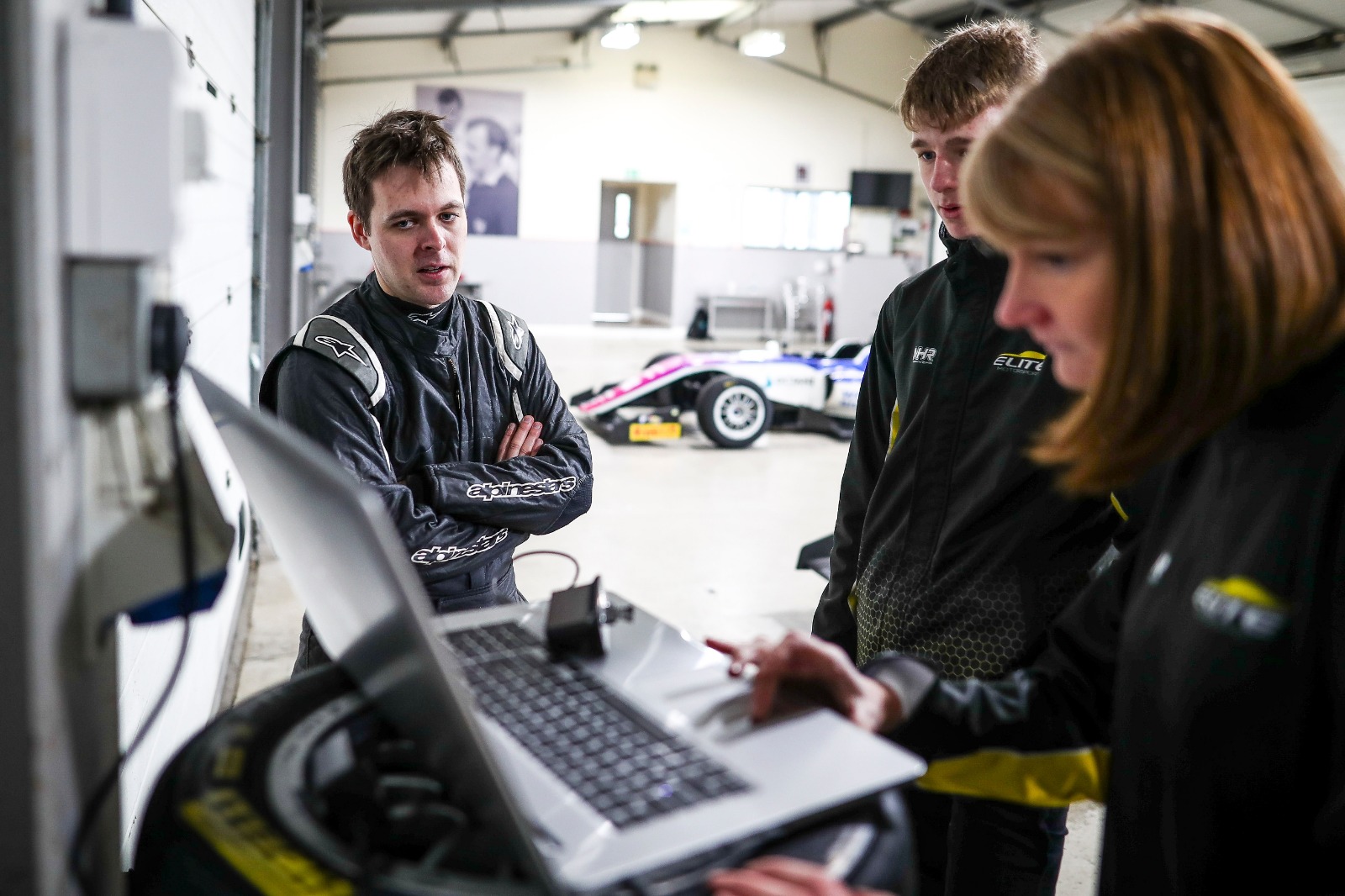
Engineer Shaw and benchmark driver Lebbon give Mackley tips on unleashing more speed from the Tatuus chassis
All this means that drivers need to hit the pedal late and hard, but there is a fine line. On several occasions I lock up the front right heading into the left-hand Agostini hairpin. This is something that’s common, according to Lebbon, since the weight is transferred to that side of the car under braking. A small tweak to the rear on the brake bias, which is adjustable from the cockpit, solves the problem.
According to race engineer Sarah Shaw, who is on hand to run through the data with me after each run, adapting to the brakes in a single-seater can take new drivers a while.
“The braking technique, that’s something we have to get sorted out at this level because every car you drive when you move up the single-seater ladder, that brake technique is the holy grail – you have to brake like that to use the downforce,” says Shaw, whose previous experience includes working for MP Motorsport in FIA F2, as well running the Manor Competition squad with her husband Tony in Formula Renault Eurocup and, before that, Formula Renault UK.
It’s an area I’m soon on top of, and my braking points and speed through the slow corners are close to Lebbon’s benchmark, which is encouraging.
The outright speed of the car, while quick, is nothing spectacular as I’m falling just short of 140mph before the end of the Bentley Straight at the back of the circuit, pretty much on par with what would be expected. But it’s through the corners where it’s most impressive.
With limited running in downforce machines, relying on what’s effectively an invisible force might be an easy concept to accept sitting in the garage, less so when barrelling into most braking zones at over 100mph. And with “the worst possible track conditions”, according to Shaw – it’s greasy – it is far from an ideal time to be trying to find the limit.
“Some drivers will find the limit by going past it and having to trim it back, some will build up to the limit,” says Shaw. “But if they haven’t driven anything with downforce, that is quite a big thing to get used to. This car has got a decent amount of downforce, so it’s good for training the drivers. But it’s one of those things – in order to trust the downforce, there’s no other way than to just barrel a load of speed through the corner, feel it and let it do its job.”
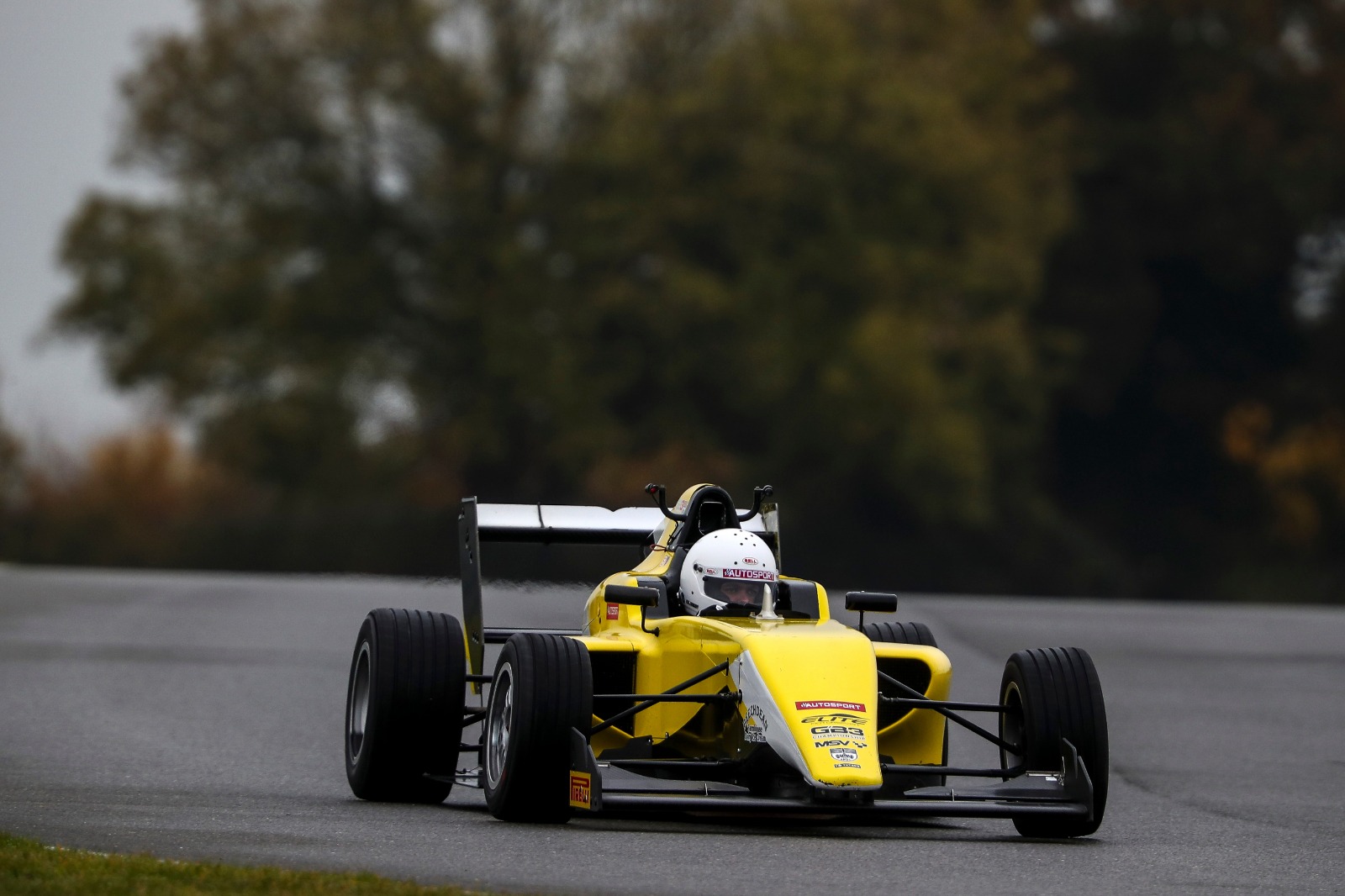
Impressive downforce on the Tatuus means drivers need to attack corners and braking zones
Photo by: Mike Hoyer/JEP
Not intent on spinning again, or worse, I take the latter approach and build my speed into the afternoon, which includes running on a worn set of wets more akin to inters as the track slowly begins to dry and the rear anti-roll bar, which was previously disconnected to induce understeer, is reconnected. Now that I’ve got to grips with the play of the throttle pedal, exiting corners is becoming more of a fluid process and the application of power is happening sooner, but doesn’t feel as brutal.
I’m also beginning to experience slight sensations of the front pushing through the high-speed left flick of Hamilton, a sign that I’m at last starting to ask enough of the car’s aerodynamics. Any slides by this point, notably still out of the slower corners of Nelson and Murrays, feel manageable as heat continues building up in the tyres. With the Pirelli rubber being such a critical aspect of the car, tyre pressures are a close-kept secret among the teams.
"I think you did really well considering you’d never driven anything like that. And you had all those people watching – I didn’t envy you!" Sarah Shaw
“I think the biggest surprise to us was the tyres because we were used to the Pirelli in F2, and that’s a tyre that comes on and then falls to bits within about two laps,” says Shaw. “Whereas this one, I think because of the nature of the championship it would be no good for young drivers to just have one-lap tyre life and then be struggling with degradation. The pressure is the first thing you look at and you know if it’s in the window based on how the pressures have come up.”
Feeling more comfortable in my surroundings, I have time to look at the onboard lap timer on my final run, intent on making gains each time around. My last lap proves to be the quickest – a 2m17.38s. That means I’ve taken 20s off my morning time across 52 laps of running, or the equivalent of more than four race distances in the space of effectively five hours.
“You only had the one spin, you never put a foot wrong again,” says Shaw. “You were sensible about it, just built up and improved every time you went out. I think you did really well considering you’d never driven anything like that. And you had all those people watching – I didn’t envy you!”
I’m still a long way from the car’s full potential, but the day does give me an insight into what it’s capable of and why it’s revered by those who have competed in it and has been a destination for so many motorsport talents. An eye-opening experience to an impressive bit of kit, even if I’m unlikely to get a call-up for next season.

Elite team watches on as Mackley presses on
Photo by: Mike Hoyer/JEP
The new era for GB3
“We wanted it to do an even better job at filling this gap between FIA Formula 4 and FIA Formula 3 and there clearly is a gap there.”
Jonathan Palmer is no stranger to producing successful junior single-seater championships – the MotorSport Vision CEO was responsible for Formula Palmer Audi and MSV Formula 2. That focus has shifted onto the GB3 Championship more recently, with the new car being introduced for next season.
PLUS: How rocket O'Sullivan banished painful memories with 2021 GB3 glory
“It’s got about 20-25% more downforce so it’s a fair old performance hike, and the power of the car is going up from 225bhp to 250bhp,” he says. “It’s now got the throttle body inlets at the side and we’re back to the old Formula 3 style of airbox. It’s going to look a great car, it’s going to sound a great car.”
All this will result in a performance boost over the current generation despite the addition of a halo head protection device adding an estimated 12kg to the weight, while elements of the current car will remain such as gearbox, suspension, brakes and electronics.
The new car will also provide a level playing field, with all teams starting from scratch with regards to set-up and data. It’s an opportunity for teams like Elite Motorsport, who only joined GB3 this season, but have a pedigree in other series.
“We’re looking forward to getting the new car next year because I feel like there was an element of us versus people with four years’ worth of experience with that exact car, which is never easy to overcome,” says team boss Eddie Ives.
“Everything that MSV and Tatuus have come up with looks fantastic. I think it was the right thing to get the halo on the car and it’s the right thing to try and make the car a little bit quicker. We’re not going to be changing anything on the new car that’s detrimental.”
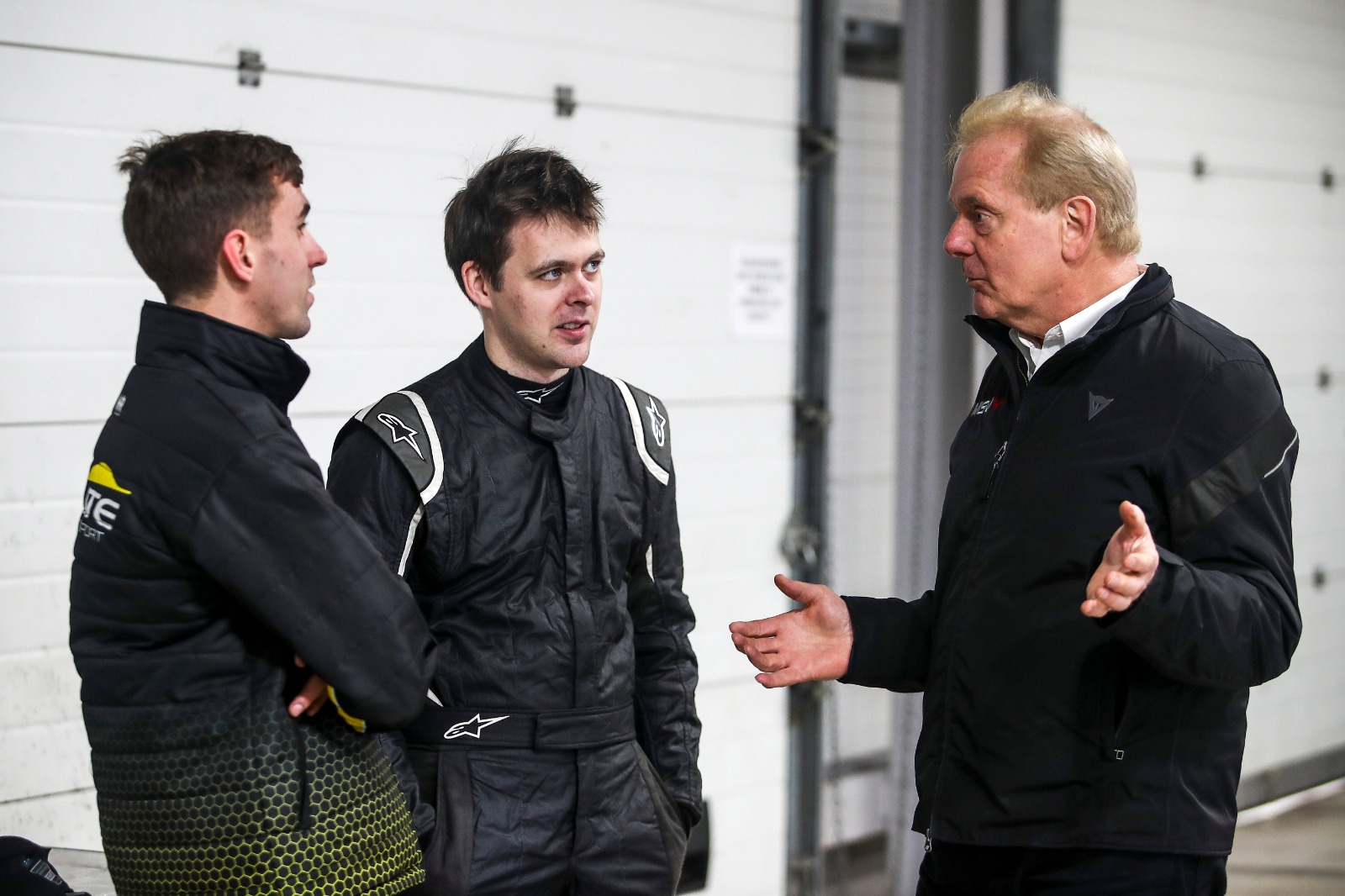
Palmer gives Mackley a run-down of what to expect from the new-for-2022 GB3 racer
Photo by: Mike Hoyer/JEP


Piquet Jr, Visser and Eaton star at Brands Hatch's American SpeedFest

Johansson and Brown among the stars of Brands Hatch Masters Historic Festival

The verdict on Formula E’s Pit Boost delayed debut

How Rowland stamped his authority on Jeddah as rivals faltered

Formula E’s Pit Boost debut receives mixed response from drivers

The influencer fishing exercise Formula E hopes can achieve its long-term aims

Beckham, Aguero amongst celebrities set to drive Formula E cars in Miami

How Evans pulled off his last-to-first recovery in Formula E's dramatic opener

Rwanda turns to F1 as it moves forward from a chequered past

Mekies extends contract as Red Bull's F1 team boss

What to expect from WEC's Barcelona debut

Acosta proposes new idea for monitoring tyre pressure in MotoGP
Subscribe and access Autosport.com with your ad-blocker.
From Formula 1 to MotoGP we report straight from the paddock because we love our sport, just like you. In order to keep delivering our expert journalism, our website uses advertising. Still, we want to give you the opportunity to enjoy an ad-free and tracker-free website and to continue using your adblocker.


Top Comments