
Recreating the first F1 race winner
Whenever it appears at a historic racing event, Peter Greenfield's Alfa 158 always turns heads. Here's the remarkable story of how it was built from a huge collection of original factory parts
The Alfa Romeo 158 is one of the most successful grand prix cars of all time and, 75 years after a 158 won the inaugural Formula 1 world championship for drivers race at Silverstone, the car of Peter Greenfield continues to compete in historic events.
The 158 was actually a design from 1937 and was raced until the outbreak of war in September 1939. When racing restarted after the conflict ended, the 158 was brought back into action by the factory team and, with its 1500cc supercharged engine, was well suited to the new F1 regulations.
Designated the Tipo 158/47 and delivering more than 300bhp, the car’s first race was the 1948 Swiss Grand Prix where, tragically, Achille Varzi crashed and died. In 1950 the new World Championship of Drivers was inaugurated and the 158 was a perfect fit as Alfa Romeo fielded a strong works team.
The new championship started over 70 laps of the Silverstone airfield circuit on Saturday 13 May and the 158 was dominant as Giuseppe ‘Nino’ Farina took victory. Luigi Fagioli shadowed his team leader home, while Juan Manuel Fangio retired shortly before the finish with a broken oil pipe on his 158. Instead, home hero Reg Parnell, in a fourth 158 from the Alfa factory, finished third.
The 158s went on to win every race they started in 1950 and Farina became the category’s first world champion. Updated and designated the 159 for the following season, Alfa faced increasing opposition from Ferrari, though Fangio held on to take the 1951 title before Alfa Romeo withdrew and the world championship was run to F2 rules.
Eventually, the surviving 158s were put away into museums but, in the 1980s, renowned engineer Jim Stokes had the opportunity to rebuild the car acquired by former racer Mike Sparken. That car was later sold on and subsequently disappeared from public view in a private collection.

The Alfa 158 completed a podium lockout at Silverstone's inaugural Formula 1 world championship grand prix
Photo by: Silverstone Archive/Museum
Then, around a decade ago, Stokes took two unexpected phone calls. “I had calls from two different people on the very same day, basically saying they had heard of a large cache of 158/159 parts for sale in Italy,” explains Stokes. “Knowing that I’d done Mike Sparken’s car from 1986 to 1989, I’m the only person outside the Alfa factory that’s ever touched one.”
A series of photographs went backwards and forwards and confirmed that there was indeed an amazing collection of parts. A deal was struck. “Ultimately, we ended up with a large pile of parts,” says Stokes. “And I mean it when I say a large pile of parts. It was a courtyard full of parts for the 158/159 and, whoever had collected these things, obviously over a period of time, probably had a very large lunchbox for walking in and out of the Alfa factory.
“There was literally a kit of everything. You even had two stub axles, one right hand, one left hand, and you had the parts for the rear swing axle. He had collected probably between 70% and 80% of a car. There were some chassis parts and no body bits, but we had radiators, oil coolers, several superchargers, several transmissions and we had a huge amount of stuff to start building this car.”
“It’s just such a wonderful, wonderful noise – I’m an Alfa and Ferrari man through and through, so that’s part of the appeal” Peter Greenfield
When Stokes rebuilt Sparken’s car he’d had enough original parts left over to build a display engine, which was sold. “It went to the States,” he explains. “Then it went all over the place, and ended up with Lord Bamford. He’s one of our customers, and I said I’d really like to acquire that engine, if it was at all possible. And, to cut a long story short, in the end he said, ‘Make me an offer’. He let me buy the engine at a reasonable price.
“Now I had got all these parts and the engine and this big project to do, and I pretty much spent all my working capital on acquiring all these bits and pieces. So I thought, ‘Well, which one of my customers would really like this project?’ Peter Giddings had always been trying to buy the other car so I just sent him a one-line email: ‘If I could build you a 158, what would you say?’ The answer just came back, ‘Yes!’”
The only thing that Stokes didn’t really have a lot of information on was the bodywork. They duly gained access to a 158 in the Biscaretti Museum in Italy and returned with lots of photographs and measurements.
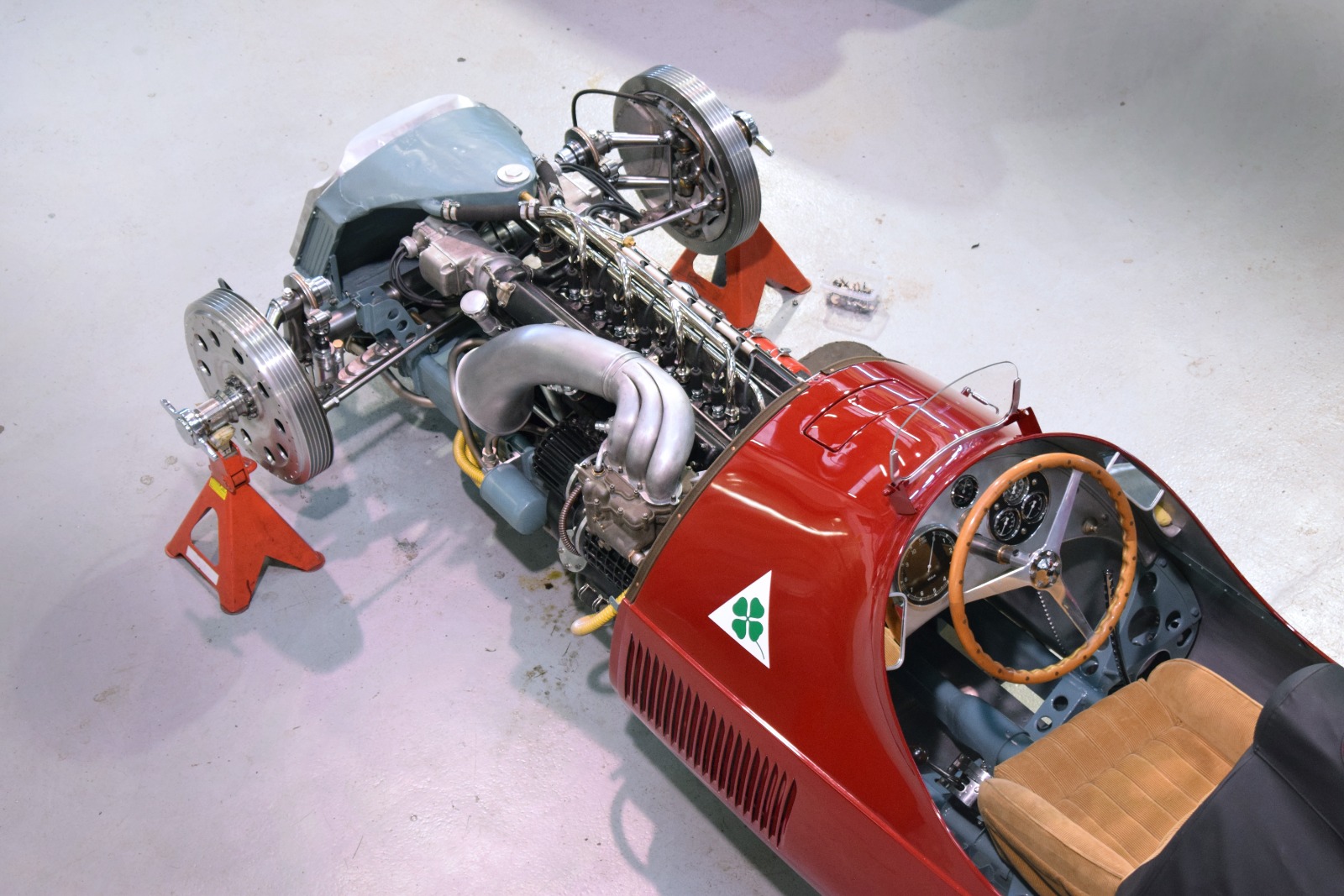
Huge stock of original parts were used to make Greenfield's car
Photo by: Jim Stokes Workshops
“We took the cover off it for the first time at Retromobile in Paris, which must be about eight years ago,” Stokes continues. “Unfortunately, Peter Giddings never got to drive the car because he was suffering from cancer. We sent the car with a couple of mechanics to Sonoma for his memorial service and Peter Greenfield, one of his best mates and another huge Alfa collector in the States, drove the car at the memorial service. He got out of it and said, ‘I have to have that car’.”
Since then, Greenfield has raced it primarily in Europe, with the Stokes team looking after the stunning 158. At the recent Vintage Sports-Car Club Silverstone event he took it to a podium finish, 74 years and 11 months after Farina’s win at the track. The car even carries the same white identification blocks on the nose as Farina’s machine sometimes used during the season.
Stokes reckons it is the only 158 still racing: “There’s probably more than one in the museum, including one that they drive, and there are two in private hands. But the only one that is seen is Peter Greenfield’s car. The Sparken car is in somebody’s collection somewhere, and nobody knows where it is. I never thought I’d ever make another one or rebuild another one. To be honest, both cars have got about the same amount of original parts in them.”
Octogenarian Greenfield, who lives on Long Island, New York, travels to Europe several times a year to race his 158 with gusto. He has owned it since 2022 after buying it from Giddings’ widow.
“My friend Peter Giddings commissioned it, but he passed away before he could ever drive it,” confirms Greenfield. “I’ve not done a lot with it and we had problems with it. They put it into storage in the US and left the methanol in it and that screwed up the whole fuel system. Eventually we shifted it back over here to Jim Stokes and they went over it and got it straightened out.”
Greenfield says that the 158 will remain in Europe due to the strength of historic racing, doing a limited number of high-profile events. Whenever it does appear, the sight and sound of the 1500cc supercharged Alfa wows the fans.
“It’s just such a wonderful, wonderful noise – I’m an Alfa and Ferrari man through and through, so that’s part of the appeal,” says Greenfield, the current custodian of a special piece of grand prix racing history.
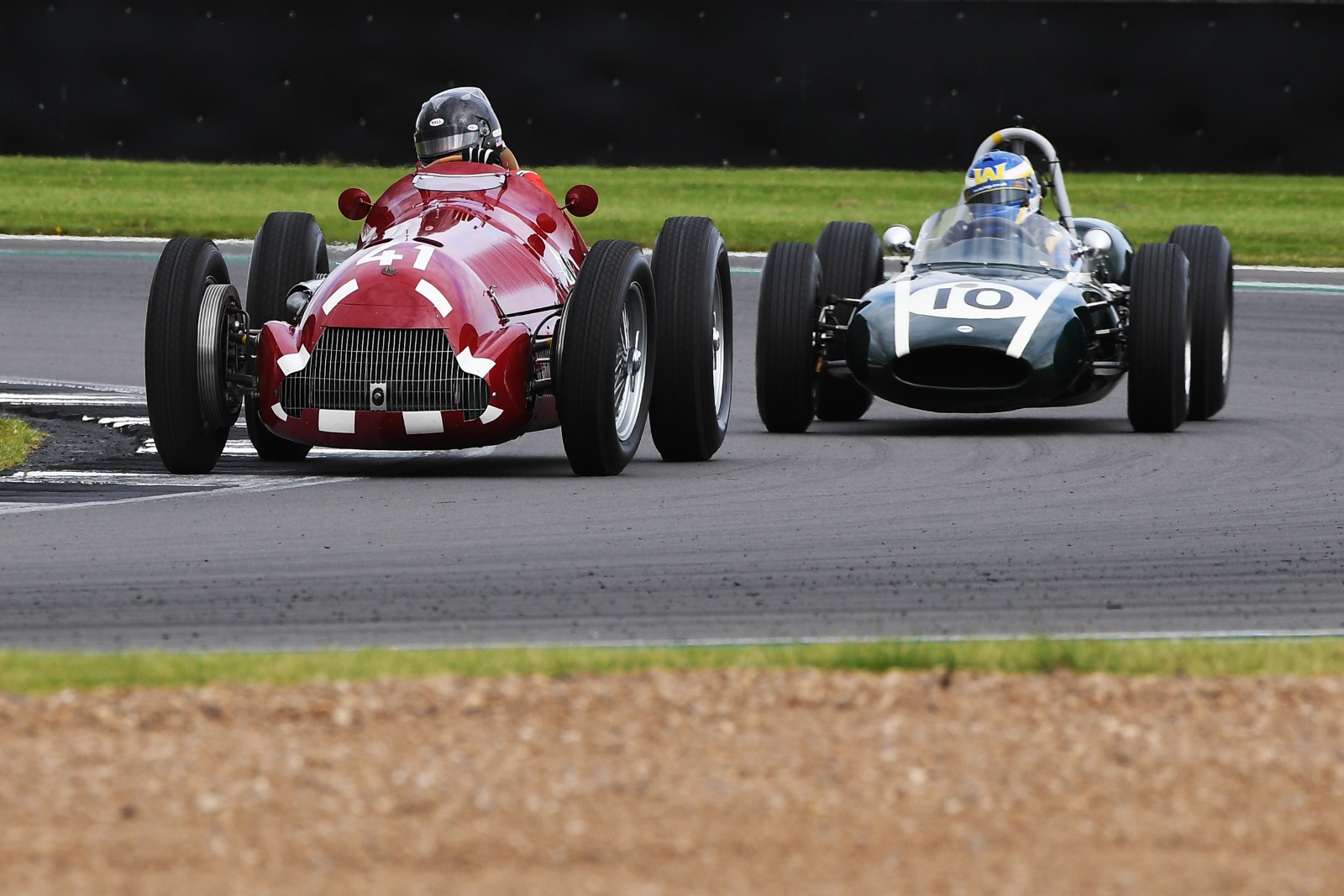
Alfa and Ferrari fan Greenfield relishes racing the 158
Photo by: JEP

Ryder clinches third British Hillclimb title by a single point at Prescott

Heard the one about the Northern Irishman rallying a Russian Lada?

Menzies takes hillclimb honours on another record-breaking day at Shelsley Walsh

All level in British Hillclimb title fight after contrasting Harewood fortunes

Hall breaks Shelsley Walsh record on momentous British Hillclimb day

Hall at the British Hillclimb summit after incredibly close early rounds

The thrills and spills from an epic Roger Albert Clark Rally

Lepley finally takes BHRC win

WEC Barcelona: Toyota scores dominant 1-2 to clinch manufacturers’ title

When Can-Am made its controversial comeback

Mercedes explains why its upgrade made its F1 car harder to drive

How levelling the playing field isn’t antithetical to the principles of F1
Subscribe and access Autosport.com with your ad-blocker.
From Formula 1 to MotoGP we report straight from the paddock because we love our sport, just like you. In order to keep delivering our expert journalism, our website uses advertising. Still, we want to give you the opportunity to enjoy an ad-free and tracker-free website and to continue using your adblocker.


Top Comments