
Inside the lightweight Czech sportscar making its mark on the UK
Ahead of Praga running its own standalone series in partnership with Britcar, Autosport got behind the wheel of the Czech company’s R1 at Donington – and was left very impressed
I’m in this little-known closed-top sportscar, hammering around Donington Park, overtaking Porsche 911s and McLaren supercars like they’re Nissan Micras being driven by doddery pensioners.
I’ve enjoyed myself so much that I’ve hung around hoping for an extra run in the car. When it finally comes, I gain the benefit of my brain auto-processing everything it learned in the morning. Now I’m beginning to join the dots properly – full gas through the Craner Curves, attack the Old Hairpin in fourth gear, getting into a flow of sorts. Clear laps are hard to come by – but when one does, I’m lapping the Grand Prix loop in well under 90 seconds.
My brain is rattling from the vibrations, but I’m loving every second. These are the days you fall in love with motorsport all over again. Today, it’s all thanks to Praga.
Like most people, I’d never heard of Praga. Unless you’re an avid follower of Britcar and its Endurance class structure, why would you? It sounds a bit like a famous fashion line, but not like any serious car maker you’ve heard about. That’s a legacy of the Cold War and what used to be called the Iron Curtain.
To automotive aficionados in the Czech Republic, Praga is sort of the Rolls-Royce of Eastern Europe – renowned maker of cars, trucks, tanks, fire engines, basically “anything with a motor” according to Praga’s UK managing director Mark Harrison. He worked at McLaren when it (re)launched its automotive arm in 2010. His job since the start of last year has been to build brand awareness for Praga globally, and in the UK that means motorsport – specifically a racing programme, and more specifically a one-make series, which will begin on the Britcar package in 2022 after a season racing as a bespoke class within the Endurance grid.
Praga has prior motorsport heritage, competing annually in the truck division of the Dakar Rally according to Harrison. It is endorsed by Czech former World Rally driver Roman Kresta and counts Czech former GP2 podium finisher Josef Kral and none other than recent ex-Formula 1 turned IndyCar racer Romain Grosjean as ambassadors.
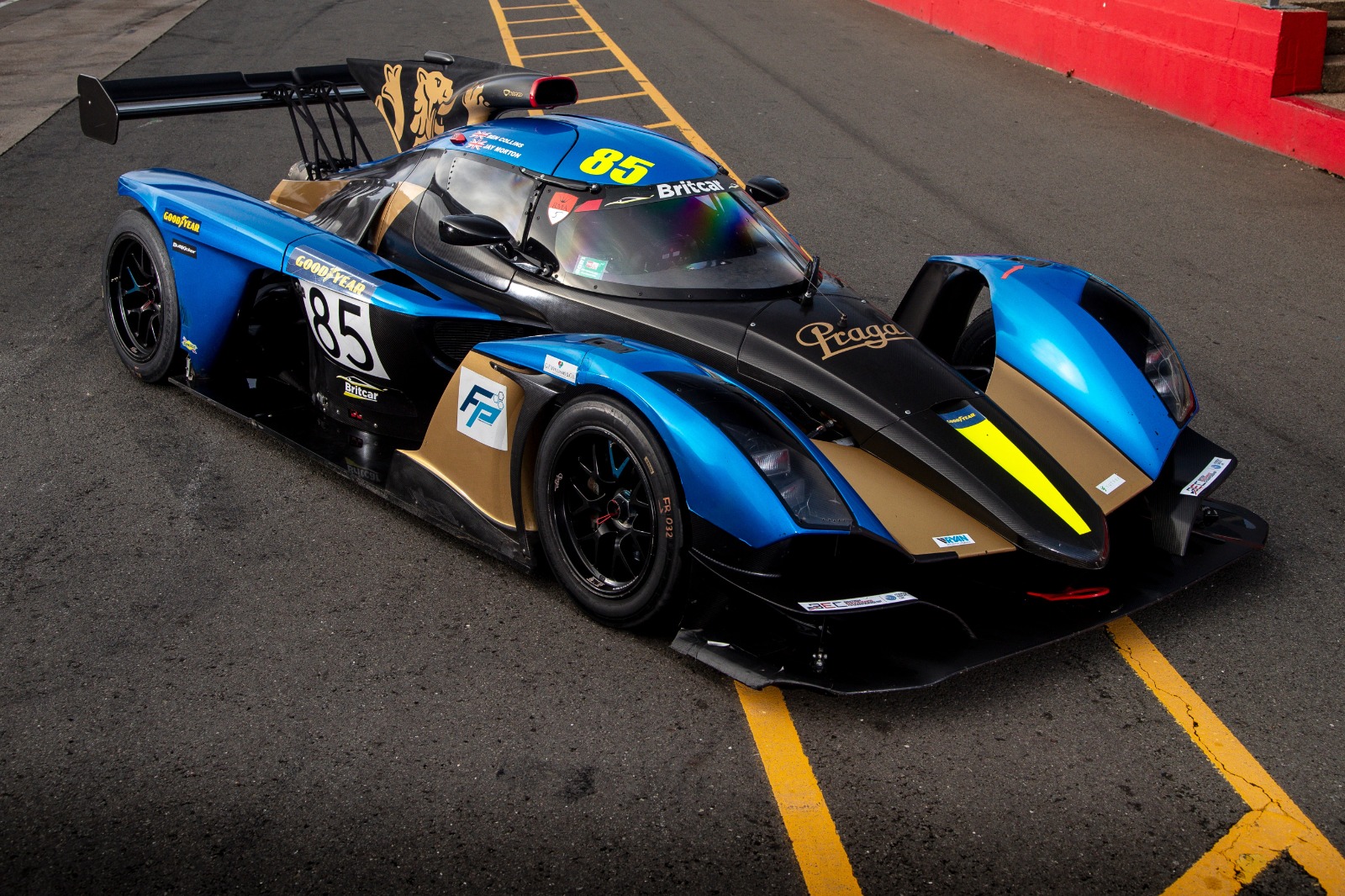
Praga has set about building a presence in the UK for a car that it had already developed, but without thought to where it would race
Photo by: JEP
The car itself is a neat-looking closed-cockpit sports-prototype that occupies the territory between club racing and Le Mans feeder categories such as LMP3. In fact, VR Motorsport – the UK distributor for Praga – tells me the R1 has previously beaten LMP3 cars on twisty circuits such as Zandvoort, owing to its lightness and extra agility.
It retails at €195,000, which puts it a step clear of Radicals and Revolutions – which also occupy this space and retail closer to £100,000 – in terms of price.
As for technical numbers, the R1 is well over 100kg lighter than the Revolution (643kg to 795kg) and just under 80kg lighter than Radical’s proven SR8 or new SR10 models.
PLUS: How Radical's latest machines fare on track
Power-wise, Revolutions and Radicals come in just north of 400bhp, but at just 365bhp in its highest engine mode, the turbocharged two-litre ex-Formula Renault unit in the back of the Praga R1 is giving up 60bhp to Radical’s turbo SR10 and a bit less to the converted bike engine(s) in the SR8 and the Ford V6 in the back of Phil Abbott’s Revolution. The R1’s Hewland transmission is stretched at this output, but that too helps keep the Praga light and compact at the rear.
"Before working out where they wanted to go racing, they [Praga] designed and engineered and built the perfect racing car. It’s a bit arse about face in that respect, but it means we are where we are now with this unique full-carbon aero racer that is unlike anything else out there" Mark Harrison
All this means the lap time spread is reasonably tight. An SR3 will do the GP loop in around 91s; an RXC in just over 90s (comparable data for the new SR10 is not available yet). Former Radical European Masters champion (and British Formula Ford race winner) Victor Correa has a neat video on YouTube from 2012 of him lapping an SR8 in 1m26.7s. When the Revolution and the Praga each competed at Donington last month (in separate categories), Ross Kaiser’s pole time in the Revolution was 1m28.683s; the fastest R1 did 1m26.367s.
Having driven Radicals (multiple times) and the Revolution (in the wet) around Donington, I’m keen to see how the Praga stacks up. The R1 should be more sophisticated than the spaceframe Radical range, while also benefiting from several years more development than Abbott’s fledgling Revolution.
Mostly, this work has focused on suspension and engine tuning. Earlier iterations of the turbocharged two-litre Renault engine were fairly brutal in their power delivery says VR Motorsport, which has been working with the R1 since 2015.
PLUS: Driving club racing's Revolution
“A guy called Jan Martinek, a suspension engineer at Skoda who worked on motorsport suspension, he was sort of the engineering inspiration behind this,” says Harrison.

Anderson is given a crash-course in the controls of the Praga R1
Photo by: JEP
“The reason why it’s taken let’s say eight years to get a presence is because before working out where they wanted to go racing, they [Praga] designed and engineered and built the perfect racing car. It’s a bit arse about face in that respect, but it means we are where we are now with this unique full-carbon aero racer that is unlike anything else out there.”
Most of the R1s made already are in the US. The car has contended for victory in the Thunderhill 25 Hours, as well as tasting success in the Dutch Prototype Challenge with VR Motorsport and Tim Gray (of 750 Motor Club RGB fame), and is now dominating the Britcar Endurance scene after VR Motorsport engineered a conventional roll hoop into the car to meet Motorsport UK safety criteria.
Having started out as what Harrison describes as a “side hustle” from HQ in the Czech Republic, Praga now boasts dealers for the R1 in California, the Benelux region of Europe, Poland and the UK and Ireland. It’s also branching out into Australia/New Zealand and the UAE, while discussions have started in South Africa, South Korea, Spain, Germany and Brazil.
Praga’s presence in Britcar grew to 10 cars this season. The plan is to go solo in 2022 with a dedicated single-make series running under Britcar’s umbrella. This is a full year ahead of schedule for Praga, Harrison says, but he’s confident of getting 16 cars on the grid.
“Praga’s never really done any sales and marketing,” says Harrison. “It really was the logic, ‘if we build something great, people will buy it’. But life’s not like that… there are odd cars dotted around: Dick van Elk at Dutch GT and Supercar saw it, loved it, got involved; Vincent Randall at VR Motorsport in the UK saw it a few years ago at Autosport International. Vincent really has done the donkey work over the last two or three years to get it approved into UK racing.
“The feedback we get from everybody driving it is sensational. They love it. It’s really accessible. Jem Hepworth, last year’s Britcar Endurance champion. That was her first full season of racing and she was 18 I think, so it’s really accessible to novice drivers. But also, you’ve got really experienced guys like Ben Collins and others, who get a hell of a lot out of it as well.”
When we chat at Donington, Collins is busy doing some set-up work – softer suspension and lighter steering – for the 24 Hours of Zolder (where his R1 qualified fifth overall). BBC Top Gear’s former Stig says he hasn’t raced anything properly for seven years, so when friend Mike Newton – who’s hosting Praga’s UK HQ out of his own Cheshire showroom – came calling, Collins seized the chance to relight the fire.

R1 is powered by turbocharged two-litre ex-Formula Renault unit
Photo by: JEP
“I got a test at Oulton Park in the wet,” he recalls. “And I absolutely loved driving it – it was just like driving an LMP2 car. The best way to describe the handling is somewhere between Formula 3 and LMP2 – because it’s got more power than an F3 car but it’s a bit heavier.
“You can brake really late, really hustle the car. It handles more like a single-seater. It’s got lovely balance. A classic track like this – you’ve got it pinned through Craners, carrying speed, it’s very reminiscent of racing in F3. The only place they’re quicker than us is the hairpins, because they’re lighter on the brakes, everywhere else we’re all over it.”
Collins says earlier iterations of the R1 were “quite physical” before the suspension was upgraded and the steering lightened.
“But that’s the amazing thing, they’re very reactive and they’ve got this really strong engineering pool out in the Czech Republic,” he adds. “Now, the car’s got no vices. It’s the perfect way to progress from a car that’s softer and more slippery. The only thing we’re noticing and are playing with is that first turn of the steering wheel is very crisp, so if you’re heavy handed you’ll know about that quite quickly.”
The R1 is fantastic to drive – like a perfect mix of Radical and Revolution: so light it accelerates much better than the Revolution; and so nimble it handles better than the SR8. The closed cockpit means no buffeting from the wind either!
This is something I learn during my first run in the damp on wet tyres, which begins with an unfortunate double spin through Schwantz Curve after the rear-left wheel meets the kerb. Suitably chastened, I build up speed and confidence gradually. Feeling the grip levels on treaded Goodyears is quite vague, so a lot of the driving is trial and error – but by the end of this run I can feel the wets are beginning to overheat. Turning through the bottom of the Craners creates a frightening kick of oversteer as the rubber reaches its limit.
My ‘crew chief’ (former 750MC Stock Hatch and RGB racer) Al Boulton and I agree the track has reached crossover point, so it’s time for a short break while we wait for some used slicks to finish cooking in the oven. Once those boots are fitted (at 90C), I wind the engine up from Map 1 to Map 3 – taking output from 320-365bhp – and crack on.
I gain confidence as the track improves and find the car is better balanced at high speed with the extra rear grip. I’m picking up a touch of irritating mid-corner understeer through Redgate and presume this is me braking too early and making the corner go on too long. I’m also losing time through the high-speed run from Redgate to Coppice, because I’m still building the trust required to attack the track properly.

Anderson enjoyed stretching the Praga's legs down the Craner Curves in sixth gear
Photo by: JEP
I also notice heavy vibrations coming through the headrest, particularly through the higher-speed corners – it sounds like accidental radio chatter or some kind of nonsensical alien communication! I’m told there is a lot of vibration transferring from the engine bay, and that developments are in progress to dampen this.
By this time, I’ve worked my way into the 1m30s, which puts me about 4s off the pace. I’m convinced I can do better, so hang around waiting for another chance while the track improves.
I want to push myself more through the section from Redgate to Coppice in particular, where I’m giving away most of my time. Despite extra traffic as the track busies up after lunch, this bonus outing is easily my best run. I’m more committed through the high-speed sections, later on the brakes, more decisive with the throttle exiting the turns, faster through the esses, and the hairpins flow much better from entry to exit.
I’m now within 3s (1m29.354s) of the pace and better accessing the prowess of the car through Craners (flat in sixth), Old Hairpin and McLeans. My driving is not perfect but getting closer to the limit. That touch of understeer through Redgate is still there, despite me being more aggressive on entry. Al tells me the car has been set up with a degree of ‘safety understeer’ for its regular driver, who simply can’t stand having the rear snap on him.
Had our day continued, I’d have liked to dial that out – maybe soften the front a bit (as it’s cold) or stiffen the rear to try to sharpen things up. But this is minor stuff. The R1 is fantastic to drive – like a perfect mix of Radical and Revolution: so light it accelerates much better than the Revolution; and so nimble it handles better than the SR8. The closed cockpit means no buffeting from the wind either! A real joy.
Outside of professional sportscar racing, it surely doesn’t get much better than this. Remember the name.

Praga appears to have a bright future in UK national racing
Photo by: JEP

Autosport 75: How Verstappen scored his first F1 win

The supercharged Revolution that has piqued an Olympic legend's motorsport taste

How Radical revamped its record-breaking flagship model

Why the Jaguar E-type remains special at 60

How McLaren’s GT3 ‘single-seater’ defies expectations

How Radical's latest machines fare on track

From the archive: Button's last spell with Williams

Driving club racing's Revolution

Why fans don't get true picture of driver performance with 2026 F1 rules - but it is fixable, according to Haas boss

F1 Hungarian GP: Leclerc tops FP1, Stroll suffers suspected suspension failure with upgraded Aston Martin

Malaysia weighs up F1 2026 round as rescheduled Bahrain GP plan fades

LIVE: F1 Hungarian GP updates - Stroll suffers suspension failure as Aston Martin runs massive upgrade package
Subscribe and access Autosport.com with your ad-blocker.
From Formula 1 to MotoGP we report straight from the paddock because we love our sport, just like you. In order to keep delivering our expert journalism, our website uses advertising. Still, we want to give you the opportunity to enjoy an ad-free and tracker-free website and to continue using your adblocker.


Top Comments