
Why the Jaguar E-type remains special at 60
It’s 60 years since the Jaguar E-type arrived and caused a sensation. As our resident racer Ben Anderson discovered when he got behind the wheel of two special racing versions at Brands Hatch, the thrill of driving them hasn't diminished over time
There is something so elegant about Jaguar’s E-type.
It has style, grace and poise that still turns heads even now, 60 years on from its original release. Our Brands Hatch test day, in early July, wasn’t private, so we shared track time with Legends, Pickups, Mazda MX-5s, even a Trans-Am Ford Mustang – and the pit garages were full of Euro NASCARs, preparing for the coming weekend’s American SpeedFest.
As I trundled up to the pitlane, taking the necessarily circuitous route around the back of the garages from our parking spot in the lower paddock, occasionally having to stop for ambling pedestrians or slow-moving recovery vehicles, I noticed countless NASCAR mechanics, who’d travelled in from Europe, reaching for their smartphones. This is one of the pure joys of driving special historic racing cars.
I recall competing in Simon Hadfield’s ex-Peter Gethin Chevron B37 at the 2012 Silverstone Classic, and the crowds that car drew to the collecting area when I fired her up and revved the engine; the smiles on their faces. It was similar with the E-types. People made signals at me to blip the throttle; they took videos and photos of the cars as they gleamed in the summer sun.
Enzo Ferrari is said to have thought the E-type beautiful when it was first released in 1961, and now I see what he saw, through the joyous faces of these enthralled spectators. Classic cars really are a wonderful thing. Two at a time – well that’s like manna from heaven.
The first and only other time I drove an E-type, at Snetterton in April 2010, I struggled to fit inside the harness and consequently felt quite uneasy driving the car. I was also somewhat distracted by Michael Schryver’s faster Chevron B6, which we ended up racing together at that year’s revived Autosport Three Hours. But I recall being impressed by the road-holding of the Big Cat’s steel chassis, and by the glorious sound of the 380bhp, 3.8-litre, Sigma-tuned XK engine. Great traction, decent handling, but not much stopping power for 1000kg of metal.
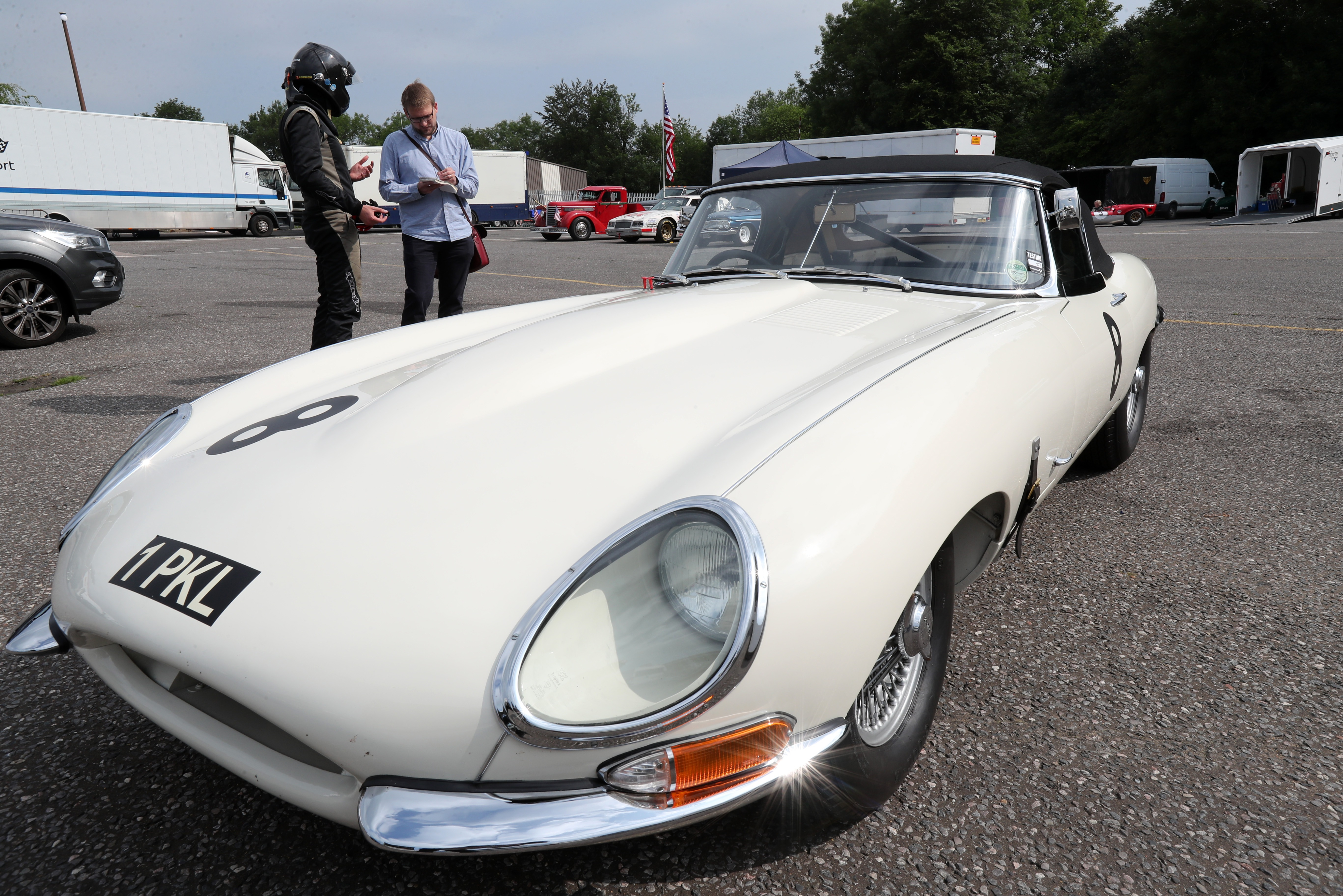
Anderson and Turner exchange notes on PKL
Photo by: Gary Hawkins
First up today is ‘1 PKL’ (E-types are often known by their numberplates), a car originally owned by George Wicken, one of Jaguar’s favoured clients who received an early Roadster. He campaigned it in 1961 and entered the car for the Goodwood Tourist Trophy, though withdrew (along with the John Coombs-entered E-type) because the cars were not yet considered ready.
‘PKL’ did little competition after that, aside from “beach racing and other silly stuff”, according to the car’s current owner, historic racing ace and preparation expert Gary Pearson.
Pearson bought the car about 15 years ago and his Pearsons Engineering company restored it as a Semi-Lightweight (ie quicker!) for historic racing. When pre-1963 competition started to take off late in the last decade, the decision was made to put it back to its original specification.
“Because it had previous competition history, we put it back to Kinrara spec,” explains Pearson. “That racing didn’t exist when we got the car.”
"It’s a comfortable car. You can drive one as quickly as you want for an hour and a half and not feel tired" Gary Pearson
The car has done little racing since, and suffered a clash with David Clark’s Lotus Elite in the Stirling Moss Trophy at the Goodwood SpeedWeek, but is due to contest the RAC Historic Tourist Trophy at the Silverstone Classic this weekend, with Pearson sharing driving duties with Jaguar Le Mans winner Martin Brundle.
PLUS: Eight reasons to watch the Silverstone Classic
Brundle has already driven ‘PKL’ and felt right at home in it straight away, finding it quite an easy car to drive. I have to say I agree with his assessment. It’s agile and pretty nimble for an old thing. Although it’s not one for a tall person – watching me climb, or is it fall?… out was an unedifying spectacle I’m sure – I immediately felt comfortable when driving.
It has a sensible seating position, which feels low enough to assist the car’s centre of gravity without compromising visibility. There was nothing about the ergonomics that bothered me, nothing to distract from the focus on driving. I limited my run to around 12 laps, working my way into the 58-second bracket by the end, but I felt I could have gone on and on without really breaking sweat.
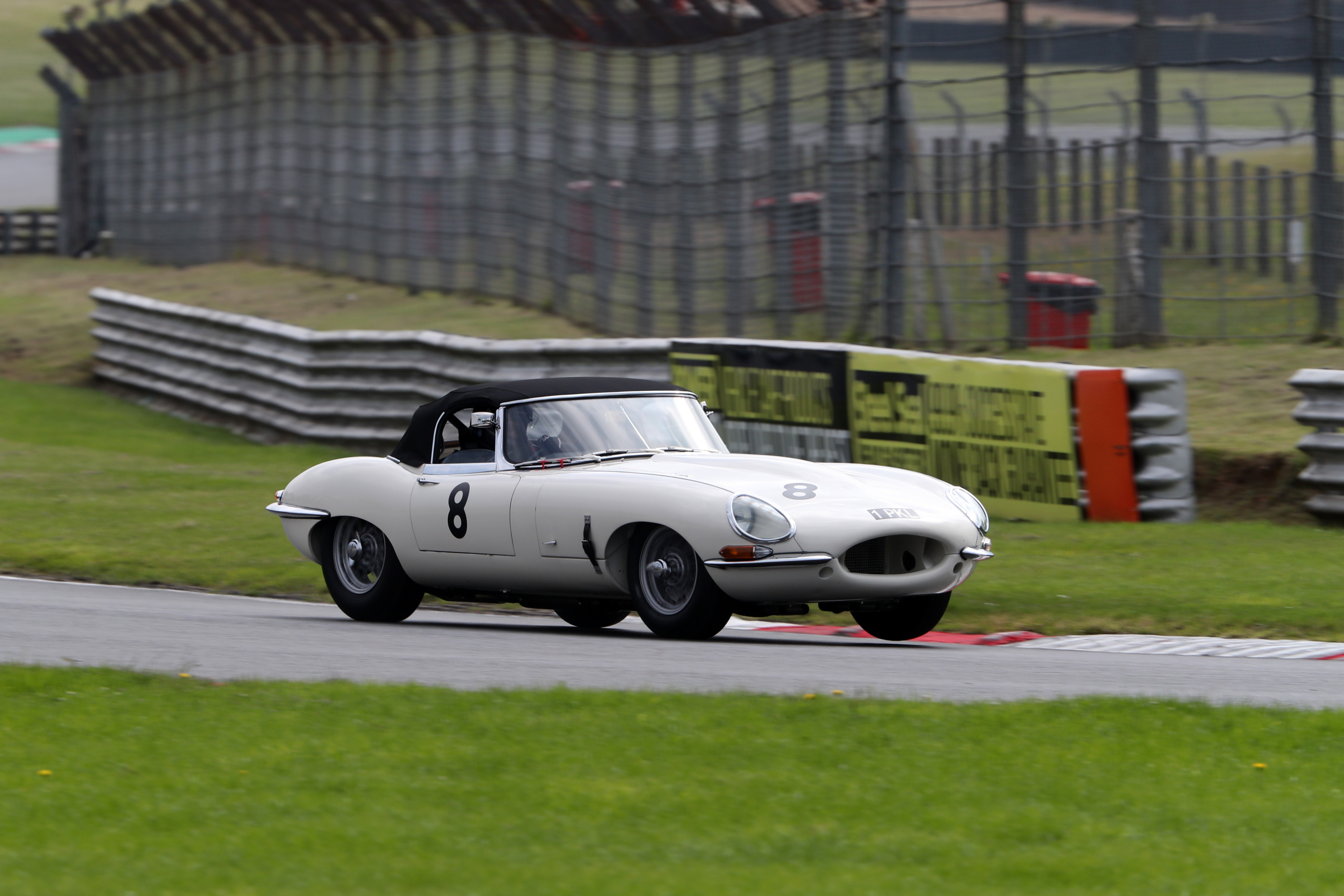
Agile PKL gave Anderson confidence
Photo by: Gary Hawkins
“An E-type is a really enjoyable car to race,” says Pearson. “It’s a comfortable car. You can drive one as quickly as you want for an hour and a half and not feel tired. Do that in a Cobra and after half an hour you’re fighting the car.”
PLUS: The historic racing ace keeping classic Jaguars winning
The brake pedal on this E-type is super-stiff, which is probably the most unexpected feature – it feels like a downforce single-seater set-up with basically next to no pedal travel. Personally, I like that, and in an endurance race it would probably bolster confidence because you would never feel through your foot like you were running out of brakes.
The flipside is that the car doesn’t stop as the pedal feels, which you particularly notice at Paddock Hill Bend and Druids. Coming into Paddock you feel like you’re not really slowing down at all. E-types are known for being ‘under-braked’ and you really feel that limitation at the fastest point on this circuit.
I was heeling-and-toeing while decelerating and downshifting, using some engine braking to help slow the car, particularly for Druids. I started by taking this corner in second gear, but the rev range on the XK engine feels very narrow, so I quickly switched to using first gear, then making a quick (relatively, this is historics after all!) upshift to second on my way out.
The engine didn’t seem to like running at anything below 4000rpm, but between 4000rpm and 6000rpm you feel like you’ve got plenty of useable torque from the 320bhp engine. It has decent grunt and I felt, in terms of straightline speed, that I wasn’t really giving anything away to any of the modern machinery I shared the track with.
This car is really quite driveable, so long as you’re not letting the revs drop too low. Apparently, none other than Bruce McLaren reached a similar conclusion about the ideal rev range in an article for Motor Racing after racing an E-type in the early 1960s. Plus ca change.
The four-speed H-pattern gearbox is very easy to use. There were a couple of times I went for second and almost got reverse on downshift, but I didn’t find it was a problem to avoid jumping accidentally through that gate. As ever with old cars, you just need to take your time with it to get your downshifts right. The upshifts barely required brainpower.
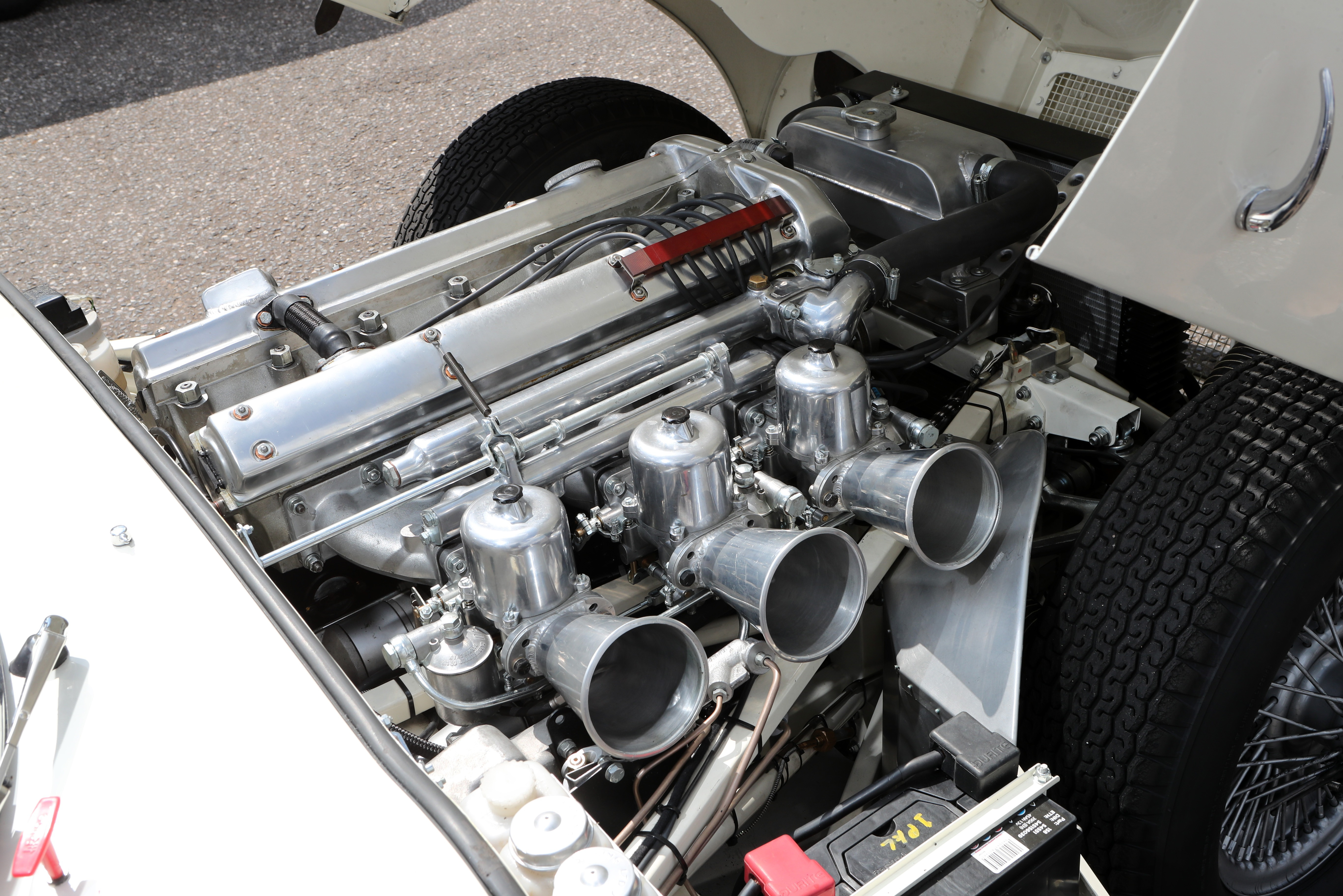
320bhp engine gave good torque
Photo by: Gary Hawkins
I took Paddock Hill Bend in third, feeling I had to brake quite early because of the lack of stopping power, so then I tried to get off the brake as soon as I dared to carry some decent speed through the corner and down into the compression. This was easily my weakest corner, because the brakes did not inspire confidence, and I often found myself wanting to get back on the throttle too soon, which means the entry definitely wasn’t right. I also had to be mindful of MotorSport Vision’s track limits rules, which state you’ll be flagged off and docked session time if you repeatedly run too wide during a test day…
I held third for the run up the hill to Druids, then braked as late as I could, shifting down to first and using the engine to help me stop. I tried to make an early turn here, as the grip level drops significantly if you try to drive too deep into this corner. Because the E-type is front-engined, most of the weight sits over the front axle, which means the car tends to understeer, so I was mindful of trying to keep some weight on the nose as I came off the brakes to help me turn in to the slowest corner on the track – similar to the driving style required for a Caterham Seven.
You can hold second gear all the way down the hill as you cross the track for Graham Hill Bend, but I had to be mindful of the exit kerb at Druids – the car tends to follow any grooves or ruts it finds. The tyres overheated so after a few laps it started to understeer then oversteer through the corners. I got sideways a couple of times at Graham Hill Bend, but the slides were perfectly controllable thanks to the car being relatively soft and malleable.
As my right foot gets heavier with its input, there’s never any real danger of excessive wheelspin or pushing myself off the circuit on the outside
Shift up to third and a gentle brush of the brake pedal for Surtees. I could probably be a bit more aggressive on turn-in, but it’s difficult to tell the gain because the car is a little bit lazy. You can feel all the weight go to the offside at Surtees. It feels better not to attack the entry too much, rather tip the car in gently, straighten up as quickly as you can, then gun the throttle while using as much kerb as you dare.
It’s down to second for Clearways, being mindful of accidentally shifting into reverse. Again, I try to get the car turned in early, to avoid washing out onto the relatively gripless part of the circuit on the outside. Given the car’s propensity to understeer, there seems little point in attacking the entry here and trying to provoke a quicker rotation, but this approach is also a function of my natural tendency to want to prioritise a clean route through Clark Curve to get onto Brabham Straight at optimum speed.
To begin with I reapply the power quite progressively, but conditions are decent and so is the traction. As my right foot gets heavier with its input, there’s never any real danger of excessive wheelspin or pushing myself off the circuit on the outside. I get back up to third gear at or near the marshals’ post that sits adjacent to the pitroad on the inside, then snatch fourth as I come across the start/finish line.
I’m impressed with how well put together the car feels. It looked after me comfortingly as I found my feet after several months away from driving. Given my rustiness, there is room to improve – particularly at Paddock – and once really comfortable I’m sure there’s time to be made from taking a more aggressive attitude and manipulating the car a bit more on some of those corner entries.
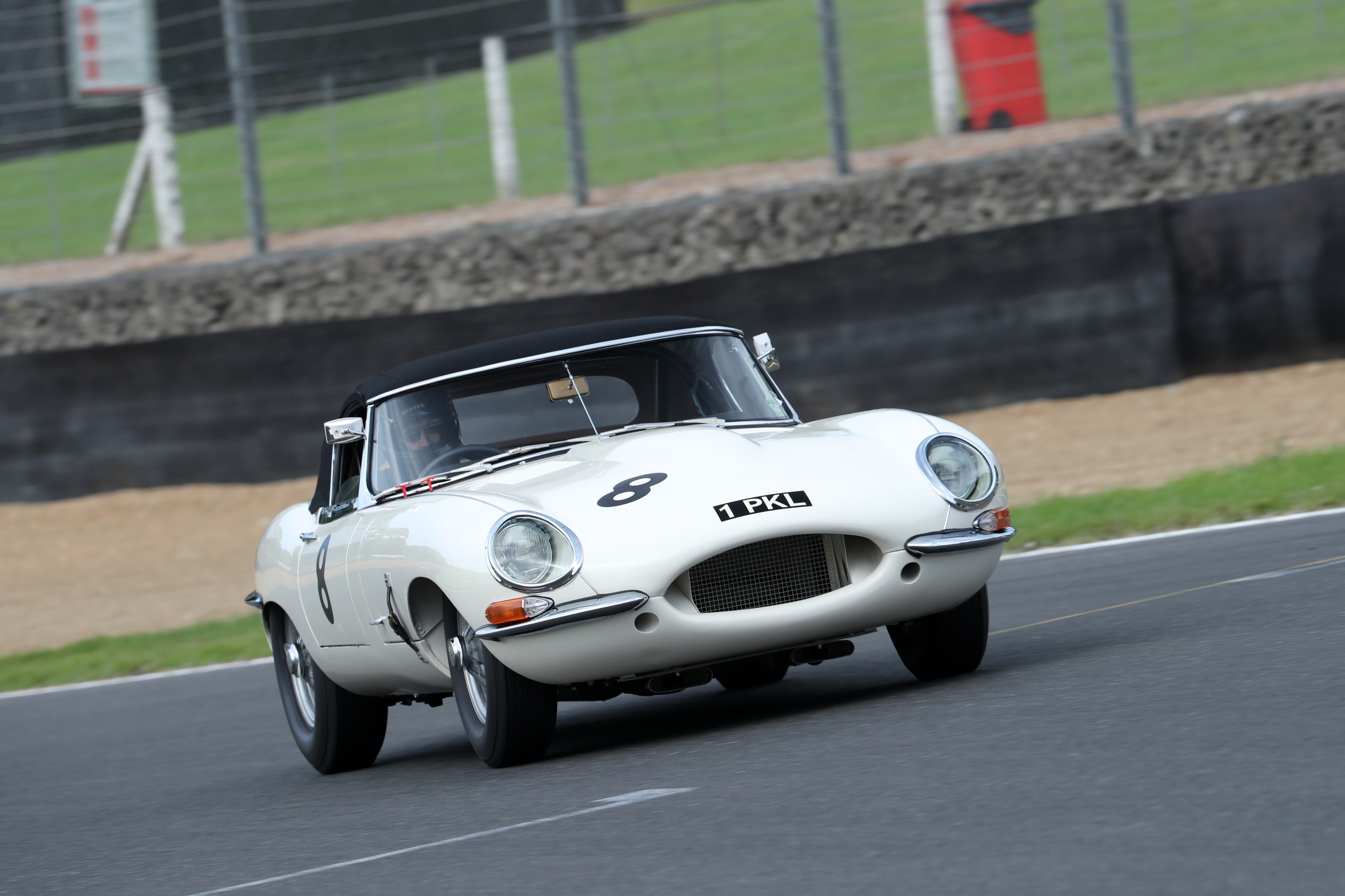
So long as the revs don't drop too low, the E-Type is happy to be driven
Photo by: Gary Hawkins
It’s worth noting that pre-1963 E-types are not slow – thanks to recent developments they can now lap Goodwood in the 1m29s and 1m30s, frontrunning pace for the pre-1966 machines when they returned to Goodwood in the late 1990s.
“The pre-1963 cars are now as quick as the Lightweight E-types were 20 years ago,” confirms Pearson. So, even though this example generally looks and feels a bit road-going, we’re still talking about a highly competent piece of historic racing kit.
There’s barely time for more than a quick coffee before jumping in to PKL’s younger cousin – Pearson’s pre-1966 GT Semi-Lightweight E-type, 254 KTU. This car was built into a Semi-Lightweight a couple of years ago, from a 1963 road car.
“When we put the white car back to the earlier spec, we put all the ‘go faster’ bits on this one,” says Pearson. “The Semi-Lightweight has more grip because we can run wider tyres – 700Ls compared to a maximum of 650s for the white car. It’s a bit more of everything. The aero on the white car isn’t as good because of the soft top, and it is heavier.
“The Semi-Lightweight feels that bit more planted and we can run it stiffer. You need to throw it around a bit to get the nose in so you can get on the power earlier.”
Development work on the engine has also afforded the car more power. The maximum achieved in period was around 340bhp, but 380-400bhp is now possible with work such as porting the heads. The motor in KTU is chucking out 380bhp, so that’s an extra 60 horses to play with compared to the earlier example. It also has slightly bigger brakes than PKL, which is useful considering how much quicker we’ll be arriving at those corners.
Amply warmed up and now dialled into the track, I feel immediately quicker and more purposeful when I steer KTU out onto the Brands Indy Circuit. I’m told the car looked that way from the outside too, and the lap times (faithfully logged by Autosport’s chief editor Kevin Turner) bear out that impression. Having overheated the skinnier tyres on PKL during my short earlier stint, this time I do a couple of installation laps before diving back into the pits to have the pressures adjusted.
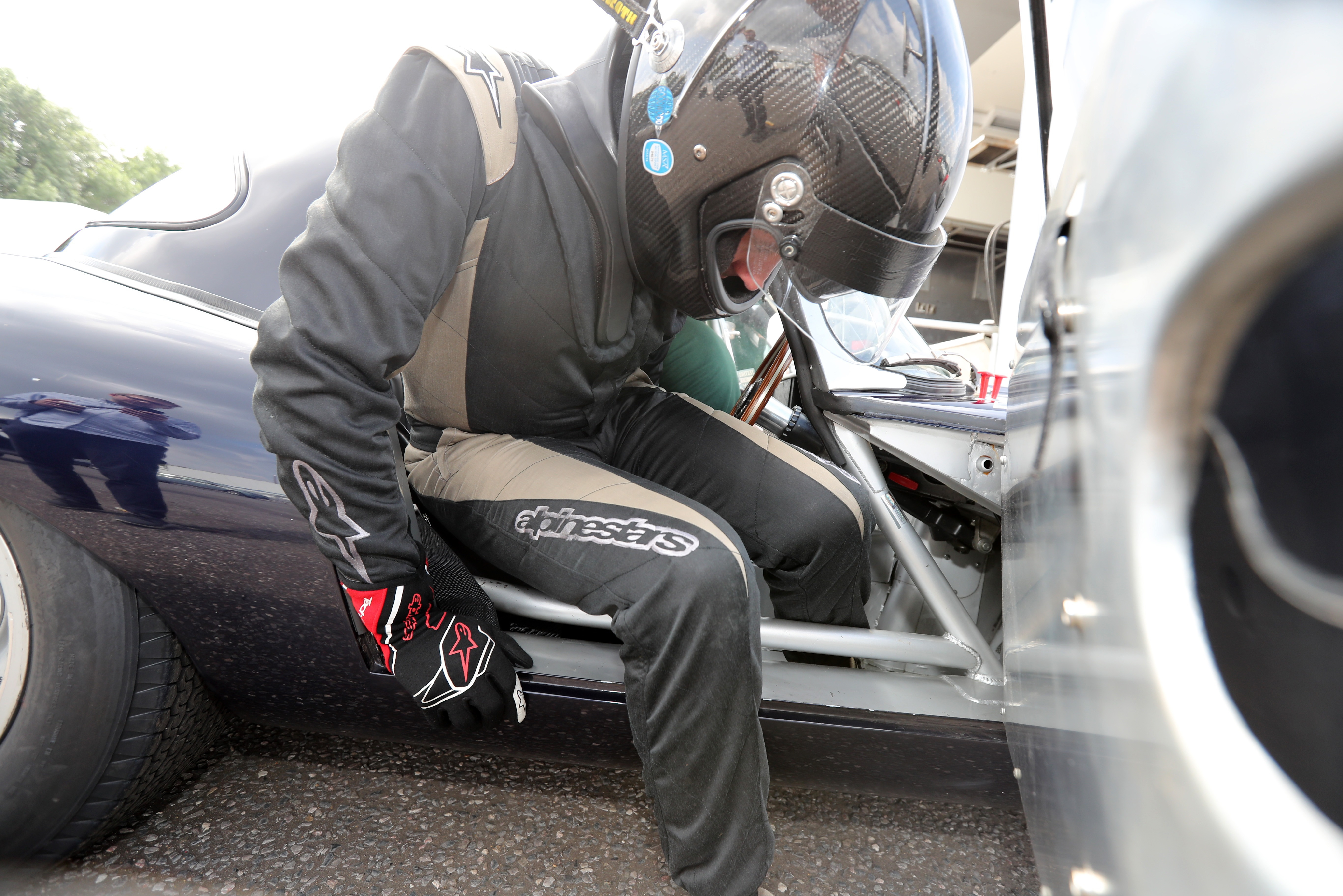
Fitting his tall frame into KTU was a challenge, but Anderson found it a treat to drive
Photo by: Gary Hawkins
After heading back out I’m straight into the low 57s in this car, then a trio of mid-56s laps, then a 55.8s before traffic – a Lotus Elan and a modern Mini Challenge Cooper – disrupt my rhythm. In four more flying laps I manage a best of 55.7s before peeling into the pits for good.
The extra grip from those bigger tyres, and the extra stiffness dialled into KTU’s set-up, becomes apparent from how much harder I feel I must work behind the wheel. To a certain extent this is a function of me getting more confident behind the (skinnier) steering wheel on my second run of the day, but it’s also the case that KTU just feels that bit more alive than PKL.
KTU has a softer, more conventional feeling to its brake pedal, and there is more throttle travel now that we’re dealing with a significant chunk of extra horsepower. When I pick the throttle back up on the exit of Clearways and drive the car around Clark Curve, KTU drifts into a powerslide that doesn’t really settle down until you’ve crested the first part of Brabham Straight opposite the marshals’ post. That means you have to be more progressive with the throttle, otherwise a gravelly accident awaits…
My confidence was up for this run and I began to enjoy drifting through Graham Hill Bend and Surtees, and even occasionally through Paddock Hill Bend, so was definitely closer to the limit with KTU than I had been in PKL
Once the tyres warm up, this settles down a bit, but the car still drifts at Clearways and moves around at Surtees. If you miss your apex travelling at this speed, you’re likely going to have to stay on your line, so you have to be more precise with your inputs than in the older car.
I again tried to use second gear at Druids, but first again proved the better way to go. KTU had an even narrower rev range than PKL – it felt like anything below 5000rpm created a misfire of protest from the combustion chambers. Consequently, this engine felt as though it was running a much peakier camshaft and that most of the grunt was at the top end of the range; the higher the revs, the better she sang.
I had to be much more alert driving this car, and was sweating when I alighted, which wasn’t the case in the pre-1963 version. It wore me out much more than the older machine! There was nothing there that frightened me, but I did feel the effort more and would probably find it harder to drive consistently over a long race distance.
I was a bit too tall for the seating position in this car – my helmet was touching the rollcage and I could feel the vibrations through it – but my confidence was up for this run and I began to enjoy drifting through Graham Hill Bend and Surtees, and even occasionally through Paddock Hill Bend, so was definitely closer to the limit with KTU than I had been in PKL.
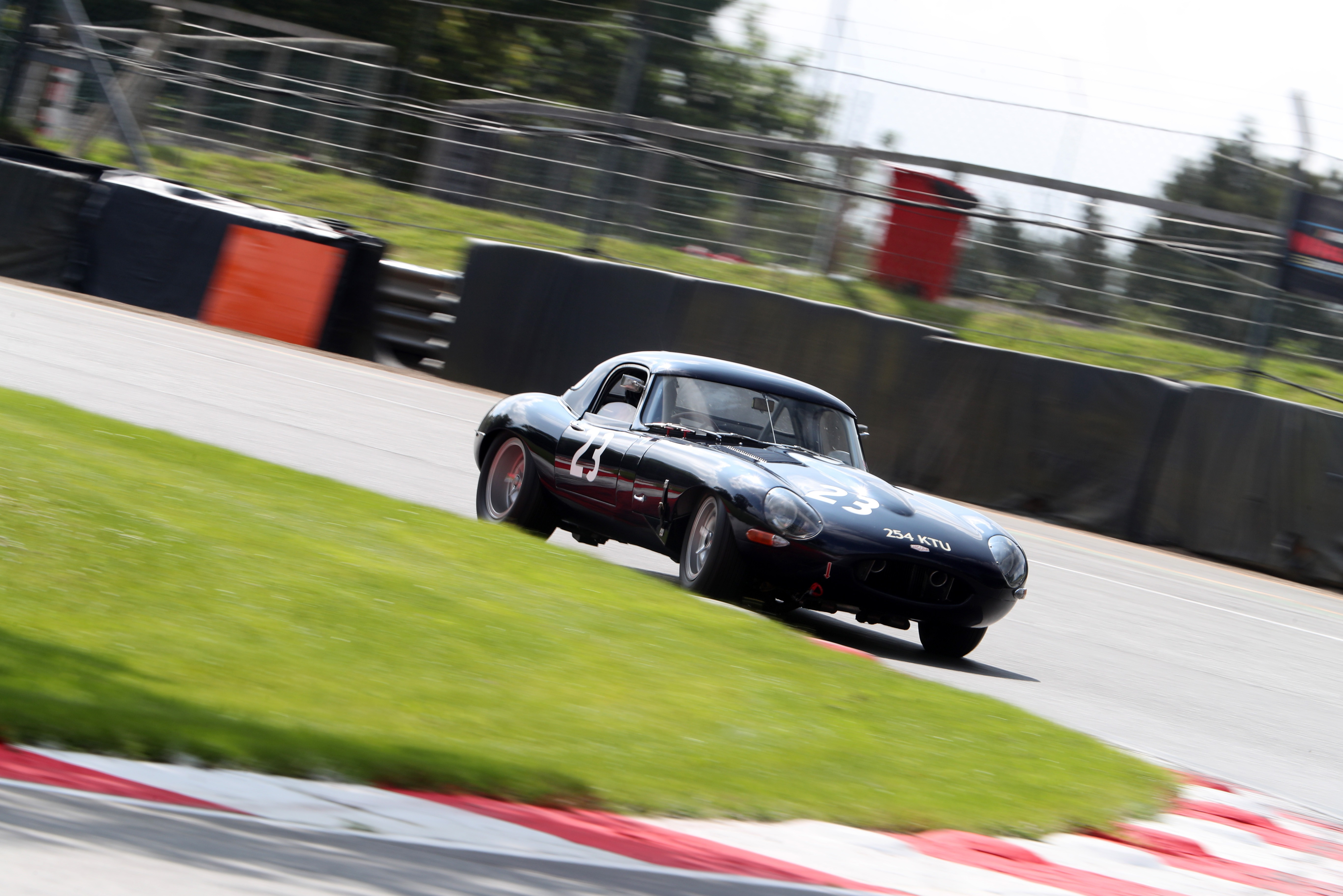
Lightweight, more modern model gave Anderson a workout
Photo by: Gary Hawkins
Adjusting the tyre pressures made quite a difference to the consistency of the car’s behaviour through the run – I’m told that getting this right is one of the main performance differentiators when E-types are racing – and the extra stopping power from those slightly bigger brakes meant it was possible to brake at similar points to the older car despite arriving that bit faster.
I also felt I could be earlier and firmer back on the power in most places, though it might also be true that I was driving better after the first session and rotating the car more effectively. I would probably have gone a chunk quicker if I’d had another run in PKL.
The run in KTU suggested to me that Brands Hatch Indy is a bit tight and busy for E-types. I imagine Brundle and Pearson will be much more in the car’s element at fast, flowing Silverstone this weekend – drifting gracefully through all those high-speed corners, turning heads, bringing smiles to faces, triggering people to reach for their smartphones to record this iconic piece of motor racing history in all its glory.
Autosport would like to thank MotorSport Vision and Pearsons Engineering
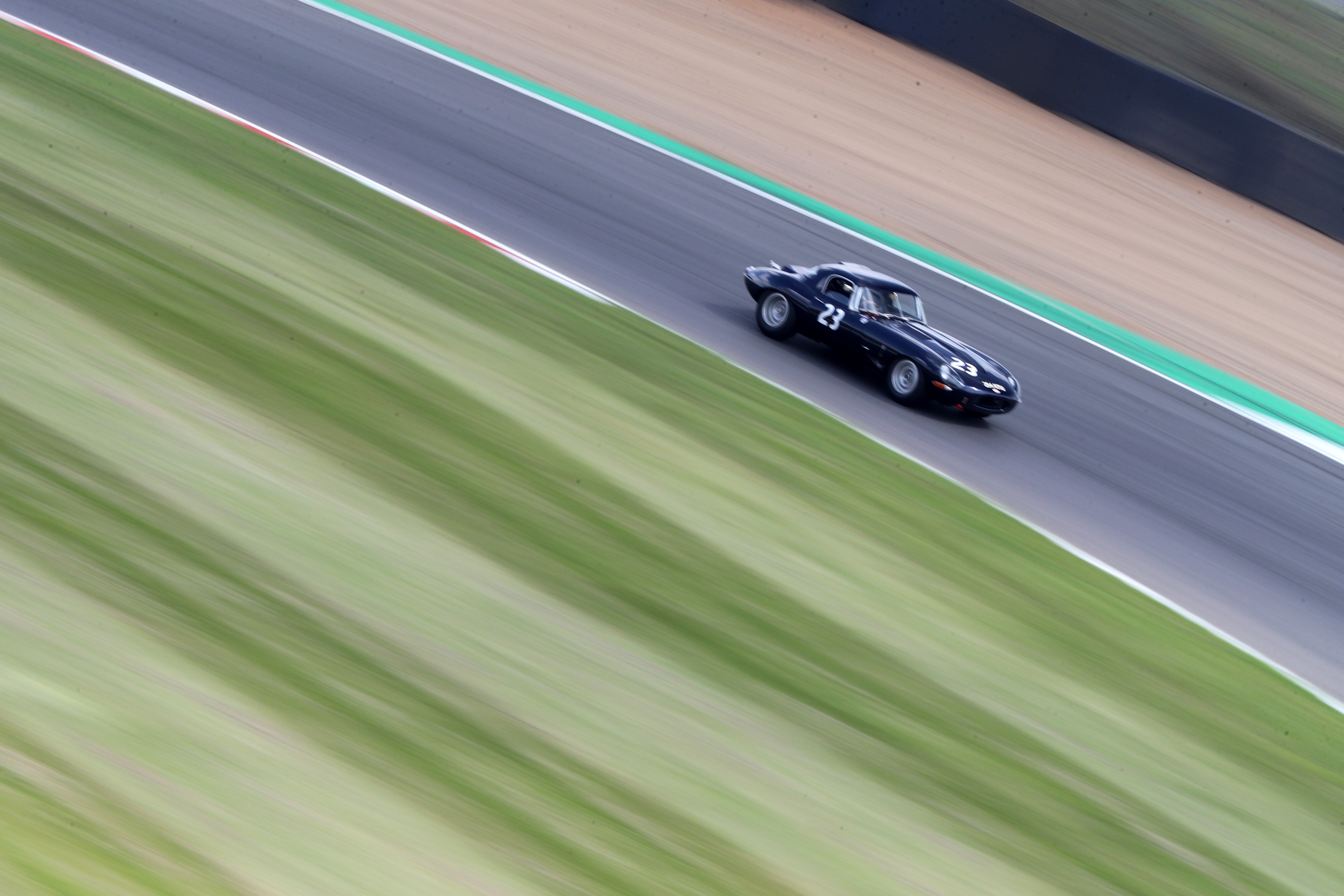
60 years on, the E-Type remains as special as ever
Photo by: Gary Hawkins
Next Stop: Oulton Park Gold Cup
Jaguar E-types can be seen at many historic race events. MotorSport Vision has already held its big Donington Park Historic Festival and Legends of Brands Hatch Superprix meetings, but there is still another extravaganza to come in 2021.
The Oulton Park Gold Cup began as a non-championship Formula 1 race in 1954, won by Stirling Moss in a Maserati 250F. It largely continued as a contemporary event for the rest of the century, being held for all manner of machinery at different times, including F5000, sportscars and British Touring Cars. But it is now one of the Historic Sports Car Club’s big meetings.
E-types are likely to feature in this year’s Guards Trophy for GT and sports-racing cars, and the Dunlop Historic Trophy for pre-1966 Jaguars, which seems fitting given the Jaguar won on its competition debut at Oulton Park 60 years ago.
As is the case with most historic celebrations, a wide variety of tastes is catered for. Single-seater fans can enjoy the Aurora Trophy for F5000, F2 and Formula Atlantic cars of the 1970s, Historic (1964-70) and Classic (1971-84) F3, two groups of thrusting Formula Fords, and Formula Junior. Historic Touring Cars (pre-1966) and the Dunlop Saloon Car Cup (featuring the ever-popular Super Tourers) should please tin-top aficionados, while the Historic and 70s Road Sports sets will bolster the sportscar action.
An auction and classic car displays add to the off-track entertainment, while an F1 demonstration is set to include a Benetton B190.
This year’s Gold Cup will take plan on 28-30 August. For more information, visit oultonpark.co.uk
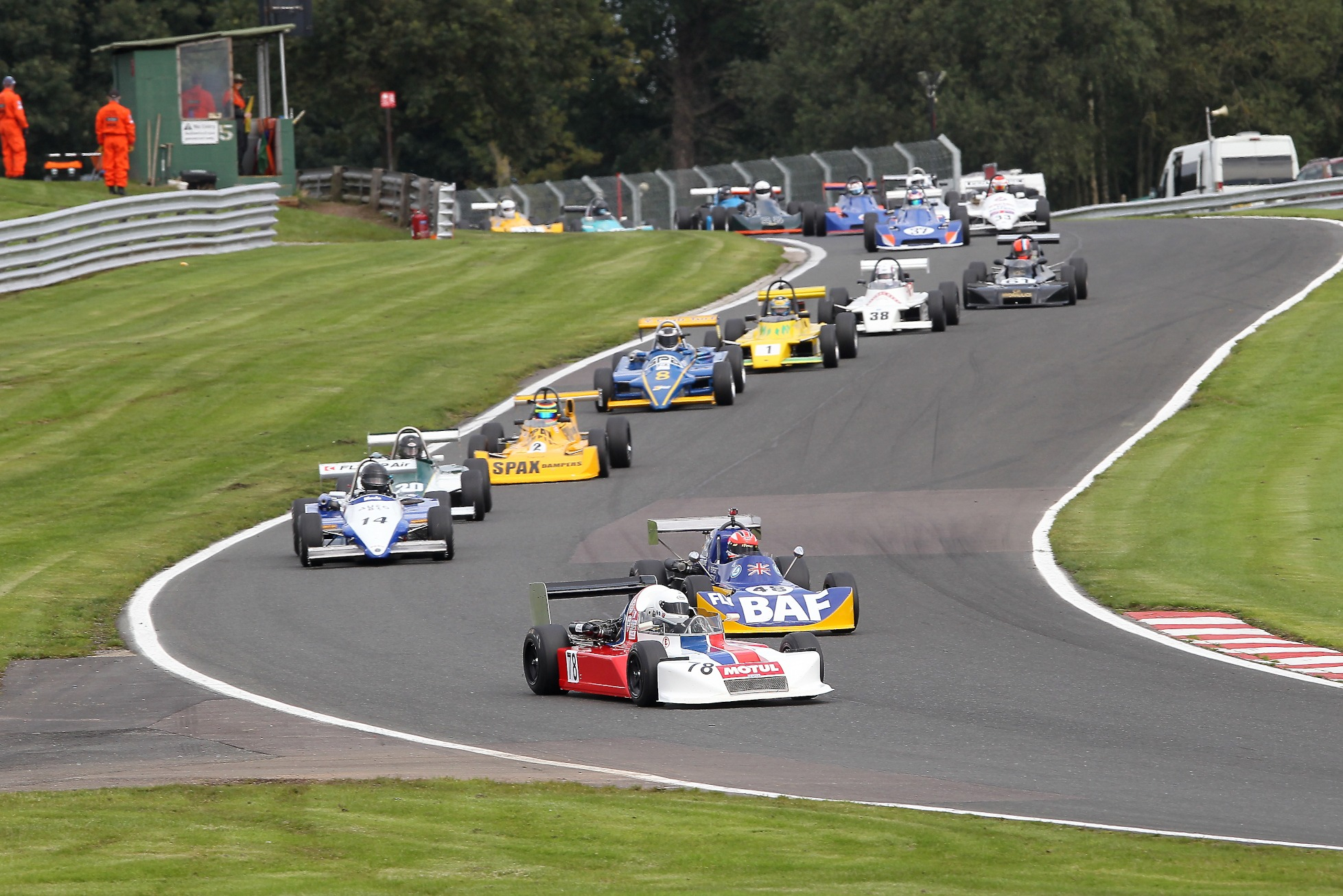
Classic F3 cars will be in action at Oulton Park
Photo by: Mick Walker

Autosport 75: How Verstappen scored his first F1 win

The supercharged Revolution that has piqued an Olympic legend's motorsport taste

How Radical revamped its record-breaking flagship model

Inside the lightweight Czech sportscar making its mark on the UK

How McLaren’s GT3 ‘single-seater’ defies expectations

How Radical's latest machines fare on track

From the archive: Button's last spell with Williams

Driving club racing's Revolution

WRC Rally Italy: Solberg grabs early lead with Evans third in title decider

The unpredictability to expect for F1's one-off return to Sepang in 2026

The reasons behind Ford's impending WRC factory return

F1-linked karting stars who should be on your radar
Subscribe and access Autosport.com with your ad-blocker.
From Formula 1 to MotoGP we report straight from the paddock because we love our sport, just like you. In order to keep delivering our expert journalism, our website uses advertising. Still, we want to give you the opportunity to enjoy an ad-free and tracker-free website and to continue using your adblocker.


Top Comments