
How McLaren’s GT3 ‘single-seater’ defies expectations
Time in a thoroughbred racer leaves you searching for time in yourself, especially when the rewards for total commitment are so high, as our man discovered at Snetterton
I’m driving back from Snetterton down the M11, traces of earlier adrenalin still coursing through the bloodstream. I’m trying to decompress, and somehow process my experience. The usual stuff: what I did well; what I didn’t do well; where I could have done better. A racing driver’s staple diet.
I’m thinking particularly about the last part of the lap, the bit that still feels most like the old circuit: the Esses, Bomb Hole, and the entry to Coram – that corner used to be super-fast, but it’s now a frustrating, long-radius, almost 180-degree right-hander that feeds into the second part of what used to be the Russell chicane.
It’s through this section – five corners if you’re being generous, three if you’re not – where I’m giving away most of my laptime deficit to McLaren pro driver Rob Bell. The main difference is that Rob brakes later for the Esses and shows more trust in the car’s aerodynamics through the fast bits. That’s not unexpected, but what is unexpected is how insanely late you can brake, and how hard you can attack these corners in what is a 1200kg supercar.
I didn’t think GT3 cars were like this, or supposed to be like this. I was expecting something lazier; something with a lot of power and a few gizmos to help you control that power, but not much else.
How wrong I was. What you have here is something much closer to a thoroughbred racing car. When you drive it, as I was fortunate to do for 25 flying laps and on a couple of sets of new Pirelli tyres, it feels closer to a junior single-seater or a closed- cockpit LMP3 prototype. I thought GT cars were all ‘point and squirt’, but this thing actually likes going around corners.
When I describe the feeling of discombobulation from this unexpected discovery to McLaren head of customer racing Danny Buxton and McLaren Automotive motorsport chief Ian Morgan (previously a Red Bull engineer during that F1 team’s title-winning years), they break out in knowing grins…

“We think we’ve got a car that’s as good as anything out there,” says Morgan, whose team launched the 720S GT3 in 2019. “We’ve got a massively stiff structure that underpins the whole thing; we’ve got a lot of focus on aero; we’ve got good suspension. Any race car needs all those aspects to be right for it to be competitive.
“There’s a lot of guys on board with our team who’ve got single-seater backgrounds, like myself, and I guess that maybe changes the way we go about trying to do a car as well. So, a bit more of a single-seater feel – very dynamic, quick to change direction, quick to respond; the things that make the car very agile. And ultimately rewarding, because nobody wants to spend 24 hours driving a car that’s lazy or boring, or which you have to hustle too much.
“We get a lot of good feedback, particularly from new drivers that come in. The likes of Brendan Iribe and Nick Moss who have come from Pure [McLaren’s own one-make GT4-spec racing series] and within one year have gone through GT4 into GT3. It’s very rare that you see anyone getting in for the first time who doesn’t feel they can get on it quickly. It gives confidence quite quickly, which is absolutely perfect for the bronze drivers.”
Which is exactly the category of driver I would be if I lived in a parallel universe where I’d made loads of money and was planning on racing one of these cars seriously. I’m in a decent position to put McLaren’s philosophy to the test. My GT experience is limited, and I’m being dropped into the team’s test mule for a few runs around some traction control development work that Bell is undertaking.
I’m slamming on my anchors too soon and at not much more than half the pressure he’s generating. This means I’m also not benefiting from the extra engine braking available from making rapid, last-second downshifts on the paddles
Snetterton is cold, but the sun is out at least, slowly drying the circuit after some overnight rain. As time ticks on towards midday, I finally get the call to jump in. From the moment I first clamber aboard, I’m impressed with what I find. I’m comfortable, the seating position is perfect, the pedals and steering wheel position easily adjusted. I feel like the car’s been made for me, even though it hasn’t.
“We designed everything to be accessible through the steering wheel,” explains Bell, as attention turns to the various switches and dials laid out before me, “so you don’t have to take your hands off.”
Giant-killers: When Geordies won the day in a "bucking bronco"
Three dials across the top of the wheel control engine map, traction control and ABS settings (12 options for each function), and there are buttons to the right for reverse gear (hopefully won’t be needing that!) and to start the engine.
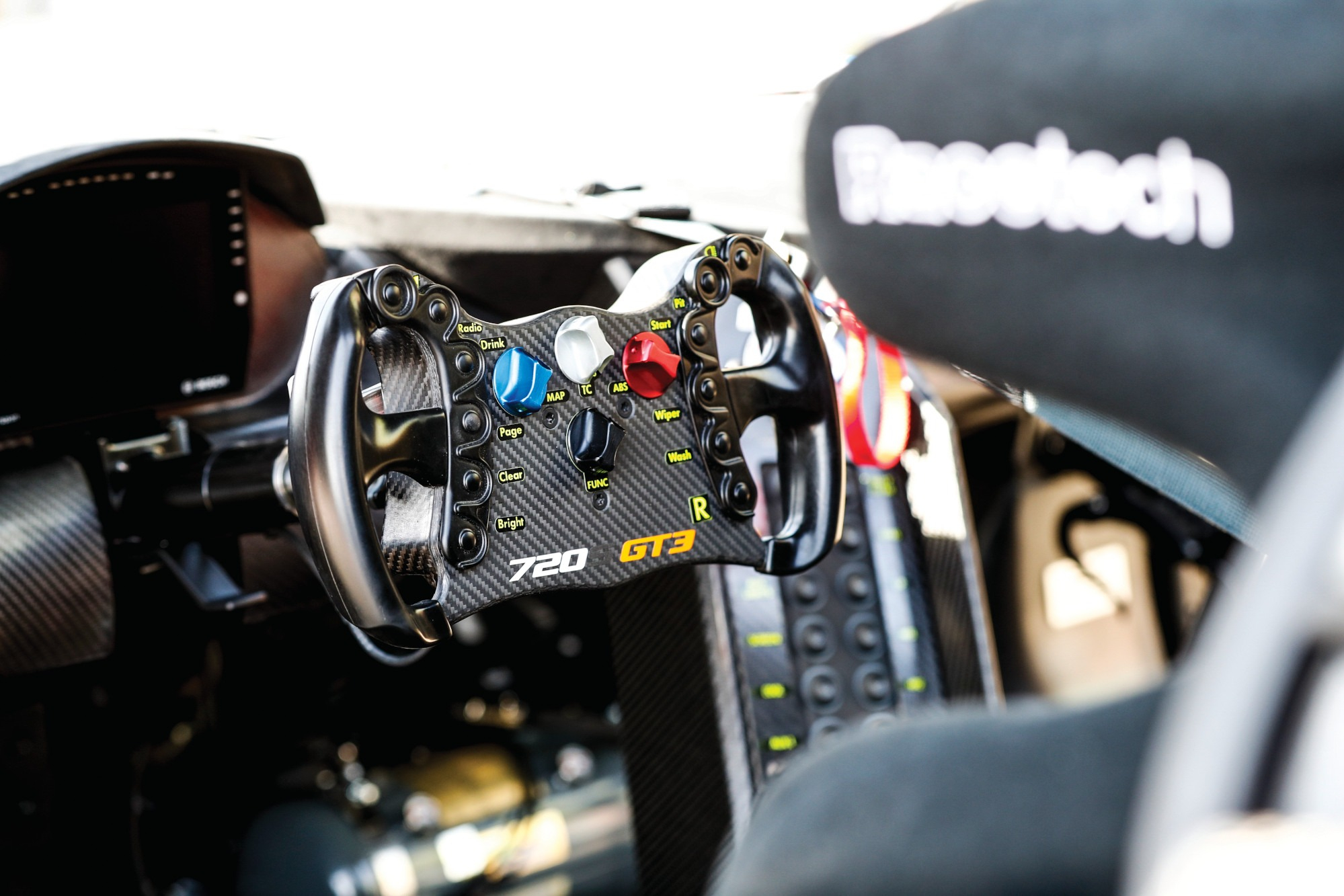
“The ABS, you don’t want to use,” adds Bell. “It’s a great tool in the wet, but you’re not [really] in control [when you use it]. We want this to be a car you drive, not one that does everything for you. The TC is primarily designed to help look after the tyres, not help you out of a shitty situation…”
The first run (on old tyres) goes off without a hitch. The cold track means front tyre temperature is difficult to generate, but of course I’m not immediately driving at a level that would land me in any real trouble in any case. The car is accessible, feels solid and enveloping – like an affectionate bearhug. My data traces are pleasingly similar to Rob’s in terms of style and steering input. The deficit starts, as ever, with braking technique.
I’m slamming on my anchors too soon and at not much more than half the pressure he’s generating. This means I’m also not benefiting from the extra engine braking available from making rapid, last-second downshifts on the paddles.
I get new boots for my second run – just a fortunate quirk of the test schedule. Unfortunately, an early chequered flag cuts this outing short after five laps. Beforehand, Rob completes a new-tyre run of his own and cuts a 1m48.2s lap, which provides a useful reference for me on the dashboard.
McLaren’s system logs mini-sectors in real time, so you can see yourself gaining – or in my case losing – time as you make your way around the lap. I’m into the 1m52s now, so still a fair way to go. I can feel I’m not quite at the races yet, not achieving the rotations I want at low speed, while Rob is compounding my weaknesses with greater commitment through the higher-speed stuff at Riches (taken in fourth gear), Bomb Hole (also fourth) and Coram. I at least break into a sweat this time, so things are starting to happen.
For my final run, I get more new tyres (lucky me!) and a full 10-lap stint. This time I can feel myself make clear improvements in technique, braking harder and getting the car to come to life under braking. Arriving onto the back straight, I’m consistently forecast to achieve 1m50s laptimes. But several times I encounter traffic through the last part of the circuit, which breaks my rhythm. On clear laps I still drop between one and two seconds to Rob, who displays his greater level of trust in the aerodynamics.

As I move past the peak of the tyre, I can feel some snap oversteer on corner exit, so I dial the TC up from ‘4’ to ‘5’. Towards the end of the run I’m consistently in the low-1m52s, so I feel sure a smoother run would yield at least a 1m51s. Rob jumps back in straight after me and I notice he consistently laps in the 1m49s-1m50s. I was starting to wake the car up, no doubt; beginning to feel what it is really capable of. But now my time is up.
Later, I reflect on how well the car looked after me, encouraged me to find fresh ground without ever threatening to turn nasty on me. I was able to progress step by step with each run, a process that surely would have continued had I been able to continue driving. It seems to me that McLaren has consciously engineered the learning curve on this car, delaying the difficult part of the slope – those last bits of hard-to-find time – towards the end of the climb, rather than giving unacclimatised drivers a dose of instant shock and awe.
McLaren’s engineers wanted to develop a driver-friendly platform for the start of that journey, something that inspires confidence in the first instance, and I’m happy to say they have achieved what they set out to do
Of course, this means the tough stuff comes later, time much harder to find as you gain experience and competence, but this is true of most cars. The bias here is similar to a Radical SR3 – the engine isn’t going to help you out much, so you need to work up to eventually hustling a laptime out of the car.
PLUS: How Radical's latest machines fare on track
McLaren’s engineers wanted to develop a driver-friendly platform for the start of that journey, something that inspires confidence in the first instance, and I’m happy to say they have achieved what they set out to do.
“Some of the cues that give you that fear factor – that snap, or that unpredictability – limit amateur drivers very quickly,” says Morgan. “If you can take that away, people then get the ability much easier to quickly notch up to the level you need to be at. We’ve been very conscious with our development to make sure the car’s predictable to the limit, and any changes at the limit are very progressive.
“Platform control is what it’s about – a lot of cars react badly because you end up with a change in aero and balance quickly through a transition phase, whether it be pitch or roll or whatever. So, we’ve been very thorough in the way we develop to make sure any changes are very progressive, that we don’t have any scares.
“If you look at the numbers [in GT3], over the past seven or eight years the downforce numbers haven’t changed that much – it’s the characteristic underneath those numbers that makes the difference.”

Morgan also speaks of the ‘cross-pollination’ McLaren gets from having its GT programme and a Formula 1 team under the same roof. People talk, ideas are swapped, and some personnel – Morgan says six mechanics specifically – have progressed from the GT side into the F1 squad. You get a real sense that this is a car sprinkled with a little of F1’s aerodynamic stardust. Superb handling, but also a high degree of efficiency to make up for Balance of Performance-limited engine performance – and horses is one area McLaren admits it is lacking in compared to some of its major rivals.
What results from this work is a truly impressive feat of engineering, which feels close in performance to an LMP3 car. In fact, Bell tells me that there are only a couple of seconds in it owing to the lightness and extra agility of the prototypes. McLaren’s unrestricted version of the 720S – the GT3X – is, Morgan says, around three seconds quicker than its GT3 cousin around Snetterton; more on longer circuits where 710+bhp from an unrestricted version of the four-litre twin-turbo V8 engine can be better unleashed.
I’ve been fortunate to drive the road-going version of the 720S on a circuit – Estoril to be precise – and it felt a world away from this. That car was all go in a straight line and quite ungainly through the turns (by racing standards).
The 720S GT3 turns the whole origin of GT3 racing – essentially road cars with roll cages – on its head. Here you have a thoroughbred race car, built by a thoroughbred racing team, something that’s absolutely worthy of competing with the biggest and best supercar manufacturers in the world. When you add in McLaren’s burgeoning presence on the international GT scene, plus a junior driver programme that makes its chosen candidates salaried employees, there is a lot to like about what the team at Woking is doing now.


Autosport 75: How Verstappen scored his first F1 win

The supercharged Revolution that has piqued an Olympic legend's motorsport taste

How Radical revamped its record-breaking flagship model

Inside the lightweight Czech sportscar making its mark on the UK

Why the Jaguar E-type remains special at 60

How Radical's latest machines fare on track

From the archive: Button's last spell with Williams

Driving club racing's Revolution

MotoGP Indonesian GP: Fernandez claims pole, Marquez outqualifies Martin

The political minefield set out by F1’s recent cost-cap grievances
Singapore sprint qualifying chaos leaves F1 teams furious

FIA reveals "human error" caused latest software glitch in Singapore sprint qualifying
Subscribe and access Autosport.com with your ad-blocker.
From Formula 1 to MotoGP we report straight from the paddock because we love our sport, just like you. In order to keep delivering our expert journalism, our website uses advertising. Still, we want to give you the opportunity to enjoy an ad-free and tracker-free website and to continue using your adblocker.


Top Comments