


How F1's ADUO system works
F1’s ADUO: what exactly it is, who it is intended to help, how it works in practice, and what it is designed to achieve
Autosport Explains
Our experts decode the most important stories in motorsport.
With Formula 1’s new power unit regulations, the FIA is introducing a new system called ADUO: Additional Development and Upgrade Opportunities.
Behind the term lies a designed structure that provides manufacturers with underperforming power units additional development opportunities, without directly interfering with the sporting balance.
The goal is clear: the FIA wants to prevent individual manufacturers from permanently losing touch early in the new power unit era. Particularly with new manufacturers such as Audi and the fundamental technical changes of the 2026 regulations, this is intended to create a closer competitive environment.
In short: the objective is greater competitive equality between power unit manufacturers without resorting to a type of Balance of Performance measures such as additional ballast or technical concessions.
How does ADUO differ from Balance of Performance?
In racing series such as the World Endurance Championship, Balance of Performance deliberately slows down the fastest cars in order to keep the field closely matched.
ADUO works in the opposite way: the reference manufacturer is not restricted; instead, trailing manufacturers are given additional tools that allow them to reduce the deficit themselves.
How exactly does ADUO work?
Between 2026 and 2030, the FIA will monitor the performance of all manufacturers during defined evaluation periods and create an ICE Performance Index. ADUO therefore applies exclusively to the internal combustion engine (ICE), not to the hybrid components.

Fernando Alonso, Aston Martin Racing
Photo by: Sona Maleterova / Getty Images
The index is based on various parameters such as driveshaft torque, engine speed, MGU-K output, and their influence on lap time. The assessment is based on real-world data, without retrospectively removing external factors such as aerodynamics, cooling or track conditions.
If a manufacturer’s internal combustion engine is at least 2% behind the best measured power unit, it qualifies for ADUO, and the FIA creates targeted development flexibility through the financial regulations.
Nikolas Tombazis, the FIA’s head of single-seater racing, describes ADUO as “an opportunity to further develop your engine through a downward adjustment. It is not a cure-all, and the FIA is not handing out bonus points here. ADUO merely creates the room to further develop your own power unit within the technical regulations.”

How much additional money do manufacturers receive through ADUO?
Manufacturers that meet the ADUO criteria may spend additional financial resources outside the standard power unit budget cap in order to carry out development work. The larger the performance deficit, the greater the available budget flexibility.
With a deficit of 2-4%, up to approximately €2.5million in additional development spending is permitted. If the deficit is between 4-6%, this rises to approximately €4m; for 6-8%, around €5.4m; and for 8-10%, approximately €6.8m. Manufacturers with a deficit of more than 10% may even invest up to approximately €9.4m additionally.
For the 2026 season, a special rule also applies: extremely underperforming manufacturers may additionally pull forward up to approximately €6.8m from future budget periods.
ADUO therefore remains an instrument for cost relief and development support, but it does not replace the fundamental necessity of ultimately building the best engine.

Nikolas Tombazis, FIA
Photo by: Kym Illman / Getty Images
What exactly do the evaluation periods look like?
To assess ICE performance, the FIA divides each season into several analysis phases. For the 2026 season, three evaluation periods are planned.
The first period, following a calendar-related adjustment, includes the races in Australia, China, Japan, Miami, and Canada. Bahrain and Saudi Arabia were originally part of this block, before they were postponed due to the Iran war making it unsafe to race in the Middle East.
The second period extends from Monaco to Hungary, while the third phase covers the races from the Netherlands to Mexico.
After each phase has concluded, the FIA recalculates the ICE Performance Index and informs manufacturers of their classification no later than two weeks after the end of the respective evaluation period.
Qualified manufacturers subsequently receive separate notification regarding their additional budget allowances and available homologation upgrades. Technical developments may be introduced as early as the immediately following round.
How do manufacturers qualify for ADUO?
The allocation of additional homologation opportunities is based on performance thresholds.
Manufacturers whose internal combustion engine is between 2-4% behind the best power unit receive one additional homologated upgrade for the current season as well as one further upgrade for the following year.
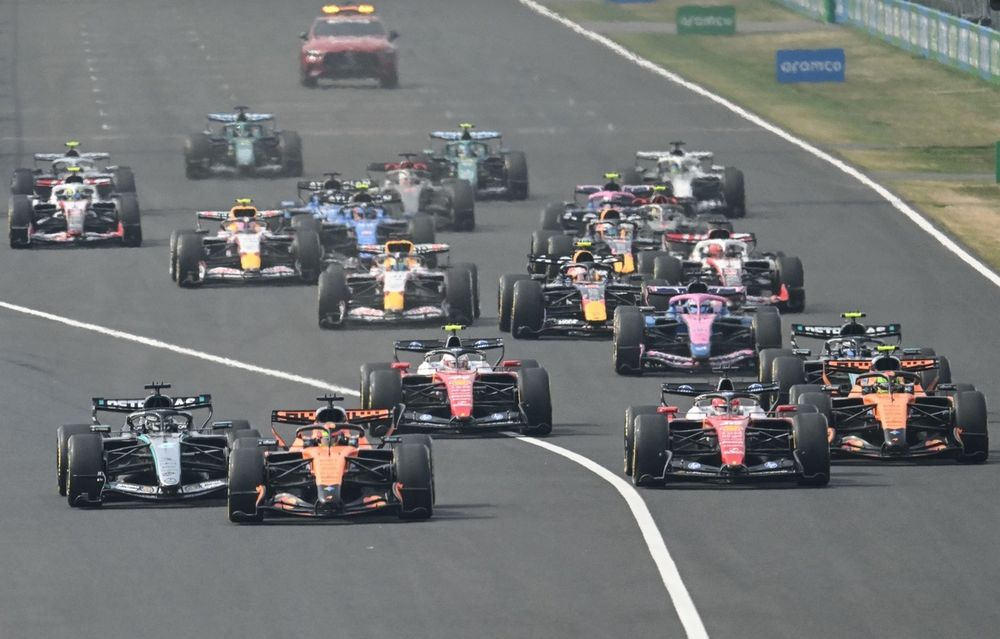
Race start
Photo by: Andrew Caballero-Reynolds / AFP via Getty Images
Manufacturers with a deficit of at least 4% receive two additional upgrades in the current year and two more in the following season.
However, there is one important limitation: manufacturers that do not gain ADUO eligibility after the first two evaluation phases of a season cannot newly enter the system during the final evaluation period of that same year.
ADUO is specifically designed to address early performance deficits, not short-term, later setbacks.
Can upgrades be stockpiled within a season?
No. ADUO homologation upgrades are not granted multiple times within a season. An engine manufacturer receives them only once – namely, the first time the FIA determines eligibility.
Over multiple years, however, development flexibility can accumulate. For example, if a manufacturer receives additional upgrades in 2026 for 2027 and qualifies again in 2027, these opportunities may combine in the following year.
In this way, significantly larger upgrade packages may become possible in certain cases, which increases the long-term catch-up potential for consistently weaker manufacturers.
For example: after the Canadian GP in 2026, a manufacturer that is under 4% behind the leading power unit and therefore receives ADUO for two upgrades in 2026 and two further upgrades in 2027.
If, however, after Period 1 of 2027 it is again under 4% behind and once more qualifies for ADUO, receiving two upgrades for 2027 and two for 2028, it may introduce a total of four upgrades in 2027.

Nico Hulkenberg, Audi F1 Team
Photo by: Guido De Bortoli / LAT Images via Getty Images
Can unused upgrades be carried over into the following season?
No. Upgrades designated for a specific season must be used within that season. Unused development opportunities expire without replacement. Only upgrades explicitly granted for the following year remain valid.
This deliberately prevents manufacturers from strategically stockpiling larger development packages over multiple years.
Which components may be developed under ADUO?
Although performance evaluation focuses exclusively on the internal combustion engine, the technical development framework encompasses far more than just traditional ICE components.
Manufacturers may apply their additional upgrades to turbochargers, exhaust systems, MGU-K, ERS components, cooling systems, sensors, control electronics, hydraulic systems, as well as certain operating fluids and ballast solutions.
ADUO therefore remains a broad-based development mechanism that offers manufacturers multiple pathways for performance optimisation within the homologated power unit.
Why is ADUO strategically so significant for F1?
The new 2026 engine regulations mark one of the biggest technical upheavals in modern F1 history.
New manufacturers, new fuel regulations, and a changed balance between internal combustion and electric power create the risk of substantial performance disparities.
Previous regulatory changes – such as in 2014 – demonstrated how dominant manufacturers can shape the competitive order for years. So with ADUO, the FIA is attempting to minimise precisely this risk.

Lewis Hamilton, Mercedes F1
Photo by: Andy Hone
Manufacturers with early deficits are intended to remain competitive without sacrificing the fundamental principle of technological competition and the system creates a middle ground between development freedom and cost discipline.
For motorsport enthusiasts, ADUO introduces an additional strategic layer in which homologation windows, development budgets, and technical recovery programs become more central.
For newcomers, the principle can be summarised simply: those who fall significantly behind technically in the new engine era receive more opportunities to catch up – but in the end, victory must still go to the manufacturer that develops the best technical solution.
ADUO could therefore become one of the most important regulatory tools from 2026 in ensuring that the new era remains exciting, economically manageable, and as competitively balanced as possible.


The numbers behind Ducati becoming a modern MotoGP powerhouse

Russell to take grid penalty in Singapore due to Sepang retirement

Le Mans 24 Hours winner Conway to retire at the end of WEC 2026

Neuville assessing his future options with WRC 2027 drive unconfirmed
Subscribe and access Autosport.com with your ad-blocker.
From Formula 1 to MotoGP we report straight from the paddock because we love our sport, just like you. In order to keep delivering our expert journalism, our website uses advertising. Still, we want to give you the opportunity to enjoy an ad-free and tracker-free website and to continue using your adblocker.


Top Comments