
The best motorsport moments of 2021
Motorsport produced one of its greatest years of all-time in 2021 despite a backdrop of ongoing COVID-19 challenges and an ever-changing racing landscape. Through the non-stop action Autosport has collected the finest moments from the past 12 months to highlight the incredible drama and joy motorsport generates
Amid various levels of lockdowns and COVID-19 pandemic restrictions, motorsport roared back into life with a near-normal 2021. However, the action both on and off track was anything but normal, with stories, moments and memories that will spring out in the motorsport annuals for decades.
From a new series offering a possible glimpse into the future of racing to the traditional championships creating fresh history, motorsport generated something for every fan to relish.
At the heart of each highlight also remains the people and the teams who create the passion and wonder behind the action, as new stars grabbed the spotlight and familiar ones returned to a hero’s welcome.
Autosport picks out its best motorsport moments of 2021.

Daring Kristoffersson leaves rivals in dust (by Matt Kew)
Saudi Arabia Extreme E, 4 April
Alejandro Agag demands his motorsport creations look stellar on TV. But when he reckoned Extreme E would resemble “Star Wars pod racing”, it seemed like hyperbole. It wasn’t. The sandy AlUla backdrop for an inaugural April round in Saudi Arabia was otherworldly thanks to the red-rock cliffs.
The electric-powered wheels started to spin, with a grid for the Desert X-Prix final populated by (now) four-time World Rallycross champion Johan Kristoffersson, World Rally legend Sebastien Loeb and 2019 World RX king Timmy Hansen.
The huge plumes of dust kicked up by each Odyssey 21 E-SUV made overtaking tough. But again, expectations were overturned – and almost immediately so – thanks to Kristoffersson.
The driver who Nico Rosberg had signed via a direct message on Instagram entered the first corner on the outside and in last place. But he dived blindly through the cloud ahead, picked off Loeb, and cut to the inside to emerge in an unlikely lead ahead of Hansen. The Swede had carried 10mph more through the corner than any other pass.
“He was miles back and explored a very creative and totally new line,” says Rosberg. “We thought it impossible to come out in front because that weekend was dominated by poor visibility. It was special.”
Evans’s magic Monaco pass (MK)
Monaco Formula E, 8 May
In a Formula E season when massive peaks and troughs were the norm for the title protagonists, how appropriate that, after one of the series’ all-time lowest moments at Valencia, it should respond with arguably its finest-ever chapter.
The Monaco E-Prix was special, and not just for the location. Formula E showed how far it had come from the earlier races that were held on a ‘diet’ lap of the principality. In May, the Gen2 machines delivered one of the most thrilling bouts on the full grand prix layout.
While F1 races draw flak for the lack of overtaking around the famous street course, Formula E stole the show with possibly the best pass in its seven-year history. Mitch Evans got the run on reigning champion Antonio Felix da Costa up the hill out of Sainte Devote to slice around the outside of Beau Rivage with barely an inch to spare against the barrier. He nabbed the lead as viewers caught their breath.
But the moment came at a heavy cost. The Kiwi’s heavy right foot on the climb to Casino Square came back to bite him when it depleted his Jaguar’s energy levels to tee up da Costa’s final-lap revenge for the win.
After all the calendar compromises brought about by the pandemic, here Formula E was back on a bona fide street circuit in one of the most legendary motorsport settings. And as a result, organisers pledged to make the previously biennial visit to Monaco instead become a yearly fixture.
Prior to the event, everyone knew Formula E lap times would pale in comparison to F1. But after these 26 laps, the electric grid proved that speed isn’t everything.

Juan Manuel Correa, ART Grand Prix
Photo by: Mark Sutton / Motorsport Images
Correa makes his racing return (by Megan White)
Barcelona FIA Formula 3, 8 May
Juan Manuel Correa’s return to racing less than two years after the horrific F2 crash at Spa that left him in a coma was nothing less than miraculous.
After suffering catastrophic injuries in the incident, which claimed the life of Anthoine Hubert, Correa was forced to relearn many things “from zero” over an “excruciating, long, painful and mentally hard year and a half”. But he joined ART Grand Prix to drive in F3 and scored 11 points, while also rejoining Sauber’s junior programme.
Despite struggling physically in the early part of the season, his highest finish came in the first sprint race of the second round at Paul Ricard, at one point battling for fourth before finishing sixth.
When he returned in August to the scene of his accident to once again tackle Eau Rouge, American-Ecuadorian Correa proved his steely determination, carrying with him a tribute to the late Hubert and a dream to one day reach F1 in his honour.

Race winner Theo Pourchaire, ART Grand Prix
Photo by: Florent Gooden - DPPI
Pourchaire makes his mark on Monte Carlo (by Tom Howard)
Monaco FIA Formula 2, 22 May
Whatever happens in Theo Pourchaire’s career, he will surely always remember his first outing in Monaco. Aged just 17, the Frenchman produced a masterful display beyond his years to take pole position and then convert that to a dominant feature race win – his first victory in Formula 2.
In doing so, the ART Grand Prix driver became the youngest ever polesitter and race winner in F2 history, taking that record away from McLaren F1 star Lando Norris.
“In Bahrain [the season opener] I was not fast to be honest and the weekend was difficult,” said Pourchaire in Monaco. “I just wanted to bounce back and do a good race weekend and be back on the podium, and I have become the youngest pole winner and race winner. I can’t believe it.
“The race was so stressful I was under pressure. Monaco is unique, you cannot make a mistake here so I was so concentrated. We did the perfect race, it feels incredible.”
The feature race victory, taken by 2.9 seconds ahead of champion-to-be Oscar Piastri, put Pourchaire on the radar of Formula 1 teams. He earned himself an F1 test with Alfa Romeo at the Hungaroring and was linked to a race seat for 2022 that eventually went to rival Guanyu Zhou.
Castroneves takes a special Indy 500 win (by David Malsher-Lopez)
Indianapolis 500, 30 May
The 40% crowd permitted to attend the Indianapolis 500 this year responded warmly to Helio Castroneves’s triumph. How could they not? He put on one hell of a display in his fight with eventual IndyCar Series champion Alex Palou, made history by joining AJ Foyt, Al Unser and Rick Mears in the four-time winners’ club, and climbed the fence to whip the crowd into a frenzy.
It was his first race in a part-time deal for the Meyer Shank Racing Honda team, and initially he didn’t hold high hopes.
“I thought, ‘What the heck am I doing here?!’ The car was just so loose,” recalls Castroneves. “Then on the Sunday practice after qualifying, we got our heads around the race set-up and I said, ‘Yes, the car is in a good spot’, and on Carburetion Day on the next Friday I knew exactly what we had.”
It came down to Palou, in just his second 500, to take on Castroneves, a veteran of 20 Indy 500s, for the victory. That experience disparity proved crucial in the closing stages.
“I have to say, he was driving very well,” says the 46-year-old. “His only problem was that he didn’t know what I had, but I knew what he had. I had learned before from battling with Ryan Hunter-Reay [in the 2014 Indy 500] not to show everything too soon. So when Alex was ahead of me, I was just waiting for the right opportunity to pass and stay there – and that’s what happened, by using the backmarkers ahead of us in the right way, getting a tow but not losing downforce in their dirty air.”
Four months after winning the Daytona 24 Hours, Castroneves was back on top of the world.
Quality racing with class acts on top (by Marcus Simmons)
Snetterton BTCC, 13 June
It was at least an hour since the chequered flag had fallen on the final race of the day, and a balmy, sunny, mid-June day at Snetterton was heading towards evening. And still Tom Ingram stood there, adjacent to the podium, courteously giving his time to the media.
“Sorry Tom, can you hang on for a few more minutes?” “Of course, I’m happy to stand here talking all night!” he quipped.
Members of the Excelr8 Motorsport team were still hovering in the background, beaming, drunk on happiness, because Ingram had just steered their Hyundai i30 N to victory – the team’s first in the British Touring Car Championship. Sure, it was the reversed-grid race, but he’d been the top points scorer of the weekend on only his second competition outing with the squad. That Hyundai was surely a competitive machine; it wasn’t a fluky luck-in such as the BTCC’s sporting regulations occasionally throw up.
And what made it so special was that this was the first time since late 2019 that the action-starved enthusiasts had been allowed back to the circuit to watch the series – well, 4000 of them anyway in that interim stage. What they saw was the three classiest, standout performers of the COVID-enforced TV-only era deliver magnificent drives to win the three races. First Colin Turkington, then an Ash Sutton charge, then Ingram.
It was one of those days when you simply feel blessed to be involved with this sport, such was the bonhomie. Somehow, the traditional delays on the A11 afterwards didn’t seem to matter – especially as Ingram was probably still chatting to media by the podium.
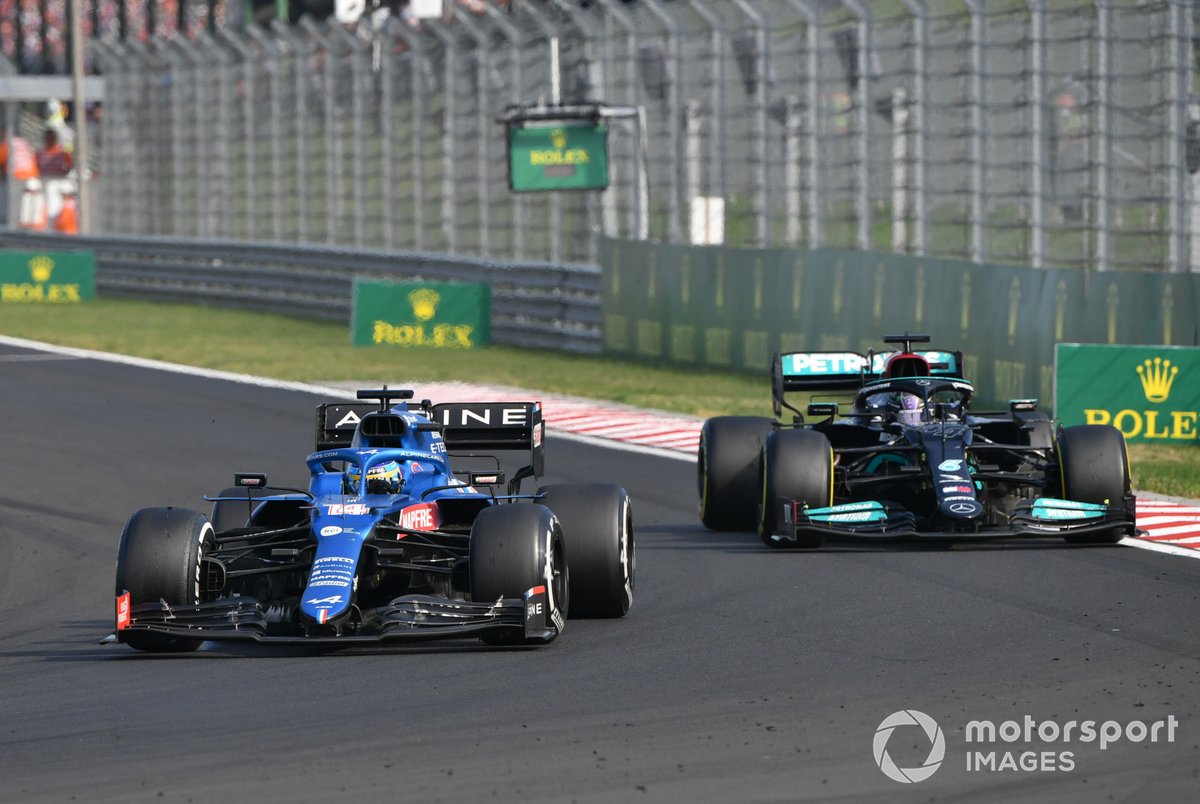
Fernando Alonso, Alpine A521, Lewis Hamilton, Mercedes W12
Photo by: Mark Sutton / Motorsport Images
Battles of two F1 legends (by Kevin Turner)
Hungarian GP, 1 August
A charging Lewis Hamilton recovering from a strategic disadvantage is usually a sight to behold – and difficult to stop. But Fernando Alonso showed that the seven-time world champion could be thwarted for a considerable time at the Hungarian GP.
Hamilton’s medium-tyred Mercedes arrived behind the hard-shod Alpine on lap 55 of 70. At that point Hamilton’s pace suggested he could catch the leading Alpine of Esteban Ocon, just 9s up the road, before the end. Alonso demonstrated all his racecraft to keep Hamilton back, positioning his car perfectly and staying ahead despite some quality attacks from the reigning champ.
Finally on lap 65, Alonso locked up into Turn 1 and ran wide enough to let Hamilton get a run, and he completed the pass on the blast to Turn 2. He was still 9.4s behind Ocon (the Frenchman providing another highlight with his staunch defence from Sebastian Vettel) at the end of that lap, and fell short by 2.7s at the flag. Alonso’s defence had been crucial to Ocon’s first F1 victory.
The overall championship fight between Hamilton and Max Verstappen was the undoubted story of the season, but none of the fights were as satisfying or as thrilling as this one, a rare reminder of what we missed while Alonso was toiling in mediocre machinery.
An outrageous gamble and incredible pass (by Gary Watkins)
Spa 24 Hours, 1 August
The Iron Lynx Ferrari looked home and dry with 60 minutes of the Spa 24 Hours to go. Then came one of the most preposterous gambles in motor racing history. The chasing WRT Audi squad opted to send the second-placed car out from its final pitstop a few minutes later onto a dry track shod on wet-weather tyres.
The black clouds gathering overhead left little doubt that it was going to rain. WRT’s gamble hung on when it would happen. Its numbers came up when the drops started as Dries Vanthoor was beginning sector two on his out-lap. And it then looked like it had hit the jackpot when Alessandro Pier Guidi in the Ferrari stayed out a lap too long on slicks on a sodden track.
Now it was WRT’s race to lose, only for the race to take a slightly more predictable turn. A safety car was inevitably called, and the Audi’s one-minute advantage was all but wiped out.
Pier Guidi closed down the four-second gap once the green flags flew and, with 10 minutes remaining on the clock, pulled a move around the outside at Blanchimont to seal the win. It was an overtaking move befitting that dramatic final hour.
The closest finish in more ways than one (GW)
Le Mans 24 Hours, 22 August
Anyone studying the timing screens in the final couple of minutes of the Le Mans 24 Hours was privy to one of the most amazing finishes in the rich history of the big race.
Shame the TV director missed it: he’d lost interest in LMP2 after Yifei Ye had ground to a halt in the leading WRT ORECA early on the final lap, and focused instead on the slowing Toyotas.
Yet Tom Blomqvist was homing in on a struggling Robin Frijns in what was now the battle for LMP2 victory. A field bunching up behind the Toyotas provided another dimension to that dramatic last lap.
Blomqvist’s Jota car was just under four seconds behind starting the final lap and gained a second in each of the first two sectors. The under-pressure Frijns had to dart in and out of the bunching pack in the second WRT ORECA as he strove to stay ahead.
What should have been his final jink from behind a Porsche left him confronted with a race official bearing the chequered flag. He needed another rapid steering input as he crossed the line just seven tenths in front. Breathtaking.

Valentino Rossi, Petronas Yamaha SRT
Photo by: Dorna
Rossi bids an emotional farewell (by Haydn Cobb)
Valencia MotoGP, 14 November
Valentino Rossi finally decided to call time on his MotoGP career at the end of this season, ending an era as one of the most recognisable and successful riders in history.
The Italian notched up 26 seasons (across 125cc, 250cc and 500cc/MotoGP), 432 grands prix, 115 victories and nine world titles before bowing out at the finale at Valencia after announcing his retirement during the summer.
While statistically 2021 will go down as Rossi’s worst campaign, it will be remembered as his farewell tour. He leaves behind a legacy of his records and a pathway for future superstars through his VR46 academy and racing team.
A 10th-place finish in his final GP might not be remembered, but with of his proteges – Francesco Bagnaia – winning at Valencia, and fellow VR46 Academy graduates Franco Morbidelli and Rossi’s half-brother Luca Marini also starring on the MotoGP grid, it suggests that the next chapter of Rossi’s story is set to provide yet more success.
After Rossi was given the ultimate send-off by the MotoGP paddock by being presented with all of his world title-winning bikes, the 42-year-old admitted he was struck by the tributes dedicated to his career: “It was very emotional, great support and great respect from all the people in the paddock. It was a great weekend, I rode well and in the race I was able to arrive in the top 10. It means I close my long career as one of the top 10 riders in the world.”
He’ll be remembered as much more than that.

Sébastien Ogier, Julien Ingrassia, Toyota Gazoo Racing WRT Toyota Yaris WRC
Photo by: McKlein / Motorsport Images
Ogier signs off in style (TH)
Rally Monza, 14 November
Elite athletes are rarely afforded the opportunity to bow out on a high, but that wasn’t the case for rally legend Sebastien Ogier in his final event as a full-time World Rally Championship driver. Ogier lifted an eighth WRC crown in style with victory on Rally Monza, which will be remembered as a modern classic.
This was a title showdown between Toyota team-mates Ogier and Elfyn Evans. While Ogier was in the box seat courtesy of a 17-point lead, a slip-up could hand Evans a maiden title and the Frenchman’s glittering full-time career a damp-squib finish.
What eventuated was one of the finest duels to grace the WRC, with Ogier and Evans going toe to toe for three days and the lead changing hands six times.
Heading into the final day, only 0.5 seconds separated the pair as Evans threw everything at Ogier. It almost worked – Ogier clipped a concrete barrier on Monza’s historic banking, but luckily it failed to halt his charge.
In the end, a mistake from Evans handed Ogier a 7.3s win that secured him an eighth world title. The cool Frenchman allowed his emotions to pour out as he and co-driver Julien Ingrassia climbed on top of their Yaris to celebrate another title, and their glittering 16-year partnership drew to a close.

F1 Spanish GP live commentary and updates - FP3 ends under a red flag

What we’ve learned at the 2026 Le Mans 24 Hours so far

LIVE: F1 Italian GP updates - Russell tops FP3 from Hamilton and Verstappen who trade blows

LIVE: F1 Italian GP updates - Gasly takes shock pole for Alpine

LIVE: F1 Italian GP updates - Antonelli takes stunning victory from 19th on the grid

F1 Spanish GP: Russell tops first practice at new Madring

F1 Spanish GP live updates: Antonelli fastest in FP2 after Lindblad crash

F1 Spanish GP live commentary and updates - Norris snatches pole

Evans: Late puncture was “harsh” but WRC title position is still "okay”

How Antonelli is proving unbeatable, even when he's beaten

F1 drivers push for Madring changes after "very poor" Spanish GP: "I almost fell asleep"

WRC Chile: Solberg seals victory as Toyota wraps up manufacturers’ crown
Subscribe and access Autosport.com with your ad-blocker.
From Formula 1 to MotoGP we report straight from the paddock because we love our sport, just like you. In order to keep delivering our expert journalism, our website uses advertising. Still, we want to give you the opportunity to enjoy an ad-free and tracker-free website and to continue using your adblocker.


Top Comments