
What Nissan's commitment to Gen3 reveals about Formula E's future
Formula E's Gen3 era grid continues to take shape, after Nissan opted to commit to the series for another four years. Nissan's global chief operating officer explains why it has thrown its lot in with FE while other high-profile marques have decided to call it quits

That Nissan has renewed its vows with Formula E by signing up to the series for another four years - announced today, exclusively with Autosport - was entirely expected. The Japanese manufacturer has pledged to offer an all-electric road car line up by the “early 2030s”. But even just where Formula E is concerned, Nissan has been making all the right noises over the past few months that it was ready to stick around for the long-term.
As any high-profile championship must, Formula E provides its competitors with a tangible reason to enter and then re-enter. What’s less well-defined is whether that reason is because the championship is a development testbed, or a marketing platform first and foremost.
PLUS: How Andretti is planning for life after BMW
Those blurred lines aren’t helped by the nature of generation rules cycles. While a four-year lifespan allows components to be refined and it keeps some check on spending, in that time the electric road car industry can catch up and even surpass the thoroughbred racers. The arrival of the Gen3 rules package wrests back control and takes sizeable steps forward so that Formula E can be that arena for ‘trickle-down technology’.
Happily, for Nissan’s global chief operating officer Ashwani Gupta, Formula E satisfies both its technical and marketing promise. He tells Autosport: “When Nissan started Formula E, we transferred all of our know-how from road to track. We transferred everything which we were doing with the Leaf [all-electric road car, which came out in 2010] into learning about the battery.
“Now, when we are getting into Gen3, we will bring back the know-how from the track to the road. By the early 2030s, all of our products will have electrified offerings. More powerful and faster Gen3 Formula E cars will help us in making the great cars for the road.”

Oliver Rowland, Nissan e.Dams, Nissan IMO2
Photo by: Andrew Ferraro / Motorsport Images
The headlines for Gen3 are made by a power boost to 350kW, the equivalent of 470bhp, plus smaller and 120kg lighter cars. This should promote better on-track action and boost the overall spectacle. More importantly to the OEMs, though, the new rules will bring back mid-race pitstops for the debut of rapid charging. Similarly, the regenerative braking capabilities of the cars will massively increase from the current total of 250kW per lap up to 600kW.
How each teams’ engineers work to understand the way their cars harvest energy under braking will be one of the critical backgrounds going forward. That analysis of the data, not just evolving the motor and invertor hardware, has further appeal for Nissan and Gupta.
"It's not only the car which gives us the expertise, but it's also the software,” he says. “The software keeps on updating. We want to capture this because the interaction between the driver and the car through the software is a great area of knowledge. Eventually, we will transfer this to the road, to our customers, especially from Ariya [electric SUV, arriving in 2022] onwards.”
Then there’s what Formula E can offer as a global marketing platform. Nissan has already shown its faith in this area. It chose the 2018 Geneva Motor Show, the most prestigious event of its type and best covered by the media, to reveal its first livery concept ahead of its championship debut. But Gupta reckons the appeal of a major Nissan motorsport programme starts far closer to home.
While Audi and BMW have suffered their seven-year itch and voted with their feet, Nissan is now the third marque to pledge itself to the Gen3 rules cycle that will run between the 2022-23 and 2025-26 seasons
He says: “For us Formula E is about excitement, energy and environment. These three words demonstrate what Formula E means to us as Nissan employees and as shareholders.
“The Formula E team, for employees, is the demonstration of the capability and capacity of our organisation, even if we are going through challenges. Racing is a culture and one that enriches our employees, it motivates our shareholders. That's what we look at when we participate in Formula E. We participate with passion and full engagement.”
That positive attitude from the second-in-command at Nissan, as it aims to be carbon neutral by 2050, is a far cry from the unattributed quote in the statement issued last winter by BMW. The German marque revealed it would quit Formula E at the end of this season having "essentially exhausted the opportunities" to develop its technologies.

Sebastien Buemi, Nissan e.Dams, Nissan IMO2
Photo by: Sam Bagnall / Motorsport Images
Formula E chief executive officer Jamie Reigle clarifies the debate to Autosport, explaining: “There are some manufacturers that say there's a very clear and direct link [between Formula E and road car technology]. And there are others who say there's a limited link. I choose to believe that there must be a link, otherwise why would they be doing this?”
When it comes to the manufacturers, the argument currently falls three-two in Formula E’s favour. While Audi and BMW have suffered their seven-year itch and voted with their feet, Nissan is now the third marque to pledge itself to the Gen3 rules cycle that will run between the 2022-23 and 2025-26 seasons.
Mahindra got there first in late November, followed swiftly enough by DS Automobiles - which has partnered race team Techeetah to win the two most recent constructors’ titles. And of the three, it’s Nissan that makes for the biggest story thanks to its global recognition and status. It sold four million cars worldwide last year when DS Automobiles flogged 44,000.
Nissan and Formula E in one guise or another, have been happily wedded now for some time. Renault, Nissan’s alliance companion, was the first automotive manufacturer to jump into bed with the championship, coming in as its establishing technical partner. It worked with chassis constructor Spark Racing Technology, formed by ex-Renault Formula 1 team principal Frederic Vasseur, to build the car and powertrain used by all teams for the maiden season in 2014-15.
The marque then backed the e.dams race team for that inaugural campaign as it won the first three constructors’ championship crowns in a row and as Sebastien Buemi landed the 2015-16 drivers’ title. For the advent of the Gen2 regulations in 2018-19, it was a rebranding that put the Nissan name at the top of an entry form, rather than one manufacturer withdrawing altogether to be replaced by another.
Along the short timeline of the all-electric championship, Renault-then-Nissan and Formula E have a long history together. But by no means is the duo joined at the hip. Nissan’s Gen3 signature was not a completely forgone conclusion and had Nissan decided to bid the series farewell, that divorce might have been the one that hurt the most. But now its loyalty is without question.
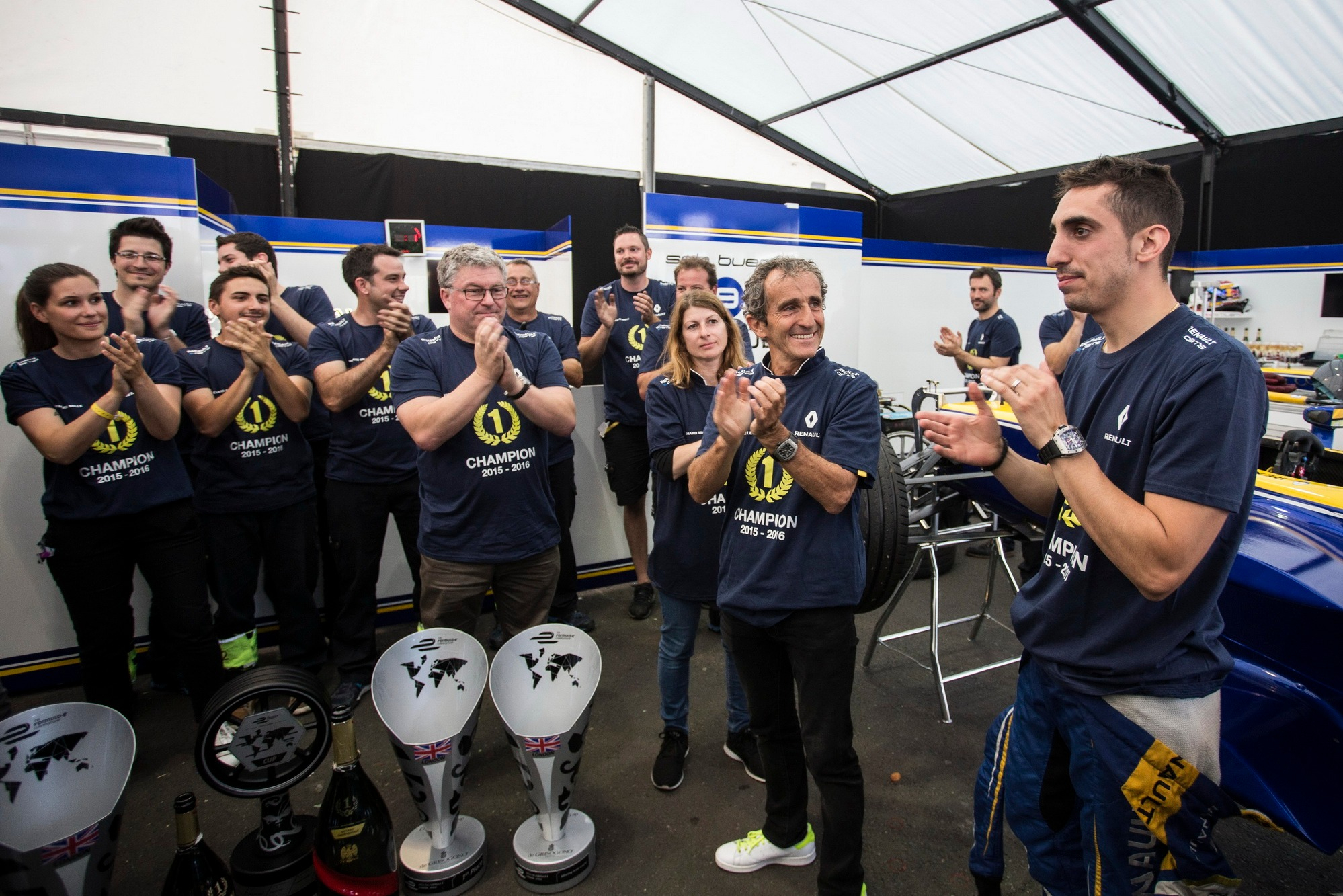
Sebastien Buemi, Alain Prost celebrate Formula E Battersea 2015-16
Photo by: FIA Formula E
The announcement from Japan arrives exactly one week ahead of the 31 March deadline for manufacturers to commit to Gen3. As Gupta says: “We just could not keep our excitement with us, because we have been working on it for months. We are so excited, because this will give us an opportunity to make faster and more powerful cars.”
With Mercedes set to undergo a major logistical restructure to consolidate its FE operations at its Brackley base for next season, it’s expected to sign on in due course. Similarly, Autosport understands that Porsche is close to formalising its agreement to remain.
Meeting the deadline will more come to define when the OEMS get access to the FIA’s data from the Gen3 parts suppliers such as Hankook and Williams Advanced Engineering
If those two, and more come to pass, it’s unlikely that there will be a flood of public press releases over the next seven days as the deadline draws near. Partly, that will give each announcement space to spread the good news stories out for Formula E over a longer period of time.
Second, it’s looking increasingly likely that the March date has some wiggle room. Rather than being a hard and fast cut-off - naturally, if Formula E isn’t at the maximum 12-team capacity, it’s not going to turn manufacturers away – meeting the deadline will more come to define when the OEMS get access to the FIA’s data from the Gen3 parts suppliers such as Hankook and Williams Advanced Engineering.
Nevertheless, Nissan has gone ahead and handed in its homework early, Gupta convinced that Formula E is the prime place to define the technology and the marketing of the ninth biggest automotive player in the world.

Sebastien Buemi, Nissan e.Dams, Nissan IMO2
Photo by: Zak Mauger / Motorsport Images


Marko: Perez improved F1 form because 2025 contract talks are at stake

Russell explains how low-fuel runs expose Mercedes F1 inconsistency

Leclerc: No answer for "once in a season" Japan F1 qualifying struggle

Sainz: Now time to "speed up" talks to find 2025 F1 seat

Hamilton: Vettel an "amazing option" as Mercedes F1 replacement

Sargeant to race repaired F1 car in Suzuka; no spare Williams until Miami

Pirro leaves role as McLaren F1 academy chief

The impatient pair who’d hoped to be a thorn in Red Bull’s side again

F1 approves shorter races for 2027 to fit revised power unit plan

Ryder clinches third British Hillclimb title by a single point at Prescott

Factory WRC driver Lappi to pause rallying career

Why Leclerc didn’t copy Hamilton’s driving style amid F1 2026 struggle
Subscribe and access Autosport.com with your ad-blocker.
From Formula 1 to MotoGP we report straight from the paddock because we love our sport, just like you. In order to keep delivering our expert journalism, our website uses advertising. Still, we want to give you the opportunity to enjoy an ad-free and tracker-free website and to continue using your adblocker.


Top Comments