


Why newly-retired Raikkonen won't miss F1
After 349 grand prix starts, 46 fastest laps, 21 wins and one world championship, Kimi Raikkonen has finally called time on his F1 career. In an exclusive interview with Autosport on the eve of his final race, he explains his loathing of paddock politics and reflects on how motorsport has changed over the past two decades

As the laps ticked down in Abu Dhabi towards the controversial, farcical finish to the Formula 1 season, the fan-voted ‘driver of the day’ was already out of the race. Kimi Raikkonen’s 349th and final grand prix start came to a premature end at Yas Marina after a wheelnut issue following his pitstop forced him to retire less than halfway through. It left him to complete his media pen commitments – reluctantly, on instruction from the FIA – before skulking away for a low-key end to his F1 career.
Over 20 years has passed since Raikkonen made his F1 debut with Sauber as a kid just out of Formula Renault, one many wrote off as not being ready to race at the highest level. He went on to win 21 races spanning more than 15 years, and is still Ferrari’s most recent world champion in 2007, establishing himself as one of the greats of his generation.
But through it all, Kimi was… well, Kimi. There had never been a driver like him, and it’s unlikely that there ever will be again. That made his final race a notable moment for F1.
For a journalist who’d never properly interviewed Raikkonen one-on-one, the opportunity to do so at his final race was perfect timing. There likely wouldn’t be any chance of him pouring his heart and soul out, or that he’d wax lyrical about his love for F1 – quite the contrary, as it turned out. But there was the hope that it would be a chance for him to be open and honest as a final hurrah before riding into the sunset.
Raikkonen makes clear from the off that, to him, this is a race weekend just like any other.
“I don’t see why it would be any different,” he says. “I’m looking forward, as any year, to the end of the last race, to have time off, and to not need to worry about F1.”
Raikkonen announced back in September that he would be retiring from F1, but it wasn’t a sudden decision. In the winter before the 2021 season, he informed the team owners of his intention to quit. He even cheekily wrote a pre-season prediction in a video for F1 that his favourite race would be Abu Dhabi because it would be his final outing – only when the envelope was opened was it revealed how far ahead his retirement had been planned.
PLUS: Why the time is right for Raikkonen to hang up his F1 helmet

Raikkonen planned his exit from F1 before the 2021 season had gotten underway
Photo by: Jerry Andre / Motorsport Images
Things have changed since his two-year sabbatical in 2010-11, when Raikkonen, then tired of F1 and out of favour with Ferrari, wanted a break. He used that time to go rallying and even try out some NASCAR before returning with Lotus in 2012. It was a break he has always credited with extending his F1 career.
PLUS: In his own words, the secret to Raikkonen's F1 longevity
But now, with his family being the priority and his children, Robin and Rianna, so young, they are at the heart of his world. He wants to spend time with them and watch them grow up.
“It will be nice to be home and the kids are looking forward to it – and I’m sure the wife is also!” says the 42-year-old, referring to Minttu. “There’ll be no need to always say, ‘I’m here, I’m there’, let’s say for a week, and then you know that you have to go again. I’m looking forward to it.”
"Money has changed, like any sport. The more money you put in, the more politics. In general, any country, there are games that people never know until you are inside the whole thing" Kimi Raikkonen
Raikkonen’s family was even at the heart of his decision to return to Sauber, now under the Alfa Romeo name, for the final three years of his F1 career. He quickly dismisses any romanticism about bookending his career with the Swiss squad: “I didn’t come here because of that. The reason was that it’s the closest to our home, so it made sense.
“I had another option, but I wanted to be where I drive [to the factory], I come back, no need to fly somewhere that takes an awful long time – and it also happens to be the same team [he started with]. It’s nice. Obviously we all wanted better results. But that’s how it goes sometimes.”
Raikkonen’s final two seasons in F1 yielded a haul of just 14 points as Alfa Romeo slumped towards the back of the field, perhaps making it the best justification yet for questions about his motivation. Raikkonen’s approach and demeanour throughout his career made it a regular talking point, but he was always very clear that if he didn’t care, he’d stop. The fashion of his final season with Ferrari in 2018, when he took that long-awaited win at Austin and finished third in the championship, showed he still had some of the old spark that made him such a force in the mid-2000s.
To have a career stretching over so many generations in F1, both in terms of drivers and cars, is rare. But again, Raikkonen doesn’t see it as anything particularly special.
“I don’t think the driving has changed,” he says. “Yes, the rules have changed, and the cars are bigger and this and that. But the pure driving, it’s not that much different.

Raikkonen made his F1 debut with Sauber in 2001 with the C20 that finished fourth in the constructors' championship
Photo by: Sutton Images
“But then I think I would be shocked if I drove the 2001 car now. That looks like a very basic car these days. In those days, it was the top car. But if you look now how basic they are, I think you would have a big shock. So it’s very difficult to compare.”
Archive: How unflappable rookie Raikkonen took F1 by storm
The people are what Raikkonen says he will miss the most from F1, although he notes he’d rather meet up with them away from the paddock anyway. “Will I miss racing?” he ponders. “Time will tell.” He adds it could “very easily” be his final competitive outing in motorsport, but nothing is certain.
“I don’t want to make plans, because for the first time in a very long time, my work schedule doesn’t dictate the whole life,” he ponders. “But it could be anything. I’m sure people will have some kind of things that will come up. And if there’s something that makes sense, then why not to do? But for sure I first need to have some time off.”
Raikkonen references his sabbatical as a time when it was “nice to get out” of F1, adding: “There are so many things that are making no sense, at least in my head, what happens here.” What kind of things?
“All kinds of bullshit that goes around,” Raikkonen says. “We know it, but nobody says it. It’s just… things that I don’t think that even should be. A lot of things are such fake things in here. It’s good to be out.”
Raikkonen offers an exasperated, almost relieved laugh when he recalls how it was “mentally good to be out of all that bullshit for a while” during his break, before adding: “I know what I’m looking forward to when I get out.”
Raikkonen is vague on exactly what he dislikes about the series F1 has become, although it is not hard to deduce what he means: it’s everything besides the driving. It’s the sponsor commitments, the extra-curricular events – perhaps even this very interview. “There’s so much more than people see from the outside,” he says.
So what’s changed F1? “Money, for sure,” Raikkonen replies. “Money has changed, like any sport. The more money you put in, the more politics. In general, any country, there are games that people never know until you are inside the whole thing. You probably know this.

Raikkonen is uninterested in the elements of F1 that don't relate to driving
Photo by: Charles Coates / Motorsport Images
“For sure money plays a big part, and power. I guess people want to have power, this and that. I think there would be a lot of good politicians that would do well in actual politics!”
Raikkonen laughs at the suggestion that he’s clearly not a political guy. “I don’t get involved,” he says. “I know a lot of things that go on, but I don’t get involved. If you get involved every day, I don’t think it’s very healthy for you.”
It’s a disassociation that, mentally, has served Raikkonen well. He’s never been one to get tied up in F1’s political sagas or wranglings, with his apolitical approach being widely praised by his peers. Sebastian Vettel always made clear how much he enjoyed working with Raikkonen during their four seasons together at Ferrari because he was so straightforward.
"Once they give up on trying to change you, it’s easier. [They think] maybe it’s best to just let him do what he wants. I’m happy that I did the fighting in the beginning. It’s much harder to try to be somebody else" Kimi Raikkonen
Yet he has raced for some of the biggest teams and brands in F1, where internal politics were inevitable. It was a challenge he likely faced most severely during his time at McLaren, racing under Ron Dennis very early in his F1 career. But Raikkonen takes heart in the fact that he always stood up for himself and his way of doing things, right from the very start.
“In the beginning, it’s more difficult, because they try to put you in somewhere,” he explains. “Once they give up on trying to change you, it’s easier. [They think] maybe it’s best to just let him do what he wants. I’m happy that I did the fighting in the beginning, because it’s obviously a lot easier. It’s much harder to try to be somebody else.”
Raikkonen’s refusal – his inability, even – to be anyone but himself has won him the adoration of fans across the globe. No matter what race you go to, you’ll see Finnish flags, most likely – with all due respect to Valtteri Bottas – belonging to a Raikkonen supporter.
A regular occurrence in Hungary, one of the easiest races for Finns to get to, is for a big flag to be unfurled on the main straight reading ‘Kimi for President’ in massive letters. Utterances such as “bwoah” and “leave me alone, I know what I’m doing!”, his famous radio call from the 2012 Abu Dhabi GP, have become part of F1 fans’ lexicon.

Raikkonen has enjoyed a passionate fan following throughout his F1 career
Photo by: Charles Coates / Motorsport Images
They were delighted when Raikkonen took a step into the often murky waters of social media a couple of years ago by setting up an Instagram account. He says it was all his doing – “They’re not going to force me into anything” – and that he decides everything that goes on there, the majority of it being wholesome content featuring his family. His only stipulation was that he wouldn’t spend lots of time on it.
“That was the only rule,” he says. “It’s normal, it’s my life. But my life outside is always a lot more important for me.”
This popularity led to Raikkonen being voted driver of the day in Abu Dhabi despite not even reaching half-distance, speaking to the cult status Raikkonen holds. But he finds it baffling.
“I don’t know why they like me,” he says. “Maybe because I am what I am… consistently odd or weird, or whatever you want to call it! [Autosport quickly reassures him he’s neither of those things, assuming we’re fit to judge!] But I’ve done it exactly on my own terms. Most of the way anyway.”
And that really is what is behind the enduring appeal of Kimi Raikkonen. He’s a driver more fitting of another era of F1, not the modern commercial beast that the series has turned into today. It’s no bad thing – after all, all sports have to become that to grow and flourish – but it just doesn’t quite fit with Raikkonen’s ideal of what it should be.
PLUS: Why F1's misunderstood party animal will thrive in retirement
If you talk to anyone who has worked with Raikkonen or knows him on a personal level, they will paint the picture of a caring and entertaining man who takes a genuine interest in others. To him, the ancillary matters, the politics and PR that are all part of modern-day F1, simply aren’t his thing.
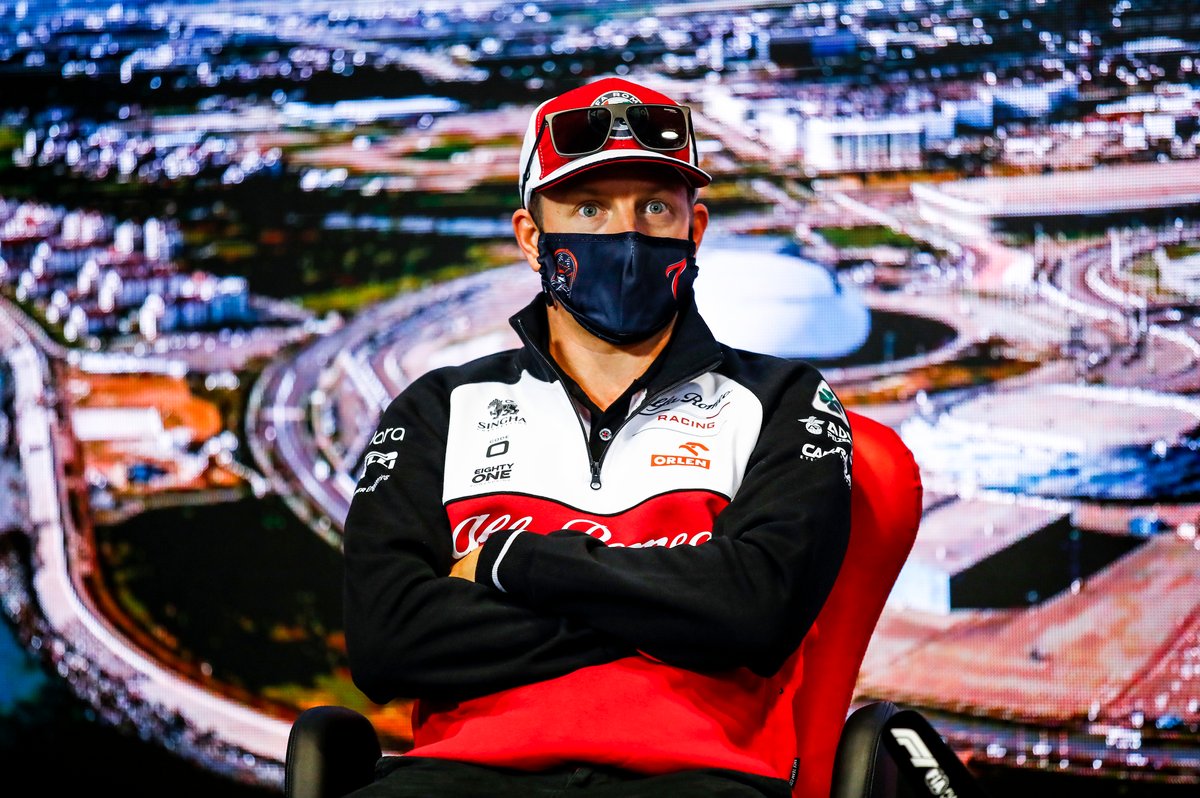
Raikkonen is looking forward to having a quieter life away from the media glare
Photo by: FIA Pool
After our interview finishes and Raikkonen heads off, Alfa Romeo’s PR scuttles over. “That’s the first time in three years I’ve seen Kimi be late for engineering because of an interview,” he says. “He talked so much!”
Perhaps Raikkonen enjoyed getting a few things off his chest. Or maybe we were just the lesser of two evils that evening… Either way, it was an interview that summed up his F1 career: honest, unfiltered, and unashamedly done his way. They’re all reasons why we will miss him, even if he’s not quite sure why.
Whether Raikkonen pops up somewhere to race again isn’t clear. For now, though, he’s going to relish spending time with his family, watching his kids grow up and, in his words, “live a normal life”.

Spending time with his young family will take up most of Raikkonen's energy in the coming months as he decides what to do next
Photo by: Sam Bloxham / Motorsport Images


1998 Belgian GP: When the Schumachers went to war

F1 Monaco GP 1982 retrospective: Remembering F1's craziest finish

Has Alonso made the right choice gambling on Aston Martin F1?

Hamilton in the process of selecting Brad Pitt’s co-star for F1 movie
How ‘demanding’ Alonso has started life with Aston Martin

Ocon got "very sick" in F1 off-season due to bad lung virus

Brown: No reason not to expand F1 grid if new teams pay "fair" fee

Hamilton: Nothing will stop me speaking up on important issues in F1

Why F1's Madring debut was a wasted opportunity

Bruising F1 2026 will not be the end for Russell - Wolff

Haas confident of getting 2027 F1 budget closer to cap with new partner talks

Top 10 Can-Am drivers
Subscribe and access Autosport.com with your ad-blocker.
From Formula 1 to MotoGP we report straight from the paddock because we love our sport, just like you. In order to keep delivering our expert journalism, our website uses advertising. Still, we want to give you the opportunity to enjoy an ad-free and tracker-free website and to continue using your adblocker.


Top Comments