


Why F1's misunderstood party animal will thrive in retirement
Three years on from Kimi Raikkonen's last Grand Prix victory at Austin, he is now six races away from ending the longest Formula 1 career in history. His friend and former Ice1 Racing rally team PR man ANTHONY PEACOCK explains why there’s nobody quite like the 2007 world champion and why F1 will miss him (but he won’t miss it)
Don’t expect a fanfare in Abu Dhabi, or any grand curtain call designed to soak up two decades of accumulated Formula 1 glory. But do expect a small farewell party. It’s just that you won’t be invited.
Kimi Raikkonen, in a move which surprised almost nobody, finally announced his decision to retire at the beginning of September – although it’s something that he had settled on for nearly a year. And that’s why his announcement came almost as an afterthought, in the form of a somewhat laconic Instagram post that started off with: “This is it.”
Kimi likes to get to the point and not waste time with words, a trait he shares with many of his fellow countrymen. They have a saying in Finland that goes along the lines of “silence is gold, talking is silver”. And Kimi has always preferred gold.
But it’s not that Finns don’t like talking. Instead, it’s that they just don’t like small talk. When Kimi is actually in the mood to talk, there’s almost no stopping him. But he likes to talk only about things that are important or interesting to him. And the questions posed during F1 press conferences invariably fall into neither of those two categories.
So he’ll probably just slip quietly out of Alfa/Sauber’s sliding glass door after he completes his last race in Abu Dhabi. The thought of valedictory speeches, public displays of affection, or worst of all, some sort of photo opportunity cake – which might just end up in his face – are anathema to him. It’s hard to know what Kimi’s last words from the cockpit of a F1 car will be, but the best bet is “bye”. Or nothing.
Then he’ll head off into the starry night, and hopefully onto some nearby hotel suite to reacquaint himself with the real glory days – such as when he went on a 16-day bender after finishing on the podium at the 2013 Bahrain Grand Prix. He sobered up in time to repeat that result at the Spanish GP, lending credence to his long-held theory that drink between events never affects him and that he actually performs better when free to be himself.
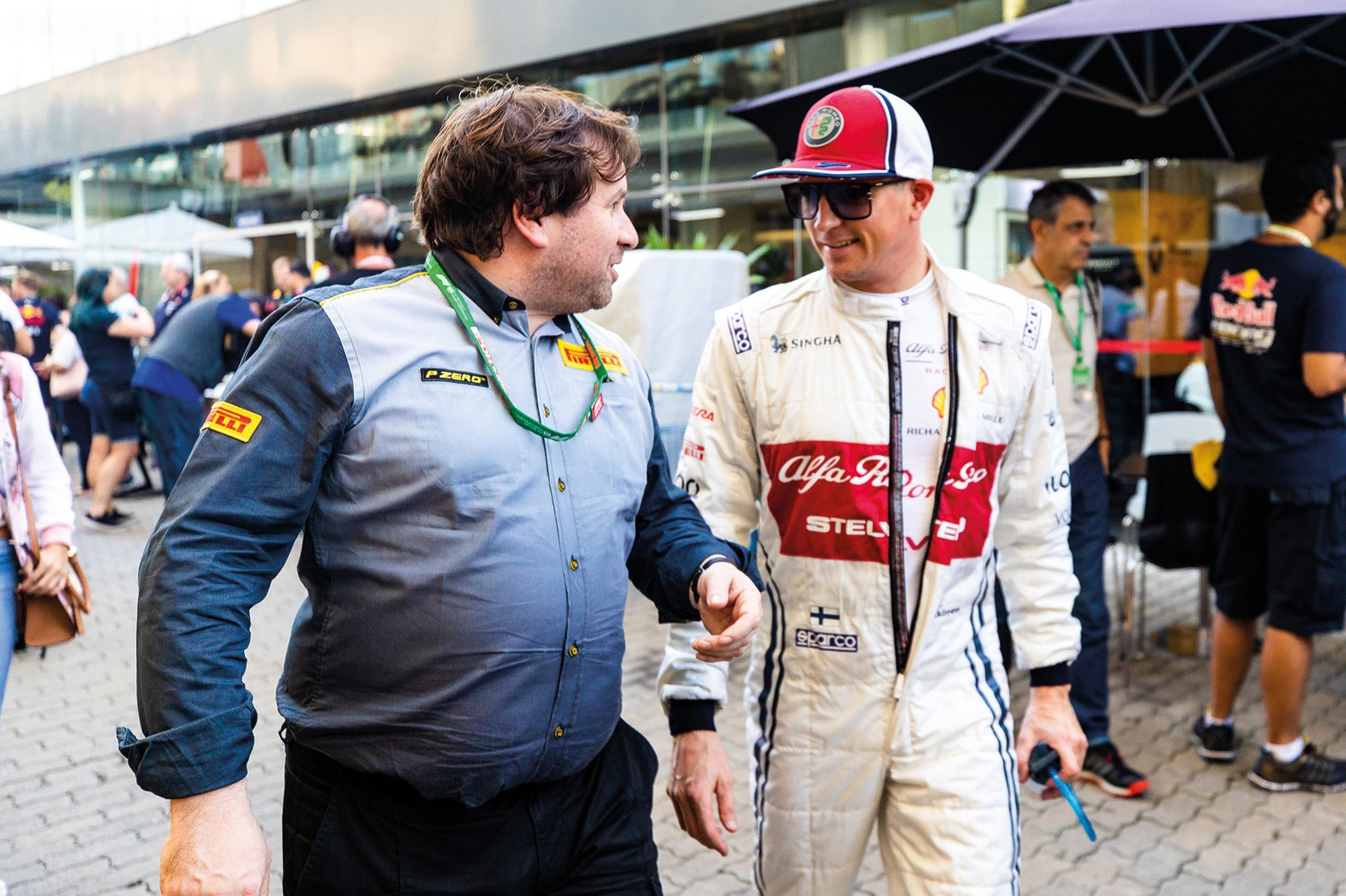
PR man Peacock has known Raikkonen for many years, spending time together away from the F1 'goldfish bowl' during the Finn's WRC stint
Photo by: ProStar Pics
Now, with that tedious ‘between events’ bit removed from his lifestyle, he’s completely at large to carry out his plans. These plans amount to precisely nothing: in the short term at least.
It’s at moments like this that Kimi truly stands out as the only sane inmate in the asylum. If you’ve won 21 grands prix, earned more millions than you can spend, driven all the cars you want, and have a yacht as well as a beautiful wife and kids at your scenic home in Switzerland – not to mention a well-stocked drinks cabinet – why on earth would you have any plans, other than systematically emptying the said cabinet and wondering idly what to do next?
Having claimed a winning ticket in life’s lottery from a young age, Kimi’s definitely not the sort of winner who insists that good fortune doesn’t change him and his work ethic. No way. He’ll just do what amuses him, exactly when he feels like it (which is more or less what he’s been doing up to now anyway). Because Kimi’s a real expert at something that many people in F1 struggle with: having fun. And speaking his mind, however outrageous it might sound at the time.
PLUS: Why the time is right for Raikkonen to hang up his F1 helmet
When he finally walks out of those paddock turnstiles in Abu Dhabi and throws away his red all-access pass (don’t expect him to keep it) the last stand of the real racing driver – a tribe that has been endangered since the late 1980s – will fall with him. Kimi’s retirement marks the end of an era.
In rallying, Kimi was able to show a little more of his true self, away from what he called the “goldfish bowl” of F1. He had no problem chilling out in the hotel bar of an evening (and yes, he’d buy the drinks): something that never happened in F1, where there were too many people in search of cheap headlines
Don’t get us wrong. The current generation of drivers are certainly nice guys and well-polished: some of them are even genuinely funny on occasions. But there’s nobody else quite like Kimi. He was once asked what people did with their free time in Finland. “Fishing and f**king,” was the answer. “And in winter, the fishing is bad.”
Kimi is happy to embrace every vice going, but not at all self-consciously. His image is in no way manufactured: instead, he has an unreconstructed love of the louche that makes him one of the most genuine people you could ever meet. Who can forget his excuse for missing the presentation to Pele at the 2006 Brazilian Grand Prix – “I was just taking a s**t” – or his spot-on identification of the best thing about Red Bull: “you can put vodka in it”?
For a driver blessed with an astonishing ability to make incredible amounts of money out of the sport – even when he went rallying in 2010, he was still being paid by Ferrari – Kimi is remarkably uncommercial.

Raikkonen had great aptitude for rallying during his two-year WRC sojourn in 2010-11
Photo by: Motorsport Images
During that time, he was asked to attend a sponsor function, which he didn’t feel like doing. To be fair, it involved mobile phones and sounded pretty tedious, but people had apparently paid a lot of money to be there. He simply shrugged and suggested: “let’s just give it all back.”
One of the other things that Kimi didn’t fancy doing during his WRC sabbatical was Rally Australia, on the grounds that it was “too far away.” You can’t argue with the geographical logic, although that stunt ultimately meant his Ice1 Racing team was excluded from the 2011 championship. Predictably, Kimi didn’t care.
In rallying though, Kimi was able to show a little more of his true self, away from what he called the “goldfish bowl” of F1. He had no problem chilling out in the hotel bar of an evening (and yes, he’d buy the drinks): something that never happened in F1, where there were too many people in search of cheap headlines. “Actually the headlines are quite funny,” he once said, inscrutably. “I can read them and find out what I was doing.”
Kimi was also very good at rallying: the only thing that let him down was the ability to work effectively with pace notes, as he was so used to just driving a road as he saw it, rather than reacting to the instructions of someone sitting next to him. “Leave me alone, I know what I’m doing,” doesn’t really work in rallying.
With a bit more patience, he could have got on top of that issue. And maybe in the future he will: he’s been offered a test in Toyota’s title-winning Yaris WRC. While you won’t find him doing a full championship – that involves too many early mornings – it would come as no surprise to see Kimi doing a few bits of rallying for fun.
As former Citroen team-mate Sebastien Loeb often pointed out, Kimi’s car control is phenomenal. During rally tests, which consisted of going up and down the same piece of road, Kimi was often quicker than the nine-time World Rally champion in the same car. And there was no doubt that he loved it: growing up in Finland, Kimi was driving a rally car (which belonged to his older brother Rami) long before he sat in a racing car. He drove it like he stole it, appropriately, because he did – much to Rami’s chagrin.
For Kimi, the worst thing about motorsport was the media, while the only good bit was the actual driving. The parties were fun too – but you can have a party at any time, he points out, including at home (which is how he prefers it). The most exciting part of a race weekend is always the start, he once told a hapless journalist. And the most boring bit? “Now,” replied a deadpan Kimi.

Raikkonen has never enjoyed dealing with the media
Photo by: FIA Pool
Because the Finn is as pure a racing driver as it gets. Along with bullfighters and mountaineers, as Ernest Hemingway famously wrote, they are the last of the true sportsmen. But bullfighting is mostly banned these days, all the mountains have been climbed, and now Kimi is retiring too. The bass line of the music has died.
Top 10: Kimi Raikkonen's greatest F1 drives
Unfortunately for him, albeit aged 41 now, Kimi was still born a couple of decades too late. His true era was that of his alter ego, James Hunt: whose name he has borrowed on a couple of occasions to enter snowmobile and powerboat races (as well as sporting Hunt’s helmet for the 2012 Monaco Grand Prix). The most charming part of this whole anecdote is the fact that the full gorilla suit Kimi happened to be wearing for the powerboat race is a mere side detail. Still, it earned him and his friends a prize for the best-dressed crew.
On another occasion, someone who should have known better asked Kimi in great detail what his helmet meant to him, hoping that the intricate design would somehow unlock a hitherto unopened window into his soul. Kimi digested the question, before replying blankly: “it protects my head.”
What really protects his head though – in a psychological sense – is the invisible wall that he puts up around himself: an integral part of being “the Iceman”. He explained his philosophy once, opining that whatever you say, people will just twist it. So the very best thing you can say is nothing at all. Funny, as we never had Kimi down as a Ronan Keating fan. He’s more partial to Finnish metal.
Kimi is an enigmatic man of many talents, with two distinct sides to him. The public person who is famous for silence and sunglasses, and a much warmer person – one fewer people get to see – who is engaging, generous with his time, and uproariously funny
That semi-permanent state of fifth amendment is ironically what has helped turn Kimi into a folk hero. The more he was aloof and taciturn, the more people loved it. This appealed to Kimi’s sense of the bizarre. He thinks of most people as being pretty odd – and can you really blame him, given the human circus he’s been surrounded by since he was 20?
He gets away with it by being utterly charming when he wants to. Just ask Thomas: a little boy in Ferrari kit who was reduced to tears after his favourite driver was eliminated at the first corner of the 2017 Spanish GP. Those tears soon dried after F1 found the little boy and brought him to the Ferrari garage to meet Kimi, in scenes that were almost nauseatingly heart-warming.
Just like James Hunt – who won the 1973 Tour of Britain in a Chevrolet Camaro as well as prizes for breeding budgerigars – Kimi is an enigmatic man of many talents, with two distinct sides to him. The public person, who is famous for silence and sunglasses, and a much warmer person – one fewer people get to see – who is engaging, generous with his time, and uproariously funny.
That’s the real Kimi: the one who is just looking forward to leading a normal life now. Of course, ‘normal’ is always relative, but Kimi – father to two mini-me children – has calmed down a lot compared with the past. He still loves to tell his old war stories though, with a wolfish grin and that distinctive cackle that can light up a room. Those were the days, my friend. And this is now.

The real side to Raikkonen may be seen more widely in retirement
Photo by: Mark Sutton / Motorsport Images

How Ratzenberger beat the odds to realise his cruelly short-lived F1 dream

F1 uncovered: A weekend behind the scenes with a chief mechanic

When McLaren was pipped by Red Bull in a modern F1 classic

The big opportunity Sainz’s Williams switch affords to F1’s latest centurion

Inside the science of F1 fuel

How F1’s plan for rotating races could look in practice

The early decisions that set Sauber’s rookie for success

How F1 media coverage has evolved in line with its subject

Why F1's future engine rules offer new opportunities but also new pitfalls

How the new WRC event format at Rally Estonia will work

Bedrin commands GB3's European leg to build sizeable points lead

Top five roles on Motorsport Jobs this week
Subscribe and access Autosport.com with your ad-blocker.
From Formula 1 to MotoGP we report straight from the paddock because we love our sport, just like you. In order to keep delivering our expert journalism, our website uses advertising. Still, we want to give you the opportunity to enjoy an ad-free and tracker-free website and to continue using your adblocker.


Top Comments