


Why Monza remains F1's eternal test of team bonds
The unique demands of La Pista Magica are wont to scupper even the most harmonious of F1 team-mate relationships

It's said that history doesn't repeat itself, but it rhymes. Perhaps nowhere more so in Formula 1 than at the temple of speed, where the ghosts of grand prix greats whisper through the tree canopy.
Seventy years ago at Monza, Juan Manuel Fangio's run to his fourth world title was briefly imperilled when his Ferrari's steering arm broke – a frequent occurrence, along with tyre failures, in this second grand prix to be held on the combined road course and concrete oval. In this era it was customary for the team leader to take over one of the other cars in such circumstances but Fangio's pugnacious team-mate Luigi Musso, upon calling into the pits, refused to do so.
Ultimately Peter Collins, himself a distant points contender, did the decent thing and swapped with Il Maestro, who went on to finish in second place behind Stirling Moss's Maserati. Moss ran out of fuel with five laps to go and only made it back to the pitlane when team-mate Luigi Piotti obligingly gave Stirling's 250F a push from behind with his own car.
This development had left Musso in the lead but, as he came off the banking onto the main straight with three laps remaining, he also lost a steering arm and halted opposite the pits – an irony even Alanis Morrisette could grasp.
Once the scoring system of the age had moved through its various convolutions, Fangio won the drivers' championship from Moss by 30 points to 27, this being an era when the calculations might have been abstruse, but the points carried individual value by dint of not being distributed like free packets of the sponsor's pasta.
Fangio had long since concluded that Ferrari was an absolute shower and made arrangements to drive for Maserati the following season.
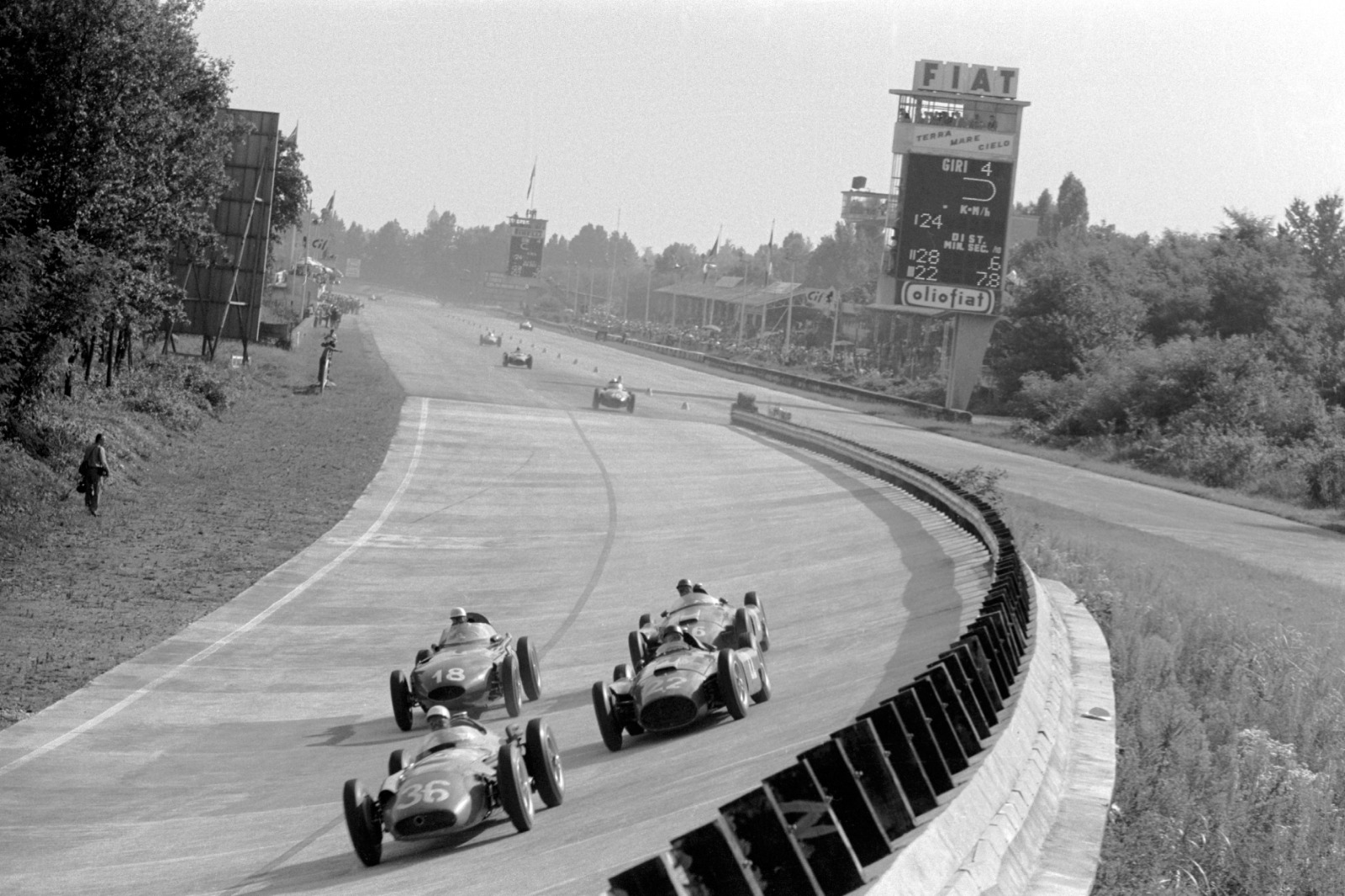
Combined road and banking course at Monza provided a stern test of mechanicals and bonhomie
Photo by: Getty Images
Monza, where an aerodynamic tow is the fundamental arbiter of race outcomes – reliability and strategy blunders excluded – has ever been a place where madness creeps in. Perhaps it's a factor of all that time spent at full throttle, either going somewhere or going nowhere, dependent entirely on whether there is a car in front leaving a useful tunnel of discombobulated air molecules.
To name just a handful of recent examples, this is where Charles Leclerc definitively broke Sebastian Vettel in 2019 by taking advantage of circumstances to ‘accidentally' renege on an agreement to give Vettel a ‘tow' in the final segment of qualifying. Leclerc went on to win from pole while Vettel, from fifth on the grid, humiliated himself by spinning off and then collecting Lance Stroll while rejoining, earning himself a 10-second penalty and three points on his licence.
"All is forgiven," team boss Mattia Binotto told Leclerc after the chequered flag, an ill-considered signal that the end justifies the means, especially if it means a Ferrari winning on home soil where the stakes are that much higher.
"I've come into the team and tried to be respectful of space and definitely not put the team in jeopardy. I stand by that and all I can talk about is on my side. You have to speak to Fred [Vasseur, team principal] about the other side [Leclerc] and decisions that are taken there" Lewis Hamilton
In 2023 Carlos Sainz qualified on pole and spent the opening phase of the race fending off Max Verstappen's Red Bull. Staying in the mix left his tyres shot in the closing laps, where he was relieved of second place by Verstappen's team-mate Sergio Perez. Next up was Leclerc and, while Sainz might reasonably have expected a team order to hold station, the pitwall remained mute.
Thus they conducted an exciting but unnecessarily fraught battle for the final podium position in which they came close to taking each other out.
Ferrari isn't the only team to have suffered the results of Monza indiscipline. Take 2024, when Lando Norris was mounting a late championship challenge to Verstappen and qualified on pole at Monza, only for team-mate Oscar Piastri to mug him for the lead on the opening lap. That move enabled Leclerc to seize the moment and pass Norris for second place, consigning Lando to third at the flag.

In 1993, Christian Fittipaldi tried to lunge past Minardi team-mate Pierluigi Martini on the final lap, flipped, then crossed the line having landed on all four wheels.
Photo by: Getty Images
A year later McLaren tripped over its own shoelaces again, controversially imposing team orders after a slow pitstop put Norris behind Piastri on track while they were running behind Verstappen. At this point Piastri was leading Norris in the championship, so ordering Piastri to move over naturally provoked ire – even more so as a resurgent Verstappen emerged as a late title challenger.
This year it was Ferrari's turn to score a series of own goals throughout qualifying and the race. Ironically, perhaps, it appeared so intent on ensuring equal treatment between Leclerc and Lewis Hamilton that it failed to properly orchestrate a tow between them on several occasions, with the result that Hamilton was nearly eliminated in Q2.
Piastri's penalty elevated Leclerc and Hamilton to third and fourth on the grid after the sub-optimal qualifying. But at the first chicane Ferrari's race came dramatically unravelled as Hamilton dived up the inside line into the right-handed section, then was run off into the gravel by his team-mate as Leclerc clung to his line when the track turned left.
That left Hamilton having to fight his way back from 10th, while Leclerc smote the barrier at the Parabolica at the end of the second lap, inducing a red flag along with heartache for the crowd. We awaited the explanations for these needless acts of self-destruction with almost breathless anticipation.

Leclerc, admittedly suffering the after-effects of his shunt, framed it in dog-ate-my-homework terms, saying "we went too far". When this was put to Hamilton he appeared not to know whether to laugh or harrumph contemptuously, ultimately settling for something between the two.
"I was ahead in Turn 2," he said. "By the apex, I was ahead. There was no 'we' in it."
He went on to, in effect, throw Ferrari under the bus.

Trip into the gravel dropped Hamilton to 10th
Photo by: Sam Bloxham / LAT Images via Getty Images
"Look, I don't race dirty. I've always raced clean and fairly and always left space. I've come into the team and tried to be respectful of space and definitely not put the team in jeopardy. I stand by that and all I can talk about is on my side. You have to speak to Fred [Vasseur, team principal] about the other side [Leclerc] and decisions that are taken there. Ultimately it comes from the top. It trickles down, decisions. It starts with Fred.
"There's only so much you can say, so much you can push and shout from the mountain top. Yesterday [Saturday], I said we've got to look at how we communicate. If we continue to travel the same path, we get the same result."

In Barcelona this year, Ferrari orchestrated its operations to achieve a win for Hamilton. Before and after this point it has given the appearance of an organisation unable to improvise as circumstances change, or to make difficult decisions without holding a committee meeting – as at Zandvoort, when a diplomatically sensitive position arose as Hamilton, on fresher tyres, felt he was being held up by Leclerc at a crucial point.
At Monza, where politesse between team-mates has so often been exposed, it was always likely that the fault lines within Ferrari would begin to chafe
Ultimately a podium finish went begging because of the inertia on the pitwall.
Hamilton obviously feels that, since he is the closest challenger to the Mercedes drivers in the world championship, Ferrari should factor this into its thinking. This is a tricky sell given Leclerc's historic status within the team.
Equally, there have been times this season where Hamilton appears to have been showing his age. During qualifying in Budapest, for instance, he expressed surprise at Piastri's presence, having accidentally obstructed the Australian's push lap. And yet had he not, moments earlier, during his own push lap, passed the McLaren on its out-lap? A younger Lewis wouldn't have been so inattentive to details.
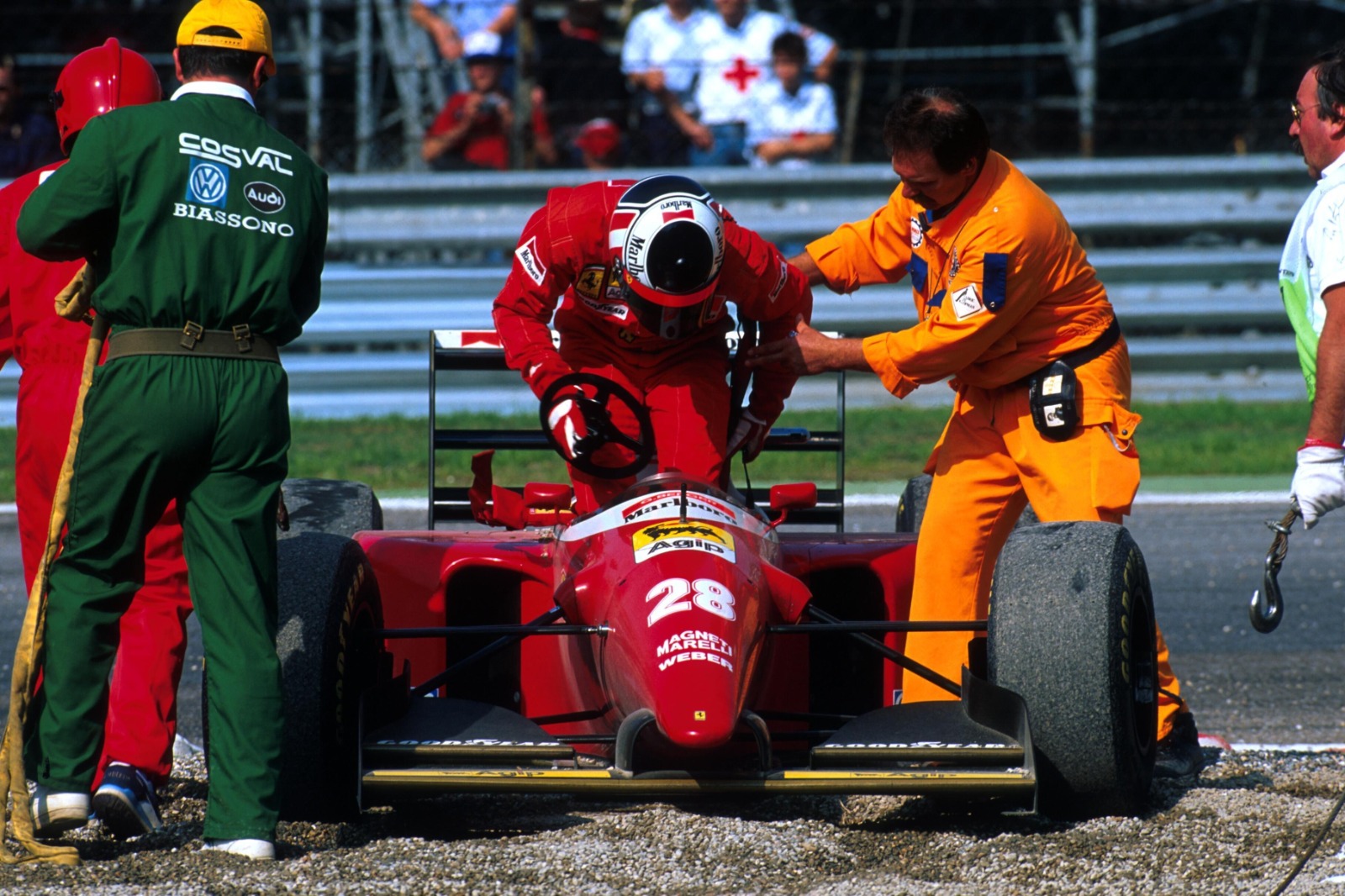
In 1993, Ferrari team-mates Gerhard Berger and Jean Alesi contrived to collide after qualifying had finished
Photo by: Getty Images
Next year Hamilton celebrates the 20th anniversary of his F1 debut. He has raced at Monza many times so he should be familiar with the layout of the first chicane, and the inevitability that the driver on the inside line at the second apex will sweep out towards the right at the exit. One does not simply dive up the inside at Turn 1 and expect the driver on the left to politely say: "After you".
At Monza, where politesse between team-mates has so often been exposed, it was always likely that the fault lines within Ferrari would begin to chafe against one another. All the more so given the absurdities wrought by the 2026 technical regulations, where the tow is more important than ever, and every second lost is all the more difficult to claw back.
It's not just the energy that's starved here. Goodwill is also in short supply.

Can Ferrari repair the relationship between Leclerc and Hamilton
Photo by: James Sutton / LAT Images via Getty Images


Why Hamilton’s return to form is not straightforward

'Senior moment' or breakdown of trust? The implications of Hamilton's Singapore GP meltdown

Why Verstappen's dominance left rivals scrabbling for alternatives in Singapore

A "better job" or more engine power? Verstappen's Singapore pole unpicked

FIA reveals "human error" caused latest software glitch in Singapore sprint qualifying

F1 Singapore GP live commentary and updates - Verstappen wins sprint while McLarens collide

F1 Singapore GP live commentary and updates - Verstappen on pole

LIVE: F1 Singapore GP - Verstappen dominates to victory from Leclerc, nightmare for Hamilton

When Cadillac will open its F1 engine factory

Mission control: Inside the FIA and F1's latest answer to football's VAR

Marquez accepts that current MotoGP contract could be his last

Slater set for F1 practice debut with Audi in Mexico
Subscribe and access Autosport.com with your ad-blocker.
From Formula 1 to MotoGP we report straight from the paddock because we love our sport, just like you. In order to keep delivering our expert journalism, our website uses advertising. Still, we want to give you the opportunity to enjoy an ad-free and tracker-free website and to continue using your adblocker.


Top Comments