


Why Mercedes' Istanbul edge is both stronger and weaker than it seems
Mercedes and Lewis Hamilton dominated the opening day of action for the 2021 Turkish Grand Prix, on the Istanbul circuit’s much improved track surface. But the Black Arrows squad’s position isn’t quite what it seems. Here’s why

Formula 1 drivers are famously never entirely happy. There’s always something. Although maybe that doesn’t apply to the eternally-smiling Daniel Ricciardo…
The pack arrived at the Istanbul Park track for its return to the Formula 1 calendar after a nine-year absence in 2020, eager to sample one of Hermann Tilke’s best and most famous creations. And they got a horrible surprise.
The re-laid asphalt surface was saturated with slippery oils as it had only been completed three weeks before that event took place and it hadn’t had time to cure properly. That meant even in the dry Friday practice sessions that were held before the wet qualifying and race sessions in which Lance Stroll and Lewis Hamilton starred, conditions were considered rather appalling. “Worse than ice,” per Lando Norris.
Fast forward not-quite 11 months to today’s opening running for the 2021 Istanbul event and things have changed considerably. And for the drivers’ pleasure, considerably for the better.
Thanks to the water-blasting treatment the 3.31-mile track has undergone in the last few weeks, grip levels have risen dramatically. The Pirelli tyres, also one step softer compared to the compounds used at Istanbul last year, are actually working – generally switching on much better as they’re blasted over the now more exposed stones that are mushed into the track’s bitumen.
“I didn’t really know what to expect when I went out there today,” said Hamilton, also the winner here back in 2010. “But, jeez, so much more grip than we’ve ever had before. It’s intense how much grip there is out there, which is awesome. It’s made it a much, much more enjoyable track to drive. Much more like it was before.”
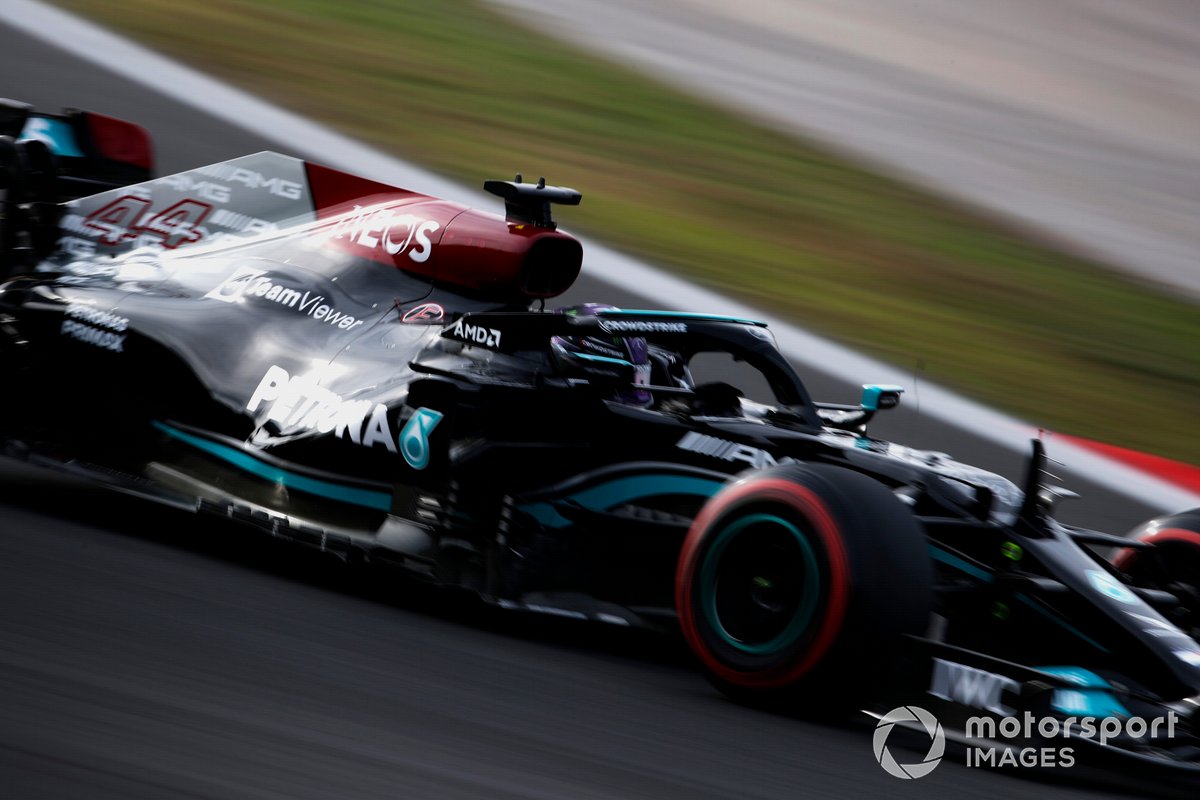
Lewis Hamilton, Mercedes W12
Photo by: Zak Mauger / Motorsport Images
The result of F1’s fastest generation of cars (although of course not quite as quick as they would have been in 2020, thanks to the rear floor alterations mandated for this season) finally getting the grip they desire at Istanbul meant that Juan Pablo Montoya’s 2005 track record was shattered. By 0.592s by Hamilton in FP1, with the world champion then going from a 1m24.178s to a 1m23.804s to top FP2 (below).
Overall FP2 order
| Pos. | Team | Driver | Time | Gap |
| 1 | Mercedes | Hamilton | 1m23.804s | |
| 2 | Ferrari | Leclerc | 1m23.970s | +0.166s |
| 3 | Red Bull | Perez | 1m24.373s | +0.569s |
| 4 | McLaren | Norris | 1m24.525s | +0.721s |
| 5 | Alpine | Alonso | 1m24.660s | +0.856s |
| 6 | AlphaTauri | Gasly | 1m24.756s | +0.952s |
| 7 | Alfa Romeo | Giovinazzi | 1m24.796s | +0.992s |
| 8 | Aston Martin | Vettel | 1m25.229s | +1.425s |
| 9 | Williams | Latifi | 1m25.307s | +1.503s |
| 10 | Haas | Schumacher | 1m25.480s | +1.676s |
Mercedes ended the day in command – something of a worrying trend for title rival Red Bull, following the Black Arrows squad’s (squandered) Monza superiority and significant Sochi advantage.
It was in a good place from the off because Mercedes “started off with a really good set-up” in FP1 according to Hamilton. The team feels it was able to do this because it had arrived in Turkey having spent considerable time working on simulations that provided a wider range of set-up options – with varying wing levels and adjustments – than is usually the case for a race. This was simply because Mercedes knew it couldn’t guarantee how much the water-blasting had impacted Istanbul’s grip levels.
"The indications from free practice are that it's going to be quite a challenge for Lewis to overtake on track. But we're looking at all the options available to us in strategy and on car set-up to allow us to fight back on Sunday" Andrew Shovlin
Although it was pleased with how it started the day, Mercedes continued to make set-up changes throughout FP1 and FP2.
It altered things "quite a bit over the course of the day as the track had more grip than we were expecting", per team director of trackside engineering, Andrew Shovlin. The tweaks kept the team on top throughout Friday, but it did encounter an understeer issue in FP2 that it knows it needs to dial out with work overnight, as the challenge became about getting the fronts turned on correctly in FP2.
At Red Bull – which finished with a best of second for Max Verstappen, 0.425s adrift, in FP1, and fourth, 0.569s slower than Hamilton with Sergio Perez in FP2 – understeer was also a problem. But not the only one.
“We've got a little bit of a balance mishmash,” said team boss Christian Horner. “The circuit is a lot grippier than it was last year [and] I think we're just a little bit out of the window with Max on set-up. So, it's going to be a busy night – burning the midnight oil with the engineers [at the track] and back in Milton Keynes as well.”

Sparks kick up from Max Verstappen, Red Bull Racing RB16B
Photo by: Mark Sutton / Motorsport Images
The balance problem Verstappen encountered meant he seemed to be suffering from considerable understeer (a problem that plagued rivals down the grid too, such as AlphaTauri’s Pierre Gasly). But the Dutchman was also having random oversteer snaps that he called “weird” in FP2. This was also not helped by the strong and unpredictable wind rising in that session.
Verstappen ended the day 0.635s off Hamilton’s best, and 0.066s behind Perez’s FP2 benchmark for Red Bull overall. And Mercedes also dominated the long runs at the end of the second one-hour session too. But its position isn’t quite what it seems.
For a start, it could be somewhat better.
Data Autosport has seen suggests that Hamilton’s best lap in FP2 might’ve been at least 0.2s faster had he not run deep at the Turn 9, 90-degree left, at the end of the first part of the back straight, which immediately feeds into the Turn 10 right kink and creates a rather fast chicane sequence.
The Briton slid deep past the Turn 9 apex and therefore lost momentum going through Turn 10. But he gained 0.2s back in the final corners versus Ferrari’s Charles Leclerc, second in FP2, to finish 0.166s ahead.
But Mercedes’ position against Red Bull is also likely to be weaker than it appears – albeit in a different area. This is particularly the case over one lap, as it is understood that Verstappen was tracked running down on straightline speed versus Hamilton to the tune of 0.2s on their respective quickest tours in FP2. This could be down to Red Bull running a higher downforce level, but is more likely to be the result of a lower engine mode – something Red Bull typically used during Friday practice.
So, it can be expected to be closer to Mercedes in the sessions that matter, but that still doesn’t close the gap all the way.
Yet, Red Bull’s position is additionally considerably stronger than it appears on paper because Mercedes has opted to give Hamilton a fourth internal combustion engine of 2021. This will drop him down 10 places from where he qualifies and this is the biggest problem Mercedes faces this weekend.

Angela Cullen, Physio for Lewis Hamilton, sits in the car and chats with Lewis Hamilton, Mercedes
Photo by: Steve Etherington / Motorsport Images
“I need to be on pole to limit the loss,” Hamilton said after FP2. “Then of course I need to understand the car to be able to do the best in terms of long run. So, [I’m] just trying to find the right balance [between a one-lap optimum pace set-up and one that aids race overtaking]. It’s not really different to any other weekend.”
Mercedes has made the ICE change to try and ward off a potential costly in-race failure or engine-related DNF later in the year. It was managing power problems during its stroll to the 2020 titles, having been able to implement a reliability upgrade after encountering problems during the pre-pandemic pre-season that it needed the initial COVID-19 lockdowns to overcome. But being in a one-team title fight last year meant it could manage these issues accordingly out of sight.
Red Bull’s enduring 2021 challenge means Mercedes cannot just back off on the power front, with the season also being a record-breaking length at 22 races.
The overall combination of factors at play this weekend pretty much heaps pressure on Bottas to deliver the victory, or be in position to give it to Hamilton if he does fight back
The team hopes Hamilton will be able to get through to the end of the year going just one ICE over the permitted season allocation, but it isn’t sounding all that confident about how easily Friday’s pacesetter will be able to get through the pack here in Turkey on Sunday.
“The indications from free practice are that it's going to be quite a challenge for Lewis to overtake on track,” Shovlin stated. “But we're looking at all the options available to us in strategy and on car set-up to allow us to fight back on Sunday.”
The problem could well be an old ‘Class A’ rival: Ferrari.
Medium tyre averages order
| Pos. | Team | Average | Laps |
| 1 | Mercedes | 1m27.732s | 12 laps |
| 2 | Red Bull | 1m28.223s | 12 laps |
| 3 | Ferrari | 1m28.317s | 10 laps |
| 4 | Aston Martin | 1m28.855s | 14 laps |
| 5 | Williams | 1m28.932s | 12 laps |
| 6 | Alfa Romeo | 1m29.275s | 15 laps |
| 7 | Haas | 1m29.787s | 7 laps |
*N/A McLaren, Alpine and Aston Martin
Leclerc might not be as close as he seems to Hamilton on one lap as he appeared, with Mercedes reckoning his engine mode was turned up to deliver roughly 0.3s more on the straights on his fastest FP2 lap, but it was still a very good Friday for Ferrari.
This is because Leclerc also delivered a strong long-run average on the critical medium tyre (above) compared to Red Bull. Carlos Sainz Jr was also only 0.452s slower on average over a much longer stint (23 laps vs Leclerc’s 10, so therefore likely more fuel onboard for a run that caught the eye at rival squads).

Charles Leclerc, Ferrari SF21
Photo by: Mark Sutton / Motorsport Images
If that holds up in the race and Ferrari’s tyre life is more Silverstone than Paul Ricard, that’ll pose a challenge to Hamilton’s fightback. Plus, recent races have demonstrated that in 2021 a Mercedes cannot simply breeze past a McLaren too…
At least aiding Hamilton’s cause is Sainz’s grid penalty dropping the Spaniard to the rear of the field. Sainz said he now has "a bit of a regret" over that situation after seeing Ferrari’s "fighting for a podium" pace on Friday, after he was given a brand new engine with the hybrid system upgrade for this event that Leclerc got at Sochi.
The overall combination of factors at play this weekend pretty much heaps pressure on Bottas to deliver the victory (or be in position to give it to Hamilton if he does fight back) for Mercedes.
One team source said it was "suspicious" of its advantage today – the team knows Red Bull always gains overnight into Saturday – but that’s still a far better position to be in than needing to close a big gap.
In 2021, Bottas hasn’t generally been as close to Hamilton as he was last year in terms of one-lap speed – with Red Bull’s rise also meaning Verstappen can usually get amongst if not ahead of the Mercedes pair. Bottas’s six spins in the race here last year are also very fresh in F1’s collective memory, which will be recalled clearer if rain falls as is predicted by some tomorrow (the race is expected to be dry). It is currently thought that Saturday morning is more at risk of being wet than the afternoon – when FP3 and qualifying will take place.
Bottas was 0.410s slower than Hamilton over their respective best FP2 laps on Friday, with the Finn also down by 0.288s on average over the same stint length (12 laps) in their long runs on the mediums.
But Mercedes puts this down to the performance gain Hamilton’s fresh engine provided, as well as Bottas being a touch more unhappy with the W12’s balance that the changes for FP2 resulted in. The team expects the gap between its drivers to close when Bottas has the higher-milage ‘Friday engine’ he ran today removed, as well as the miles building up on Hamilton’s new unit.
“No big issues and no red flags so a lot of running and it feels like it could be a strong weekend for us,” Bottas said after FP2. “Looking at the timing board, it looks like a good track for Ferrari but I'm sure Red Bull have a lot more to come, as we all do. It's going to be close.”

Valtteri Bottas, Mercedes W12
Photo by: Jerry Andre / Motorsport Images
Assuming Bottas starts on pole ahead of the Red Bulls and with Hamilton halfway down the grid, the leading teams opting to go for a one-stop strategy has to be considered the best and most likely option right now.
This is because while there are much higher levels of grip on the reworked track surface in 2021, that doesn't necessarily mean the drivers will encounter big tyre degradation. This is despite Istanbul being very demanding in terms of tyre load – particularly at the fast, downhill Turn 1 left and the flat-out, multi-apex Turn 8 sequence.
Even with the asphalt’s stones being exposed more by the water-blasting, the surface remains not particularly abrasive. This likely explains why Shovlin was surprised about the low tyre degradation levels witnessed today: "We'd expected them to suffer a bit more given the high energy corners here but they seem to be holding up surprisingly well."
Mercedes could opt to go aggressive and pit Hamilton for a second time to keep him in free air and with an off-set tyre life advantage to use come the end of the race
With that in mind, Bottas and the Red Bull cars would therefore be expected to try and get through Q2 on the mediums to start the race on that compound, then take hards at a single planned stop. Logically, Hamilton would be on an identical plan to retain strategic flexibility on when his first stint is ended.
But the Istanbul track’s demanding layout and the relatively cool temperatures this weekend could mean graining, which did occur during the running today. If that is the case in the race and poses a considerable tyre management challenge, Mercedes could opt to go aggressive and pit Hamilton for a second time to keep him in free air and with an off-set tyre life advantage to use come the end of the race.
If F1 drivers are generally never entirely happy, then how Verstappen went from Sochi grid penalty pain to the podium sums that cliche up nicely. How Hamilton will be hoping for at least a similar result in similar circumstances in Turkey this time around.

Lewis Hamilton, Mercedes W12
Photo by: Charles Coates / Motorsport Images


Why Britain’s role in Formula 1 endured a troubled start

Why Bottas believes his F1 reserve driver role is the fastest route back to a race seat

Why Norris is now ready for his final exam

The key advantage for Bottas vs Perez in the 2026 F1 return race

Why Ferrari's management is under pressure after its bad start to F1 2025, not Hamilton or Leclerc

Why Red Bull can’t solve its second F1 car problem with a simple paint job

Hirakawa replaces Doohan at Alpine for Japanese GP FP1 outing

How Alonso and Bortoleto can be F1 rivals in a unique driver management deal

Mekies extends contract as Red Bull's F1 team boss
What to expect from WEC's Barcelona debut

Acosta proposes new idea for monitoring tyre pressure in MotoGP

Horner's inside story of how Red Bull built its own F1 engine
Subscribe and access Autosport.com with your ad-blocker.
From Formula 1 to MotoGP we report straight from the paddock because we love our sport, just like you. In order to keep delivering our expert journalism, our website uses advertising. Still, we want to give you the opportunity to enjoy an ad-free and tracker-free website and to continue using your adblocker.


Top Comments