


Why Ferrari has its work cut out in Spain
Any hopes of Ferrari making inroads against Mercedes at the Spanish Grand Prix appeared to be dashed on Friday. BEN ANDERSON looks into the reasons behind that outcome
The beginning of the European season usually provides the first major skirmish in Formula 1's endless car development war, and with it hope among those who are trailing the competition that they might - with some clever thinking and lots of hard work - close up to, or even overtake, their nearest rivals.
At the front of this year's F1 grid that means Ferrari's ongoing efforts to catch Mercedes. Sebastian Vettel spoke ahead of this weekend's Spanish Grand Prix about his hopes that the Scuderia might close the gap with a raft of updates to the SF15-T.
But on the evidence of the first day of running at Barcelona, that hope hasn't become a reality.
The story of Mercedes versus Ferrari so far this season has been highly dependent on specific circuit layouts and conditions. The Maranello outfit is generally quicker at places that are very hot (Malaysia) and on circuits where the emphasis of crucial tyre management is at the rear of the car (Malaysia and Bahrain).
 Hamilton wasn't always happy, but his car was fast on Friday © LAT
|
The Mercedes W06 is a slightly faster car overall, and usually increases its edge in cooler weather (pre-season testing, Australia and China) and on front-limited tracks.
Events at the predominantly front-limited Circuit de Catalunya on Friday merely emphasised the trends we've already seen so far in 2015. The first session took place in a relatively frosty 19C, with a track temperature of 30C, and Mercedes was almost a full second faster than Ferrari (on the harder tyre).
Temperatures climbed to 27C (ambient) and as high as 50C (track) for the afternoon session, as teams began using the faster medium tyre, and Mercedes' pure pace edge dropped off as a result - back to the sort of four-tenths gap it has enjoyed at the circuits Ferrari has been stronger at, namely Malaysia and Bahrain.
Of course, we cannot account for fuel loads and engine settings etc. But it's fairly likely that Lewis Hamilton and Nico Rosberg will once again engage in a personal battle for pole position here.
Many drivers struggled with the circuit conditions in the afternoon, and Rosberg ended up four tenths adrift of Vettel as a result, but it will likely require a massive underperformance from Rosberg on Saturday for Vettel to have a chance of splitting the Mercedes.
On pure performance at least, it looks like a stalemate at the front of the field in terms of car development.
Single-lap pace ranking
1. Mercedes, 1m26.852s (Hamilton)
2. Ferrari, 1m27.260s (Vettel)
3. Red Bull, 1m27.943s (Kvyat)
4. Toro Rosso, 1m28.017s (Verstappen)
5. McLaren, 1m28.494s (Button)
6. Williams, 1m28.525s (Bottas)
7. Lotus, 1m29.086s (Grosjean)
8. Sauber, 1m29.333s (Nasr)
9. Force India, 1m29.601s (Hulkenberg)
10. Manor, 1m31.929s (Stevens)
Daniel Ricciardo suffered a problematic day on his side of the garage, but Red Bull team-mate Daniil Kvyat arguably enjoyed his cleanest Friday of the season so far in the updated RB11, which featured a new front wing and nose. The result was 'best-of-the-rest' behind Mercedes and Ferrari, which is where Red Bull would expect to be.
 Revised Red Bull could be in a frantic fight for best of the rest © XPB
|
However, sister team Toro Rosso (which has brought a new floor and some other small aero tweaks to the STR10) was very close behind, while Williams traditionally makes huge gains from Friday through to Saturday - as it dumps out the fuel and turns up the engine - so you would expect Valtteri Bottas and Felipe Massa to jump into the gap behind Ferrari come qualifying.
On the face of it, the improving McLaren-Honda alliance appears to have made a big jump forward in Spain. Fernando Alonso came close to making Q3 last time out in Bahrain and Jenson Button's seventh fastest time in FP2 at Barcelona (in a car that features continuous aerodynamic upgrades and a fresh Honda engine for this race) suggested McLaren might be a top-10-shootout certainty here.
However, the 2009 world champion suggested after the session that his MP4-30 still needs to improve in "all areas", and an analysis of each car's long-run pace on the medium tyre (which should be the rubber of choice in Sunday's race) reveals why the Brit is so pessimistic.
Long-run ranking (medium)
Average lap time
1. Mercedes, 1m31.582s (Rosberg)
2. Williams, 1m32.292s (Massa)
3. Ferrari, 1m32.504s (Vettel)
4. Force India, 1m33.178s (Hulkenberg)
5. Red Bull, 1m33.290s (Kvyat)
6. Toro Rosso, 1m33.492s (Sainz)
7. Lotus, 1m33.509s (Maldonado)
8. Sauber, 1m33.738s (Nasr)
9. McLaren, 1m33.961s (Button)
10. Manor, 1m37.891s (Stevens)
The McLaren-Honda was easily the slowest of the midfield contenders over a nine-lap average stint (using Nico Rosberg as the reference).
It's bad news too over at Ferrari, which has usually been closer to Mercedes over longer runs. That was not the case on Friday afternoon in Spain.
Kimi Raikkonen claimed he was simply "wasting laps" and "getting nothing out of this" while he pounded around on the harder tyre (which Pirelli calculated was 1.5s slower than the medium in the heat of the afternoon), but team-mate Vettel's more-meaningful running on the medium will not ease the Finn's discomfort.
"Overall it's fairly straightforward - the medium is the faster tyre, but it was pretty slippery today for all the cars, you saw everyone was a little bit all over the place," explained Vettel.
 Raikkonen didn't enjoy his day of practice in the Ferrari SF15-T © LAT
|
"Unfortunately grip seems to be very low, nothing abnormal. We've seen that across many years now, when you come here in the summer the track is quite a bit slower than in the winter."
But the hot conditions of Friday afternoon, which affected performance so drastically that some cars - namely the Mercedes, the Sauber and the Force India - were actually quicker on harder rubber in the morning than they were on the medium in FP2, are expected to remain for the rest of the weekend.
This usually plays to Ferrari's strengths, but the SF15-T doesn't look as strong here as it has done recently, and the Scuderia may actually be looking over its shoulder at a resurgent Williams, rather than focusing on pressuring Mercedes.

However, the big caveat here is fuel loads. Vettel's total race run was almost twice as long as Rosberg's, so you would expect the Ferrari to be a bit stronger when it comes to the race itself. That said, Felipe Massa's mightily impressive effort in the updated FW37 was only three laps shorter than Vettel's, which suggest Williams has taken a genuine step forward here.
As Valtteri Bottas said after FP2, "we are very much looking forward rather than backwards". That's bad news for Ferrari given how good the Williams looks over a longer run. Massa was even more impressive on the harder rubber, but that run lasted only five laps (Raikkonen did 13) and occurred on a much lighter fuel load.
Nevertheless, Friday's running indicates that Williams is perhaps finally getting on top of the tyre management difficulties that plagued its form over the first four races. If that translates, it could be a genuine podium contender on Sunday, though it should be noted that Ferrari still appears to retain its advantage on tyre degradation, which should give it a strategic upper hand.
If Ferrari is forced to fight Williams again it will create the conditions for an exclusive battle for victory between Rosberg and Hamilton - the likes of which we haven't seen since the season-opener in Australia.
Hamilton endured a tricky afternoon session in Spain - complaining of a problem with his seat and requiring tweaks to the set-up in order to get comfortable. He trailed his team-mate over longer runs on both types of tyre (on average he was 0.07s slower on the medium and 0.077s adrift on the hard), but only fractionally.
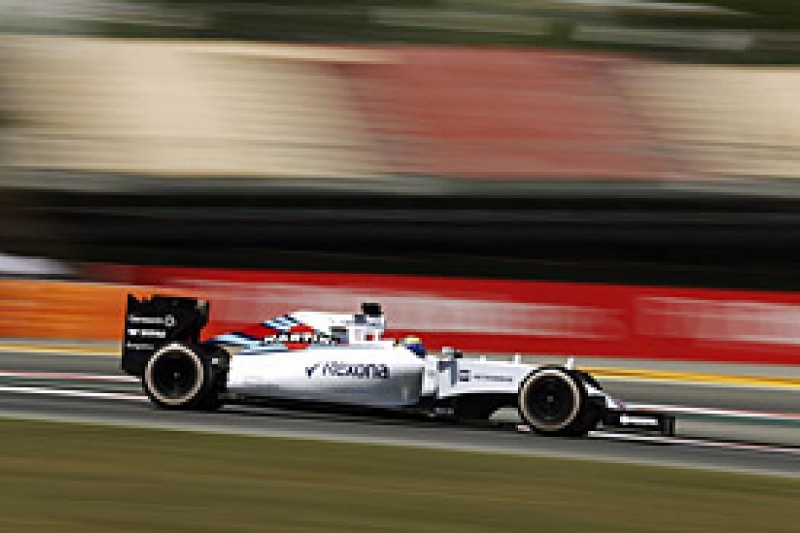 Williams appears to be in better shape that Friday's times suggested © LAT
|
If he can again translate his single-lap pace advantage into Saturday's qualifying session, it's difficult to see how his team-mate can use that small long-run edge to overturn the deficit. In short, if Rosberg is to claim that first win of 2015 he so desperately needs to spark his title challenge into life, he's going to need to quickly rediscover the magic qualifying touch he possessed last season.
Single-lap pace is certainly not the strength of the Force India VJM08, which continues to trail its midfield rivals in the downforce stakes. Nico Hulkenberg managed a surprisingly rapid longer run on the medium tyre in FP2 though - better than all bar the first three teams.
But it will be difficult to translate that into a good result unless the team can unlock a bit more performance from the car for Saturday's qualifying session - given how difficult it is to overtake on this track.
Fellow Mercedes customer team Lotus has generally been a rock-solid top-10 contender over the first four races, but a rear wing upgrade to the E23 has not produced the desired gains yet, so the Enstone squad may well slip back behind the improved Red Bull and Toro Rosso squads here.
A similar lack of aerodynamic progress afflicts Sauber, which has often been a lower-points contender so far in 2015, but has struggled to stop its rear tyres from overheating in Spain.
On the evidence of Friday, things don't look nearly as rosy as usual for the Ferrari-powered teams. Ferrari has recently been the one turning the screw on Mercedes; now it's time to see how the new-look Scuderia reacts when it is the one on the rack.


Autosport 75: How Verstappen scored his first F1 win

The supercharged Revolution that has piqued an Olympic legend's motorsport taste

How Radical revamped its record-breaking flagship model

Inside the lightweight Czech sportscar making its mark on the UK

Why the Jaguar E-type remains special at 60

How McLaren’s GT3 ‘single-seater’ defies expectations

How Radical's latest machines fare on track

From the archive: Button's last spell with Williams

Historic single-seaters celebrate a century of power at Brands Hatch

Pirelli's battle with F1 wheel rim development

Why strategic variation makes WEC 2026 a fascinating watch

Win the dream ticket to attend every F1 race next season
Subscribe and access Autosport.com with your ad-blocker.
From Formula 1 to MotoGP we report straight from the paddock because we love our sport, just like you. In order to keep delivering our expert journalism, our website uses advertising. Still, we want to give you the opportunity to enjoy an ad-free and tracker-free website and to continue using your adblocker.


Top Comments