


Why F1 should stop considering a return to refuelling in 2031
OPINION: As the FIA and the manufacturers prepare to negotiate 2031's engine regulations, the topic of refuelling has been put on the table. For the good of F1, this should be ignored entirely

If there's anything that unites a significant chunk of the oft-divided Formula 1 fanbase, it's the dislike of politicking and grandstanding over regulations - or rather, that nobody ever seems to learn anything from it.
Case in point: the current power unit regs. While I don't have anything against the general theory of it, and genuinely believe that a hybrid formula can be a net positive for F1 overall, the 'compromise' solution taken between manufacturers ends up being a series of disparate ideas cobbled into a ruleset rather than a cohesive treatment overall.
When it comes to the discussions over F1's next powertrain formula in 2031, the manufacturers are already slotting their stakes in the ground in an effort to shape the regulations towards their own varying agendas. One manufacturer might want turbos, another might want a naturally aspirated engine. Another might want a small hybrid element, another might want a mammoth 400bhp motor. The cycle continues, we learn nothing, and the manufacturers' opposing desires warp the final ruleset into something flawed from conception.
At some point, someone has to take the lead and tell the manufacturers "this is the engine formula, deal with it". Build a V8, make sure it fits in the defined box, and off we go.
Roberto Chinchero's piece demonstrating the minefield of 2031 engine politics outlines the tightrope that F1's rulemakers will be deigned to navigate as the world's automakers angle for a formula that allows them to market their own road-going products. Appended to the bottom of it was a worrying sub-heading that truly demonstrates that nobody learns anything from history: Chinchero wrote that the FIA is considering a return to in-race refuelling.
Since this is an opinion column, I shall air one of my strongest - and I do not believe that this is a controversial take: reintroducing refuelling to F1 races is a dreadful idea. It is a solution to a question that does not exist, and antithetical to what - in my opinion - Formula 1 should be about.
This would not be the first time that F1 has reintroduced refuelling, having been banned after the 1983 season and then reintroduced for 1994. When the World Motor Sport Council convened for a meeting on the 15 October 1993, it enshrined a swathe of regulatory changes; most of them targeted the use of driver aids, but it also threw refuelling back into the mix.

Steven Tee's infamous shot of Jos Verstappen's fuel fire at Hockenheim of 1994 demonstrated the perils of in-race refuelling
Photo by: Steven Tee / LAT Images via Getty Images
The contract to produce the refuelling rigs was given to French firm Intertechnique, which became infamous when a fuel spillage ignited on Jos Verstappen's Benetton during the '94 German Grand Prix, producing an inferno that left the Dutchman and fuel-handler Simon Morley with burns. It wasn't Intertechnique's fault that Benetton was said to have removed the filter to speed up their fuel stops, but it did force a redesign for 1995 to limit the chance of further instances of pit fires.
Regardless, the added danger associated with in-race refuelling must be considered. In both 2008 and 2009, the final years of refuelling before the practice was outlawed for 2010, there were incidents where a driver left the pit lane with the fuel nozzle still attached: Felipe Massa did so in Singapore in 2008 (and other scenarios in the race led to him contesting the results of that year's championship in court), thankfully without any consequences other than to his own points tally, but Heikki Kovalainen doing likewise in the 2009 Brazilian Grand Prix spat combustible fuel at Kimi Raikkonen's car. The fuel caught fire, but it was lucky that there was no further damage; Raikkonen had left his visor up, and some of the fuel had sprayed into his eyes.
With refuelling, a driver might not even need to engage with the other cars on the track and instead is in service to the strategy calls
Now, with expected advances in technology 20-odd years after the fact, it can be assumed that this should be less of an issue. Yet, it lies entirely at odds with F1's modern-day safety drive; one that spawned the halo, an increase in deformable crash structures, and Zylon-weave anti-intrusion panels. The sticking point for the FIA isn't one of safety, but logistics; the added freight needed to ship several refuelling rigs around the world sits in stark contrast to its pledge to reduce cargo as part of its sustainability initiatives.
The other - and arguably most important - issue is that refuelling significantly affects what fans see on track. While there is value in strategy, and I personally enjoy the races where teams explore a mix of multi-stop strategies - in the mould of those that Barcelona and Austria produced over the past month - the longer stops for fuel make it much easier for teams to use this as a means to pass another driver rather than allow the driver to do so on-track.
Now, while the current regulations have (at least in the early-season) diluted the use of on-track overtakes as a metric for how action-packed a race can be, this still has value when contextualised between 1984 and 2010, before DRS was implemented.
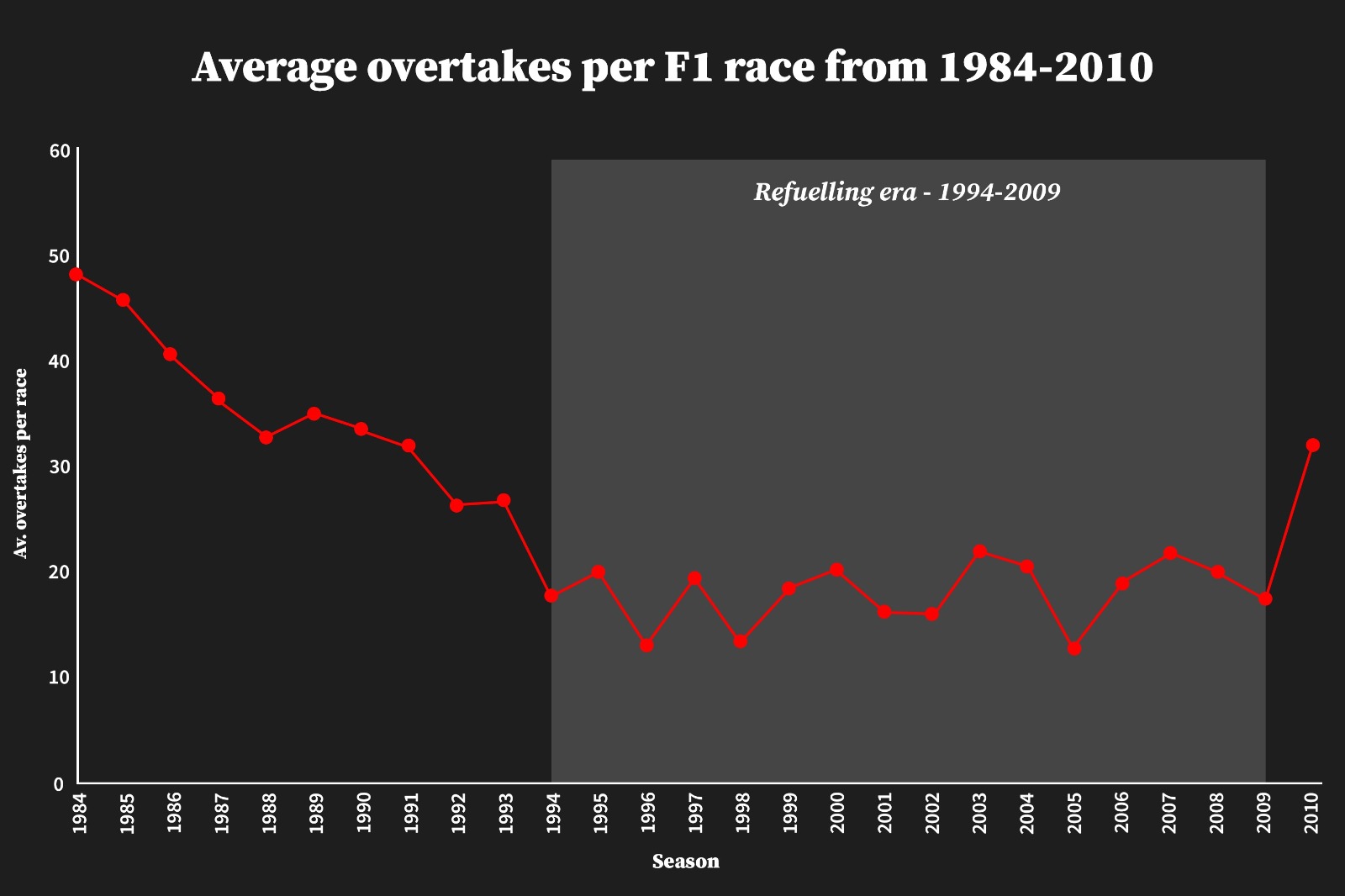
It's very easy to see the drop-off in passing during the refuelling age, and the rebound when F1 removed fuel stops. Extrapolating from this, it's much less likely that the viewership will get to bear witness to genuinely good wheel-to-wheel action; it's more likely that a driver would be called in to short-stop to theoretically gain track position once the other driver stops.
If people are already dissatisfied by the now-less-prevalent zero-skill overtakes under energy boost, at least this happens on track where the racing is; the passing-in-the-pits racing promoted by a refuelling formula largely deletes that. And, in the age of race simulation software and zillions of data channels, this would only take even more power away from the drivers.
The theory is that bringing refuelling back into play would help the FIA commit to its drive to cut the weight of the cars down, as cars are only fuelled for one stint and have a much smaller fuel tank. But you can do this by potentially shrinking the cars even further, and minimising (or even deleting, if you want to get rid of hybrid systems altogether) the size of the battery. The governing body does not need to reintroduce the main contributing factor to many of the dull races that were prevalent over the late 1990s and across the 2000s.
And don't get me wrong, this is a time period that ignited my love for F1; the cars produced a sonorous V10 soundscape, had matinee-idol looks, and looked genuinely difficult for even the best drivers to thread around the circuit. But, having watched almost every race from that era, they weren't the thrill-a-minute affairs that the highlights reel would have you believe.
In the lead-up to the Austrian Grand Prix, F1 put a highlights reel of the 2003 race onto its YouTube channel - and it's amazing that they found 18 minutes' worth of stuff to put in the video; pretty much every comment picks up on the noise, which apparently is enough to placate any fan when the actual on-track racing is virtually an afterthought. Michael Schumacher's fuel hose catching fire filled up one of those 18 minutes; the rest features commentators James Allen and Martin Brundle reading out timings and postulating strategy - because fuel stops superseded what was actually happening on-track.
At this juncture, you might be thinking "yes, but don't tyre stops do this as well?". In this instance, I would argue otherwise; while these still bring an element of undercut-overcut jeopardy to races, the shorter nature of the stops are much less geared towards this.

Massa took the fuel hose with him in Singapore in 2008
Photo by: Eugene Hoshiko / AFP via Getty Images
Refuelling encourages the practice of putting a driver on the other side of the track to go and set blistering laps on half a tank of fuel, with the express purpose of coming out in the lead in the final stint. In this scenario, a driver might not even need to engage with the other cars on the track and instead is in service to the strategy calls.
The nature of tyre stops, on the other hand, is about giving drivers tyre-life deltas to work with; the art of racecraft is still in place, giving drivers licence to defend their positions against someone with fresher tyres, or to attack in order to proactively make it work out. I want to see drivers attacking and defending against each other, especially in modern-day F1 where the relative skill level of each driver is so close. At the worst moments in F1's refuelling age, the FIA may as well have let each car do their 60-odd laps in isolation, and then stitch all the race times together at the end to declare a winner.
I personally don't care what the next engine formula is, but having something that the fans are genuinely enthusiastic about would be a considerable win for F1 as a whole. If they want noise, let them listen to it. If they want power, let them experience it.
There is no compelling reason, however, for refuelling to be a part of F1 again. Leave that in the past.

Kimi Raikkonen narrowly avoided anything worse than stinging eyes when Kovalainen left the pits with fuel hose in tow
Photo by: Steven Tee / LAT Images via Getty Images


What we learned from Friday practice at the 2026 Bahrain GP in Malaysia

Mercedes introduces new floor, sidepods for F1 Bahrain GP

The problem with Ferrari’s endless team principal speculation

Azerbaijan Grand Prix Driver Ratings 2026

Not quite "plain sailing": Baku's late-race chaos almost cost Russell victory over Verstappen

How Russell claimed his career-best pole margin in F1 Azerbaijan GP qualifying

How the chase to catch Mercedes is unfolding

What we learned from Thursday practice at the 2026 F1 Azerbaijan GP

WRC Sardinia: Neuville snatches lead from Fourmaux as Hyundai remains on top

Why Verstappen’s unusual run plan highlights F1 teams’ biggest challenge in Malaysia
What we learned from Friday practice at the 2026 Bahrain GP in Malaysia

Why ‘Mr Formula E’ has called time on his racing career
Subscribe and access Autosport.com with your ad-blocker.
From Formula 1 to MotoGP we report straight from the paddock because we love our sport, just like you. In order to keep delivering our expert journalism, our website uses advertising. Still, we want to give you the opportunity to enjoy an ad-free and tracker-free website and to continue using your adblocker.


Top Comments