


Uncovering Silverstone's engineering secrets for F1 success
Formula 1 returns to Silverstone this weekend, but despite its familiarity to all the teams it is no picnic. Here are five of the key points for engineers to consider prior to the British Grand Prix

Throughout its seven decades as a Formula 1 circuit, Silverstone has changed significantly. Once a circuit that ran around the perimeter of an old RAF base, it has metamorphosed into one of the world’s most renowned racing venues, blending some of motorsport’s most iconic corners into a fast and flowing layout.
In 2010, the layout received its most dramatic change since its 1991 overhaul, bypassing the Abbey/Bridge corners with a more comprehensive infield section to fit the Wellington straight into the equation. It’s not only a mainstay of the F1 calendar but one of its toughest circuits, with a penchant for the unexpected and the punishment it inflicts on the cars demanding extensive preparations from the teams.
Silverstone’s wealth of idiosyncrasies, then, must not be underestimated – and there’s a lot of work that goes on behind the scenes to find a set-up to cope with the extremities of its 3.661-mile Grand Prix layout. Here are five tips for tackling Silverstone – Maggotts and all – successfully.

An Alfa Romeo mechanic makes set-up tweaks to Kimi Raikkonen's front wing at Silverstone in 2020
Photo by: Alfa Romeo F1 Team
1. Find the right aero balance
Teams cannot be successful in modern F1 without a correct aerodynamic set-up – and Silverstone requires two diametrically opposed approaches within its confines. High-commitment corners such as Stowe, Abbey and Copse provide high-speed challenges, so an aero balance that allows the drivers to power through them and carry the speed into the following straights is crucial.
Yet, the lower-speed corners prove to be something of a fly in the ointment. After Abbey, the cars then face the considerably more glacial transit from Farm into The Loop, and then follow up after the Wellington straight into the Brooklands-Luffield section – which also bring the cars down to the lower range of speeds.
“You’ve got to contend with those, what are now, ludicrously quick corners,” explains Williams’ head of vehicle performance Dave Robson. “Copse completely flat is really tough, not so much in balancing the car, but just making sure the drivers are confident with it.
“Obviously, you need the aero balance to be quite strong there. Stowe now is a real proper corner, a bit like Copse used to be, I suppose – quick and seriously demanding.
“You’ve got to have that fine balance between having the stability of the entry, but its drivers still being confident the aero balance is there to actually get it round the corner and you’re not going to understeer off.
"The front left takes a hammering because of those quick right-hand corners, so you’ve got to be careful about how you get around those corners and use the aero balance and the mechanical balance actually to complement each other so that you don’t just wear the front left tyre out" Dave Robson
“The bigger problem you get to is that the low-speed stuff, Turns 3-4-5-6, onto the old start/finish straight, those corners are probably much more towards the understeer side. They’re a bit more awkward if you put the aero balance up where you’d ideally like it for the high-speed corners, because you then run into some problems on the exit of those low-speed corners. That’s probably the trickiest bit.”
Therefore a healthy dose of compromise is vital when tackling Silverstone – the engineers have to analyse the reams of data they have at their disposal and determine the parts of the track from which they can extract the biggest time gain. Focusing entirely on the low-speed corners’ tendency to reward curing understeer will leave a car skittish and susceptible to scrubbing off speed on the quicker parts – losing valuable time.
The old Silverstone was what Robson describes as a “much higher-downforce, low-efficiency circuit”, and the transition to the revised layout added considerations in terms of ride and more time that could be extracted from the new and reworked corners on the track.

George Russell attacks Copse in 2020
Photo by: Williams Racing
2. Manage the tyre wear
It’s no secret that Silverstone really puts the tyres through their paces. The 2020 British Grand Prix provided the most recent showcase of that as Valtteri Bottas, Carlos Sainz Jr and eventual race winner Lewis Hamilton all sustained front-left blowouts that left them limping back to the pits – in Hamilton’s case, after first dragging his car across the finish line to victory over Max Verstappen.
The front-left tyre experiences a huge degree of load throughout the course of a race at Silverstone, as it reacts to the weight transfer in the middle of the high-speed corners to keep the car on the road. Paired with the increasing aerodynamic loads experienced by the tyres as F1 cars evolve, it created a perfect storm in which the well-worn front-lefts could no longer handle the loading through the corners.
It wasn’t dissimilar to the 2013 race, in which a number of failures and delaminations occurred – to the front and rear left-sided tyres, which prompted Pirelli to rework the construction within to strengthen them. Regardless, the degree of wear placed on the tyres is something that anyone racing at Silverstone must contend with – albeit hopefully with fewer explosive results.
“It is a massively demanding circuit for the tyres now,” explains Robson, who joined Williams as a race engineer to Felipe Massa in 2015 after five years with Jenson Button at McLaren.
“The front left takes a hammering because of those quick right-hand corners, so you’ve got to be careful about how you get around those corners and use the aero balance and the mechanical balance actually to complement each other so that you don’t just wear the front left tyre out.”
Although set-up and tinkering with the parameters available can alleviate any tyre concerns, it may require the drivers to curb their enthusiasm in those high-speed corners, especially mid-race.
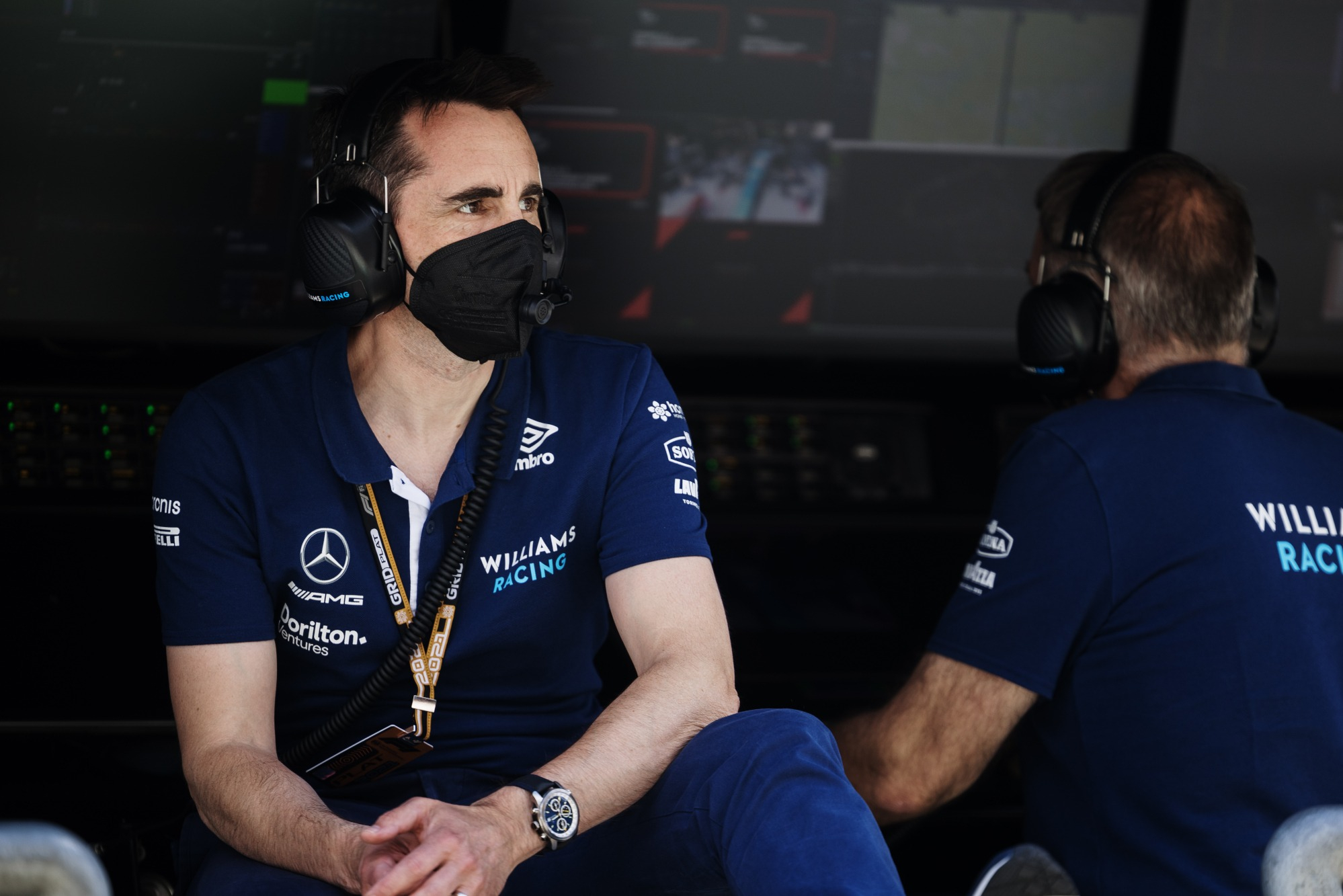
Williams head of vehicle performance Dave Robson
Photo by: Williams Racing
“You can play with the set-up a little bit, but ultimately if you want to reduce the wear, you really just need to reduce the energy on the limiting tyre,” Robson adds.
“On a circuit like Silverstone, you may just have to say, ‘Well, once we get to the race, we’ll back off a bit in the really high-speed corners, and we won’t take Copse as quick as we could do. And we’ll just reduce the wear on that front-left tyre in order to be able to do the stint length that we want.’
“If that doesn’t look practical, maybe that’s what forces it into being a two-stop race. You’ve got to constantly weigh up how that behaviour is working out that particular weekend.”

Sebastian Vettel makes a pitstop in the 2020 British GP
Photo by: Ferrari
3. Get plans and strategies in place
Given F1 has been given the moniker of ‘chess at 200mph’, this might sound like a rather obvious step. But as Silverstone is a circuit that everyone knows well, engineers can possibly take a little more licence with strategic risks.
As Robson explains, there’s a degree of assessing the tyre wear before pulling the trigger on a change of strategy. If there’s one thing about current F1, it’s that, while one-stop races are common, they’re never 100% certain. The recent French Grand Prix was expected to be a single-stop affair, but higher-than-expected tyre wear put the strategic calls on a knife-edge and some teams successfully managed a two-stopper.
The extent of tyre degradation and whether this will be conducive to a two-stop strategy will be extensively considered in pre-race simulations, ensuring that teams aren’t caught out – although one eye will be kept on any strategic variations that may result from safety car interruptions.
"Because we’re watching what everyone else is doing, you’re involved in this genuine game theory problem. They’re all watching everyone else. Everyone’s watching everyone working out what your best response is to everyone else’s best response" Dave Robson
“We will turn up with an idea of what we want to do,” Robson says. “And a lot of Friday is about testing that out: ‘Can we do what we want and if we can’t, what’s the next best thing to do?’ At the same time, ‘What does it look like everyone else thinks they’re going to do?’ In a way, it’s a shame that little of that is as obvious to the TV viewers as perhaps it could be.
“For me, at least, as an engineer, what makes it fascinating is that combination of a prediction, we then test, we iterate. And at the same time, because we’re watching what everyone else is doing, you’re involved in this genuine game theory problem.
“They’re all watching everyone else. Everyone’s watching everyone working out what your best response is to everyone else’s best response, if you like. Actually, I think it’s way more fascinating than sometimes it appears.”
With the hardest range of Pirelli tyres available for the British Grand Prix – the C1, C2 and C3 compounds – the teams should have a bit of a safety net, but Silverstone puts even the most rock-solid rubber through its paces. Using Friday to assess the trade-off between going more slowly on a one-stop strategy or using the tyre life up and risking a two-stop will be a key focal point of the weekend.
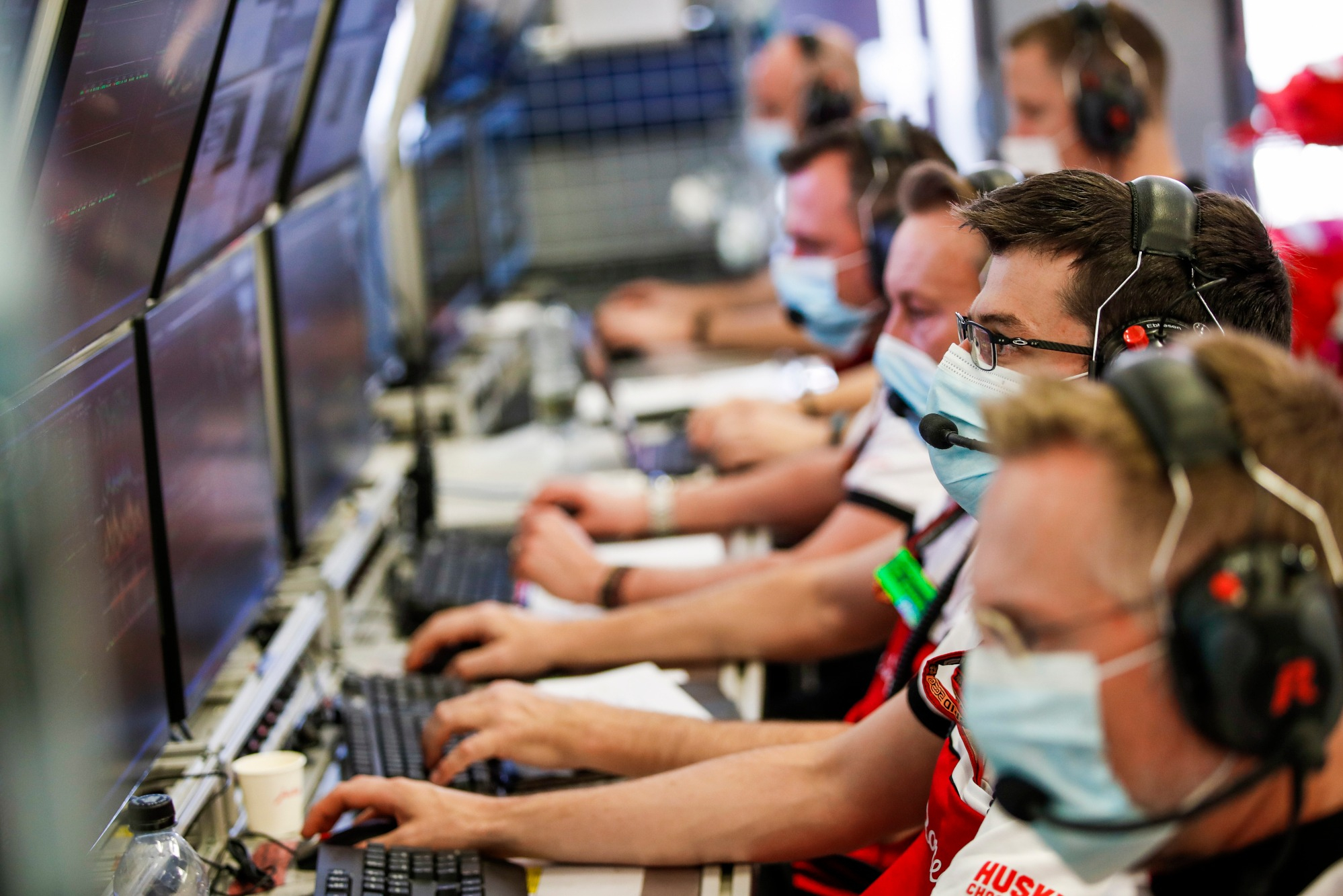
Engineers have to predict what everybody else will do and strategise around it
Photo by: Alfa Romeo F1 Team
4. Expect the unexpected, especially when it comes to the British summer
Contrary to popular perception, many Silverstone races have been able to bask in the July sunshine. But many have also had to contend with a downpour as the fickle British weather reverted to type.
In the 2008 race, for instance, Hamilton passed polesitting team-mate Heikki Kovalainen (who had Robson in his corner as performance engineer) and simply disappeared into the spray to a famous victory. Plenty more examples have followed of changeable conditions setting the cat among the pigeons on the pitwall and laying all of those best-laid strategies to waste.
In such circumstances, decisions have to be made on the fly, but if you can predict unpredictability then you’ll always have some idea of how a race might play out. As Robson explains, if inclement weather seems likely, teams can have a chance to tinker with the limited options left post-parc ferme to add some extra flexibility in the set-up.
“Perversely, at least you know there’s a good chance that it’s going to be unpredictable – it at least makes you think about it,” he says. “I remember in one of the races since we moved to the new paddock, getting ready to do the lap to the grid on a Sunday, it had been hot and sunny in the pitlane.
“It turned out it was raining pretty heavily at Copse and, fortunately, we hadn’t sent the car out too early – other cars got round there and they were all just falling off. It was completely dry and sunny in one part of the track and wet and quite slippery in other bits.”
Rain was marginally in the mix for Williams in 2015, during a more prosperous season in which both Robson’s charge Massa and team-mate Bottas were challenging for victory. Massa had an early lead, lost it to Hamilton amid the first round of stops, and the occasional moments of rain eventually necessitated a switch to intermediate tyres – which Hamilton put on before the Williams pair to ensure a comfortable victory.
There’s also the risk of safety cars to contend with – and although that’s a consideration at any race, Silverstone has ‘welcomed’ its fair share of incidents over the years. Two safety cars were needed within the first 12 laps of last year’s British GP, and the high-speed corners can magnify tyre and brake problems, leading to heavy impacts – as AlphaTauri’s Daniil Kvyat discovered.
But not every disruption is the result of contact. David Coulthard’s dislodged headrest and the track invasion by defrocked priest Neil Horan caused two safety cars in 2003, allowing Cristiano da Matta’s Toyota to briefly lead the race.
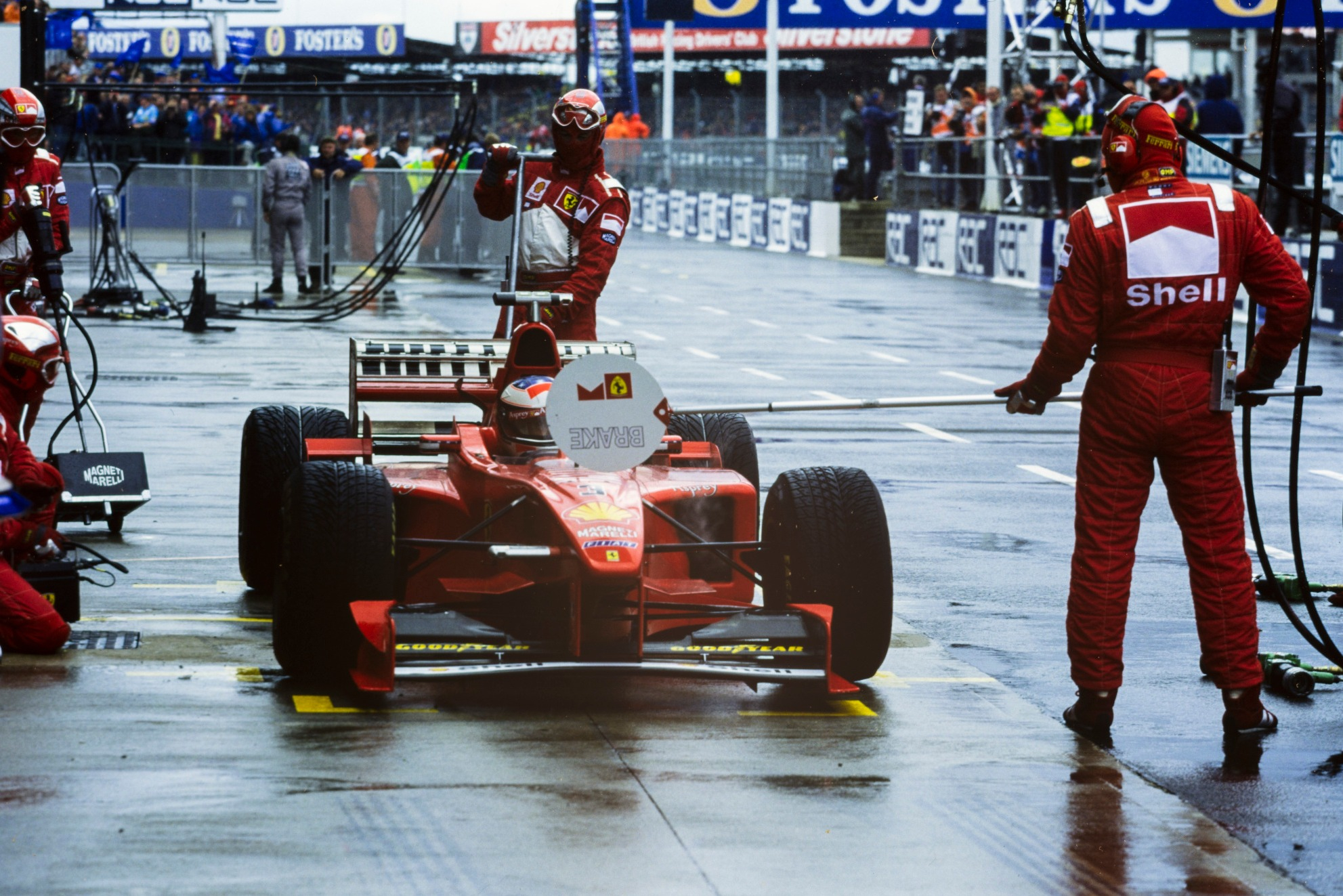
Schumacher courted controversy at 1998 British GP
Photo by: Motorsport Images
5. Cop a penalty? Plead innocent… but don’t risk it
Warning: don’t try this at home. Only one driver has made it work – and even he didn’t always manage to escape the arm of the law when it came to Silverstone indiscretions.
In his pomp, Michael Schumacher could pull a qualifying lap out of nowhere and dominate races apparently without breaking sweat. But every superhero has their Kryptonite – and Schumacher’s weakness was arguably his occasional disregard for the rulebook. In one British Grand Prix, it worked out for him – and in another, it began a deluge of penalty-serving in an altogether chaotic season.
The 1998 race was blighted by rain that caused several cars to aquaplane off the road, warranting the safety car’s arrival. When Schumacher then lapped Alex Wurz, he incurred a stop/go penalty. Although the future seven-time champion took the lead from Mika Hakkinen after the restart when the McLaren careened off the road, the looming penalty looked set to strip Schumacher of the win. Thus, he elected to serve it at the end of the final lap, and since the Ferrari pit sat beyond the finish line, Hakkinen would not be able to repass…
Even Schumacher wasn’t sure if he was victorious and there was confusion over whether it was a stop/go penalty or a 10-second addition to the race time. In the end it was rescinded altogether. Schuey, who finished over 20s ahead of Hakkinen, was in the clear, but the race is remembered for him claiming the win while sat in his pit.
Four years before, Schumacher’s itchy overtaking trigger finger had also landed him in hot water. Damon Hill had taken pole for the 1994 race, and was set to lead away on the formation lap. Schumacher elected to dart ahead of Hill before handing back the lead, then overtook his rival again on the run to Abbey.
Benetton and Schumacher were handed a fine and reprimanded respectively for ignoring the black flag, but the World Motor Sport Council upped the fine to $500,000 and subsequently disqualified Schumacher from his second place
The Benetton driver repeated these antics on a second parade tour required after Coulthard’s stall and earned a five-second stop/go penalty as a result. When he failed to serve this within the allotted three-lap window, he was black-flagged but stayed out as his team protested. Eventually, Schumacher obeyed and handed the lead back to Hill – after passing him during the first pitstop phase – but that was not the end of it.
Benetton and Schumacher were handed a fine and reprimanded respectively for ignoring the black flag, but the World Motor Sport Council upped the fine to $500,000 and subsequently disqualified Schumacher from his second place. He was also handed a suspended two-race ban, which was triggered when his skid block was worn excessively in the Belgian GP.
The lesson? In today’s F1, time penalties are handed out more often than anything severe and black flags are rarely employed. The former can be overcome with rapid driving and keeping it clean, but if the black cloth is waved at you – don’t dare ignore it unless your case is watertight, or be prepared to pay the consequences.

Schumacher's 1994 Silverstone antics resulted in disqualification
Photo by: Motorsport Images


Horner's inside story of how Red Bull built its own F1 engine

Why Mercedes' latest 2026 F1 update is no downgrade

Singapore Grand Prix Driver Ratings 2026

What we learned from the 2026 F1 Singapore GP sprint race and qualifying

The political minefield set out by F1’s recent cost-cap grievances

What caused Mercedes' pace deficit at Sepang despite upgraded W17?

Three kings: F1's generational stars shone at Sepang

Bahrain Grand Prix in Malaysia Driver Ratings 2026

Mekies extends contract as Red Bull's F1 team boss

What to expect from WEC's Barcelona debut

Acosta proposes new idea for monitoring tyre pressure in MotoGP

Horner's inside story of how Red Bull built its own F1 engine
Subscribe and access Autosport.com with your ad-blocker.
From Formula 1 to MotoGP we report straight from the paddock because we love our sport, just like you. In order to keep delivering our expert journalism, our website uses advertising. Still, we want to give you the opportunity to enjoy an ad-free and tracker-free website and to continue using your adblocker.


Top Comments