


The grand prix that never was – but did happen
We’ve already lost the Bahrain and Saudi Arabian GPs from the 2026 F1 calendar, but what about running a race and then deciding it didn’t count…

Autosport Retro
Telling the forgotten stories and unearthing the hidden gems from years gone by.
According to the official Formula 1 website, Alan Jones won five grands prix on his way to the 1980 world championship. It’s not a fact you should run past Jones if you wish to enjoy a polite conversation. The Australian will bluntly tell you he won six GPs even though the race in question is not mentioned at any point in the authorised summary of his career.
That’s because the 1980 Spanish GP was declared illegal despite 22 cars taking the start and racing for the prescribed distance around the Jarama track.
The location of this political squabble in a dusty region north-east of Madrid had a bloodier precedent. The Battle of Jarama, fiercely fought in February 1937, played a significant part in the Spanish Civil War even though it reached no firm conclusion other than heavy losses on both sides. Forty-three years later, at the motor racing circuit constructed in the same unprepossessing area, a terse fight for control also produced an indecisive result.
The major casualty this time was the sport itself. There may have been a dramatic race with four different leaders, but events on the track that weekend were a sideshow to the turf war within the arid paddock.
Trouble had been looming from the moment Jean-Marie Balestre was elected president of the Commission Sportive Internationale (CSI) in 1978. The name of the FIA’s motorsport division would eventually change but the French leader’s intent would remain the same. In Balestre’s view, the F1 teams controlled money that really ought to go to the FIA – even though this rapidly escalating income stream was due entirely to the dealings of a shrewd former motor trader from Essex.
Bernie Ecclestone had been quick to realise the sport’s untapped potential from the moment he bought Brabham in 1972 and became the owner of an F1 team. He was appalled by the shambling organisation as teams did individual deals with high-handed race promoters and then took part in GPs that desperately lacked consistency and structure. Ecclestone pulled up the teams by their tatty bootstraps and presented a slick and well-drilled show worth televising – which is where the potential earnings lay.

The 1980 Spanish GP turned into a non-championship race amid the FISA-FOCA war
Photo by: Rainer W. Schlegelmilch / Motorsport Images
F1’s attraction to broadcasters had been ignited by the dramatic events of 1976 when Ferrari’s Niki Lauda made an extraordinary return from a near-death crash to take the championship battle with McLaren’s James Hunt to the wire.
Ecclestone, having united the teams under the umbrella of the Formula One Constructors’ Association, was now dictating terms to the television companies rather than the other way round. Balestre, on behalf of the governing body (now known as FISA), felt control slipping away and wanted a piece of the action.
Ecclestone was not alone in countering Balestre’s challenge. As a founding member of the March team, Max Mosley had sold his interest, the eloquent former barrister then readily accepting the role of political adviser to FOCA. Ecclestone and Mosley made a formidable partnership – as Balestre had been discovering to his discomfort in the months leading up to the 1980 Spanish GP on 1 June.
It was at this point that Ferrari, Alfa Romeo and Renault opted to side with FISA, Renault in particular being anxious not to upset the governing body and cause future unpleasantness in other motorsport activities
In broad terms, the teams could be split into ‘manufacturers’ (Ferrari, Renault and Alfa Romeo) and ‘private entrants’, which formed the majority and, without exception, ran Ford Cosworth DFV V8s. Among many contentious reforms, Balestre proposed a ban on sliding skirts from the start of the following season. By getting rid of skirts on the outside edge of sidepods and crippling the efficiency of ground effect, the normally aspirated DFV runners would be at a huge disadvantage compared to the Renault turbo V6 and Ferrari and Alfa Romeo with their 12-cylinder engines. It was no coincidence that this technical split would assist Balestre in his attempt to divide and rule.
Mosley claimed Balestre had not followed established procedures. The legal weight of Balestre’s proposals had been challenged at the races preceding the Spanish GP. Balestre had called for mandatory driver briefings; a sensible suggestion in itself but one which the FOCA teams decided to use as a test case.
Certain drivers were ordered not to attend the pre-race briefings in Belgium and Monaco on the understanding that FOCA would handle their fees in the event of the expected fines. When the money was not forthcoming, Balestre said the drivers’ licences would be suspended until the fines were paid. The financial penalties were no more than an excuse for a trial of strength as FOCA threatened not to race at Jarama unless the fines were quashed.

The FISA-FOCA war dominated F1 in the late '70s to early '80s
Photo by: David Phipps
The hapless Spanish organisers suddenly found themselves in the middle of this stand-off. When the Real Automovil Club de Espana (RACE) offered to pay the outstanding fines, Balestre would have none of it. RACE responded by saying their meeting would be run under FIA regulations, thus bypassing FISA – a move which, unsurprisingly, FOCA wholeheartedly endorsed as it sent Balestre into orbit.
Meanwhile, the media had arrived to find the paddock in disarray as rumours flew in all directions. Italian journalists, mainly in thrall to Ferrari, said one thing; Britain’s Fleet Street hacks with an ear to the ground at Brabham, Williams and McLaren, said another. Bewildered officials in the press centre had not the faintest idea what was happening. When Ecclestone appeared at the back of the Brabham truck and began handing out a press release, the ensuing bedlam resembled a zoo at feeding time.
The statement informed us of RACE’s switch from FISA to FIA regulations – and then added, “The presence of FISA officials is no longer required at Jarama”, before concluding: “Because the race is not run under FISA rules, the FISA [drivers’] licences are not required.”
The FISA president was nowhere to be seen. Perhaps anticipating the indignity of a ban, Balestre had chosen to mastermind his operation from a bank of telephones installed in a local hotel room. His immediate reaction was to declare the race illegal because the drivers’ licences were invalid. As the start time for Friday’s practice came and went, the only on-track activity was an impromptu football match between mechanics from various teams.
It was at this point that Ferrari, Alfa Romeo and Renault opted to side with FISA, Renault in particular being anxious not to upset the governing body and cause future unpleasantness in other motorsport activities.
Osella was caught in a similar bind. The small independent team also raced in categories outside F1 but, on this occasion, did not wish to let down their main F1 sponsor, Denim Aftershave. Earlier in the morning Enzo Osella, keen to know if he could side-step the issue by entering his team as ‘Denim F1’, visited the pyjama-clad Balestre in his room. The subsequent conversation had been brought to an unexpected conclusion when Osella noticed water seeping beneath the bathroom door. The overwrought Balestre had been running a bath and forgot to turn off the taps.
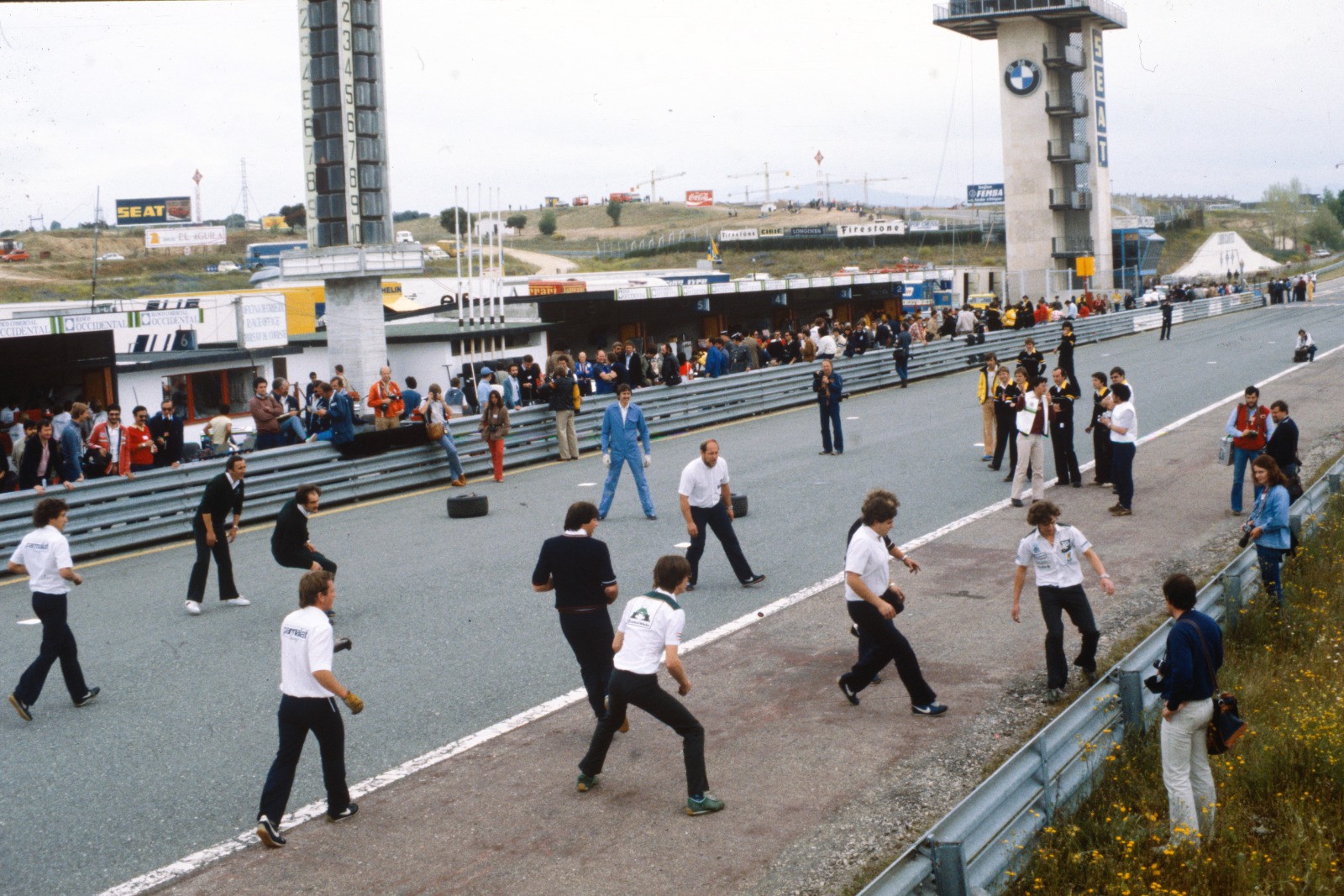
Football match at Jarama between mechanics of F1 teams
Photo by: Getty Images
Osella eventually decided to take part in delayed practice and join 11 other teams on the grid for what would be the first ever Ford Cosworth DFV GP.
It turned out to be a cracking motor race, led initially by the Williams of Carlos Reutemann. The Argentinian was eliminated after 35 laps when the challenging Jacques Laffite got himself tangled with a backmarker and found his Ligier spearing into the side of the hapless Reutemann.
“To this day, I can still see no reason in which the Spanish Grand Prix was not valid for the championship. From a driver’s point of view I know that just as much effort and risk went into that race as any other on the calendar" Alan Jones
Nelson Piquet’s new-found lead in a Brabham was ended by a pinion failure. This put Didier Pironi in charge – until a front wheel actually fell off the Frenchman’s Ligier for no apparent reason. Jones could hardly believe his luck when he found himself in front with 15 of the 80 laps to go.
Although the dispute continued, subsequent races maintained their championship status. But there was no going back on the Spanish deadlock.
“To this day, I can still see no reason in which the Spanish Grand Prix was not valid for the championship,” says Jones. “From a driver’s point of view I know that just as much effort and risk went into that race as any other on the calendar. Not to get the nine points I needed after winning the race was a bitter blow. As it turned out, I didn't need the Spanish points for my championship. But what if I had?”
1980 Spanish GP top six
| Position | Driver | Time |
| 1 | Alan Jones (Williams FW07B) | 80 laps in 1h43m14.076s |
| 2 | Jochen Mass (Arrows A3) | +50.940s |
| 3 | Elio de Angelis (Lotus 81) | +1m12.271s |
| 4 | Jean-Pierre Jarier (Tyrrell 010) | +1 lap |
| 5 | Emerson Fittipaldi (Fittipaldi F7) | +1 lap |
| 6 | Patrick Gaillard (Ensign N180) | +5 laps |
Editor note: Spare a thought for Patrick Gaillard, who didn’t score points in his F1 career – but would have scored one point for his sixth place in Spain had the race not lost its championship status.

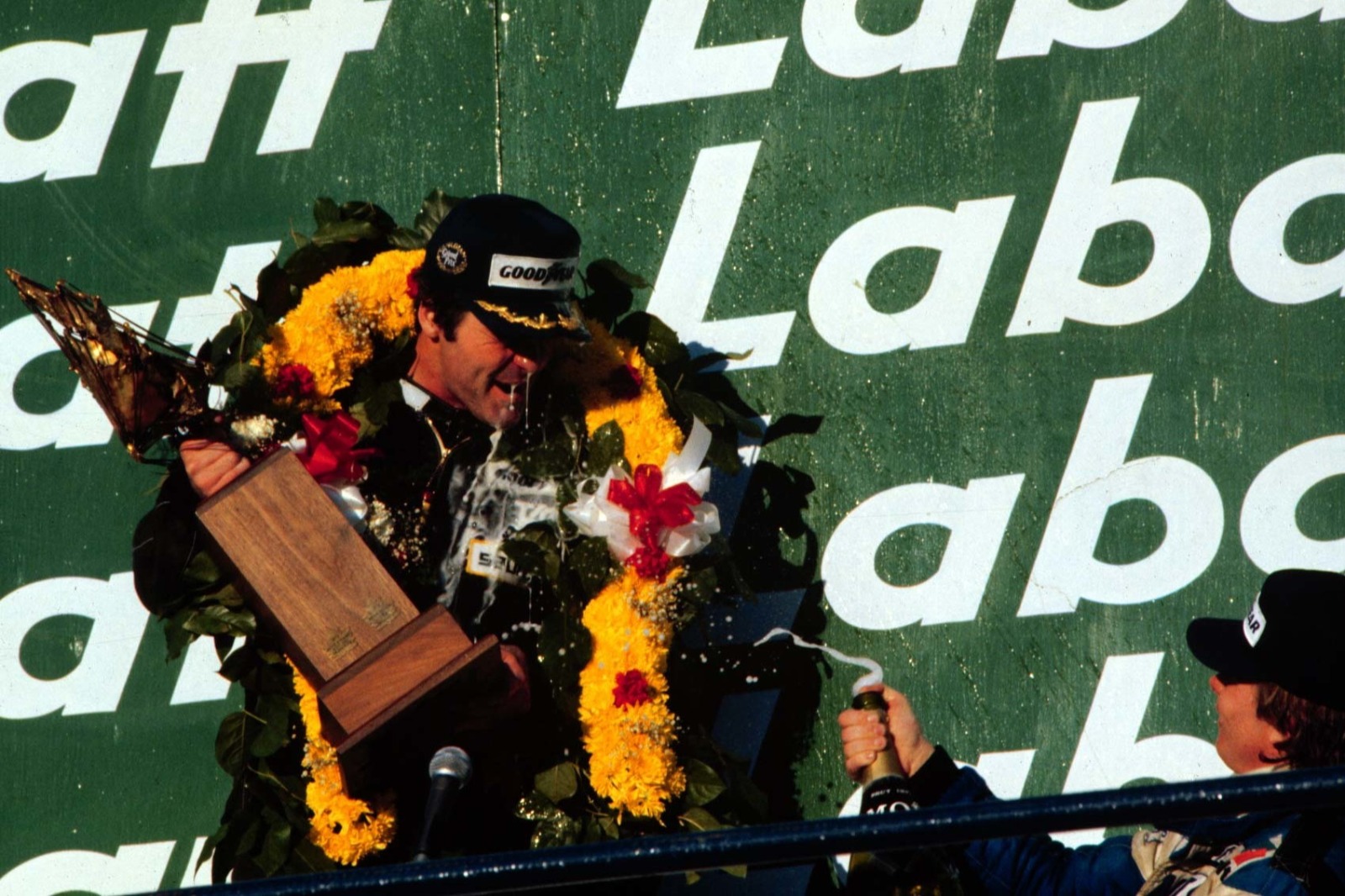
Alan Jones became the first Williams driver to win the F1 world championship in 1980
Photo by: Getty Images

Memories of Ken Tyrrell, 25 years on from his passing

Why Garden Gate Green and Yamura White are all part of McLaren’s colourful history

When plucky private entrants could afford to go GP racing, and how F1 changed with the rise of commercialisation

How an F1 mechanics’ reunion recalled stories of working practices that would now send HR into meltdown

F1 fans might well wish for simpler times, but no one wants armed race officials…

Remembering a lost Italian F1 hero 40 years on

What links a scribe's rudimentary '70s transport with an inspiring education initiative?

From the Archive: How Spygate rocked McLaren and F1

Sainz yet to be "convinced" that F1 2026 will finish in the Middle East

Verstappen’s words explained: Why Red Bull’s turnaround is so different this time

When Cadillac will open its F1 engine factory

Mission control: Inside the FIA and F1's latest answer to football's VAR
Subscribe and access Autosport.com with your ad-blocker.
From Formula 1 to MotoGP we report straight from the paddock because we love our sport, just like you. In order to keep delivering our expert journalism, our website uses advertising. Still, we want to give you the opportunity to enjoy an ad-free and tracker-free website and to continue using your adblocker.


Top Comments