


The two key contributors to Leclerc's defeat to Perez in F1's 2022 Singapore GP
In a marathon Formula 1 Singapore Grand Prix, Sergio Perez’s victory was only assured hours after the race due to a stewards investigation. Throughout the contest the Red Bull driver impressively held off Ferrari’s Charles Leclerc in changing conditions to see the Mexican pull out enough of an advantage to negate his post-race penalty

It wasn’t supposed to be this dark yet. The sun hadn’t yet set over Singapore, yet gloom was engulfing the Marina Bay circuit.
Rain. It had fallen hard between FP3 and qualifying. Now it was coming down even harder, with just 65 minutes before the 8pm scheduled race start time. Formula 1 drivers, team staff, paddock guests, officials and media alike darted for cover as nearby skyscrapers disappeared from view. Soon the inevitable followed, the start process was delayed.
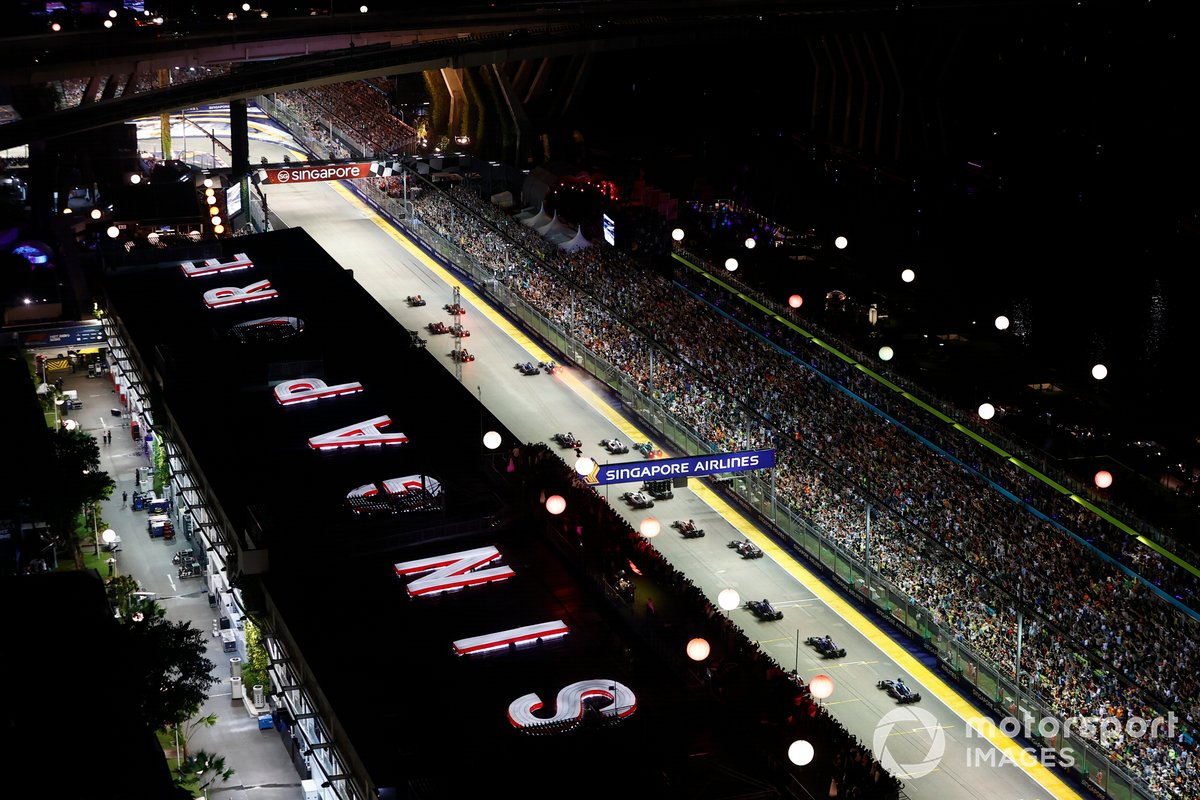
When the race eventually did get going 65 minutes later than billed, it would be won by Red Bull’s Sergio Perez, who shared the front row with pole-winner Charles Leclerc. Those two stole the show in the headline battle, while the fighting fortunes of two world champions created fascinating sub-plots.
The lead battle
Leclerc had sat astride his F1-75 after finally arriving on pole position following the rain delay. But with the grid still slippery enough to require the whole field to start on intermediates, he wisely spent a moment putting rubber overshoes onto of his race boots for the pre-start ceremonies.
Back in the cockpit, Leclerc reflected on how “track position in Singapore is really, really important”. Indeed, both Ferrari and Red Bull had been prepared to sacrifice race preparation time in FP2 to nail qualifying set-ups even before the two squads had various disruptions on Friday night. Passing was expected to be tricky even with the new ground-effects cars – a factor that increased in the wet given the challenge of getting stopped off the racing line.
When the lights went out, Leclerc and Perez reacted in unison – shooting off the line together. But in the second phase, Leclerc “had a little bit a bit of wheelspin”. The Red Bull then rapidly powered alongside and Perez swept into Turn 1 to seal the race lead, which he would never lose thereafter.
“The bad start put us on the back foot and it was a really difficult race after that,” said Leclerc, who would not be drawn on whether the outcome might have been different in the post-race press conference. But he knew just how costly it had been, one of two key contributors to his eventual defeat.
While that would come much later – the race never reaching its scheduled 61-lap duration and instead stopping at the two-hour limit only begun when the lights went out at 9.05pm – first Perez had to go about doing the winning.
Wheelspin costs Leclerc at the start as he loses the lead into the first corner to Perez
Photo by: Andy Hone / Motorsport Images
His efforts in the wet first phase of the race were superb. For a start, only he and Leclerc were able to run in the 2m01s bracket, then the 2m00s, then the 1m59s – the following Carlos Sainz 7.7 seconds adrift by lap seven.
Perez had the pace advantage by 0.1s each time over this period as he managed his tyre wear smoothly, everything, he felt, “under control” on the inters. That stage was ended by the race’s first safety car calling – after Nicholas Latifi carelessly lost where Zhou Guanyu was positioned on the run to Turn 5 on the seventh tour as they scrapped over 18th.
The Williams drifted across the Alfa and clattered it into the outside wall. Zhou was out on the spot with broken right-front suspension, while Latifi crawled back to the pits with a puncture before he too retired.
Perez could keep his pace higher on the ageing inters – his lead growing by an average of 0.3s over the 11 laps that followed the restart. Then it jumped around, but only because of the dramas suspending and reanimating proceedings
The safety car picked Perez, but he and all the rest eschewed pitting for fresh inters – with the potential slicks crossover still around three seconds quicker than the leader’s then pace. The race remained naturalised until the start of lap 11, just before which Perez did something rather naughty. As spotted by Lewis Hamilton from fourth place, he’d dropped more than 10 car lengths behind the safety car – something that later imperilled his victory.
But that was still far off and at the restart Perez was under no pressure from Leclerc. He duly re-established a 1.2s lead on the first lap back racing and the scenes then played out much as they had at the initial start. Sainz again couldn’t hold onto his team-mate’s rear and in just five laps he was over eight seconds off the lead.
Again, Perez could keep his pace higher on the ageing inters – his lead growing by an average of 0.3s over the 11 laps that followed the restart. Then it jumped around, but only because of the dramas suspending and reanimating proceedings.
Three virtual safety cars were activated – starting with Fernando Alonso pulling off at Turn 10 on lap 21 due to an engine failure. That led to a two-lap nullification, with the VSC then activated again on the leader’s lap 26 because Alex Albon had gone head-on into the Turn 8 wall at slow-speed, knocking off his front wing.

The race was interrupted by two full safety car periods and three virtual safety car stints
Photo by: Simon Galloway / Motorsport Images
Albon became the second Williams driver to retire in the pits after driving off from the scene, his debris needing to be recovered. This was done under the second VSC – the FIA later saying scenes showing marshals still on the track when that ended after lasting one lap being down to a poorly captioned TV replay.
Just one tour after the Albon VSC, the system kicked in again after Esteban Ocon’s Renault engine also expired in his Alpine – this one much more dramatically in a plume of smoke as he traversed the Anderson Bridge on lap 27. The final VSC lasted until the leaders were halfway around lap 30, after which Perez’s lead was clocked at 4.3s.
But suddenly Leclerc unleashed a new level of pace in the 1m56s and slashed Perez’s advantage to 2.8s in two tours. But if Perez had lost critical tyre temperature as it appeared – something that would plague the Red Bull later on – it wasn’t disastrous. And this was because of something happening far behind.
That was George Russell suddenly lighting up the timing screens with a series of purple sectors having taken medium slicks under the Alonso VSC. He’d initially wanted fresh inters, but Mercedes “thought it was time to go on slicks and try something”, he said, given Russell was still just 16th after his pitlane start for taking a new engine post-qualifying.
“I was in a position where I just thought ‘screw it’,” he added. Although he was soon thinking “it was totally the wrong decision”, as he had to catch a massive sideways moment exiting Turn 3 and was then lapping 3-5s off the pace until the track dried enough to warm his slicks.
This happening triggered a rush to the pits on lap 33 – initially Pierre Gasly, Yuki Tsunoda, Valtteri Bottas and Kevin Magnussen. Leclerc came in the next time by, having been told to pit “opposite [to] Perez”.
He erred – sliding deep past his pitbox marks and enduring a 5.3s stop as his mechanics had to adjust. That reduced the pressure on Perez’s lap 35 stop – with the undercut in any case not too powerful given the low temperatures on the still-slippery-in-places track surface.
Not that green-flag tyre warm-up was an issue for long for the leaders, as the race was neutralised by the safety car appearing again on lap 36 when Tsunoda crashed at Turn 10. He’d “completely misjudged the braking point, carrying too much speed into the corner, and went into the wall”, hard.

Tsunoda's meeting with the barrier and subsequent safety car put a new complexion on the race
Photo by: Glenn Dunbar / Motorsport Images
The safety car picked up Perez again and stayed out for three laps. At the end of the 39th lap, Perez got himself into actual trouble by repeating the same infraction as at the first restart – letting the pace car get more that 10 car lengths ahead before its lights had gone out, signifying an upcoming restart.
“There was a bit of miscommunication with Bernd [Maylander, the safety car driver],” Perez later explained in the post-race press conference. That had been delayed so he could argue the following case to the stewards, who had been looking at his restart tactics in both instances. Ahead of the second, he’d actually come alongside Maylander, gesturing for him to speed up.
“On the places where I could keep up with him, he was super slow; on the places where I could not keep up with him, he was fast. So, it was a bit of miscommunication there. But these [damp] conditions are not normal. So, it's fully understandable that in the conditions we were facing, especially final sector, it was super tricky.”
“When you’ve just lost all your temperature behind the safety car, and you're going with a slick tyre through a wet patch it’s really difficult. You are just a passenger” Sergio Perez
Racing next got back under way on lap 40, with Perez again comfortably ahead of Leclerc – the pair weaving in a bid to fire up their new mediums, tyre temperature now a factor back in focus. Sainz again was quickly dropped in third.
Perez got his gap back to 1.1s at the end of the latest new green-flag lap, but then Leclerc came alive. He cut the lead to 0.7s the next time by and then for the next six and a half tours produced a display of thrilling, harrying chasing.
Time and again Leclerc would close on the rear of Perez’s RB18 – again benefiting from its slippery nature and potent rebadged Honda engine. DRS was finally activated on lap 43, which turned the Ferrari’s pursuit into an overtaking challenge. Add to this, Perez reported “driveability” problems during the first part of this breathtaking phase.
Although he later explained “there were a few occasions where the engine was doing something we were not expecting”, Perez put the main reason for his handling loss down to lacking tyre temperature early on post-restart.

Perez, dealing with his own car problems, had to fend of a charge from Leclerc
Photo by: Zak Mauger / Motorsport Images
“When you’ve just lost all your temperature behind the safety car, and you're going with a slick tyre through a wet patch it’s really difficult,” he added. “You are just a passenger.”
Leclerc threw all he had at trying to snatch victory. He locked up briefly at Turn 14 on lap 45, with Perez doing so worse at the same point the next two times by. But the Red Bull was fast enough in a straight line to erase the threat of an easy DRS pass.
“I was just trying to be as close as possible because I basically had to make the overtaking on the straight,” Leclerc explained of his swarming charge.
“I couldn't really go on the braking zone and brake later because I didn't really know how the track was on the inside and I didn't want to take that risk. I had one lap where I was really close [lap 46 into Turn 7] and I actually thought about going in the inside and braking later. But, for me, it was not worth it. So, I was just waiting for the right opportunity. That unfortunately didn't arrive at the end.”
That was because on lap 48 Leclerc went deep at Turn 16 – just as he had on his final Q3 flier the day before. That dropped Leclerc out of DRS range and he never reached it again. Another Turn 16 near-off lost another 0.7s on lap 52, but the Monegasque driver suspected something additional had changed for Perez as he was already up to 1.9s clear. This was ultimately the second main contributing factor to Leclerc’s defeat.
“I was quite surprised because as soon as I lost the DRS I think it was exactly at the time when Checo’s tyres started to work properly,” he said. “But before that everything was really on the limit. With the dirty air in conditions like this, the slightest mistake you pay big time.”
Perez then scampered clear, with a reason beyond making his gap to Leclerc safe. This was the safety car infringement investigation that he’d had overhanging since the second restart. The leader therefore “pushed like qualifying for 15 laps” and took the flag 7.6s ahead.
Leclerc felt the Red Bull being “very good after six/seven laps” into each stint meant staying within five seconds in anticipation of a penalty wasn’t doable even as he pushed “until the end”. Or, at least until “as soon as I knew that the five seconds gap was done, [then] I just brought the car home”.

Once Perez had cleared off at the front Leclerc knew he had to settle for second
Photo by: Ferrari
The fight for third
The final podium spot was taken by Sainz – making it two Ferraris on the podium for the first since Miami in May. But this battle wasn’t really his story, not after he’d sealed third on the road bumping Hamilton off ahead of the Turn 2 apex on lap one having powered by the wheel-spinning Mercedes leaving the line.
When Hamilton attacked back wide on the outside, Sainz held his line – feeling “it's a bit my corner at that point”. Hamilton later reflected the move was “fine” and “racing”. But it wrecked his race, as the seven-time world champion spent the next 32 laps bottled up behind the second Ferrari. He was certain "I could do similar times to the guys ahead" but wasn’t "quick enough to get past him in these conditions".
Hamilton was vexed at Mercedes’ insistence he take new inters for the start when he’d wanted scrubbed ones and his team felt his “fronts were getting a hard time in the traffic”, per director of trackside engineering Andrew Shovlin.
“I knew it was all over from then. But these things happen. I mean I'm not going to punish myself for a mistake” Lewis Hamilton
It also felt this was a factor in Hamilton’s second major error the 2022 campaign – locking up solo from 0.9s behind Sainz on lap 33 and going gently head-on into the Turn 7 barriers. He reversed away and owned the gaffe, apologising over his team radio.
“I knew it was all over from then,” Hamilton said later. “But these things happen. I mean I'm not going to punish myself for a mistake.”
He got going again with front wing damage, emerging immediately into the next sub-plot battle.
Verstappen’s battling back
Hamilton rejoined fifth behind Lando Norris and ahead of 2021 adversary Max Verstappen. The Dutchman’s first chance to seal the 2022 world title had been spoiled by Red Bull’s Q3 fuel miscalculation, then was made even harder when he “dropped the clutch and [got] anti-stall” at the start.
This dumped Verstappen from eighth to 12th immediately – and he might’ve lost more spots were it not for a decision to cut Turn 1. This was reviewed by the stewards and declared acceptable under the first lap rules understanding.

As their race fortunes fluctuated, Verstappen and Hamilton briefly found themselves battling for track position
Photo by: Zak Mauger / Motorsport Images
Then followed a series of skirmishes. First, Verstappen had to repass Kevin Magnussen midway through lap one. After he’d squeezed the Haas towards the wall between Turns 9 and 10, the pair making light contact, they went side-by-side into the Turn 11 tight right just before the Anderson Bridge. Magnussen’s endplate had been damaged tagging Lance Stroll in the seconds after Verstappen’s squeeze – another move declared not worthy of investigation by the officials.
Magnussen shoved Verstappen wide at Turn 11, but his efforts were in vain as the Red Bull soon overcome him and Stroll on the second tour. Verstappen got Tsunoda on lap three before getting stuck behind Sebastian Vettel’s Aston Martin, something he put right quickly post-safety car restart one. He jumped Pierre Gasly on the same lap, then rapidly caught Alonso’s Alpine before spending the next 10 laps behind until it spluttered into retirement, ending the Spaniard’s 350th F1 start underwhelmingly.
Next up was Norris, who Verstappen chased through the final two VSCs. Towards the end of the third, for Ocon’s car recovery in the Turn 13 runoff, Verstappen tried to jump the McLaren, but went too soon and nearly infringed the restart, risking a penalty in a move Norris called “very dangerous”.
Just after this came Hamilton’s Turn 7 error, and Verstappen briefly then pressured him while complaining, as he had with Magnussen much earlier resulting in the Haas being black-and-orange flagged for the third time in 2022, that the Mercedes’ damaged endplate could fall off.
Verstappen’s Norris VSC overshoot was not investigated and didn’t matter in any case given what came after the second safety car restart. The second big neutralisation had preserved Norris’s lead as Verstappen had just taken a green-flag service for mediums when it was called. But when it ended, Verstappen pounced. And got it badly wrong.
“I got alongside him [through the Turn 6 kink down the first sector’s main acceleration zone],” said Verstappen. “I braked, not even late, but I bottomed out.”
That meant he locked up badly and shot down the Turn 7 escape road, so very close to hitting the wall. His mediums massively flatspotted, Verstappen needed to pit, and took softs. He used these to go from 14th and last to back behind eighth-placed Hamilton (the Mercedes had lost out too stopping for a new nose and mediums just before safety car period two started) in just 11 laps.

Verstappen missed out on his first chance to wrap up the 2022 F1 world title
Photo by: Red Bull Content Pool
They ran nose-to-tail behind Vettel for six tours before Hamilton made another mistake – taking to a still-wet patch on the inside run to Turn 8 and sliding wide. Verstappen was through and free to deprive Vettel of seventh on the final lap.
That means he takes a 104-point lead to Japan this weekend, where victory with the fastest lap will seal the title even if Leclerc is second again. But that gap is only so because Red Bull and Perez won one final battle post-race.
Although, the stewards actually found Perez guilty of infractions at both restarts. Their reasoning was, at best, confusing.
“My best performance. I controlled the race, although the warm-up was very difficult. The last few laps were so intense” Sergio Perez
“We do not accept that the conditions were such as to make it impossible or dangerous for Perez to have maintained the required less-than-10-car-length gap,” read identical vital parts of the documents announcing each verdict. “Nevertheless, we took into account the wet conditions and the difficulties highlighted by Perez as mitigatory circumstances for this incident.”
For the first he was reprimanded, but given a five-second time addition for the second because the stewards noted “this was the second breach of Article 55.10 by Perez during the race and followed an express warning from the race director”.
Confusing, certainly. But the right winner won the night and he was delighted.
“My best performance,” he said in parc ferme. “I controlled the race, although the warm-up was very difficult. The last few laps were so intense. I didn’t feel it that much in the car but when I got out of it, I felt it.”

Perez survived a post-race stewards investigation to keep hold of his Singapore GP win
Photo by: Steven Tee / Motorsport Images


Why Britain’s role in Formula 1 endured a troubled start

Why Bottas believes his F1 reserve driver role is the fastest route back to a race seat

Why Norris is now ready for his final exam

The key advantage for Bottas vs Perez in the 2026 F1 return race

Why Ferrari's management is under pressure after its bad start to F1 2025, not Hamilton or Leclerc

Why Red Bull can’t solve its second F1 car problem with a simple paint job

Hirakawa replaces Doohan at Alpine for Japanese GP FP1 outing

How Alonso and Bortoleto can be F1 rivals in a unique driver management deal

Ferrari not yet switching focus to 2027 F1 car

The verdict on the WRC Rally Chile tyre solution

Top five roles on Motorsport Jobs this week

Quartararo explains why Yamaha relationship has strained ahead of Honda move
Subscribe and access Autosport.com with your ad-blocker.
From Formula 1 to MotoGP we report straight from the paddock because we love our sport, just like you. In order to keep delivering our expert journalism, our website uses advertising. Still, we want to give you the opportunity to enjoy an ad-free and tracker-free website and to continue using your adblocker.


Top Comments