


The trait displayed by F1’s newest winner to earn Alpine’s trust
Alpine raised eyebrows when it awarded Esteban Ocon an unusual three-year contract. Even more so when his performances seemed to tail off once he had that contract in his pocket. Now, after Ocon brilliantly seized the moment to win in Hungary, Alpine’s decision seems to be vindicated. LUKE SMITH analyses why Ocon loosened his Mercedes ties to stick with ‘Team Enstone’
From the seasoned veteran to the hopeful debutant and all points on the career trajectory in between, stability is a commodity all Formula 1 drivers covet. For those looking to gain a foothold in F1 that usually means a manufacturer team’s junior academy or a wealthy benefactor – even the most talented prospect might not be able to flourish without powerful support and investment.
That’s something Esteban Ocon has rarely been able to rely on. He’s seen a lot that most Formula 1 drivers haven’t. He’s lived out of a caravan with his parents, who sold their family home to keep him karting. He’s faced uncertainty in junior series despite a stunning record (it is often overlooked that he beat Max Verstappen to the European F3 title). Twice in F1 he’s raced for teams operating on the edge of financial oblivion, and slipped through the cracks in the driver market as a result – at one point spending a year on the sidelines.
But Ocon’s resilience has paid off, not only with his surprise breakthrough victory snared in Hungary before F1 began its summer break. With Alpine he’s found a home for the long-term, a status now expressed in black-and-white in the form of a three-year contract, signed and announced in June, which binds him to the French team until at least the end of 2024.
PLUS: The “heart-breaking” call that led to Ocon’s Hungarian GP triumph
Ocon has therefore joined a rarefied long-contract club. Last year Charles Leclerc and Max Verstappen signed extensions binding them to their teams until the end of 2024 and 2023 respectively. Daniel Ricciardo’s first McLaren contract was for three years, while Lewis Hamilton’s new deal is a two-year extension to the one-year contract he signed at the start of 2021.
It points not only to how much Ocon has impressed Alpine since his return to Enstone in 2020, but also that the team sees him as the ideal driver to fulfil its longer-term goal of returning to F1’s summit, and make trips to the top step of the podium less of a freak occurrence.

Esteban Ocon, Alpine F1, 1st position, on the podium with his trophy
Photo by: Jerry Andre / Motorsport Images
Throughout his chat with GP Racing – prior to his win in Hungary, it must be noted - Ocon returns to a distinctive phrase to describe his new deal: as a way to “continue the story” with the Enstone-based operation. Indeed, over the past decade his career has intersected many times with this team’s numerous incarnations. As early as 2010, the 14-year-old Ocon was snapped up by Gravity Sports Management, a group owned by the company which had recently bought a majority stake in the Renault team and was soon to rebrand it as Lotus. “I was training in the HPC [Human Performance Centre] in Enstone, seeing the drivers and thinking, ‘one day, I want to become one of those,’” Ocon recalls.
But this wasn’t to be a tale of a gilded path to glory. As Lotus’s financial woes mounted, Ocon, who had won the 2014 European F3 title ahead of Verstappen, was forced into a sidestep, moving into GP3 as Max took the leap up to F1.
PLUS: How Ocon ended up back at the team that rejected him
"Life is not always easy, and you’ll always learn from tough moments. I’m very sure that the experience at Mercedes, my experience at Force India, it all made me the driver I am today" Esteban Ocon
Mercedes threw Ocon a lifeline by making him an affiliate of its young driver programme, and his charge to the GP3 title paved the way for him to become a fully-fledged member as of 2016. After half a season in DTM he was ‘placed’ at the Manor F1 team (which would go bust at the end of the season) where his performances and personality were enough for him to leapfrog Pascal Wehrlein in the Mercedes pecking order and land a seat at Force India for the following year.
But even as Ocon proved to be a good match for Sergio Perez in their two seasons together, he found himself facing the exit towards the end of 2018. Force India’s financial collapse – can you see a theme here? – and rescue by Lawrence Stroll spelled doom for Ocon’s prospects of staying on. Perez’s portfolio of sponsors meant his position was secure, while Stroll’s son Lance was almost inevitably destined to occupy the other seat. At the height of the crisis, over the Belgian GP weekend, it wasn’t even certain Ocon would be racing one week later at Monza.

Esteban Ocon, Racing Point Force India VJM11 crosses the line
Photo by: Mark Sutton / Motorsport Images
Mercedes kept him in a holding pattern for a season as reserve driver for 2019 and, while it might not have been much fun for Ocon, he didn’t fade from F1’s radar. When Mercedes opted to retain Valtteri Bottas for 2020, Renault moved swiftly to sign Ocon on a two-year loan, deciding he was a better mid-term bet than Nico Hulkenberg. Ocon was no longer a Mercedes ‘young driver’ but retained links to the team through his management.
“It’s been a very strange way in my career,” Ocon acknowledges. “I’ve been through difficult times, from a team perspective but also from my perspective. But I always believed that if I had more motivation than everybody else, people would see it.
“Life is not always easy, and you’ll always learn from tough moments. I’m very sure that the experience at Mercedes, my experience at Force India, it all made me the driver I am today, which is a more complete driver and more experienced.”
Ocon’s year on the sidelines left him a little ring-rusty and he struggled to match his new team-mate Daniel Ricciardo’s form in the much-improved Renault. He was often unable to extract the maximum performance from the car in qualifying, which then made for harder work on race day. Finally at the Sakhir Grand Prix, Ocon strung a full weekend performance together and took advantage of Mercedes’ meltdown to finish second, netting his first F1 podium and proving that he could seize the moment.

Esteban Ocon, Renault F1, 2nd position, celebrates on the podium
Photo by: Mark Sutton / Motorsport Images
“We’ve been through tough times where it was not working the way we wanted, and we managed to figure out the issues,” Ocon says, reflecting on his comeback season. “The podium definitely helped. The team was very happy. They knew they could count on me, at times where we have to perform, at times where there is the opportunity, they realised they could really count on me.
“And from then on, we understood more about the car and how it started to work, and the characteristics of it. Through this year, we kept that going, and we did an even better job, I would say, with the new team that I have around me.”
"We’ve seen enough of Esteban, we know he is good. I don’t want to be here again, looking for another driver after two years. Recent past showed that it never really turns the right way. If you have a good driver, you want to keep them" Laurent Rossi
As Renault became Alpine for 2021, the changes reached beyond the name above the door and the colour of the car. Two-time F1 world champion Fernando Alonso – renowned for being tough on his team-mates – arrived, as did a new management team headed up by Alpine CEO Laurent Rossi with co-managers Davide Brivio and Marcin Budkowski beneath him.
But Ocon’s side of the garage also underwent changes. Josh Peckett replaced Mark Slade as Ocon’s race engineer, while Stuart Barlow was drafted in to replace Peckett as performance engineer. The trio previously worked together at Manor when Ocon made his F1 debut.
“He’s bonding better with his race engineer and his team overall,” says Alpine executive director Budkowski. “He can work in a much more constructive way than he was able to last year. And then the confidence builds up, especially in the qualifying sessions. If you have to put everything together and you need this kind of osmosis with the car and the team, this makes a difference.”
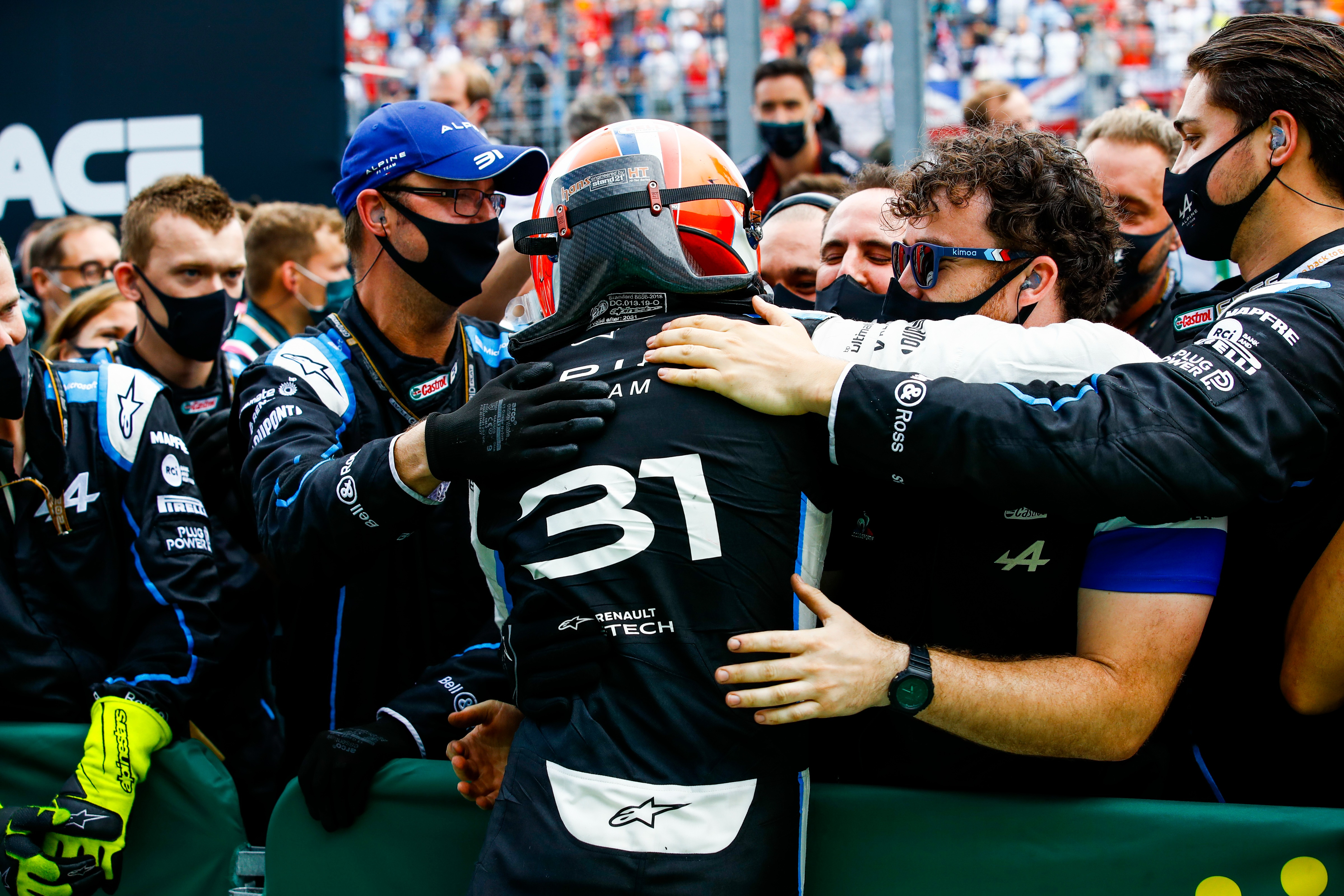
Esteban Ocon, Alpine F1, 1st position, celebrates with his team after winning the 2021 Hungarian GP
Photo by: FIA Pool
That chemistry was evident from Imola to Monaco as Ocon notched four straight points finishes and reached Q3 on three occasions, including third-row starts in Portugal and Spain. After seeing Alonso destroy Stoffel Vandoorne 21-0 in qualifying through 2018, to record four straight Saturday and Sunday wins over the Spaniard was an impressive feat.
PLUS: The mantra Ocon must follow to challenge Alonso
Budkowski hailed Ocon to be “a significantly improved driver”, while Alpine CEO Rossi revealed in May that talks were already underway about securing a contract extension – unconventionally early by F1 silly season standards. He made clear no other drivers were being considered, despite rumours about AlphaTauri’s Pierre Gasly (not to mention the gaggle of Alpine juniors in F2), so impressed was the team by Ocon’s performances. Rossi even went as far as comparing Ocon with F1’s greatest French driver, Alain Prost, for being “a great fine tuner” and “very good at extracting the maximum from the car”.
It made news of a new contract in June unsurprising, even if the length of the deal was. But for Rossi, the chance to lock down a driver of Ocon’s ability was a “no brainer”.
“We have a mid-to-long term view of things,” Rossi explains. “We’ve seen enough of Esteban, we know he is good. I don’t want to be here again, looking for another driver after two years. Recent past showed that it never really turns the right way. If you have a good driver, you want to keep them. We have a long way to make progress. He buys into the project, and adds credibility to our project. It’s a guarantee that we’re going to perform on the driver department.”
Ocon is excited by the potential he sees at Alpine, which is very much at the beginning of its journey to the front. With new regulations in 2022 and the budget cap set to level the playing field, giving the Renault-backed team a chance to fight its more established manufacturer rivals, he feels the opportunity will be there down the line to fight for more than just points.

Esteban Ocon, Alpine A521, Sebastian Vettel, Aston Martin AMR21
Photo by: Charles Coates / Motorsport Images
“We’re doing a really good job,” says Ocon, who then throws in a disclaimer over “recent races” after a dip in form post-Monaco that led him to ask for as many parts as possible to be changed on his A521 car for Silverstone. He’s since recovered and silenced some who used his rough patch as ammunition with which to question his new Alpine deal in the most emphatic way by becoming an F1 race winner.
Ocon adds: “If we keep doing the job we can, extracting the maximum out of the car with the performance we have, it could be a top-10 today. But if we manage to do that in the future, maybe it’s going to be a podium car.” Weeks later, he’d find out he already has a race-winning car underneath him when the stars align, but to remove the numerous caveats of the Hungary race to this statement will be the goal in the future.
"I’ve seen how changing team to team could be tricky in the beginning, and how long it takes to settle. I thought, let’s keep the story going [with Alpine], let’s continue, and do the best we can" Esteban Ocon
Rossi is also eager to place Ocon at the heart of Alpine’s future, getting as much input from him as possible, which is quite the compliment to a 24-year old. “In-between the races, when he’s not here, he’s asking me, ‘what do you think we can still do?’” Ocon says. “Even if it’s tough at times this year, we keep on working. It’s only lessons that we are going to learn for the future. Of course, we’re counting on those new regulations. We need to do a great job there. But I feel very well integrated in the team and ready to work with them for that many years.”
“He’s very generous with his time, constantly giving his time even to us in the larger Alpine construct,” says Rossi of Ocon. “He always offers to join in the development of the new cars, or the brand awareness type of work. It’s really good to have him around. That’s also why we signed him for three years.”
Alpine clearly thinks enormously well of Ocon – so why didn’t Mercedes opt to snap him up, given the obvious connections?
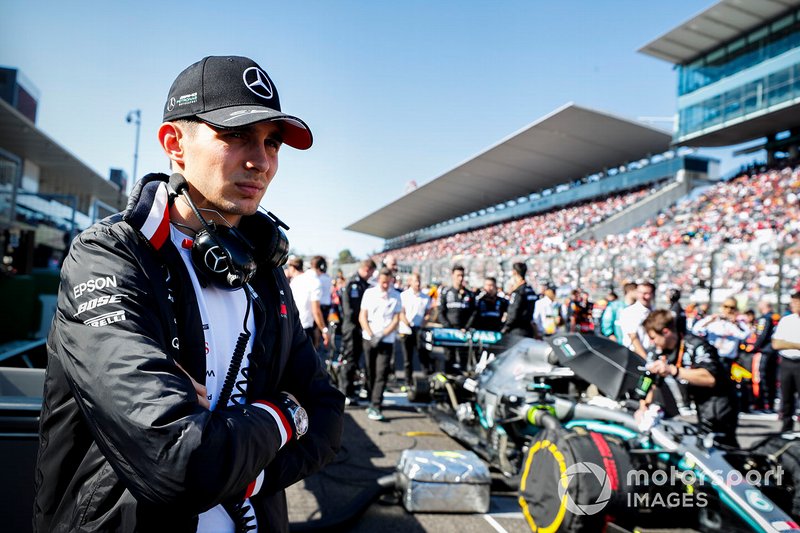
Esteban Ocon, Mercedes AMG F1 on the grid
Photo by: Steven Tee / Motorsport Images
Toto Wolff made clear early on that it would be “Laurent and Esteban’s call first” before Mercedes got involved, saying how impressed he was with Ocon’s improvement and growth. When Ocon sat down with Wolff and Gwen Lagrue, Mercedes’ young driver advisor, it was clear they felt Alpine was the best place for him to continue his development.
“We did talk together, and we decided that the best thing for me was to be at Alpine – to develop a strong relationship with the team, have potentially a great car next year, and to be fighting there,” says Ocon. “I’ve seen how changing team to team could be tricky in the beginning, and how long it takes to settle. I thought, let’s keep the story going [with Alpine], let’s continue, and do the best we can. I was very keen to stay here for very long.”
Ocon’s three-year deal contains no Mercedes-related clauses that would allow it to pluck him away, and Wolff is explicit that Ocon is “100% an Alpine driver”. But it’s hard to imagine him not being high up the list in the future when Mercedes comes to consider driver signings. George Russell may be the heir apparent at Brackley, but Lewis Hamilton has to hang up his helmet someday. By then, Ocon is likely to have gained plenty from the team-building experience he will be at the heart of at Alpine that could make him a valuable asset to Mercedes.
But for now, Ocon and Alpine are in it together, flying the Tricolore and looking to capitalise on the forthcoming regulatory overhaul to make ‘Team Enstone’ a dominant force again, and ensure the Hungary win is not just a one-off. And the secret to achieving that could be the one thing Ocon has craved for so much of his career: stability.
“We have a great shot of doing very good if we produce a great car in the next three years,” Ocon says. “And if it is as close together between the cars as everybody is saying, to have stability is going to be a great thing I think. That could make all the difference.”

Esteban Ocon, Alpine A521
Photo by: Jerry Andre / Motorsport Images

How Ratzenberger beat the odds to realise his cruelly short-lived F1 dream

F1 uncovered: A weekend behind the scenes with a chief mechanic

When McLaren was pipped by Red Bull in a modern F1 classic

The big opportunity Sainz’s Williams switch affords to F1’s latest centurion

Inside the science of F1 fuel

How F1’s plan for rotating races could look in practice

The early decisions that set Sauber’s rookie for success

How F1 media coverage has evolved in line with its subject

Taken for a ride? The less heralded flaw of the 2026 F1 regulations

Sainz set for Rally1 outing in latest gen WRC car

United States Grand Prix Driver Ratings 2026

Martin's fight to get fit for Malaysian GP with MotoGP title at stake
Subscribe and access Autosport.com with your ad-blocker.
From Formula 1 to MotoGP we report straight from the paddock because we love our sport, just like you. In order to keep delivering our expert journalism, our website uses advertising. Still, we want to give you the opportunity to enjoy an ad-free and tracker-free website and to continue using your adblocker.


Top Comments