

The three sidepod trends visible in 2025 F1 testing
Now the new F1 cars have hit the track, we can give a closer inspection to the tweaks made for 2025. And it would seem that the humble sidepod has been a key area of development

Although launch season is a great chance to analyse the full field of new Formula 1 cars for the first time, it comes with its own pitfalls: the teams only show what they want to show. The key details are conspicuously hidden to avoid giving rival squads a leg-up with their own development but, once testing begins, there's fewer opportunities to hide any new design traits. That is, of course, unless a team decides not to bring them until the season opener...
The fuller range of photography available at testing ensures that we can take a closer look at the key details - and try to predict how the teams are shaping their aerodynamics to draw out certain properties from a car. And, with the use of a drawing tablet (which has seen plenty of action throughout this launch season) we can infer how the new aerodynamic surfaces are working.
PLUS: How rare Bahrain testing weather is complicating the early F1 2025 pecking order picture
One of the interesting areas of development present across the field of 2025 is in the design of the sidepods, which is informed by the position of the inlets. When Red Bull and McLaren demonstrated their then-atypical presentation of the sidepod inlets in 2024, it didn't take long for other teams to start adopting them and put their own twists on the formula. The two aforementioned outfits opted for a design that became known as the "overbite" sidepod inlet, achieved by positioning the side impact structure further up along the chassis flanks and using that as the upper bound of the intake system.
Even so, Red Bull and McLaren had two different approaches to that; McLaren had the overwing and then a squarer inlet, while Red Bull had completely recessed its inlet position into the undercut face of the sidepod - effectively, like the mouth of a shark.
As the idea has become more widely adopted, with nine of the 10 teams using some variation of this, there is a split between the 'Red Bull' school of thought and the 'McLaren' concept. Ultimately, inlet size comes down to the cooling demands of the powertrain, and each of the four will likely require a different mass flow rate of air to enter the car to keep it at an adequate temperature.
Before we demonstrate how the air flow in each of the three different types of inlet seen appears to work, it's probably not a bad idea to explain the rationale behind the switch. Creating a large undercut in the front face of the sidepod has been a popular pursuit over the past 15-20 years, as shortening the path of airflow around the sidepod ensures that it loses minimal energy on its path towards the rear of the car. There are some constraints upon this supplied by the shape of the underbody's 'internal' layout, so getting the sidepod concept to marry with the floor is of utmost importance. Exposing the upper surface of the floor also helps to build the pressure difference between the upper and lower surfaces to improve the efficacy of the Venturi tunnels, and also gives the aerodynamicists more latitude to experiment with the floor edge.
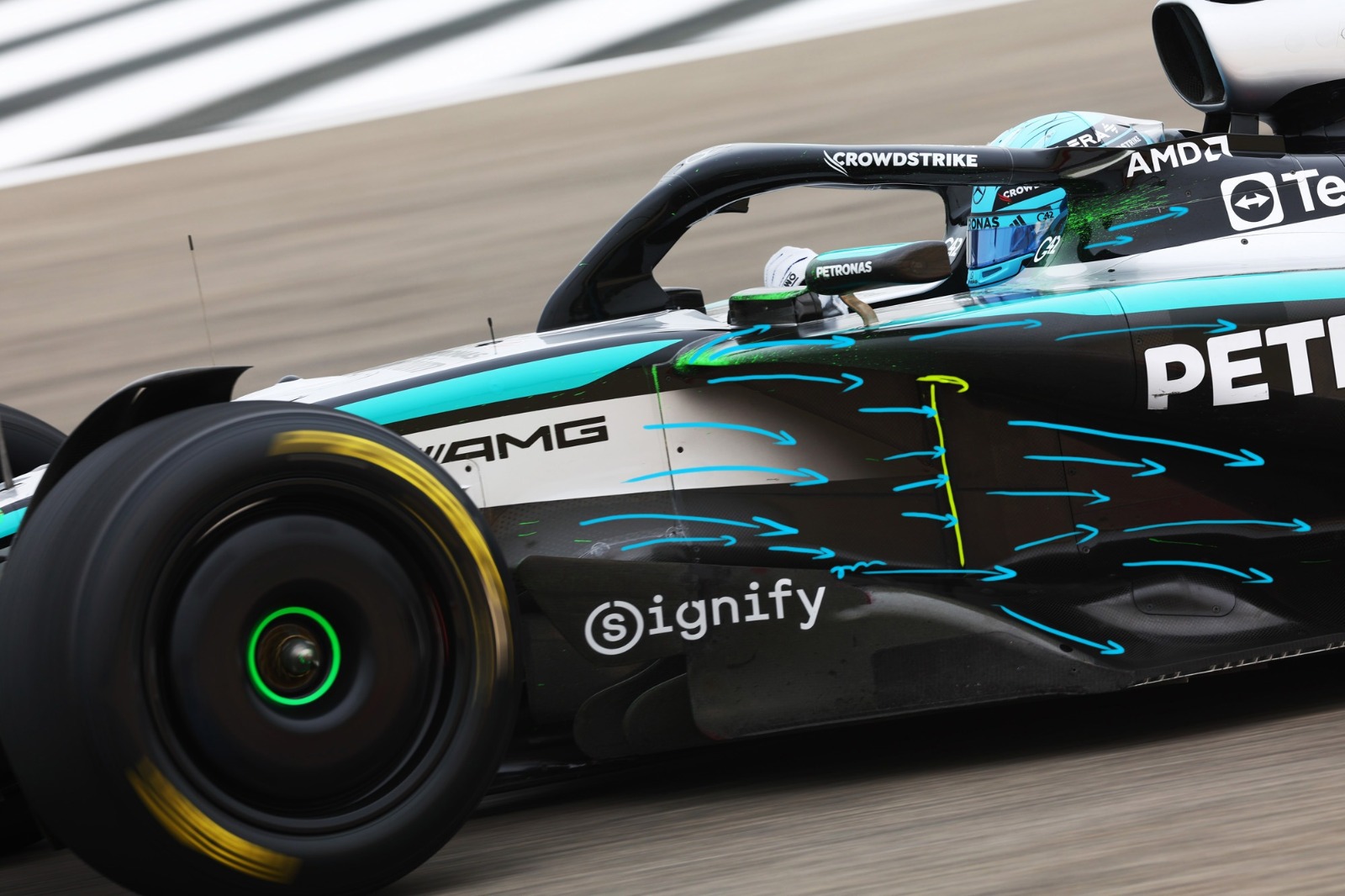
Mercedes has now adopted the Red Bull sidepod approach
Mercedes has switched to the Red Bull philosophy with its sidepods, which effectively creates one larger leading edge and allows some airflow to be pulled into the inlet and the rest following the sculpting of the sidepod undercut. The green flow-vis shows some of the split between the airflow passing over the top and the rest passing underneath, with a sharp edge to minimise the effect of air deceleration that you'd get with a bluff surface. The inlet is set back further, outlined in yellow, which pairs with its vertical inlet that sits next to the car's flanks.
The junction between the chassis and the floor is shaped to offer the initial airflow guidance (marked in blue) from lower down and around the sidepods, some of which enters the vertical inlet. The airflow slightly further outboard passes around the outside of this inlet, and around the undercut. The horizontal inlet set within the sidepods captures some of the airflow further up, ideally with more energy as the inclination of suspension members produced to help any turbulent wake here will direct it out of the way.
Keeping part of the inlet high up and the other part close to the chassis flanks also mitigates the chance of turbulent flow emerging from the front tyre entering the car. Uncontrolled turbulent air, which the wheels produce in great quantities, will not pass through the inlet at the same rate - so is much less effective at providing the required cooling.
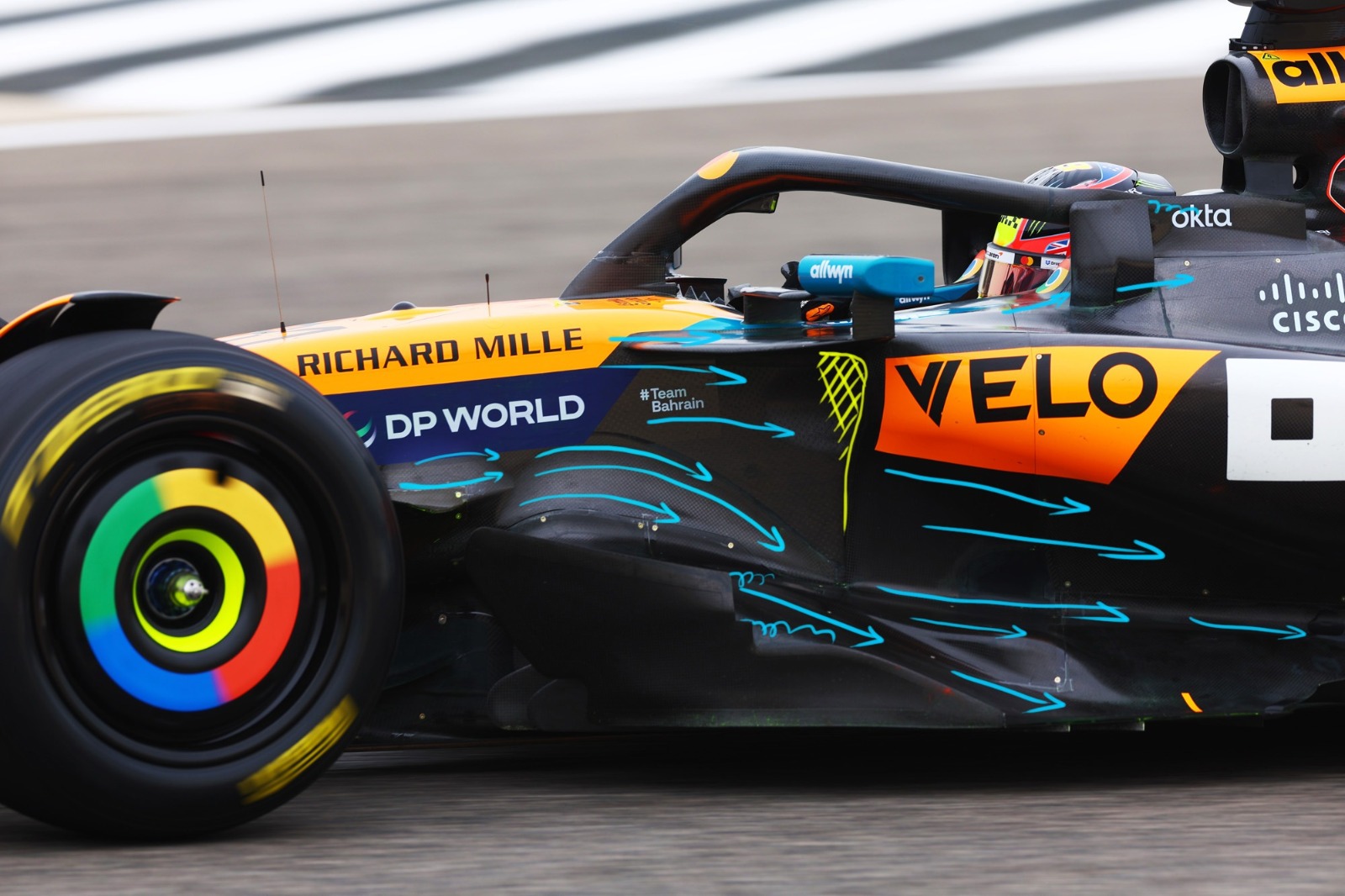
The McLaren MCL39 sidepod features a more noticeable channel that connects the floor to the chassis
McLaren has produced an adaptation of its inlets from last season, which now extend into a P-shape along the sidepod flanks. There's a much more noticeable channel line connecting the floor to the chassis, seen under the DP World logo, which appears to be used to control any tyre wake moving inboard towards the lower reaches of the sidepod. Again, this helps to ensure that the airflow moving through the inlets is comparatively clean. A bulge where the upper wishbone's rear leg attaches to the car also enhances this effect.
The 'overwing' also has a sharp leading edge, but maintains a low thickness throughout the aerofoil profile used. This allows a more direct supply of air to the inlet. The McLaren aperture appears slightly larger compared to the Mercedes, but it has made its overhead inlet smaller to compensate for this. You can also see a fin next to the driver's head to help clean up the flow in this area and also produce a tip vortex at the upper edge, which can be packaged to strengthen the airflow moving over the bodywork.
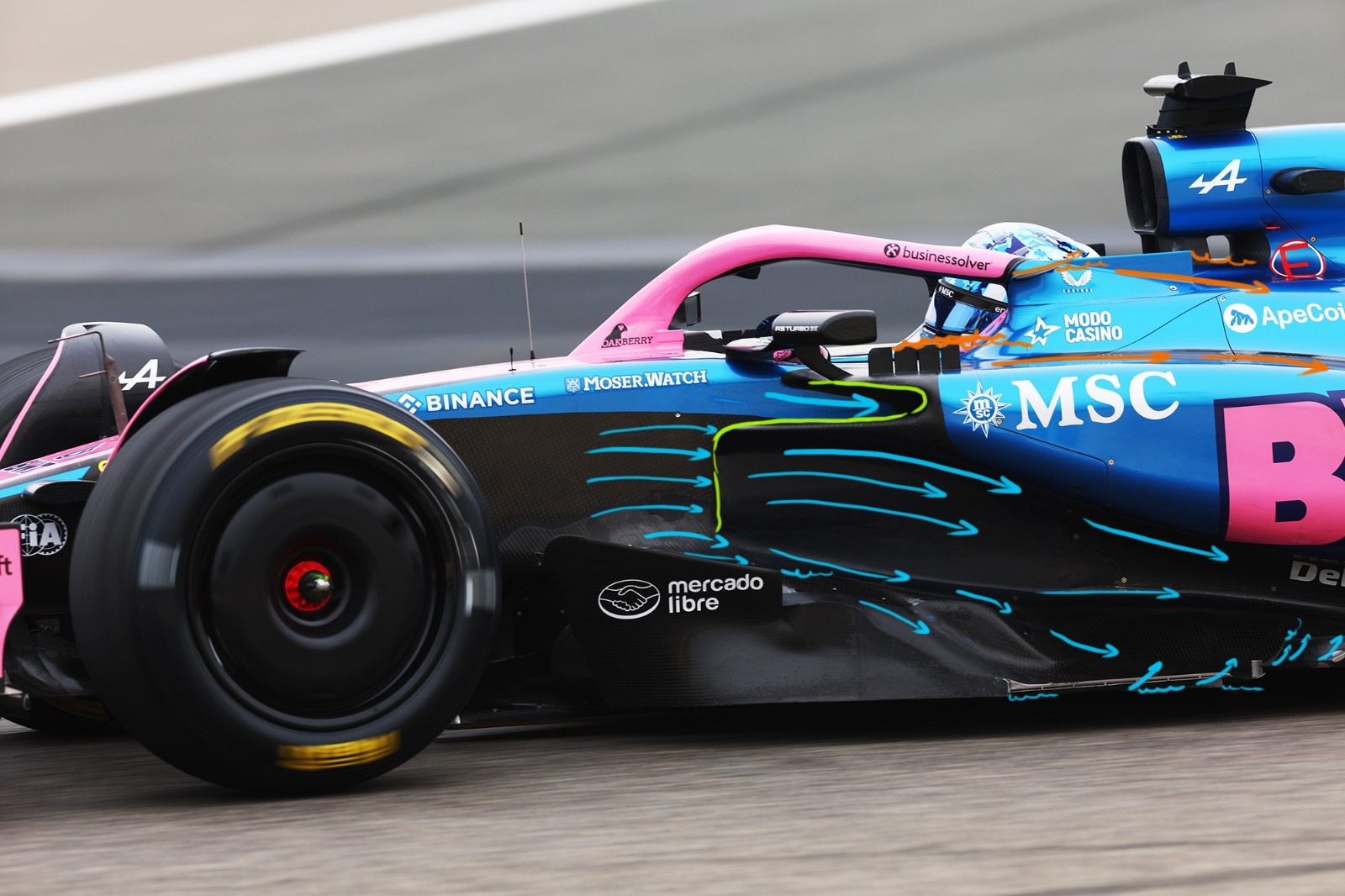
Alpine is an outlier having adopted ideas from both key sidepod concepts
Alpine is the sole outlier, in that it seemingly uses the 'underbite' inlet. In reality, it's almost a halfway house between the underbite and overbite concept, with an extruded lower inlet point that recedes back for the main horizontal opening. The air entering the car closest to the chassis flanks experience the overbite, while the airflow further outboard assumes the flow pattern associated with the underbite.
This reduces the scope of the undercut available to the sidepods, but it may be that this shields the inlet a little more from the effect of tyre wake. Regardless, Alpine is certainly the outlier in the current inlet trend.
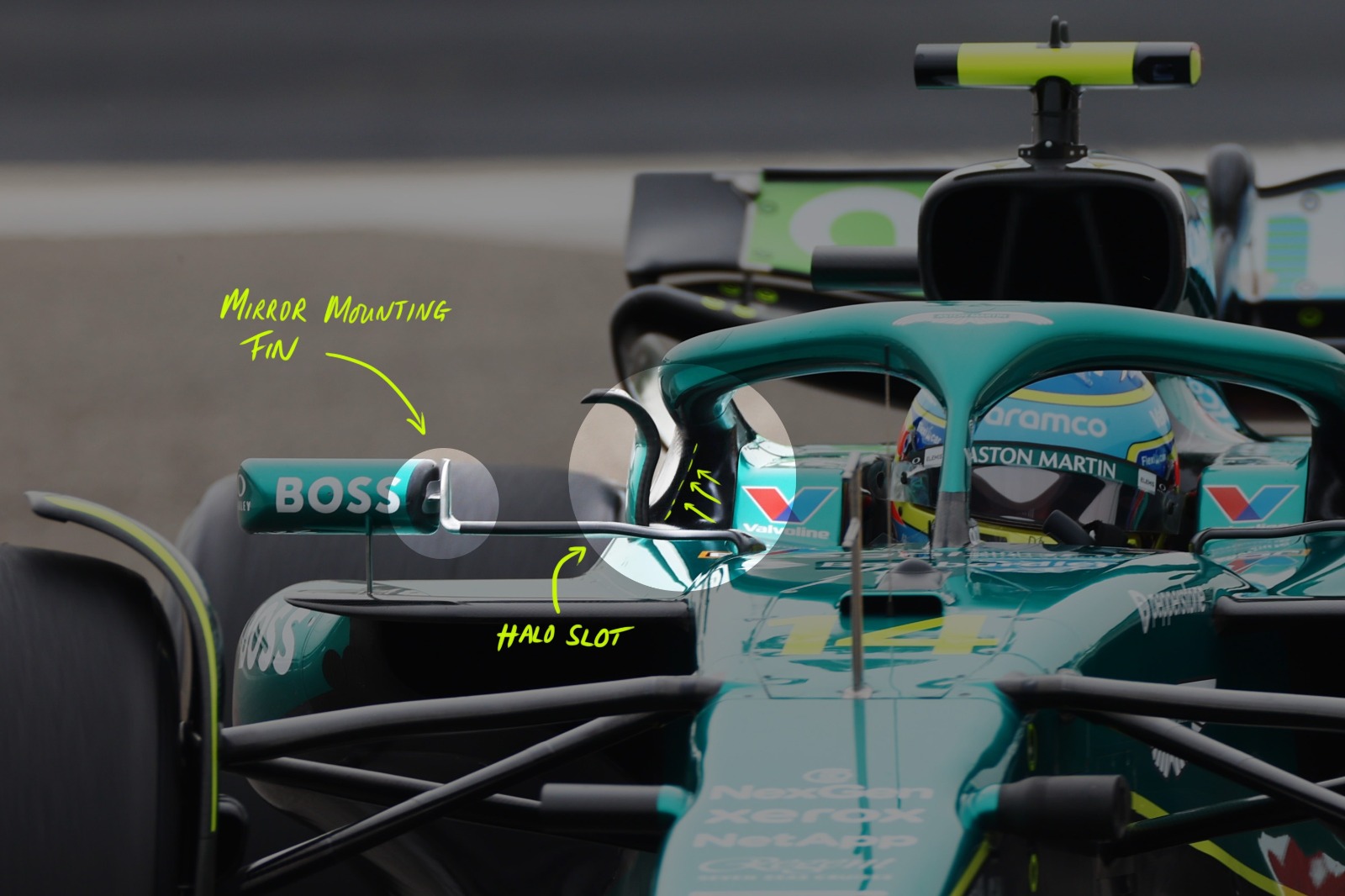
Aston has paid plenty of attention to the airflow around its wing mirrors
Two minor details have emerged around the cockpit area of Aston Martin's AMR25, with a hidden slot bedded between the halo and the cockpit sidewalls, and a mirror mounting that should help shape its overall wake profile.
The slot sits behind the cobra-shaped side fins and allows air to pass through the slot - although it is currently unknown if this feeds an outlet elsewhere or is simply an augmentation to the car's cooling package. Red Bull implemented inlets in a similar area last year either side of the cockpit, adding to its overall inlet area, so it may well be that this is a way of introducing something similar with lesser frontal area.
The mirror mounting stretching from the cockpit area to the mirror flicks up before the joining bracket, with an outwashing tip running parallel to the sides. In doing this, it directs clean airflow into an area where the pocket of wake produced by the mirror would usually sit, ensuring that it can shift, if not trim, the size of that turbulent zone. Aerodynamicists would rather not have mirrors on the car, and teams often go to great lengths to reduce their more irksome effects.
Sauber has also introduced an outer fin to its mirror to produce a similar effect, although this time leading the turbulence away from behind the mirror rather than directing it away from the inside.
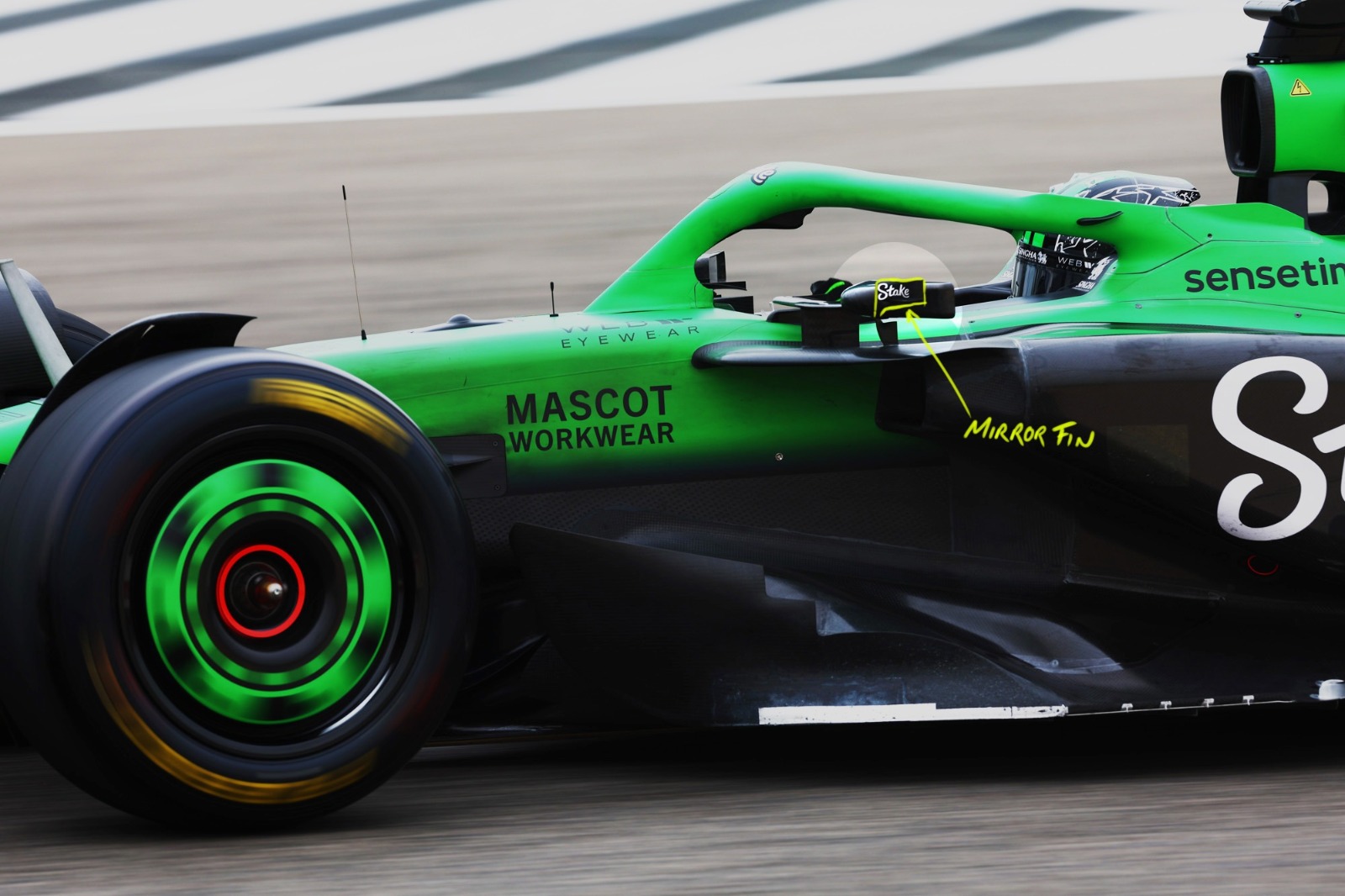
Sauber has taken a different approach with its mirrors by adding an outer fin


What caused Mercedes' pace deficit at Sepang despite upgraded W17?

Three kings: F1's generational stars shone at Sepang

Bahrain Grand Prix in Malaysia Driver Ratings 2026

The slick tyre gamble that hurt McLaren and Ferrari's chances in Bahrain GP in Malaysia

The wide world of strategy options expected in F1's Bahrain GP in Malaysia

McLaren explains recurring Norris straightline speed issue after Bahrain GP qualifying

How drivers waiting in the wings can still make their presence count in F1

What we learned from Friday practice at the 2026 Bahrain GP in Malaysia

MotoGP riders divided on contentious 2027 weekend format change

FIA completes investigation into F1 chaos in Malaysia and announces measures

Peugeot promotes test driver Quinn to race seat for 2027 WEC

No denying it now – the one reason why F1’s ‘horrible’ start in Malaysia could be a good thing
Subscribe and access Autosport.com with your ad-blocker.
From Formula 1 to MotoGP we report straight from the paddock because we love our sport, just like you. In order to keep delivering our expert journalism, our website uses advertising. Still, we want to give you the opportunity to enjoy an ad-free and tracker-free website and to continue using your adblocker.


Top Comments