


How rare Bahrain testing weather is complicating the early F1 2025 pecking order picture
McLaren started the 2025 F1 season testing as strongly as it ended the 2024 campaign overall, with Lando Norris setting the fastest time and Mercedes also got off to its best start to Bahrain testing in this car design rules era. But the long-run times clocked late on Wednesday at the Sakhir track look better for Red Bull. Here’s how

For the fairer-skinned members of the Formula 1 paddock, burning cheeks are a very familiar feeling in Bahrain – but things are different in 2025.
The soreness remains, but it’s stemming from a different reason. This is also hampering the efforts of the teams as they prepare for the new campaign. Windburn for many of those on the ground, unpredictable handling for those superstars blasting across it in F1 machinery, all thanks to hefty, ever-blowing early gusts.
Although the opening session of the three-day event at the Sakhir circuit started bright enough, wind speeds around 14mph were soon sending ugly clouds across the desert region. As the temperatures never climbed above 17C on Wednesday, it was all very Silverstone, rather than boiling Bahrain.
But the rare rather wintery conditions here did not seem to hamper reigning constructors’ champion squad, McLaren. The orange team led the way with Lando Norris’s 1m30.430s effort from the afternoon/evening running.
But, as his flow-vis doused car slipped sideways exiting the tricky double left Turns 9-10 complex even during a last-minute steady-state aerodynamic test in the day’s final minutes, it was a reminder of how the conditions are hampering the pecking order picture overall.
It was George Russell – second fastest overall on Mercedes’ strongest opening day of testing in this rules era (its previous best was being fifth fastest on day one in Bahrain in 2023) – that explained this particular problem for the teams.
“You've got to try and think what it could have been if the temperature was 20C hotter, if the wind was 180-degrees different,” Russell said in response to an Autosport enquiry on the matter during the day’s lunchbreak.
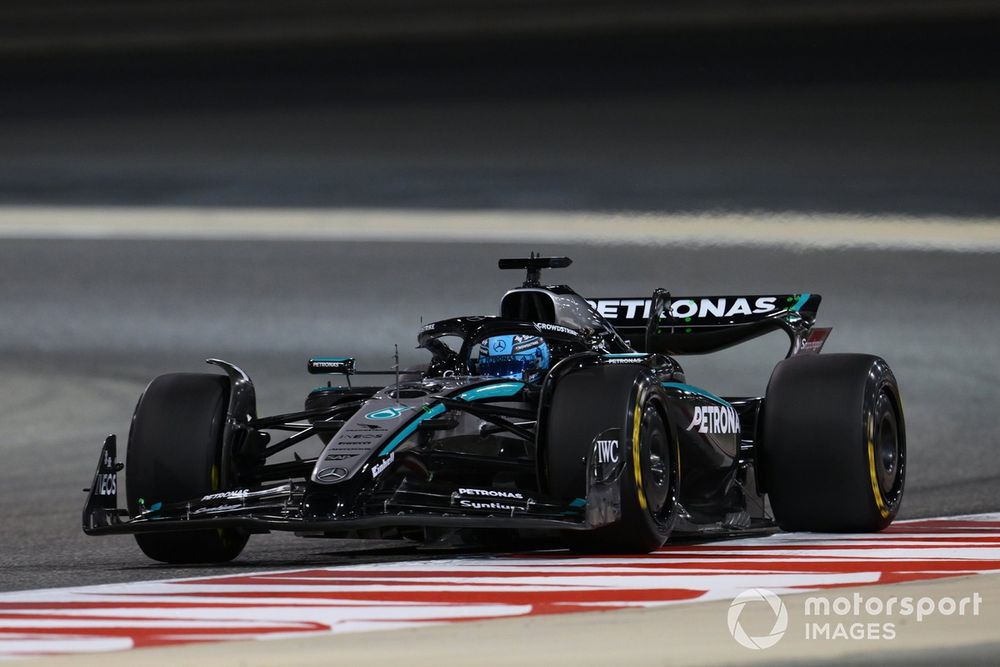
The weather conditions in Bahrain on Wednesday made it tricky to decipher the F1 2025 pecking order
Photo by: Simon Galloway / Motorsport Images
“And that's what we use the simulator for. Because it's all well and good to say the car feels great here in Bahrain with 15C… but we're never going to race in Bahrain in 15C and the wind as strong as it is today.”
Those teams with the most sophisticated simulators will be able to cope best with the additional calculations needed to adjust the data and driver feedback taken in from the blustery opening conditions.
Here, McLaren will have a handy edge given its investment in such facilities in recent years, but the technology can only replicate things in very specific ways. This includes reproducing real-life runs for the simulator drivers now getting to work across the F1 field far away from Bahrain with wind level, direction and track temperature corrected to more ‘normal’ conditions. Once this is done, the teams will dig into how the cars are performing in even greater depth.
On the long-run averages, and with the added caveat that not only were the conditions better in the afternoon/evening but ever more rubber was going down for those later runs, the picture looked far more like early 2024 than late last year
Mercedes insiders are refusing to get carried away with its strong start to testing, with Russell’s best just 0.157 seconds slower than Norris. The Silver Arrows' good day included Lewis Hamilton’s replacement, Andrea Kimi Antonelli, topping the morning running in the W16.
He was eventually shuffled back to seventh overall of the 20 drivers, as the afternoon session where Russell took over – where the wind also calmed considerably around the additional challenge of the day’s long power cut stoppage – produced the best times.
This included Norris’s effort, plus Max Verstappen rising to third for Red Bull – 0.244s behind the initial pace set by his 2024 title rival.

A circuit-wide power cut suspended running for over an hour, further complicating the picture
Photo by: Mark Thompson - Getty Images
After the Dutchman’s new team-mate Liam Lawson had been “caught out” by a wind gust exiting Turn 2 in the first session, which had the RB21 in the gravel and briefly stopped, Verstappen also had a few wobbles on day one.
This included a big snap on the approach to Turn 2 and running wide in the long, left-hand Turn 11 when running a brand new set of C2 hard tyres.
But, while this seems as reminiscent of the early handling ills of the RB20 in Bahrain testing as the RB21 looks similar to its predecessor, if not in relation to flexing front wings stopped on TV coverage, Red Bull was actually leaving day one very happy with its long-run pace. More on this below.
PLUS: Why does Red Bull's RB21 look the same as its predecessor?
Charles Leclerc had led the top times for Ferrari before the power cut, with his best of 1m30.878s eventually coming in 0.448s down on Norris’s leading time. He and new team-mate Hamilton insisted “it’s still too early to come to any conclusions about our performance”, but barbs came from elsewhere.
“McLaren was also very consistent and fast,” Red Bull motorsport advisor, Helmut Marko explained to media including Autosport. “Same with Mercedes. A little bit disappointing for all of us [was that] we expected more from Ferrari. But there are two more days, so we'll see…”
On the long-run averages from the opening day, and with the added caveat that not only were the conditions better in the afternoon/evening but ever more rubber was going down for those later runs, the picture looked far more like early 2024 than late last year. This is the case when just focusing on the frontrunning pack based on how last year played out.

Max Verstappen and Red Bull were F1's dominant force in early 2024
Photo by: Clive Mason/Getty Images
Red Bull led the way with a best average from a late C3 long run by Verstappen that came in at 1m33.080s, with Norris’s similar effort slower by a narrow 0.188s.
Russell’s stint on the same compound was 0.774s adrift and showing more signs of heavy tyre degradation as his times climbed later in the stint.
Red Bull insiders are pleased with the tyre wear clocked so far on the RB21, but an added caveat here is that the team goes historically well on this track and found a big gain over the 2024 race weekend by the wind changing direction. Overall fuel levels and engine modes can of course change the true times considerably.
More unusual Bahrain weather is predicted across the rest of the test, with proper rain showers possible on Thursday
While those averages above come in over 10, 13 and 12 lap stints for Red Bull, McLaren and Mercedes – all produced at roughly the same time late in the extended second session – Ferrari did things differently in the long-run stakes that don’t mirror race simulations at this stage.
Ferrari had Leclerc clock more of the shorter long-run stints Russell had quickly started doing for Mercedes during session two, with Ferrari’s best average so far therefore an outlier of 1m36.330s.
More unusual Bahrain weather is predicted across the rest of the test, with proper rain showers possible on Thursday – just when F1 would normally see the first race simulation efforts (and therefore much more representative lap time averages) start to come in.

The unusual weather may continue over the final two days of Bahrain testing making it more difficult to decide on a pecking order
Photo by: Peter Fox - Getty Images


Why Britain’s role in Formula 1 endured a troubled start

Why Bottas believes his F1 reserve driver role is the fastest route back to a race seat

Why Norris is now ready for his final exam

The key advantage for Bottas vs Perez in the 2026 F1 return race

Why Ferrari's management is under pressure after its bad start to F1 2025, not Hamilton or Leclerc

Why Red Bull can’t solve its second F1 car problem with a simple paint job

Hirakawa replaces Doohan at Alpine for Japanese GP FP1 outing

How Alonso and Bortoleto can be F1 rivals in a unique driver management deal

F1 United States GP live commentary and updates - Q3 starts

F1 United States GP: Ferrari completes perfect practice record as Hamilton tops FP3

James Hunt’s 10 greatest races

F1 United States GP live commentary and updates - Hamilton leads FP3
Subscribe and access Autosport.com with your ad-blocker.
From Formula 1 to MotoGP we report straight from the paddock because we love our sport, just like you. In order to keep delivering our expert journalism, our website uses advertising. Still, we want to give you the opportunity to enjoy an ad-free and tracker-free website and to continue using your adblocker.


Top Comments