


The steering wheel switches that helped Norris battle with Verstappen in late Imola F1 contest
For a race that threatened to tail off into a Max Verstappen walkover, the climax to the Imola Grand Prix came close to making it a Formula 1 classic, as a late charge by Lando Norris came up just short. However, key to the story of the race were some steering wheel adjustments that enabled the McLaren driver to reel in the Red Bull

Autosport Plus content
The best content from Autosport Plus, our subscription service. Subscribe to get access to all the features
If this year’s edition of the Emilia Romagna Grand Prix had been held last season, Max Verstappen’s victory from pole position at an Imola circuit notoriously difficult to overtake on would have been a foregone conclusion. Even in races where a Red Bull’s usual prodigious pace had been missed, Verstappen could be expected to control the race from the front lines.
It looked certain to go that way in the first 44 laps at Imola. Verstappen was 7.4 seconds clear of Lando Norris, the McLaren driver struggling for pace on the hard tyres and just about repelling Charles Leclerc’s DRS-assisted overtures for second place. The gap to the front had been growing; not at a particularly rapid rate, but enough for Verstappen to look reasonably secure.
But there was a sudden change in the dynamic on the following lap. Norris suddenly chewed a second out of Verstappen’s lead, guiding Leclerc out of DRS range in the process as a fightback – on a weekend full of them – suddenly appeared on the cards. The prospect of a late-race showdown had looked unlikely over the first two-thirds of the grand prix, but that’s exactly what emerged.
What followed had shades of the 2005 race at the same venue – at least, to a degree. It came with its own modern twist, affected by the contemporary concepts of Pirelli degradation and the notion of performance windows. And, this time, it was the multi-time champion keeping the less-decorated driver at bay, a reversal from Fernando Alonso’s 12-lap defence against Michael Schumacher at the business end of the race 19 years ago.
Verstappen had already enjoyed something of a fightback after a disappointing trio of practice sessions, and was now reaping the rewards offered by ex-F1 driver Sebastien Buemi’s simulator stints back at Red Bull’s Milton Keynes factory. The correct ride height settings continued to elude the team into Saturday but, thanks to the Swiss driver and the work of the trackside engineers, a fix was implemented in time for qualifying to help Verstappen battle his way to pole. Nico Hulkenberg’s tow cemented the Dutchman’s position at the head of Sunday’s grid.
That Oscar Piastri, who narrowly trailed Verstappen in qualifying, was shuffled back three places for impeding in Q1 diluted McLaren’s interest at the front of the order. Perhaps Verstappen could have been susceptible to a pincer movement, but it left only Norris to challenge into the opening chicane at Tamburello.

Due to Piastri's grid penalty, Verstappen was fending off one McLaren rather than two at the start
Photo by: Steven Tee / Motorsport Images
Both front-row starters seemed to enjoy comparable initial phases off the clutch, but Verstappen held the inside line while Norris came under scrutiny from Leclerc and had to focus on defending second. McLaren’s hope of getting Norris ahead at the start had come to nothing, so it had to refocus on remaining in touching distance of Verstappen over the opening stint on medium tyres.
Norris seemed to do so, although sat on the cusp of the one second needed for DRS rather than within it. But Verstappen began to flex a slender advantage and the opening laps were singing from the same hymn sheet: Norris could find a couple of tenths in the opening sector, but lost ground in the following two as the Red Bull’s superior kerb-strike ability could yield lap time through Acque Minerali and the Variante Alta.
That advantage started to snowball more readily as the opening stint started to settle. McLaren team principal Andrea Stella suspected that tyre temperature had started to sap at Norris’s pace, stating that: “If you took your tyres to too high a temperature, then the drop was quite significant. For us, the tyres at the start of the race in the first stint were too hot and we were losing ground to Verstappen.”
"At that time of the race, we were not thinking we would be in the question to beat Verstappen, we were more like, 'We want to retain second position'" Andrea Stella
While Verstappen was able to shake off Norris, the Briton could not offer Leclerc the same treatment and, instead, the Ferrari remained consistently within a two-second window. McLaren knew this could give Leclerc a potential undercut reward if Ferrari made the call to stop, and thus it took the front foot and pulled Norris in for a switch to hard tyres on lap 22. The kicker was that Sergio Perez, running to a contra-strategy by starting on hard tyres from 11th, was ahead when Norris emerged back on track. McLaren suspected that this would be the case, but the threat of losing track position to Leclerc was too much of a risk.
“We wanted to make sure we could hold the position because, at this track if Leclerc pits, he finds Perez in the DRS zone, and he was going to try and undercut us,” Stella explained. “We checked with [Norris] a couple of times, he was comfortable that we would pass Perez, but it was important to retain track position. In fairness, at that time of the race, we were not thinking we would be in the question to beat Verstappen, we were more like, 'we want to retain second position'.”
Thankfully for Norris, his confidence that he’d successfully clear Perez came to pass on the following lap with DRS, ensuring he wouldn’t be at threat from a Ferrari over-cut attempt either. On fresh rubber, Norris was the fastest man on track, so when Verstappen pitted on the 24th tour and emerged back on track, the gap had been cut to just 4.4s. But there was no way Norris could retain that sort of pace over the next 40 laps and, when Verstappen’s tyres were up to temperature, the second stint started to reflect the first.

Norris gradually lost touch with Verstappen over the first stint, so an early stop covered off the threat of Leclerc behind
Photo by: Andy Hone / Motorsport Images
Leclerc wasn’t out of the picture either, even though his pitstop culminated in the same Perez traffic that Norris had endured three laps prior. Just as Norris was trying to ward off a Leclerc undercut, McLaren had been trying to put one up on the Monegasque driver with Piastri; the Australian had been stuck behind the two Ferraris during the opening third and his heavy pressure on Carlos Sainz had come to nought. His undercut strategy brought him much closer to Leclerc and, crucially, ahead of Sainz when the Spaniard eventually called in for his own stop.
It was Piastri who was told that “degradation is higher than expected” by race engineer Tom Stallard, as McLaren seemed to have a bead on the cars around it and their – by the Woking team’s estimation – profligate use of tyre life. Despite Norris using his undercut to close the gap to Verstappen, the arrears were extended once more and Verstappen was over six seconds clear by the race’s mid-way point. Add that to Leclerc studiously chipping away at the gap to second, and Norris started to get hot under the collar.
He wanted to know why the cars around him were faster, and was told that they were “using a lot more tyres than us”. He didn’t seem entirely satisfied by that response but felt that he had to press on regardless.
“I was asking because I just felt slow and I didn't feel like I could push a lot more,” Norris clarified. “So as soon as I started to push, I felt like I'd oversteer, I'd understeer, lock tyres. It was just the tyres were not in a good window. I think it's clear that, as soon as they're not in the right window, you can't push. You don't have the confidence with the car. So I had to just manage things as best I could.”
But the frustration was palpable, as Verstappen started to drift further away into the distance and Leclerc nudged himself into DRS contention. Lap 43 was arguably Norris' nadir at this phase; Verstappen was 7.5s ahead, while Leclerc sat gamely within a second and ready to pounce.
But Norris flipped the switch. Rather, he flipped a few; the effect of traffic ahead had knocked the hard tyres out of their ideal range and the Bristol-born racer had to paw at the steering wheel to imbue his car with a little more grip. He wanted to shift his balance slightly more rearwards “and try to kill the fronts”, the car proving too pointy at the front end. Brake balance and differential settings were among those tweaked at the wheel, which seemed to bear the fruit desired.

A few steering wheel switch flicks and Norris was on the attack again
Photo by: Mark Sutton / Motorsport Images
Thus, with 18 laps to go, the dynamic of the race changed. Norris became the hunter, rather than the hunted, as Leclerc’s power started to wane and Verstappen’s tyres started to lose their lustre. For the Red Bull driver, his emerging struggles on the hard tyre was down to the after-effects of his miserable practice sessions, as the team had not gathered quite enough information about the Pirelli C3s to shape its predicted stint. “Probably with hindsight, we maybe would’ve been better running a hard tyre long on Friday,” Red Bull team principal Christian Horner said. “We opted to take two new hard tyres into the race, but maybe it would’ve been better to get the information on the tyre.”
Leclerc eased the pressure on Norris by skipping across the Variante Alta on the 47th lap to lose about half a second, by which time the MCL38’s tyres were starting to come on song relative to the cars around him. Norris said that the timing of his resurgence and Leclerc’s mistake was “coincidental”, but it nonetheless proved to be felicitous in the circumstances.
“When Charles was behind me, I didn't have a lot more than what I had,” Norris reckoned. “If I did, I probably would have made a mistake and went off track. So yeah, it was tricky. But as soon as Charles made the mistake, it gave me a bit of breathing room. I was like, ‘Ok, maybe now I can try to push it a little bit more’. And it started to come back to me…”
Verstappen could not take the same liberties: he lacked grip and sat precariously on a black-and-white flag for track limits. Any further mistakes and a five-second penalty would come his way, one that would put Norris ahead
Norris then started to hack away at the gap in front. The 7.5s delta soon shrunk to five seconds by the end of lap 50, and each further nibble at the gap loaded extra pressure onto Verstappen. It didn’t help that the leader felt that his tyres had fallen out of the operating window, and thus resorted to improvisation in order to try and keep them in. Verstappen noted that he had to take “weird lines” as a prophylactic measure and try to corral his white-walled Pirellis towards the ideal temperature window, but the grip did not seem entirely recoverable.
With seven laps remaining, a once-healthy barricade now stood at a mere two seconds. But these were the most difficult seconds that Norris had to break through, as the effect of dirty air started to work against the McLaren driver dancing his car on the limit. A couple of snaps at the wheel laid the amount that Norris was pushing bare, each one helping Verstappen’s breathing become slightly less laboured.
Verstappen could not take the same liberties: he lacked grip and sat precariously on a black-and-white flag for track limits. Any further mistakes and a five-second penalty would come his way, one that would put Norris ahead. Straightline performance also came into play, a Red Bull strength that continued to keep Norris out of DRS range in the dying stages of the grand prix.
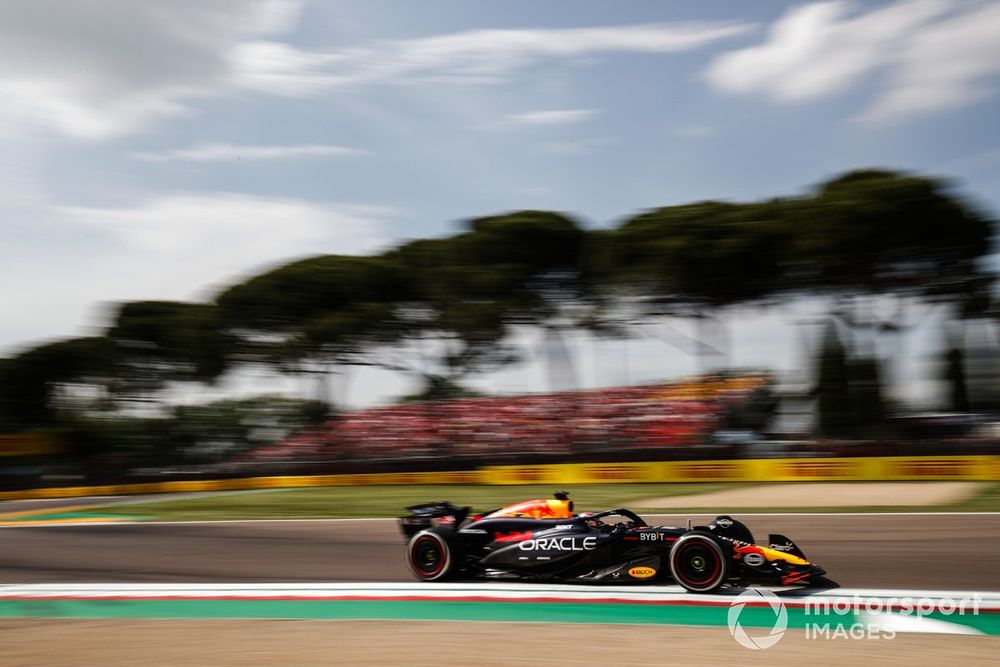
Verstappen made his own adjustments to haul to Red Bull to the finish
Photo by: Zak Mauger / Motorsport Images
“You cannot suddenly try and force half a second out of it when you don't have the balance,” Verstappen explained. “So I was just trying to really not make mistakes, really try to drive around the balance issues that I had, and be quick on the straight. That's basically what I think helped me a bit at the end. Also, with the rear wing that we had, we were quite fast on the straight. That probably helped a bit in the last few laps to defend.”
After a couple of tentative laps, Norris broke the back of that two-second deficit and sat 1.4s behind with three laps remaining. Then 1.2 seconds. Then there was a wait as the final lap looked set to begin: a wait to see if Norris could open the final pass through the main straight with DRS.
Instead, he was just a couple of hundredths shy. Without an overtaking aid, Norris thus had to rely on his battery power and positioning to try and make an unlikely break into the lead. Verstappen had purged most of his battery pack of energy ahead of the final lap, while Norris had a bit more and settled within a second of the leader. Attempting to force a mistake out of Verstappen, he shifted around in the Red Bull’s mirrors to perhaps offer some degree of distraction.
But, as Michael Schumacher found nearly two decades ago, it’s almost impossible to make a pass work in the final throes of the Imola circuit. The 0.725s difference at the line underlined a valiant effort and suggested that, had the race been one lap longer, Norris might have had half a chance to take a second consecutive win. Instead, the win was Verstappen’s – a few hours after he’d helped Team Redline to victory in the virtual Nurburgring 24 Hours with two stints either side of his Saturday night kip.
“Maybe we were not on top of things for the race still, because on the hard tyres, for sure, something was not optimised,” Verstappen reflected after a breathless end to the race. “I just never felt like the tyres were working on our car. So that's something that we have to analyse.
“It just felt like they were not operating in the right temperature window. And that just got worse and worse. The last 15 laps for me was really like driving on ice. They were not responding anymore.”

After their fortunes were reversed in Miami, Verstappen returned to his familiar top spot in Imola
Photo by: Mark Sutton / Motorsport Images
In the meantime, Norris felt that McLaren had perhaps anticipated cooler conditions for the Sunday race and set itself up accordingly. He suggested that he’d “paid the price” for that decision, and taking out more front wing might have been a better step in the right direction. Regardless, he was lauded for “managing the budget of the tyres” by Stella, particularly noting the easier tyre management conditions that Verstappen held in front.
Stella also took responsibility for Piastri’s inability to beat Leclerc to third, despite a spell after their respective stops that handed the Melburnian a chance to hustle the Ferrari. The impeding penalty for blocking Kevin Magnussen in qualifying was, by Stella’s account, a team error. “Given the performance he deployed in qualifying, he had all the cards this weekend to finish on the podium,” the Italian said of his younger driver.
"When you only have a tenth in between Red Bull, McLaren, and ourselves, we need to do everything perfect. And the third place [on the grid] cost us maybe a better result in the race" Charles Leclerc
Leclerc, meanwhile, felt that he might have been on for better than third had qualifying gone a little more to plan. He revealed that Ferrari had been on a different “power strategy” along the straights, which had cost time to both Red Bull and McLaren on the run to Tamburello, something that he had earlier noted had been an issue in other qualifying sessions this year. “We lost everything on the run down to Turn 2 [in qualifying],” Leclerc said. “When you only have a tenth in between Red Bull, McLaren, and ourselves, we need to do everything perfect and the third place [on the grid] cost us maybe a better result in the race.”
Was this race a harbinger of further challenges to come for Red Bull, or was it a one-off set-up miss that caused the most damage? It’s hard to argue that McLaren and Ferrari aren’t much closer to the team that started off in such dominant fashion, particularly as their latest upgrades have come on-song. And, although Red Bull had its own, their impact was masked by the set-up difficulties faced at the start of the weekend.
Monaco will be much different, although whether Red Bull retains last year’s shakiness in low-speed, street-circuit conditions remains to be seen. But if the RB20 falters in the principality, McLaren and Ferrari will be there to pick up the pieces.

Is a three-way team fight on in Monaco?
Photo by: Mark Sutton / Motorsport Images


Haas confident of getting 2027 F1 budget closer to cap with new partner talks

F1 doesn't need to change its VSC rules despite Norris' Spain loss

Spanish Grand Prix Driver Ratings 2026

How Norris unfurled a surprising - and "unrepeatable" - Spanish GP pole lap

Audi’s long road back to the top of grand prix racing

What we learned from Friday practice at the 2026 F1 Spanish GP

Leclerc accepts blame for Italian GP clash with Hamilton: "I went too far"

Should Ferrari have pitted Hamilton under the VSC at the Italian GP?

What's behind the talks between the FIA president and Alonso over ADUO?

Evans favourite to become WRC champion as Rally Saudi Arabia is cancelled

Alonso is right to sound the alarm about F1 - but history seems to be repeating itself

Ogura set to make MotoGP return in Austria
Subscribe and access Autosport.com with your ad-blocker.
From Formula 1 to MotoGP we report straight from the paddock because we love our sport, just like you. In order to keep delivering our expert journalism, our website uses advertising. Still, we want to give you the opportunity to enjoy an ad-free and tracker-free website and to continue using your adblocker.


Top Comments