


The ‘screaming’ F1 engine future that may not be out of reach
OPINION: It wasn't just the Verstappen/Hamilton clash that had the Red Bull and Mercedes bosses at loggerheads at Silverstone, with the nature of Formula 1's 2025 engines also subject for disagreement. But hopes to have loud, emotive engines that are also environmentally friendly don't have to be opposed

Retro YouTube videos cannot do justice to just how loud Formula 1’s old screaming V8 and V10 engines were. In the flesh, they not only assaulted your ear drums (making ear plugs an essential every F1 weekend), but they also reached the parts that other more modern power units cannot reach.
I recall many a time watching trackside at Monaco in the tunnel, and standing behind a well-placed soft drinks vending machine to help shield some the vibrations and force of the engines thrown out as the cars blasted past a few metres away. You could feel the 20,000rpm monsters pounding on your chest and punching through your torso every time.
That is exactly the kind of emotional response that Red Bull team boss Christian Horner hopes that F1’s next generation of engines can bring back fans when they are unleashed from 2025. For while F1’s current turbo hybrids have done some magical things – in driving forward energy recovery technology, and improving thermal efficiencies to levels not seen in road-going engines – they equally brought with them some big negatives.
The costs of developing the power units were astronomical, and their technical complexity plagued the manufacturers who did not get it right from the start. Just look how long it took Honda to turn things around from its year one disaster with McLaren in 2015 to a title challenge with Red Bull this season. But while the above issues were isolated problems for competitors, there were wider factors at play too that did trigger fans.
F1’s manufacturers and its bosses did a bad job initially of marketing the positive messaging of the hybrid push: and it certainly was not helped by ex-F1 supremo Bernie Ecclestone never being behind the concept. Furthermore, the PR battle was effectively lost from day one thanks to the new generation of power units being too quiet.
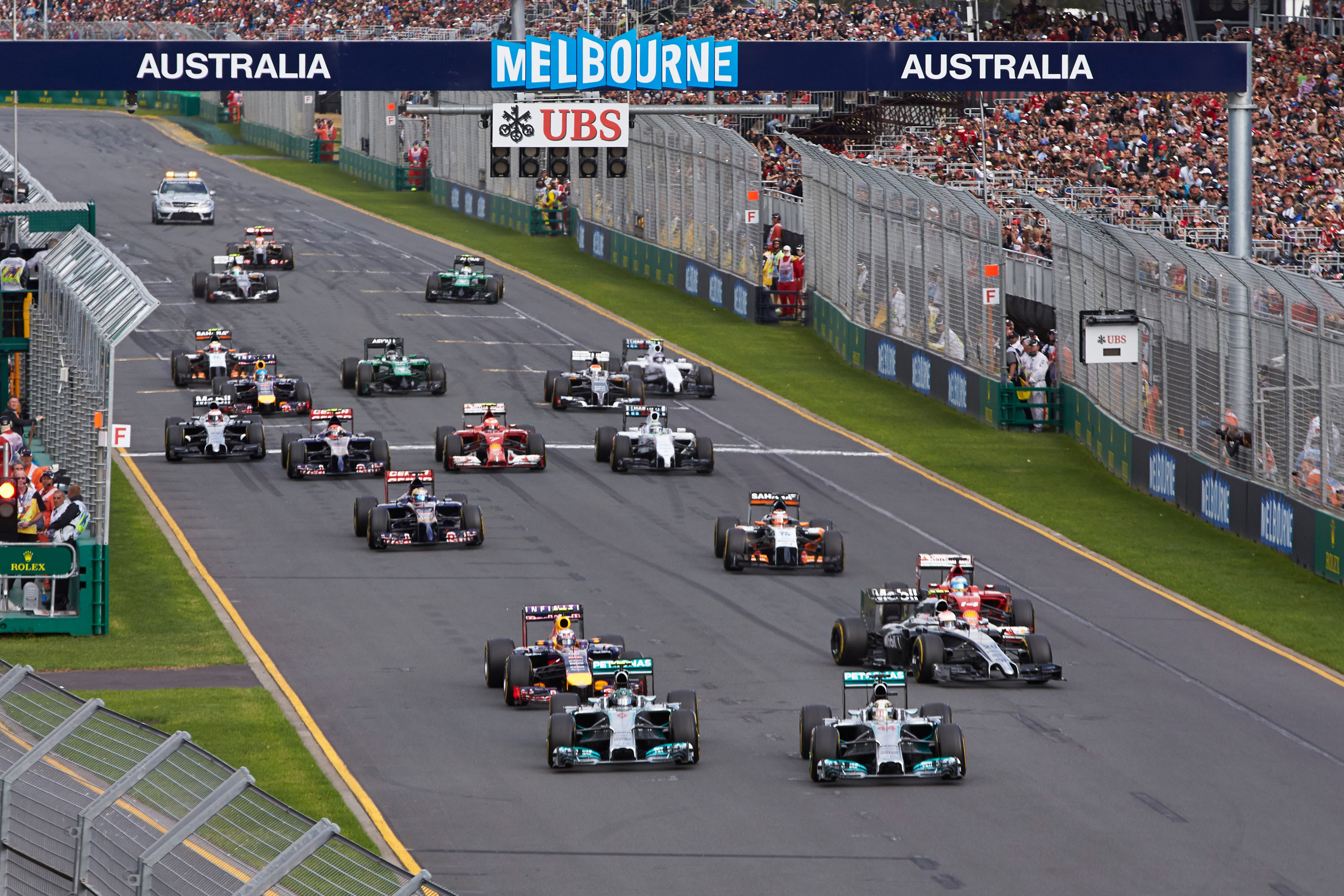
PR battle was lost from the beginning in 2014 with F1 bosses failing to publicly back the move to hybrids
Photo by: Motorsport Images
Taking away the emotive aspect that had made the V8s and V10s so thrilling was an element that F1 had perhaps not acknowledged enough to be a problem when it formulated it rules plans from 2014. As the performance of the power units ramped up, the noise did get better, but it’s still fair to say that they are nowhere near the levels of the old era.
Turbo-hybrid F1 engines: In defence of the 'quiet' beasts
So going back to the chest-battering sensations of the past is what is motivating Horner’s most recent push. But is it feasible amid a world where sustainability is becoming an essential part of everyday life, to go back to something that the greens would have a field day attacking?
"It would be totally misaligned of where the world is moving, and probably turn every single business partner away from F1 if we stick with internal combustion engines that scream, even though we may like them" Toto Wolff
From the camp of the manufacturers, the answer is a definite no. Car makers are facing tremendous challenges trying to meet government targets on emission reductions, and their involvement in F1 is dependent on it committing to a more carbon neutral future.
It would be hard for a manufacturer to justify trying to sell the ultimate green road-going fleet if on Sundays it was involved in a sport being portrayed as a gas-guzzling show. Mercedes boss Toto Wolff thinks even many of F1’s sponsors are turned on more these days by the potential of sustainability.
“The [sponsor] pitches are not anymore, these are the audiences and these are the amount of pictures you can take with Lewis Hamilton,” he said. “They actually ask about our environmental policy and what we do in contributing.”
That’s why Wolff fears that if F1 did go back to a more regular noisy ICE power unit, while it may suit fans, it would be bad for the global sport.
“I think we would lose complete relevance with our partners, sponsors, and major stakeholders, if we weren't looking at the environment and the impact that we make,” he added. “I think it would be totally misaligned of where the world is moving, and probably turn every single business partner away from F1 if we stick with internal combustion engines that scream, even though we may like them.”

Wolff is eager to see environmental concerns put above fans desire for loud F1 cars
Photo by: Steve Etherington / Motorsport Images
But while a return to traditional power units may have been completely unthinkable a few years ago, what has opened the door slightly on the idea is the booming interest in sustainable fuels. F1 is convinced that it can lead the charge in developing the technology to create carbon neutral fuels amid a reality that road cars are going to be running on combustion engines for many years to come.
PLUS: Why sustainability is being mandated by F1
And if F1 can hit that target – with the plan being for 100% sustainable fuel to be a core component of the new 2025 power units – then ultimately it would not matter too much if the engine was a smaller turbo V6 hybrid or a bigger screaming or throaty V8.
As Horner said at the British GP: “I think that the combustion engine does have a future, so why not introduce high revving engines that sound fantastic, and that are doing it in an environmentally friendly manner? I think that the biofuel and sustainable fuels enable you to do that.”
Of course, a simpler engine to develop - without the added complications of developing high-tech energy recovery systems - does perfectly suit Red Bull’s own agenda as it becomes an engine manufacturer. After all, it doesn’t want a hugely expensive R&D budget to suddenly be added to its bottom line.
But, even so, the outline wish of a louder engine is a pretty big must for when F1’s manufacturers do get together to formulate the rules. A straight revert to the old V10s is realistically out of the question, but aiming to deliver on something that assaults the senses needs to be made a priority.
There is a clear path for F1 that can tick off the sustainability factors – of green fuels and hybrid energy recovery systems – but twin them with a throatier, higher-revving power unit that lifts emotions and brings some of the aural excitement back to grand prix racing.
Saving the world doesn’t have to be boring. What a great message it would be for F1 if it could deliver the fastest, loudest, most spectacular racing cars in the world that run on fully sustainable fuels as part of a carbon neutral racing series. It would be a win for manufacturers, a win for sponsors, and, best of all, a win for fans.

F1's next generation of engines are up for debate, and could mean a shake-up is in the offing
Photo by: Andy Hone / Motorsport Images


Brundle awarded OBE in King’s New Year’s honours

The new rules dilemma that will define the 2025 F1 season

Verstappen issues Red Bull title warning in push for RB21 progress

Mercedes opens up on the factors that hurt Hamilton with the W15

How McLaren faced up to the misinformation, noise and distractions of being an F1 title challenger

Why Bottas is not letting the “worst-case scenario” end his F1 career

Jon Noble: An unfair perception or a genuine concern? Lifting the lid on Red Bull’s Tsunoda scepticism

Binotto on Audi's F1 reality check after finding team "frozen" with no plans

Acosta's long road to his maiden MotoGP win

MotoGP Austrian GP: Acosta finally claims maiden win

Great debate: Which circuit should host the F1 2026 finale if the calendar has to change?

Live: MotoGP Austrian Grand Prix updates as it happens
Subscribe and access Autosport.com with your ad-blocker.
From Formula 1 to MotoGP we report straight from the paddock because we love our sport, just like you. In order to keep delivering our expert journalism, our website uses advertising. Still, we want to give you the opportunity to enjoy an ad-free and tracker-free website and to continue using your adblocker.


Top Comments