


The off-track considerations that led to F1’s Hamilton/Verstappen Silverstone shunt
OPINION: Formula 1’s 2021 title fight turned ugly last weekend when Max Verstappen and Lewis Hamilton collided at the start of the British Grand Prix. Verstappen thankfully walked away unharmed, but this had been a clash long-since coming

It finally happened. Formula 1 got to see what would’ve happened had an Ayrton Senna/Alain Prost collision – but not Suzuka 1990, to be absolutely clear – taken place in the social media age. And the results, unsurprisingly, were absolutely, shamefully disgusting.
But, leaving behind the opinions of anonymous cowards (which is not to say that horrendous racist abuse such as that directed towards Lewis Hamilton in the aftermath of Sunday’s British Grand Prix shouldn’t be challenged and condemned, it should), F1 can reflect on its fiercest title fight for years arriving at its most contentious flashpoint yet.
Hamilton and Max Verstappen have very nearly been here before in 2021.
At the season’s second race, the pair made contact at Imola’s first real corner, the Tamburello chicane, with Hamilton bouncing across the kerbs and picking up a damaged front wing endplate footplate. In Spain two rounds later, Verstappen sent a very aggressive move up the inside of Barcelona’s Turn 1 to claim the lead, while his Mercedes rival turned out of contact. Then there was the Silverstone sprint race, where Verstappen weaved three times down the Wellington straight in a battle that lasted until Hamilton attacked to Copse’s outside and came off second best, any chance of victory in a bit of F1 history gone for good.
The sprint race outcome had a direct bearing on the grand prix controversy, precisely because Hamilton realised he’d made a mistake in “not going for the gap that was down the right-hand side” on the approach to Copse and had been left feeling he “really regretted” his move to the outside.
“I got a great tow down to Turn 9,” Hamilton said of his run to Copse in the main race. “I dummied him, moved to the left and then moved to the right for that gap. I was pretty far up alongside him, but I then could see he wasn't going to back out and we went into the corner and then we collided.”

Max Verstappen, Red Bull Racing RB16B, Lewis Hamilton Mercedes W12
Photo by: Glenn Dunbar / Motorsport Images
We don’t have Verstappen’s full side of the incident because after hitting the tyre barriers in a 51G impact he was taken to Coventry hospital for scans that thankfully came back clear. But we can surmise from Red Bull’s furious reaction to the incident, such as Christian Horner’s “dirty driving” assessment, that he wouldn’t exactly be taking blame.
Verstappen is never one to back down in a fight – as was evidenced in his thrilling, aggressive driving over nine corners last Sunday.
The investigation into the clash concluded that Hamilton was “judged predominantly at fault” because the stewards noted the space between the Mercedes and the Copse apex line.
In their reasoning for awarding Hamilton a 10-second time addition penalty, the stewards stated, "car 44 [Hamilton] was on a line that did not reach the apex of the corner, with room available to the inside" and so "when car 33 [Verstappen] turned into the corner, car 44 did not avoid contact and the left-front of car 44 contacted the right-rear of car 33”.
The sprint race outcome had a direct bearing on the grand prix controversy, precisely because Hamilton realised he’d made a mistake in “not going for the gap that was down the right-hand side” on the approach to Copse
Hence “predominantly at fault”, which reflects the view, supported by Autosport, that this was very nearly a racing incident, but that Hamilton just shares the majority of the blame.
This could be seen in Hamilton’s very similar move at the same corner with Leclerc later in the race (Hamilton’s pass other pass here, on Lando Norris, was completed well before the Copse turn-in point). On lap 50 of 52, rather than the opening tour, Hamilton’s “heart nearly stopped… because I though the same thing was going to happen that happened to me and Max”.
But it’s too simple to say he made a choice in where to position his car versus the Ferrari – into the space against the apex that the stewards highlighted in the Verstappen clash. In fact, it seems as if Hamilton made a different choice altogether when racing his title rival nearly two hours earlier.
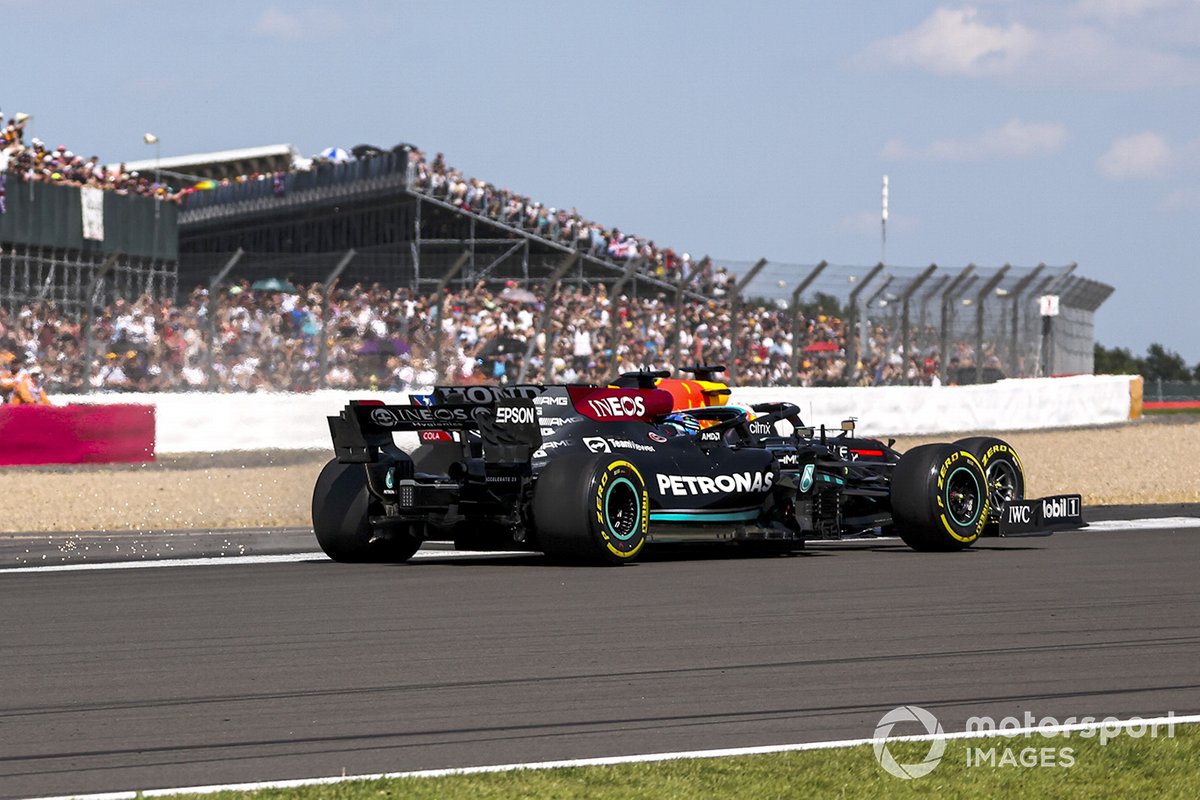
Max Verstappen, Red Bull Racing RB16B, Lewis Hamilton Mercedes W12
Photo by: Glenn Dunbar / Motorsport Images
At Copse with Leclerc, Hamilton had space to take the inside line much tighter through the rapid right-hander and stay at full tilt. Leclerc was wider and so there was space for both to get by without contact, with the Ferrari then going off into the Copse runoff when Leclerc suffered a lead-losing oversteer “snap” that needed correcting.
PLUS: How Leclerc almost defied Hamilton after F1 title rivals’ Silverstone clash
At the same point with Verstappen, because the Red Bull had squeezed him to the inside wall of the national pitstraight, then come back wider, then turned in again, Hamilton just couldn't make it to the inside as he did with Leclerc because of the high-speed understeer coming from the tighter angle. His hands stayed locked on the wheel.
Therefore, we can assume that the choice wasn’t ‘drive into the space on the inside to stay alongside Verstappen or not’ but was ‘back off and lose the chance to get by or stay committed and face the consequences of possible contact’.
It seems he chose the latter, the same as Verstappen had done, and what happened, happened.
“I was pretty far up alongside him,” Hamilton later reflected. “But I then could see he wasn't going to back out and we went into the corner and then we collided. Of course, that’s never the way I ever want to win a race or just in general to race, but these things do happen. I just hope he’s OK and look forward to many more races.”
We can guess at the likely reasons why Hamilton made such a choice (and of course, this is an interpretation of the circumstances based on the available evidence).
There was the build-up of the fallout from previous incidents with Verstappen this year, where Hamilton had clearly been the one to back out. So, perhaps, this was sending a message: "Don't try it again".

The car of Max Verstappen, Red Bull Racing RB16B, is returned to the garage on a truck
Photo by: Charles Coates / Motorsport Images
But the more obvious motivating factor was the championship standings when both drivers left their garages under the Silverstone Wing last Sunday. Hamilton was 33 points behind, and likely 41 adrift if Verstappen came out of Copse in the lead. And he knew it.
“As you saw [in the sprint race], once he’s out in the clear, they’re too fast,” Hamilton explained. “So, when an opportunity comes, I’ve got to try and take it. That’s what we’re out there doing – racing.”
Unlike in previous years – especially of late – where he's been involved in 50-50 moves and aggressive overtakes, Hamilton cannot afford to take the 'big picture' view on the championship standings.
If he backs out to bank points at Copse, he's also conceding them to Verstappen, who is already well ahead thanks to Red Bull’s run of wins since Spain. If there's contact and both are out, he loses no ground. If there's contact and the Red Bull comes off worse, he likely gains. The logic in his decision making is sound, if utterly, brilliantly ruthless.
"Of course, that’s never the way I ever want to win a race or just in general to race, but these things do happen. I just hope he’s OK and look forward to many more races" Lewis Hamilton
The penalty he received was ultimately correct - perhaps even a touch harsh considering what happened with Alex Albon in Austria last year, where Hamilton was given a five-second penalty for a similar small touch that also had significant consequences. The argument for a difference at Silverstone is that at the Red Bull Ring the clash came at a corner exit with cars rather more side-by-side.
It’s right that sporting incidents are judged on the move themselves, not the consequences - or otherwise, where does it end? Motorsport is risky and Verstappen's risk paid off badly for him this time. In a lot of commentators’ minds, this was a racing incident. Live by the sword etc.
But one can understand questions relating to Romain Grosjean getting banned because his actions “eliminated leading championship contenders from the race” at Spa in 2012, per that event’s stewarding documents – although only they’re asked politely and not in rabid (pathetic) Twitter fury.

Romain Grosjean, Lotus E20 Renault, Sergio Perez, Sauber C31 Ferrari, Fernando Alonso, Ferrari F2012, and Lewis Hamilton, McLaren MP4-27 Mercedes crashed at the start
Photo by: Steven Tee / Motorsport Images
But that is for the FIA to answer and in fact that specific example is likely superseded by a request from the teams to judge incidents on circumstances, not consequences, per race director Michael Masi.
“That's been a mainstay for many years,” Masi told assembled reporters in the golden, falling light of the near-empty Silverstone paddock last Sunday night.
“And this came through discussions prior to my time between all of the teams, the FIA and F1. The team principals were all quite adamant, that you should not consider the consequences in an incident. So, when they judge an incident, [the stewards] judge the incident itself, and the merits of the incident, not what happens afterwards as a consequence. [They’ve] been advised to do from top down. And I'm talking team involvement, and so forth.
“That's the way that the stewards judge it, because [if you] start taking consequences into account, there's so many variables, rather than judging the incident itself on its merits."
What will be very interesting for the next phase of F1’s title fight is to see just how Verstappen responds. Both contenders have now drawn the lines of where they're willing to go to win this title.
He doesn't generally change his approach, at least not publicly, but Verstappen can’t afford to come off second-best in a collision again given Hamilton’s eventual Silverstone win carved his points lead down to eight.
There will surely be another flashpoint in this enthralling title fight. There's been three already, plus the arguments over track limits in Bahrain and (sort of) in Portugal too (over Verstappen’s lost fastest lap point).
Now, those all become further off-track considerations that will result in certain decisions being taken at 200mph. And therefore, they may very well decide the circumstances of how the next clash plays out, as they did at Silverstone.
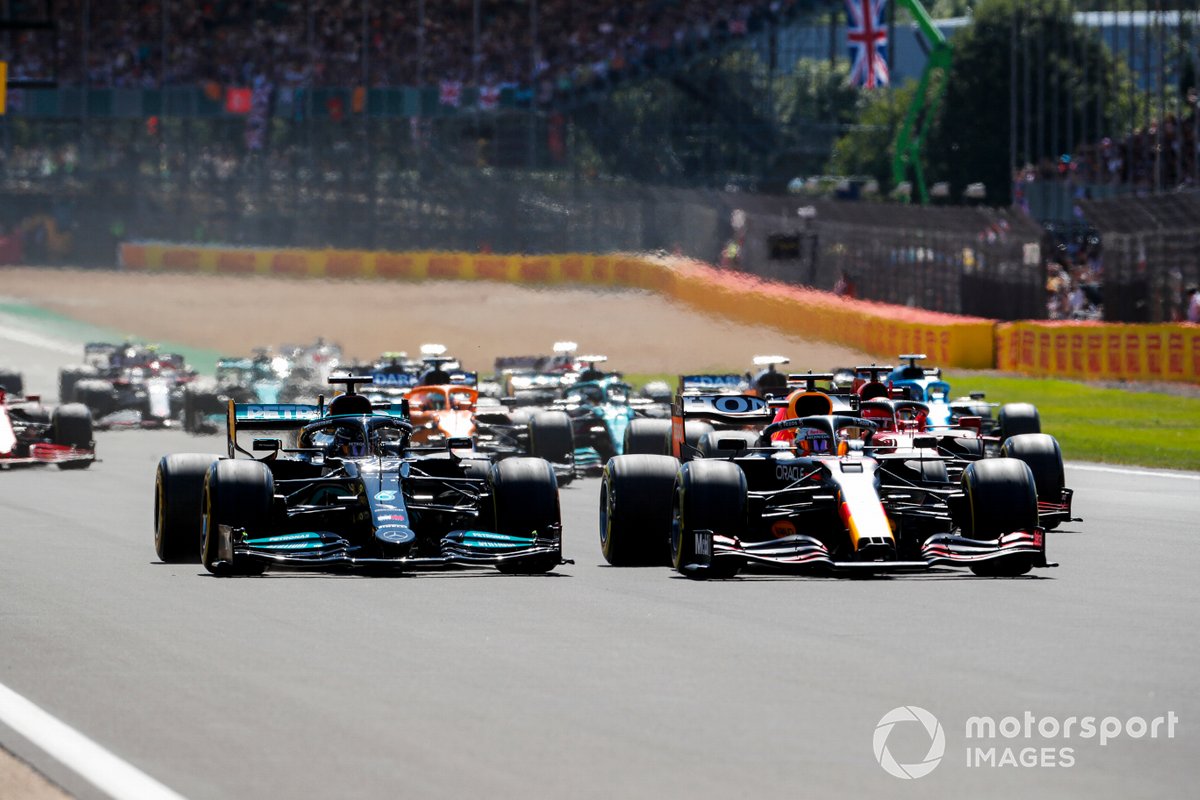
Max Verstappen, Red Bull Racing RB16B leads Lewis Hamilton, Mercedes W12 at the start of the race
Photo by: Steven Tee / Motorsport Images


Why Britain’s role in Formula 1 endured a troubled start

Why Bottas believes his F1 reserve driver role is the fastest route back to a race seat

Why Norris is now ready for his final exam

The key advantage for Bottas vs Perez in the 2026 F1 return race

Why Ferrari's management is under pressure after its bad start to F1 2025, not Hamilton or Leclerc

Why Red Bull can’t solve its second F1 car problem with a simple paint job

Hirakawa replaces Doohan at Alpine for Japanese GP FP1 outing

How Alonso and Bortoleto can be F1 rivals in a unique driver management deal

WRC Chile: Pajari to take deeper look to understand lack of speed in Chile

WRC Chile: Solberg saves best until last to pull away from Evans

How Norris unfurled a surprising - and "unrepeatable" - Spanish GP pole lap

F1 drivers criticise Madrid circuit, Verstappen laughs: "I'll sort it out"
Subscribe and access Autosport.com with your ad-blocker.
From Formula 1 to MotoGP we report straight from the paddock because we love our sport, just like you. In order to keep delivering our expert journalism, our website uses advertising. Still, we want to give you the opportunity to enjoy an ad-free and tracker-free website and to continue using your adblocker.


Top Comments