


The key threats facing F1 with thunderstorms forecast for Miami GP
While many of the drivers have tested the 2026 cars in the wet, Sunday in Miami could be their first experience in race conditions – and there are misgivings about the state of preparedness
"If it rains in Miami," mused Oscar Piastri in the Thursday FIA press conference, "it does it properly."
While it may seem premature to be fretting about the prospect of rain this far out from race day, there are compelling reasons to prepare properly given the threatening nature of the weather forecast.
Not only are there local laws to be observed in the event of thunderstorms, none of the current generation of cars has run in race conditions during wet weather. That leaves many unknowns given the immature state of the 2026 F1 technical package – and several drivers have expressed concerns about how the new cars will behave in wet weather, and the possibility of large differences in relative speeds while visibility is poor.
Readers of a certain vintage will recall the 1989 Australian Grand Prix, where the rear-facing camera on Martin Brundle's Brabham captured the moment Ayrton Senna's McLaren loomed out of the ball of spray at a substantial closing speed and smashed into the back of him. This was with the lap count barely into double figures, having already been restarted after a first-lap collision – without the presence of Alain Prost, who had the luxury of already having won the world championship, and accordingly declared himself out.
Provisions for wet weather were already enshrined within the new regulations, but these have been bolstered by the latest tweaks agreed ahead of the Miami GP weekend. These principally concern levels of electrical deployment, such as the disabling of boost mode in the wet and a cap on power deployment to 250 kilowatts, as well as revisions to straightline mode, while the permissible pre-heating temperature for the intermediate tyres have been raised.
But what emerged from the round of press conferences on Thursday in Miami was that several drivers have reservations about the effectiveness of these measures.
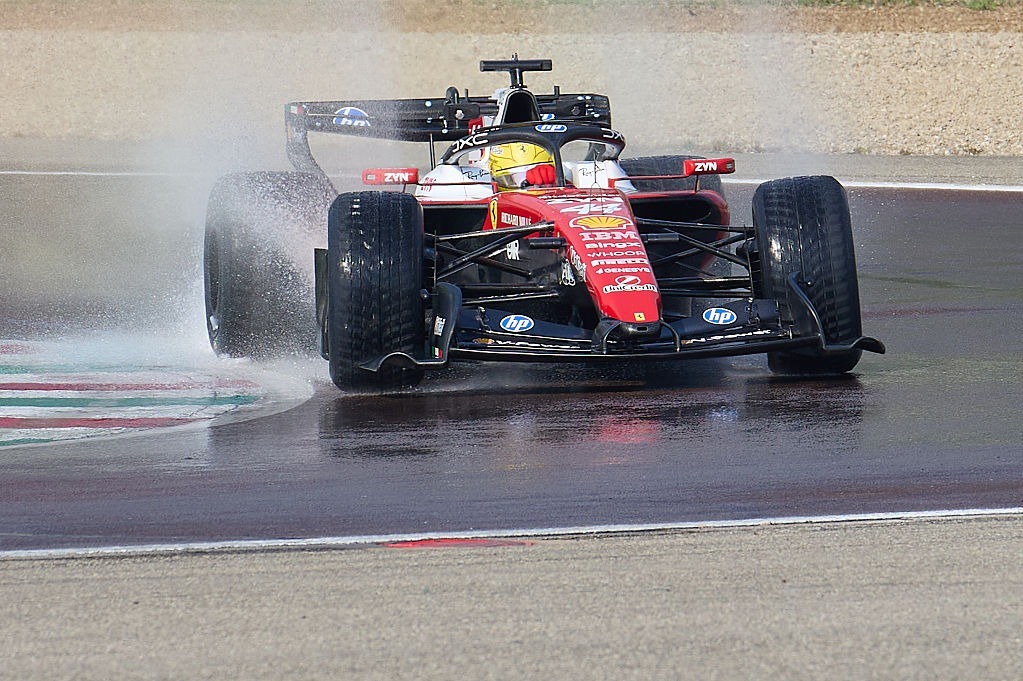
Lewis Hamilton spent two days testing Pirelli's wet tyres at an artificially damped Fiorano in April, but this was aimed at 2027 development.
Photo by: Getty Images
The straightline story
"There are a few things, like the SLM [straightline mode] in the wet only at the front, that I really don't understand why we have that if it doesn't reduce the drag much," said Carlos Sainz.
The principle of allowing only the adjustable front wing flaps to be activated while running in straightline mode in the wet was discussed late last year and evaluated in testing. But, given how the majority of testing was conducted in dry conditions, in Bahrain, its effectiveness remains an unknown factor.
Straightline mode usually involves flaps on both the front and rear wings flattening off to cut drag, the aim being to avoid wasting the limited electrical energy available to the cars over the course of a lap. But there were concerns that allowing both flaps to be defeated in the wet would render the cars dangerously unstable.
It's already well established that the new cars are sketchy in low-grip conditions. And Pierre Gasly described in perhaps too much detail his experiences of driving in the wet when he shook down his Alpine at Silverstone in January.
"It was 30 degrees tyre temperature, wheelspinning in sixth gear," he said.
"After Maggotts, Becketts – underwear change every lap. It was the most extreme I've ever done in my life."
It's understandable, then, that the FIA wishes to avoid exacerbating low-grip conditions by introducing a destabilising influence to the car. But it's clear opinions differ over the effectiveness of partial activation, and there are those who view it as another sticking-plaster solution: why not just bar straightline mode entirely in the wet?
That would be because its effects on the balance of electrical energy are unknown, especially given the new cap of 250 kilowatts per lap in the wet. Cornering speed, electrical harvesting and tyre temperature are interdependent, so if one of these inputs drops it can induce a negative spiral which affects all of them.

Isack Hadjar was one of a handful of drivers who lapped in the wet during the Barcelona 'shakedown week' in January.
Photo by: Getty Images
Tyre temperatures
If it rains on Sunday, this will be the first time the latest generation of intermediate tyres will see action in race conditions, so questions remain about their likely performance and whether the rise in blanket temperatures will be enough.
Pirelli is still trying to develop a full wet tyre which is actually raceable. For the past several seasons its performance envelope has been too far removed from the intermediate, and its lifespan too short. Teams therefore avoid fitting it because by the time the weather is bad enough to warrant going to the full wet, a red flag is imminent.
"I drove the car when we did the shakedown in Silverstone in the wet and definitely it was very tricky," said championship leader Kimi Antonelli.
"Although now with the changes, they clipped the power to 250 kilowatts for the wet and no boost, so that's already a step forward in that regard.
"But I think also another big topic is that we will need to increase tyre blanket [temperatures] for the wet because I think as they are now, probably they will be a bit too low for the conditions.
"Definitely it's going to be very interesting because there's so much unknown in the wet at the moment, especially no one really used the inter tyres, so we don't know how it's going to feel, how much grip there will be, especially with the new regulation. And I think also one thing with this year's cars, it's a bit harder to build temperature with the tyres, so in the wet they might be tricky and that's why we probably would need to increase tyre blanket [temperatures] in order to make it a bit better and a bit easier on that side."
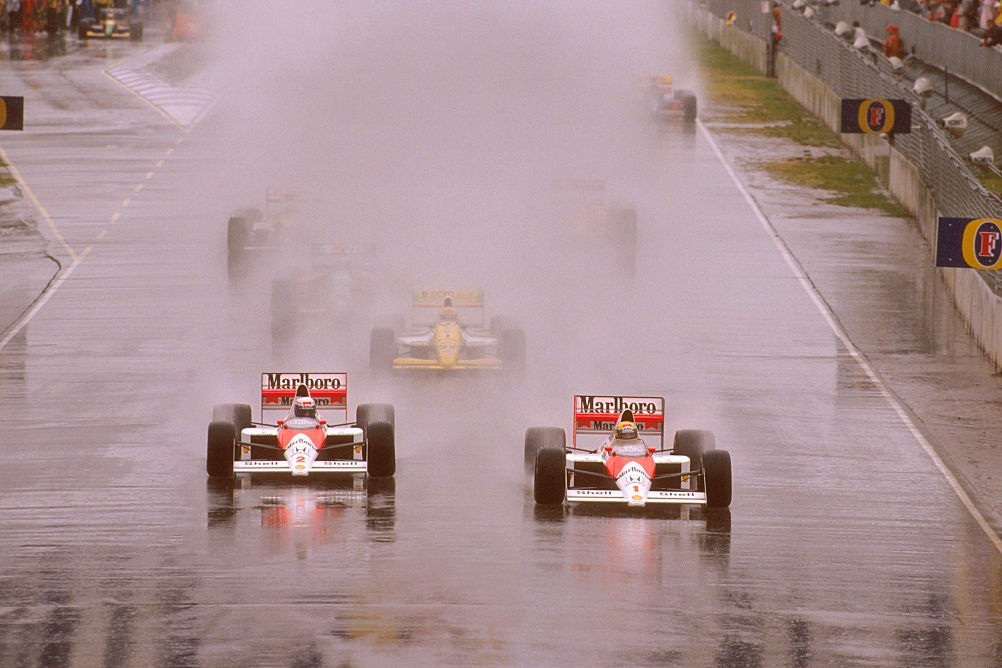
Ayrton Senna leads teammate Alain Prost at the start of the 1989 Australian Grand Prix. Neither would see the finish: Prost withdrew, while Senna smashed into the rear of Martin Brundle's Brabham on lap 13, unsighted by spray. Yes, that is Pierluigi Martini in a Minardi in P3...
Photo by: Getty Images
Closing speeds
A related concern – particularly at the Miami circuit, which tends to accumulate standing water – is the intersection of poor visibility with different closing speeds. This is another area where the electrical deployment has a powerful influence.
"I think the weird thing about these cars in the wet is that you might end up going much faster at the end of the straight in wet conditions than you do in the dry conditions," said Charles Leclerc.
"Because you don't have that engine cut [the mandatory tapering or "ramp down"] because the batteries are a lot more... you're not using as much energy. So you might have less cut in the straights and arrive faster at the end of the straight.
"You can find yourself in tricky situations, especially if drivers are driving with different power unit strategies. You've got very little visibility, so that's the trickiness of these rules and something that we need to get to understand a way out of that.
"Because in the wet we are really passengers. In the rain it's not about being brave or not. It's you stay flat out and you hope that no cars in front of you are slower than you – and you just assume they are on the same speed as you."
That didn't work out well for Senna in Adelaide, did it?
Thunderstruck
The FIA's planning for the race weekend also has to take into account local health and safety regulations for outdoor events when thunderstorms are forecast. These direct people to take shelter indoors when thunder and/or lightning is observed.
Thunderstorms were also forecast for race day last year, so the teams have already been well briefed on procedures should these force the start to be delayed or the race to be stopped while in progress. On the day these circumstances did not transpire – but as the old saying goes, fail to prepare, prepare to fail…


How F1 let a golden opportunity slip at Sepang

How the Bahrain GP in Malaysia exposed Red Bull’s hidden resurgence

How Verstappen’s two subtly different laps beat Hamilton in Bahrain GP in Malaysia qualifying

Why Mercedes' upgrade is still a "big question mark"

F1 Bahrain GP in Malaysia: Leclerc leads second practice from Hadjar

LIVE: F1 Bahrain GP in Malaysia updates - FP3

F1 Bahrain GP in Malaysia: Verstappen dominates for pole from Hamilton

LIVE: F1 Bahrain GP in Malaysia - Verstappen wins from Antonelli, Russell DNFs after late engine failure

No denying it now – the one reason why F1’s ‘horrible’ start in Malaysia could be a good thing

Inside Alonso's decision to contest the 2027 Dakar Rally with Aston Martin

The greatest F1 campaigns with no wins

MotoGP to introduce sprint qualifying amid 2027 format changes
Subscribe and access Autosport.com with your ad-blocker.
From Formula 1 to MotoGP we report straight from the paddock because we love our sport, just like you. In order to keep delivering our expert journalism, our website uses advertising. Still, we want to give you the opportunity to enjoy an ad-free and tracker-free website and to continue using your adblocker.


Top Comments