


Why OEM involvement has caused vast problems for F1 and the FIA
Both F1 and the FIA have been on the defensive during the enforced April break, struggling to justify the needless complexities of a technical formula which has divided the fanbase to no good end

The venerable board game Diplomacy requires no dice. Achieving a position of pan-European dominance requires those at the table to work with each other – and then choose the optimal moment to stab their former allies in the back.
Diplomacy's underlying mechanics are brutally simple, the rulebook consequently succinct. Conquest is determined by pure weight of army/navy units rather than the pseudorandom caprice of a die roll, hence the requirement for players to covertly work with and against one another, and the inevitability of betrayal.
It is not, therefore, a game for milquetoasts.
Formula 1's rulebook, by contrast, is positively Byzantine, but this is not entirely the fault of those charged with making and enforcing the rules. There are too many players involved – and the inevitable result of trying to please too many people is a mess of compromises which pleases very few.
FIA single-seater technical director Nikolas Tombazis held a roundtable call for select media including Autosport this week, ahead of the rule changes set to be implemented (pending ratification by the world motor sport council) for the Miami Grand Prix. During this he echoed the sentiments of F1 CEO Stefano Domenicali in an exclusive interview with Autosport two weeks ago.

Whether or not the similarities in phrasing were an unintended consequence of trying to present a united front with the commercial rights holder, it represented a delicate diplomatic dance around the subject of the car manufacturers involved in F1 having too much say in policy. F1's sporting and financial ecosystem requires them to be engaged, but their priorities change faster than F1's regulatory framework can keep up.

Audi was one manufacturer lured in by the 50/50 power split, though it now says electrification is less important.
Photo by: Nurphoto/Getty Images
The many peculiarities and controversies of the 2026 season so far all stem from a decision made in the summer of 2022 to embrace a near-50/50 mix of electrical power to internal combustion engine output. In the intervening years Tombazis and his team have had the thankless task of trying to make the unworkable workable.
"It is true the political landscape has changed and back when we discussed the current regulations, the automotive companies who were very involved told us that they're never going to make another [new] internal combustion engine again," he said.
"They were going to phase out and by whatever year they were going to be fully electrical. Obviously this hasn't happened. That's not to underestimate the importance of electrification globally but it didn't happen as much as said."
In a subsequent call with Italian media, Tombazis went a little further: "There was strong direction from several stakeholders towards much more electric component and in my opinion, perhaps this potential of electrification was overestimated, pushing towards a 50/50 split."
Being an engineer, Tombazis is a fascinating interviewee because of the depth, detail and nuance he brings. But it was inevitable that a quote such as this would be extracted and then, shorn of context, touted around social media as some sort of smoking gun.
It's well established that when the 50/50 principle was agreed in the summer of 2022, electrification in the automotive industry was seen as inevitable. In the interim, for various reasons, it has become less so.

The direction of the automotive industry at the time dictated the direction of the F1 2026 ruleset
Photo by: Alpine
The challenge for the rulemakers has been to mitigate the inherent disadvantages of requiring that much energy to be charged and discharged every lap. From the outset, the prospect of cars running out of charge at inconvenient points, and the safety implications of huge disparities in speeds, has set the direction of travel towards the present scenario in which the drivers have less influence over car performance than they should.
In the background, the power unit manufacturers have continued to play a vexatious and disruptive role in the development of the 2026 regulations, although this is not a sentiment either F1 or the FIA is going to express too loudly. But it is known that various proposals about material choices which could be made in the internal combustion engines, for instance, to cut weight and cost, were ultimately vetoed by the manufacturers and their allied teams.
Here we get into the problem of competitors having a voice in the shaping of the rules, because the common good can be neglected in favour of establishing or guarding competitive advantage. This came across, albeit obliquely, in several areas of the roundtable discussion attended by Autosport.

"It's true that when you have a percentage of electrical to internal combustion energy and power of that ratio, that the whole energy management becomes more challenging," said Tombazis.
"We knew that from day one of these regulations and I think we've worked to mitigate a lot of these compromises. The reason we feel one of the reasons it hasn't been right from the start is that cars are going a bit faster, have found a bit more downforce than we were expecting and therefore the energy recovered during braking is a bit lower than it would normally be.
"So we have a bit more of a challenge than we would have liked to have. We did propose the reduction of [electrical] power about a year ago and it was rejected. The point there was that we were going to wait for the first few races, which is what we did now."
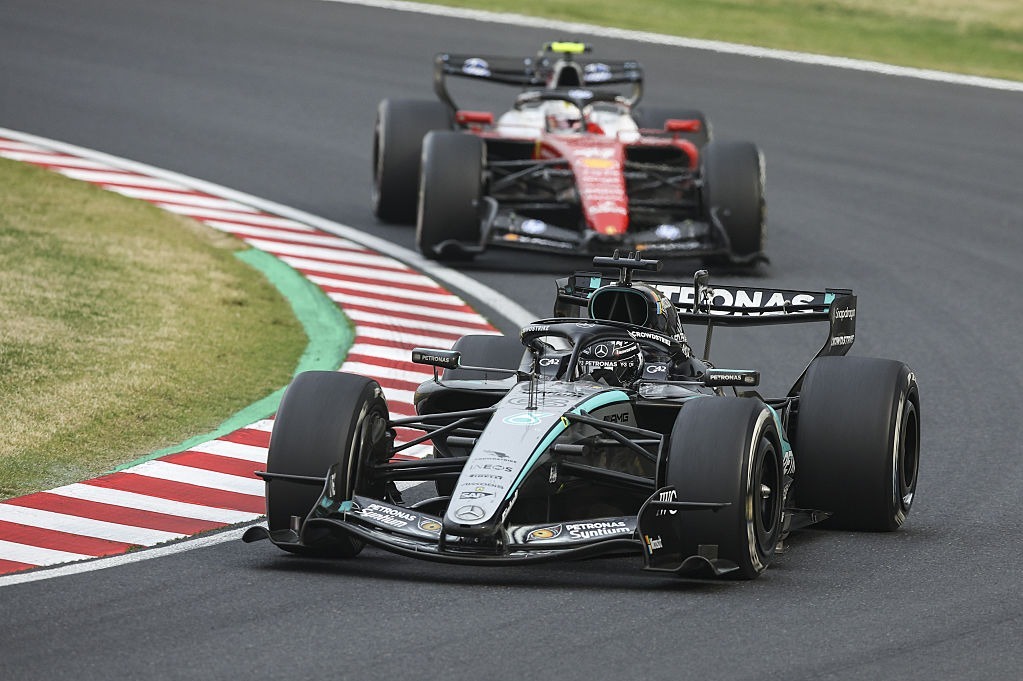
As a team owner, and engine supplier to three other teams, Mercedes enjoys considerable influence in F1.
Photo by: Getty Images
From this we can infer that at least some of the reasons for the regulations in effect still being in beta spring from continued manufacturer intransigence. Guarding competitive advantage again.
To enabled manufacturers struggling for competitiveness to catch up, from this season F1 has adopted the Additional Development and Upgrade Opportunities (ADUO) framework. This, predictably, has become a hotbed of intrigue as various power unit suppliers brief against each other.
Essentially ADUO grants breaks under the engine cost cap for additional research and development, and a leeway for upgrades, depending on the internal combustion engine's power deficit to the best on the grid. The measurements and upgrade windows are scheduled for specific intervals of the year.
And – surprise, surprise – this too appears to have been a process akin to herding cats, with much quibbling about what lies within and without the scope of the measurements. At least with cats one can rattle the treat packet to attract attention and divert the conversation from back pressure and compressor sizes.
"The fact that engine power is not just a single number has obviously been known," said Tombazis. "In the spring of 2025 we had quite long discussions with them, we offered whether we wanted to consider certain things like the turbo pressures, or the turbo diameters, or the plenum operating temperature and such. The universal position by the PU manufacturers back then was that we should keep it simple.
"So the fact that it is the current horsepower measurement of the internal combustion engine has been appreciated right from the start. I would personally be quite open to the idea of complicating the parameters a bit, but that discussion was had more than a year ago and it was quite clear what it concluded."
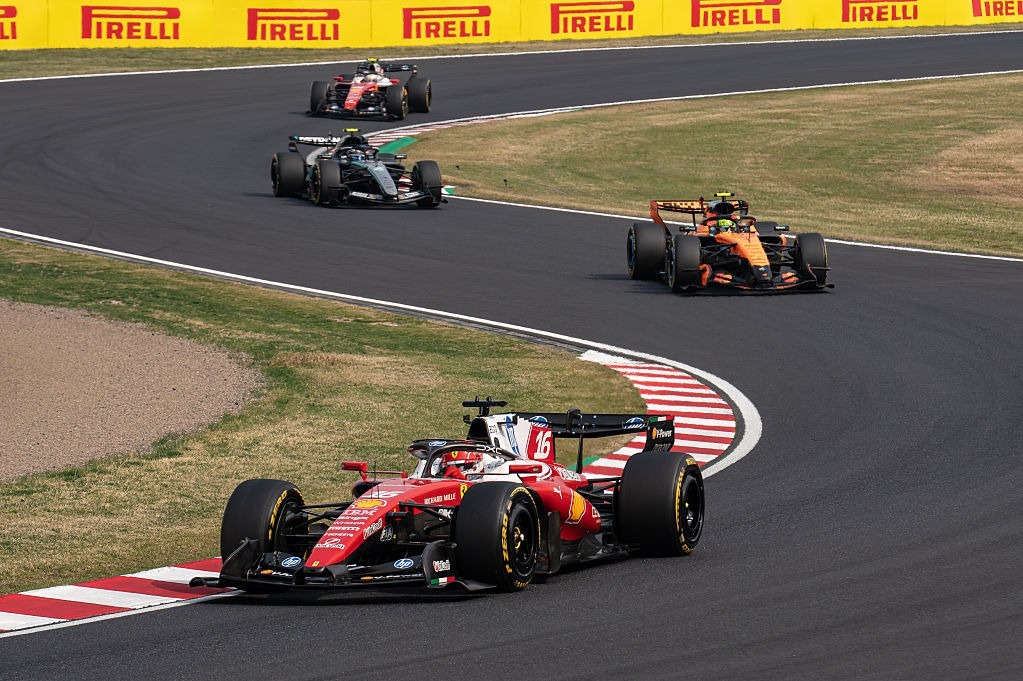
In Japan, Norris overtook Hamilton unexpectedly because, in backing off the throttle to avoid hitting Hamilton at 130R, Norris inadvertently reset a throttle-triggered engine power mode.
Photo by: Getty Images
Perhaps this is a rare example of manufacturers doing the audience a favour by rejecting complication.
In all other respects, the excess complexity of the current technical regime stems back to the basic concept. To fulfil the 50/50 split, there are too many rules: for instance, the hidden division of tracks into ‘zones' where various proportions of electrical power can and cannot be applied.
There are performance reasons for this, since teams and drivers rightly want to ensure the limited amount of electrical augmentation comes where it is most useful. But a more pressing reason is safety, and the mitigation of the risks of cars running out of deployment suddenly at high speed.
The solutions Tombazis and his team have arrived at to perform these mitigations are clever – but as many of the participants, including the drivers, have pointed out, they are sticking-plaster solutions for a flawed basic concept. And in limiting the drivers' opportunities to make a difference, the formula represents a failure to understand the attraction of motor racing.
The fastest cars on the planet are only part of the draw. Seeing the greatest drivers in the world demonstrate their artistry is what engages the audience.
So much of that is now lost in the morass of varying deployment and energy modes. When Autosport draws up its post-race driver ratings, clearly there are those readers who digest these through the optics of fan allegiance and are therefore prone to disagree. But we do genuinely attempt to rigorously analyse driver performance over the course of a weekend.

Driver input is arguably less crucial than ever
Photo by: Mark Thompson / Getty Images
What the current regulations have done is muddle, conceal or even flout the driver's input. Scrutinising onboards and telemetry data used to provide a very clear picture of individual skill and performance; now this is obscured by the intrusion of deployment and the software which metes it out. Has this driver left laptime on the table at this particular corner, or did he accidentally trigger a reset of power-limited mode in correcting a slide earlier on, and is now paying for that with lack of electrical punch?
Frankly it's enough to make you lose the will to live – or, if not that, at least be on the cusp of entering will-to-live-limited-pending mode.
These flaws are baked into the current regulations and they are only going to become more complicated rather than less. What's needed, as we contemplate the next set of regulations, is a less-is-more approach.
As with Diplomacy, a simpler game mechanic makes the competition purer. F1 fans do not want to see race outcomes dictated by abstruse algorithms and software witchcraft while the driver plays the role of frustrated passenger. They come for spectacle, skill, and the killer instinct.
That should be the starting point of the next rulebook. Rather than pick an arbitrary ratio of electrical power, focus on taking weight out of the cars and cost and complication out of the engines.
In doing so it would make the category as a whole less vulnerable to the whims of manufacturers who, as businesses, bend like reeds blown by the winds of market forces. They have had too much influence for too long.
The next formula needs to be better. How about giving the rulemakers a chance to make that happen?


Why Mercedes is still quicker than McLaren

Why "dangerous" Hamilton-Lawson incident in Azerbaijan GP practice hasn't led to change

Will the "big swing" Williams F1 car upgrade be a hit or a miss?

Russell's theory on his big hope for F1 2027 – and Antonelli's reply

What’s behind the delay in cancelling the Qatar and Abu Dhabi GPs?

What were Leclerc's "other opportunities" before signing new Ferrari deal?

Italy’s next F1 world champion?

Why Norris doesn’t buy Russell’s driving style theory

BTCC Silverstone: Ingram victorious in wet finale

British GT Brands Hatch: Orange/Clutton take shock title as Collard spins

BTCC Silverstone: Record-breaker Sutton wins fifth title in style

Alpine condemns abuse again following Colapinto's Azerbaijan GP crash
Subscribe and access Autosport.com with your ad-blocker.
From Formula 1 to MotoGP we report straight from the paddock because we love our sport, just like you. In order to keep delivering our expert journalism, our website uses advertising. Still, we want to give you the opportunity to enjoy an ad-free and tracker-free website and to continue using your adblocker.


Top Comments