


The flaw Cadillac must fix to reach F1's midfield
F1's newest team is closing in on the midfield in qualifying, but tyre degradation is keeping it from challenging for points finishes

Had Sergio Perez not forgotten how to park during the Monaco Grand Prix's start and later restart, Cadillac could well have opened its Formula 1 points account by now. Sure, circumstances were such that Perez relied on others' misfortune to be classified 10th in the first place, but it would have been a deserved point for the newcomer team's efforts thus far.
Easy come, easy go.
Arriving in F1 with an all-new team is no easy feat in the current climate, especially when facing up against teams with tried-and-tested infrastructure. The last time a team had entered F1 having started from scratch was when Haas joined the fray in 2016, but the team benefitted considerably from using Ferrari's pre-existing facilities and in using as many shareware components as permissible within the regulations. Cadillac has not enjoyed such luxuries during its arrival.
Still, the team had at least prepared for the season as much as it could: race-day operations through virtual race weekends at its Silverstone base, and in putting together a test with an old Ferrari to ensure its trackside crew could gel together. It spared Cadillac from having to endure the awkward getting-to-know-you stage while in the thick of the Barcelona shakedown, and meant that it could put some miles on the clock of its first-ever F1 car.
What was impressive is that Cadillac managed to run its new car before that in a shakedown at Silverstone, before a handful of the established runners had managed to get their 2026-spec machines onto the track. Furthermore, the team has kept a steady stream of developments working through the pipeline, aiming to demonstrate that it can keep pace with the other F1 teams on the grid. Per the submissions available via the FIA, Cadillac has declared an update at each race this year.
Barcelona was the smallest package of the seven thus far, as the team retained the little winglet in the straightline mode actuator bounding box, adding two Mercedes-inspired winglets on the outer trailing edge of the rear wing. The early part of the year had been dedicated to more wholesale updates, particularly around the front wing and floor as the team sought to bolt downforce onto its chassis.
In comparing the team's gains through the opening seven races, Cadillac has uncovered more than a second on single-lap pace; Perez was 3.098s off George Russell in Q1 for the Australian Grand Prix, then 1.920s away from Lewis Hamilton's Barcelona Q1 pace. As a percentage, Perez's best effort was 105.205% away from Russell's best lap of the weekend in Australia, and 103.838% in equivalent circumstances versus Russell in the Barcelona-Catalunya Grand Prix. The gain of around 1.4% is impressive in just seven races, although it is true that the first second in lap time is the easiest to find.

Sergio Perez, Cadillac Racing
Photo by: Sam Bagnall / Sutton Images via Getty Images
This is especially impressive when we consider the characteristics of Barcelona, one that tends to set the cars in their competitive order as it rewards efficient downforce, front-end balance and engine power. Both Cadillacs were ahead of the Aston Martins with over a second's margin in hand.
It's race-lap degradation where Cadillac struggles, and Barcelona's humid and high-energy encounter exposed this. Comparing his race pace to that of Carlos Sainz, who ran with a very similar tyre strategy before the two diverged when Perez switched to the mediums for his final stint, it's plain to see how the Williams – still bearing its own flaws in terms of weight and downforce – is able to maintain a more consistent spread over its laps.
Perez framed it as such: "We had a lot of degradation; from lap 15 onwards we had a very significant drop-off with the tyres, which doesn't help us much. But we have a good idea of how to fix it, we can see it clearly in the data, and I think it will just take us a little bit of time to get it sorted out."
Over the opening stint on softs, Perez is missing an average of 0.652s per lap versus Sainz before making his stop. This is pretty much in line with the 0.664s difference in pace during Q1. Perez's short stint (12 laps before stopping) countered the emergence of degradation after the 15th lap, having been a smidgen less than 0.6s down on Sainz on his final two laps before stopping.
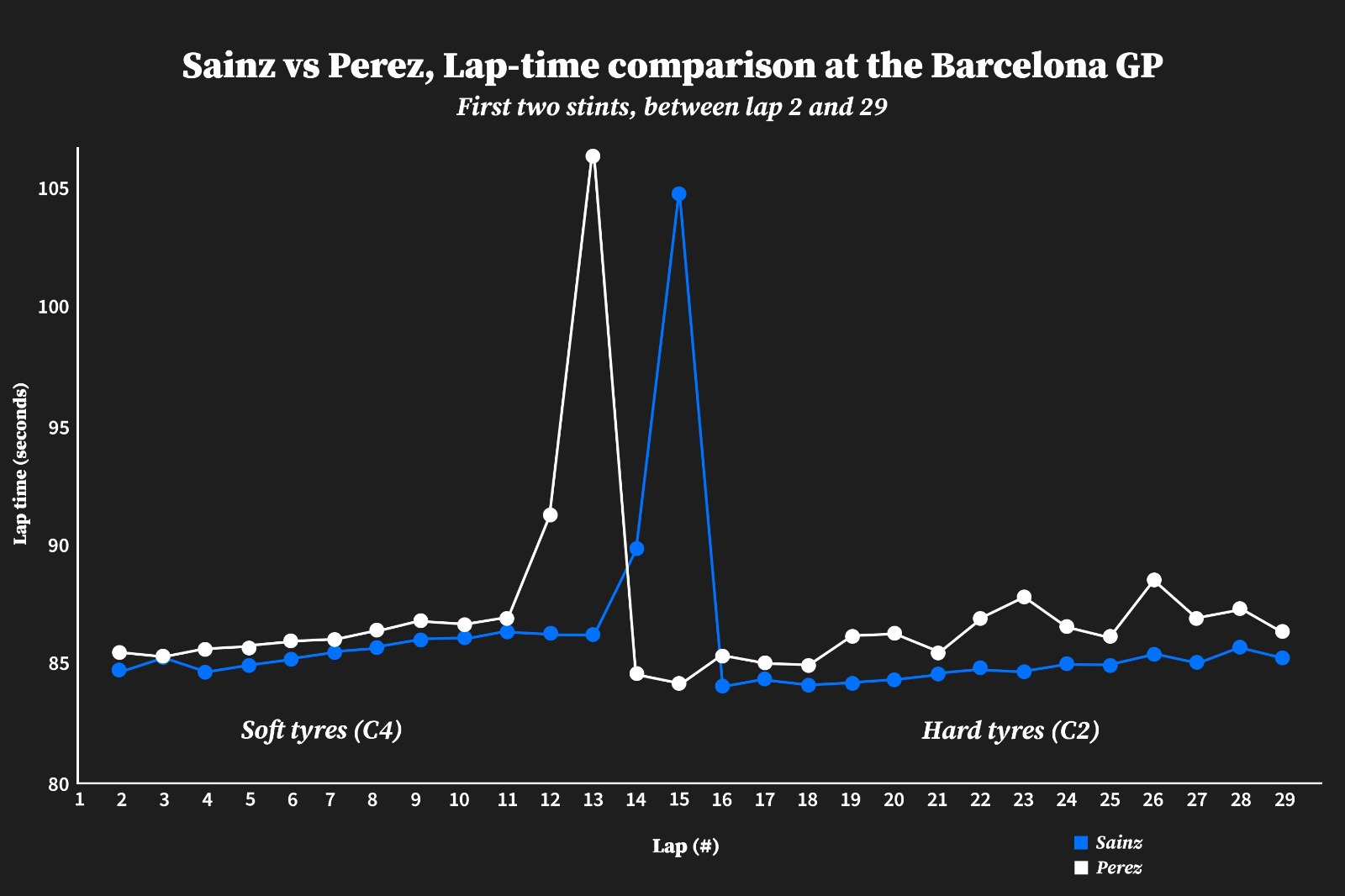
It's more visible on the hard compound, although Perez does complete a longer stint than Sainz as Williams was trying to angle for a way into the top 10. Per lap on the hards, Perez is a lot further down on Sainz; being lapped accounts for a bit of that time, but there's only one lap where the Cadillac driver is within the previous stint's ballpark across his stint. He's managing the hard tyre, and it's costing him about a second a lap to the Williams, not 0.6s.
Degradation has been an issue throughout the year so far for Cadillac, something that has contributed to its greater arrears in race pace versus that seen in qualifying. And that's something that will keep it out of the points for now, unless there is a significant quantity of retirements in a race, until these issues are understood.
There are two mechanisms through the race that contribute to tyre degradation: thermal degradation and physical wear. Under thermal degradation, the tyres overheat and their chemical properties change, reducing the adhesion that the rubber can provide.
This can be somewhat mitigated with set-up to reduce the amount that the tyres heat up, but much of this is based on the intrinsic kinematic properties of the car – in other words, the relationship between the chassis, the suspension, and the tyre. The loading on the car which is transferred through the suspension cannot be easily changed without a significant redesign, but small steps can be made with how the suspension is operated.
One available avenue, however, is in the design of the wheel rims and brake cooling system. Teams try to optimise the airflow solutions through the rim and around the brakes to reduce the heat-sink effect in this area, shielding the tyre away from a build-up of hot air. Given that Cadillac is a new entrant, it would be reasonable to assume that it is underdeveloped in this area, particularly as its focus has been on adding downforce to the car.

Valtteri Bottas, Cadillac Racing
Photo by: Simon Galloway / LAT Images via Getty Images
Adding downforce helps to mitigate the physical wear of the tyre, as it prevents the car from sliding too much in the corners. In that instance, the tyre surface not only gets a build-up of heat but abrades against the race course. Perez's suggestion that the team knows how to fix it suggests that this something that can largely be cured with further updates, presumably by increasing rear-end downforce or through further research into keeping the brakes and wheel rims cool.
Cadillac ideally needs to find another second in pure lap time to be in contention to score points on merit this year, plus whatever methods it needs to reduce degradation to ensure that the team can remain in the fight during the longer stints. There's also the question of reliability as Valtteri Bottas has suffered in the past two races, while Sergio Perez was subject to his right-front suspension giving up on him in Montreal. While the car has proven capable of reaching the end on multiple occasions, it's not surprising that a new outfit is uncovering teething problems.
Regardless, the team has started impressively well given the hurdles placed in its path to get to F1...and it's proved that it doesn't need F1's most revered designer to keep it off the back of the grid.


The one aspect of the 2026 US GP that should be a blueprint for F1 2027

A strategic masterclass: How Antonelli put himself on the cusp of F1 title at the US GP

Leclerc and Hamilton's differing theories behind Ferrari's Austin qualifying disappointment

What we learned from Friday practice at the 2026 United States GP

The reasons behind Ferrari's US GP upgrades

Mission control: Inside the FIA and F1's remote operations centre

FIA expects F1 races in Qatar and Abu Dhabi to run as planned

Why Piastri has struggled to show his best with this year's McLaren MCL40

Morrow edges Grant as older Formula Fords entertain in Festival support contests

Is MotoGP’s title fight over after the Australian GP swing?

The one aspect of the 2026 US GP that should be a blueprint for F1 2027

Red Bull explains why Verstappen and Hadjar's 'silly' problems won't all be fixed in 2026
Subscribe and access Autosport.com with your ad-blocker.
From Formula 1 to MotoGP we report straight from the paddock because we love our sport, just like you. In order to keep delivering our expert journalism, our website uses advertising. Still, we want to give you the opportunity to enjoy an ad-free and tracker-free website and to continue using your adblocker.


Top Comments