


The fine lines that denied "faster" Antonelli in Canadian GP qualifying
Did a rejected downshift for Kimi Antonelli account for George Russell claiming pole position by 0.068s in Montreal? Perhaps – but Russell’s different approach to tyre management is the more plausible reason

How to unpack a difference between team-mates which amounts to less than the average blink of the eye? 0.068s separated George Russell and Kimi Antonelli in final qualifying for the Canadian Grand Prix – a fine margin but one whose significance can be measured in the intensity of the whoop of joy Russell sent across the radio waves after realising he had annexed pole position.
Ultimately it came down to the often-dreary subject of tyre preparation, since Antonelli did two prep laps and a push lap on his crucial second run, while Russell essayed two push laps separated by one of lower tempo. When the margins are this fine, it’s easy to reach for an explanation which suits your agenda; for the legion of ex-drivers now earning a coin as expert analysts on TV, that tends to lead to a hot take.
Ralf Schumacher on Sky Germany was one such: “Kimi was faster. And for him to get that close to George with just one lap – that was a very strong performance.”
Beneath this apparently contradictory statement – if Antonelli was faster, he’d have put the car on pole – there is an interesting proposition. Mercedes boss Toto Wolff was travelling in a similar direction but was more nuanced in his phrasing.
“I don’t think we gave them a top car for qualifying today,” he said after the session. “You could see that we only managed to put it together in the final phase. We didn’t have balance.
“George rescued it for himself by doing those two laps to create the balance and get more rear temperature. And Kimi had a missed downshift. That means on the fast lap one gear didn’t engage, and that was exactly where he lost the difference.”

Russell mastering tyre temperature control during qualifying set up his late charge to pole
Photo by: Sam Bagnall / Sutton Images via Getty Images
Tyre temperatures, and the tricky task of balancing them across the front and rear axle, very much dictated the mood of all the drivers in the post-qualifying media ‘pen’. For those who had contrived to switch on both axles at the optimal moment, the warm glow of a job successfully accomplished; those who hadn’t located the sweet spot were obvious by the hangdog gloom that accompanied them.
The Canadian Grand Prix is a month earlier this year, and Montreal presents a complicated weather picture in late spring: of all the venues on the calendar this season, this is the one with the biggest difference in high and low ambient temperatures through the day. Add in a low-grip surface, and a track layout where most of the corners are of relatively short duration, and you have the perfect conditions for a negative spiral.
The low grip makes it difficult to put temperature through the bulk of the tyre, so the driver feels unable to push. When they do, they tend to slide, generating a temporary spike in surface temperature without that transferring to the core – and then, on the straights, the front and rear shed temperature at different rates.
Antonelli had the upper hand in sector 1
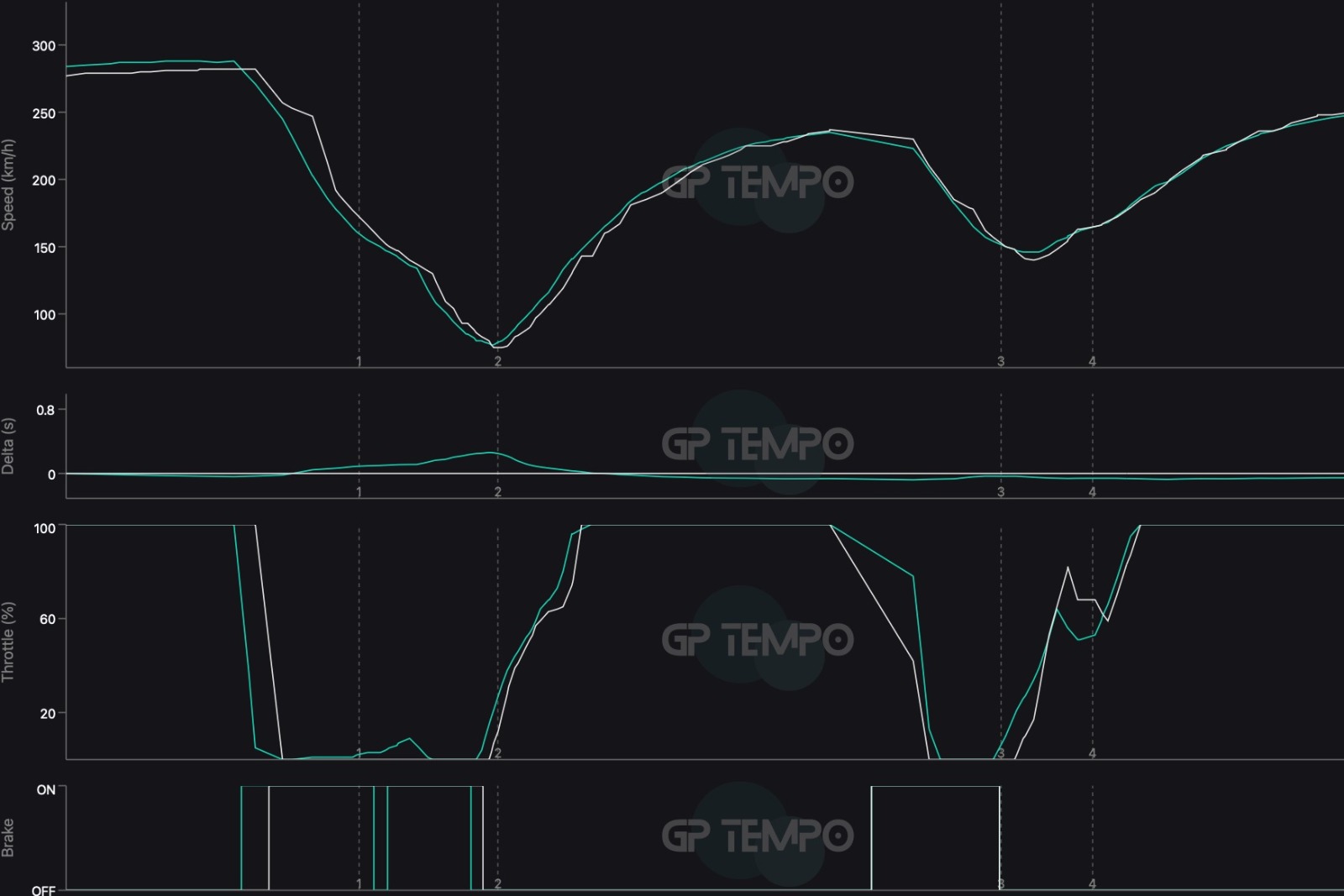
Our telemetry analysis of the Mercedes drivers’ fastest laps shows some interesting contrasts in style. Though you might consider Antonelli (pale blue trace) the last of the late brakers, actually Russell (white trace) was slightly later on the brakes into Turn 1.
The graphs showing the time delta between two drivers often reach unnatural-looking peaks in corners such as this, based on the transient speed offset of one of them braking later. Russell gained something in the order of a tenth of a second on his team-mate here, only for Antonelli to overturn that with a cleaner exit from Turn 2, where being decisively earlier on the throttle converted into a speed advantage on the straight that followed.
Antonelli then got off the throttle later and less sharply into the quick chicane at Turn 3, though the two Mercedes drivers’ braking phases were nearly identical here. It was enough for Antonelli to sustain his advantage of a little under a tenth of a second and netted him a purple sector.
Russell took the advantage in sector 2
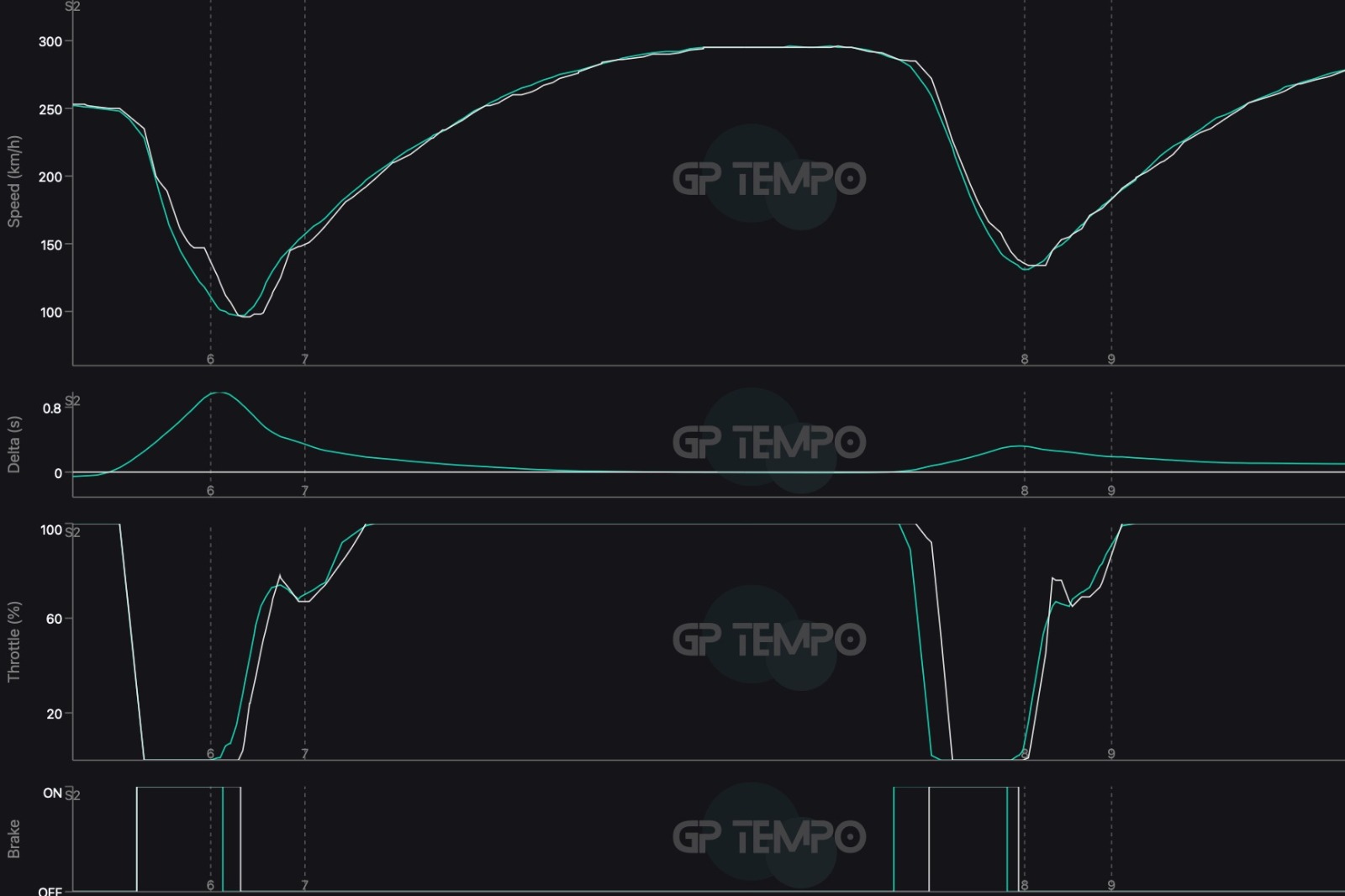
Turn 6 is where the balance shifted, if only by an order of milliseconds. This is likely the location of the missed downshift – or, more accurately, a rejected downshift where the selection was delayed by a tenth or so in the braking phase. It’s difficult to be precise without the more granular detail available to teams, but our data indicates a different journey down through the gears from sixth to second, with Antonelli spending longer in fifth.
Both drivers hit the brakes at the same point but Russell was able to carry more speed through this sharper turn, though again without access to more granular data it’s impossible to decisively separate the effect of Russell’s superior tyre grip versus the discombobulation wrought by a fractionally delayed downshift. What we can see is that Antonelli got off the brakes and on the throttle slightly earlier, limiting the damage to something in the order of six hundredths once they were at full acceleration (with electrical boost) out of Turn 7.
At Turn 8, where Antonelli had his frustration-fuelled off (with the assistance of a bump in the surface) on lap six of the sprint race, he was much more circumspect than Russell, blending out of the throttle and onto the brakes noticeably earlier in the data and producing another gentle spike in the delta graph. He was earlier off the brakes, too, but Russell had been able to carry more apex speed through a corner which is one of F1’s great thread-the-needle exercises – albeit one with a more forgiving outer boundary of grass rather than the ‘Wall of Champions’ at the end of the lap.
That left Russell a tenth of a second up and clocking up a purple sector as he entered the final phase of the lap.
Antonelli hits back – but not enough
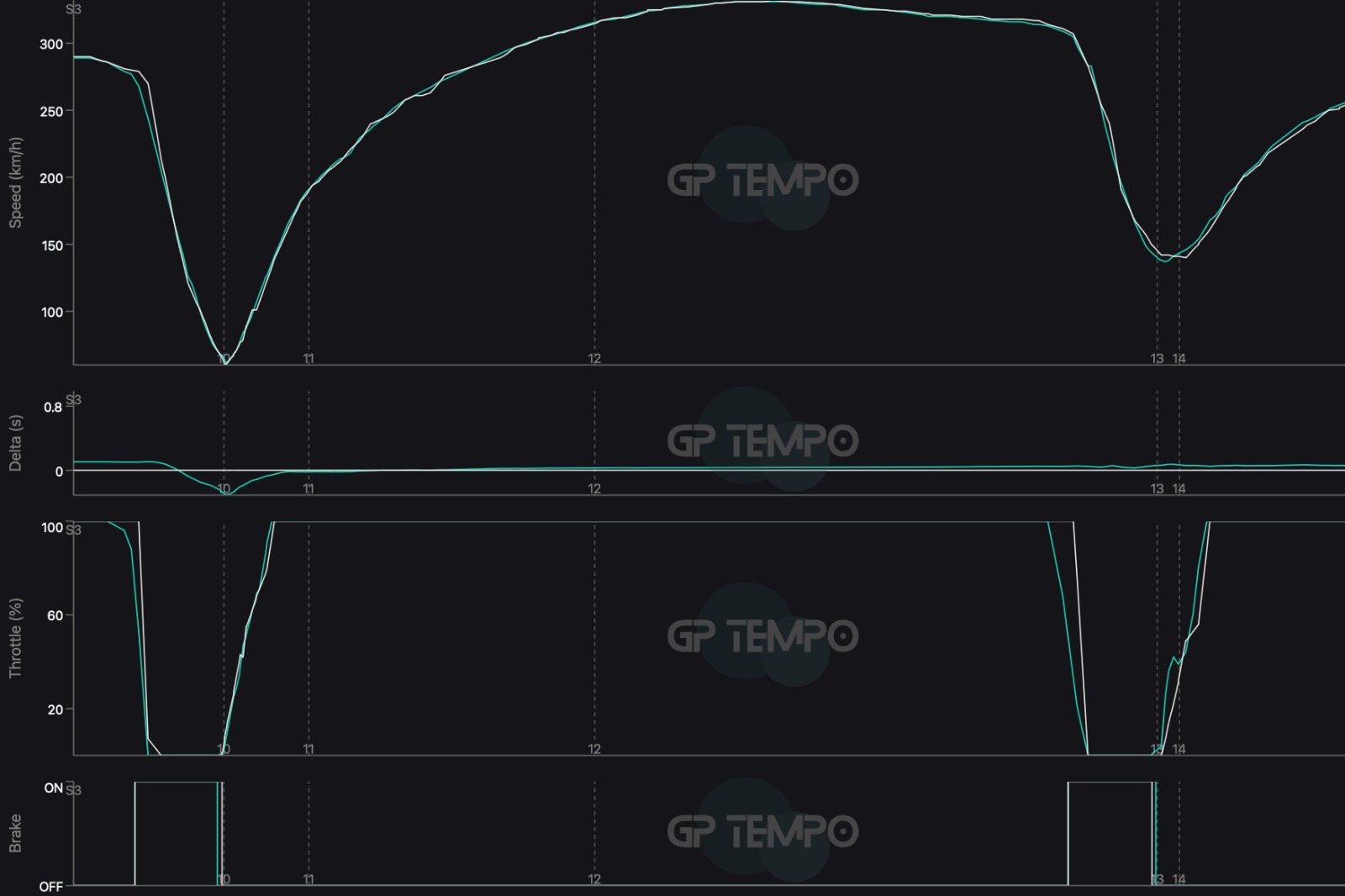
Sector 3 at Montreal only has two real corners, a hairpin and a chicane, but they are rightly infamous. At the Turn 10 hairpin Antonelli blended out of the throttle slightly more gradually for a neater entry trajectory in which he sacrificed a fraction of speed at turn-in for a softer and faster path through the apex, successfully nibbling six hundredths or so off Russell, who was later and sharper off the throttle even though he braked at the same point.
Their throttle and speed profiles are almost identical out of the hairpin and along the straight that follows. By this point Russell had just five hundredths in hand over his teammate, and he went on to claim almost another two in the final chicane at Turn 13/14 – again, braking at the same point as his team-mate, but releasing the throttle much later and more steeply to rotate the car faster at entry.
“That last lap came from nowhere,” said Russell. “And it was just such a great feeling when it was such a challenging session and you need to put it all together on the last lap to throw yourself up the leaderboard – it was epic. We weren’t as clearly ahead of everyone else as we were yesterday, so it was definitely a challenge. I managed to redial my driving for that last lap and put it together.”
Mercedes had made the task facing its drivers that much more difficult by adopting set-up changes to bring the car into a theoretically better window for the colder, wetter conditions forecast for race day. “It may have hurt us a little bit for now,” said Russell. “It took the car out of sync a little bit.”
Earlier in Q3, Russell had bailed out of a push lap after a snap of oversteer at Turn 6, and immediately pitted for a fresh set of tyres. Being out of sync with his rivals gave him the luxury of that slightly different approach to his final run – but with no ‘banker’ lap on the board, it was a high-stakes effort.
The capricious effects of tyre temperature were amply illustrated by Isack Hadjar, who topped Q2, only to feel hard done by with seventh in Q3 – only finding an extra four hundredths where Russell picked up almost half a second.
Whether Antonelli would have been faster overall if his tyres were closer to optimal is a matter of conjecture, but he was certainly quicker in two of the three sectors. And he certainly believes he had it in him.
“Of course there was still a little bit left on the table, but George did a great lap,” Antonelli said afterwards. It was a subtly backhanded morsel of praise, perhaps indicative of the frisson in the air between the two team-mates after the events of the sprint race.

Full focus will be on how Russell and Antonelli engage in the grand prix after their clash in the sprint
Photo by: Mark Thompson / Getty Images


'Senior moment' or breakdown of trust? The implications of Hamilton's Singapore GP meltdown

Why Verstappen's dominance left rivals scrabbling for alternatives in Singapore

A "better job" or more engine power? Verstappen's Singapore pole unpicked

FIA reveals "human error" caused latest software glitch in Singapore sprint qualifying

F1 Singapore GP live commentary and updates - Verstappen takes sprint pole

F1 Singapore GP live commentary and updates - Verstappen wins sprint while McLarens collide

F1 Singapore GP live commentary and updates - Verstappen on pole

LIVE: F1 Singapore GP - Verstappen dominates to victory from Leclerc, nightmare for Hamilton

WEC Barcelona: Toyota scores dominant 1-2 to clinch manufacturers’ title

When Can-Am made its controversial comeback

Mercedes explains why its upgrade made its F1 car harder to drive

How levelling the playing field isn’t antithetical to the principles of F1
Subscribe and access Autosport.com with your ad-blocker.
From Formula 1 to MotoGP we report straight from the paddock because we love our sport, just like you. In order to keep delivering our expert journalism, our website uses advertising. Still, we want to give you the opportunity to enjoy an ad-free and tracker-free website and to continue using your adblocker.


Top Comments