


The fight to cling on to an F1 calendar place
There will be casualties in Formula 1's calendar revamp, and five grands prix with huge history are battling to keep their places on the schedule for 2020 as Zandvoort and Hanoi arrive. Only three will make it

The confirmation of the return of the Dutch Grand Prix in 2020, following on from last November's announcement of a new race in Vietnam, means two existing Formula 1 events will be dropped next season.
We know that because F1 CEO Chase Carey is adamant that we will still have a 21-race calendar in 2020, with any possible expansion beyond that number postponed for at least another year.
The focus is now on which two of Mexico, Britain, Italy, Germany and Spain - the five races whose contracts happen to expire this year - will not be retained next season.
Carey made F1's position on the calendar clear over the Barcelona weekend.
"We've not finalised the number of races in 2020," he said. "But we currently expect it to be 21, the same as 2019. Obviously the maths means that we will not be able to renew all our current races.
"We clearly have demand for more than 21 races in 2020, and do expect that number of races in a year will increased slightly after 2020.
"However, we want to make sure that we're maximising the opportunities for the sport and fans, and not rush to decisions."
This is an unprecedented situation. Of course, races were always coming and going during the Bernie Ecclestone era - among the more recent departures were Sepang (last race 2017), Delhi (2013), Yeongam (2013), Nurburgring (2013), Valencia (2012, pictured below), Istanbul (2011), Fuji (2008) and Indianapolis (2007).

But events that left the calendar invariably did so voluntarily, because the promoter had lost their shirt and knew that ploughing on would be financial suicide, or perhaps in the wake of an election a new-broom local or central government did not want to continue to back an F1 race that had hitherto been subsidised.
Venues were sometimes so desperate to cut their losses that they begged Ecclestone to be allowed to walk away from contracts that still had several years to run.
As there was always a new venue coming along that kept the numbers up, Bernie cancelled ongoing deals on more than one occasion - he knew that he could fill any missing slots. One in, one out.
This time around it's different. The five venues that are going out of contract are all still keen to stay on the 2020 calendar - if suitable commercial arrangements can be agreed. In effect they are being pitched against each other in a fight for the three spots.
Two are going to be disappointed, and they will both be 'classic' races with a long history. All four of the European events are races that have supported F1 for decades, and while Mexico only returned to the calendar in 2015 after a lengthy absence, it was first used for a world championship event in 1963 (pictured below).

The only clue that Carey gave as to where negotiations stand was his suggestion that some races are closer to being retained than others. "We have agreements in principle on two renewals," he noted. "And are actively engaged on three other renewals."
So which are the two races that have such agreements? Carey did not elaborate, but a week before he made that comment one promoter made a pre-emptive strike by claiming to the world that a deal was close.
A statement from the Automobile Club of Italy said: "ACI and F1 have reached a general agreement regarding the economic aspects of the collaboration contract for the Italian Grand Prix at Monza for the next five-year period 2020-2024.
"The General Council of the ACI has therefore given its President Angelo Sticchi Damiani a mandate to continue negotiating with F1 on all the technical and commercial aspects relating to the partnership, so as to reach, in a short time, the signing the contract and making the collaboration fully operational."
You might wonder why, if a deal to stay at Monza has been agreed, has it not been signed?
These things are never straightforward - Zandvoort, for example, had a deal in place for some time before it was actually signed. Some observers suggest the Italian announcement was simply part of an internal political strategy.
Nevertheless a 2020 calendar without Monza seems inconceivable and the consensus is that the race will eventually be confirmed.

The same could also be said of Silverstone. The British GP is in a slightly different position to rivals in that a long-term Ecclestone deal was in place at one time. But the latter part was voided in 2017 when the circuit took the opportunity of a break clause to give itself the chance to negotiate a more favourable deal from 2020 onwards. And that was always going to be a tricky situation, given that Liberty was not too happy about that strategy.
Suggestions that such a deal is already done are premature and, while it may be close, it hasn't been agreed and signed.
"It's not easy to make a proper job if you are just getting a deal for one year" Hockenheim's Jon Teske
"F1 has been very consistent in saying that Europe is the heartland of the sport," says circuit boss Stuart Pringle. "And they value the traditional races. And that's very encouraging from Silverstone's point of view.
"But it's widely understood that we've got our own commercial pressures which we have a responsibility to address. And that includes as part of our consideration our future with F1.
"I remain optimistic that we'll reach an accommodation that works for both parties. But we're not there yet."
Pringle believes that F1 needs Italy and Britain: "I think there are two standout important races among the five that are up renewal. I'd rather be batting for this circuit than the others..."
Is Silverstone the second race that Carey cited as having an agreement in principle? That honour is more likely to belong to Hockenheim.

An influx of Max Verstappen fans contributed to a successful event last year, and with some support from Mercedes the circuit negotiated a one-race deal for 2019.
What's less well known is that the contractual conditions for a German GP in 2020 were established at the same time. F1 just has to press the 'yes' button on its option.
"Our position is that we would like to have a race," says Hockenheim commercial boss Jorn Teske. "There is an option in place in our contract, which is not up to us. And basically we need to wait and see what will happen.
"We made a one-year agreement for 2019, with this option for 2020 under the same conditions. We were happy with these conditions, but it's not up to us if it will take place or not.
"We had some discussions during the Barcelona weekend. But actually we don't know for the moment. And we had the same situation at this time last year, that we didn't know if we had a race next year."
Hockenheim is therefore in a different position to the other four races that are currently in limbo, in that its 2020 deal is already outlined in a contract - the others have had to negotiate. Those events are not just talking about one more year, though, but much longer deals.

"I don't know the other contracts," says Teske. "I just know the others are not just speaking about 2020, they will probably speak about a mid-term deal, three, four, five years. We would like to speak about that as well, but I'm quite aware that under these conditions we are only talking about 2020.
"It's not our ideal scenario, definitely not. But it's better to have a race in 2020 to see what we can achieve for a longer term agreement, to win partners, or to get other support from whatever or whomever.
"We would love to have a period of time when we have a strategic plan for F1, and not this year-by-year. It's not easy to make a proper job if you are just getting a deal for one year."
Losing Germany when Mick Schumacher is within one step of an F1 seat would be unlucky at best.
"Nobody can say at what time Mick can be competing in F1, and how successful he will be, but this is a big chance for F1 in Germany again," Teske agrees. "This is also not in our hands, we can just hope on this."
What then of Spain? There have long been doubts over the public funding behind the race - the circuit company is 78% owned by the regional government - and the absence of Fernando Alonso clearly hit this year's crowd.
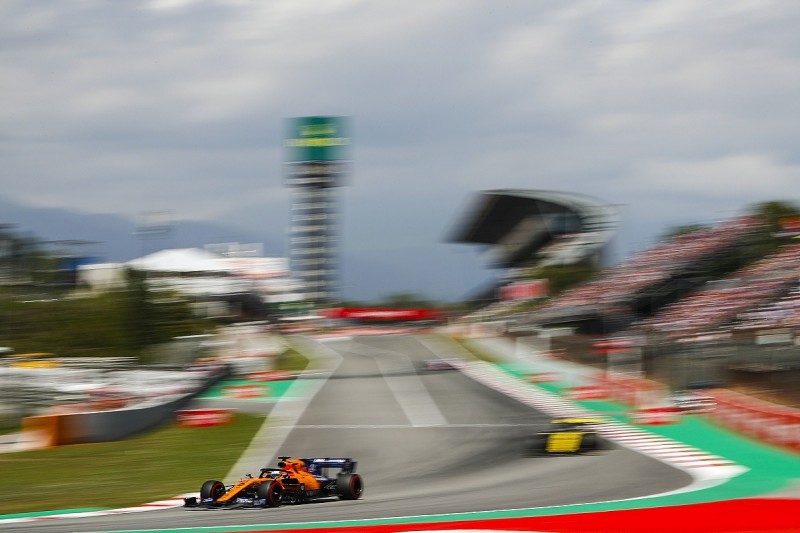
And what is inescapable is that Zandvoort has been given the early May date, leading many to believe that the Barcelona race is already a lost cause. But there's still some hope.
"We are in the middle of the process of negotiations," says Barcelona circuit president Vicenc Aguilera. "We are not in, but we are not out. The Catalan government is willing to reach an agreement; it's doing a lot of things that make it able to find a balanced situation between Liberty and Barcelona."
Aguilera is well aware that the 'five into three' scenario puts the onus on the circuits to pay up: "Liberty is playing its game, and tries to put pressure on the people, and tries to use all the time [the fact that] we have to negotiate.
"September will be absolutely not acceptable for us. We'd have a big mess - it would be a disaster. And why should you pay for a disaster?" Barcelona's Vicenc Aguilera
"We know that we have a certain time, and we try to use [it] as best we can, in order to find this balanced situation. We need to fit both positions, and I think we will be able to do that. I am optimistic."
If Barcelona ultimately wins a spot on the 2020 calendar, it will be looking for a new date. That won't be without precedent - the inaugural race at the current track in 1991 (pictured below) took place in September, rather than May.

"First the contract, second the date," says Aguilera. "If we don't have the contract, it's a stupid thing to discuss the date. I'll say to Liberty that I'm not flexible. But I will say that 10 minutes before signing the contract!
"September is not good, that will be absolutely not acceptable for us, because we have typical rain here. It's a crazy thing, and we'd have a big mess - it would be a disaster. And why should you pay for a disaster? July is too hot. It should be May. But I will not discuss dates until we have a contract."
As a flyaway, Mexico City is the odd one out of the five races at risk. Events outside Europe pay significantly more to host F1 races, simply because the transport costs are factored in. And having lost central-government funding, it's been apparent for some months that Mexico is in serious doubt, despite the massive enthusiasm for Sergio Perez.
Mexico may ultimately be regarded by Liberty as a straight swap for Vietnam - dropping a flyaway race for a new flyaway - therefore maintaining a stable number of European events.
But the race organisers insist that it's not yet over, as they noted in a statement last week: "Negotiations with both F1 and with the Mexican authorities continue in order to find viable alternatives to assure the permanence of the grand prix in Mexico."
The fact that a crowd-pleasing race such as Mexico can't work without a public subsidy shows just how broken the F1 business model is as far as the events are concerned.

"This is an expensive game," says Barcelona's Aguilera. "And in this expensive game there is always a loser - and that is the circuit. This is the picture today, and we want to minimise these effects.
"Liberty knows our figures in detail, I presented all the figures in a very transparent way. These are our figures, this is not sustainable, we need to change it. There are only two ways: you reduce costs, or you increase our income."
"We think it will be a shame if we and Germany lose the grand prix," says Hockenheim's Teske. "It's not understandable for the fans and for the public, because we're still a strong automotive country, we still have Sebastian Vettel hopefully fighting for the title, we still have Mercedes as a German manufacturer.
"But we are competing against countries where the government is paying for the race, and this is not the case for us."
You could argue that by adding two new races, Liberty has played a clever game and ensured that it has the most lucrative 21 deals, boosting its income. Yet things are not as clear-cut as that - are the new races really paying top dollar?
We know that Miami, which could still happen in 2021 as a race around a football stadium rather than the intended venue next to the waterfront, is due to be a "joint venture", with a minimal upfront fee.
Some observers believe that Vietnam agreed a relatively cheap deal by Asian flyaway standards, and that Zandvoort too has done well compared to established European rivals.
A sceptical view is that Liberty is so determined to score PR victories by being seen to pull off race deals that it has been relatively generous. At the same time, adding those new races puts pressure on the established venues to cough up and continue pay the sort of rates that they used to agree with Ecclestone.
Another scenario is that, despite promising a stable 21 races for 2020, Liberty could yet slip in a 22nd, something that the teams are not exactly keen to see. But if that means a classic race such as Britain, Italy or Germany is 'saved', who's going to argue?
It's not just the out-of-contract races that have been impacted by Zandvoort. Consider Spa, which is understood to be committed to an above-average European fee - and which in 2020 will potentially lose a chunk of its audience to Verstappen's new home race.
It's going to be intriguing to see how things play out over the next couple of months - and which races ultimately fall off the draft 2020 calendar.
"We value our partnerships with our existing promoters," Carey noted. "However, we believe it is important for our fans and the growth of our sport and business that we both add exciting new locations and manage a limited level of churn.
"We're in the fortunate position of having more demand than supply, but recognise that we need to manage that dynamic in a thoughtful manner."


Krack: Aston Martin F1 team no longer in “no-man’s land”

Gasly rues costly floor damage from Ocon contact in F1 Japanese GP

Andretti planning F2 and F3 entries to promote US talent to F1 team

Andretti F1 team formally opens new Silverstone facility

RB: Tsunoda “mentally on a different level” in 2024

Russell: Dirty air is causing F1 helmet turbulence problems

Vasseur: No guarantee that Ferrari F1 tyre issues are resolved

How an F1 underachiever became a Japanese political player

Acosta's long road to his maiden MotoGP win

MotoGP Austrian GP: Acosta finally claims maiden win

Great debate: Which circuit should host the F1 2026 finale if the calendar has to change?

Live: MotoGP Austrian Grand Prix updates as it happens
Subscribe and access Autosport.com with your ad-blocker.
From Formula 1 to MotoGP we report straight from the paddock because we love our sport, just like you. In order to keep delivering our expert journalism, our website uses advertising. Still, we want to give you the opportunity to enjoy an ad-free and tracker-free website and to continue using your adblocker.


Top Comments