


The decisive steps in Vettel’s Ferrari F1 disappointments
It was a different Sebastian Vettel who moved to Ferrari: a driver who knew what he wanted and how to get it, full of the confidence and commanding influence four world championships could bring. ROBERTO CHINCHERO recalls that the mission was nothing less than to recreate the glory days of Michael Schumacher. What could possibly go wrong?
Luke Skywalker, George Bailey, Maverick, Neo, Captain America… even Bill and Ted. It’s a trope of Hollywood screenwriting that at some point the hero is sorely tested, plunged into a transformative ordeal – and then, from the depths of despair, they rise again to be triumphant. For Sebastian Vettel and Ferrari, though, the final act in the drama didn’t conform to this Aristotlean ideal.
The story of Sebastian Vettel and Ferrari was one of a professional relationship undercut by, as ever with Maranello, a strong element of passion. The relationship had moments of great exaltation and bitter disappointments, quickly reaching its first victories and slowly fading towards a divorce that wasn’t without controversy. Inhabiting the story was a driver with a strong personality and a team with a complicated dynamic, constantly under powerful spotlights which amplified any success but mercilessly exposed any perceived shortcomings.
Few gestures are as potently evocative as Vettel’s first appearance at the wheel of a Ferrari, testing an F2012 nine days after the announcement, on 20 November 2014, that he would be forsaking Red Bull for a new life at Maranello. He arrived at Fiorano, Ferrari’s test track, with a plain white helmet upon which was written: “My first day in Ferrari: 11/29/2014”.
Five and a half years later, in April 2020, the prevailing emotion was colder during a phone call with team principal Mattia Binotto during Covid lockdown, during which Vettel was informed he was surplus to requirements at the end of the season. It was a stingingly abrupt termination of a partnership which had yielded only a portion of the anticipated glories. He had won 14 grands prix, and twice finished the season in second position, but the world championship that both he and Ferrari had dreamed of never came.
Vettel and Ferrari were drawn together for three compelling reasons. The first was Vettel’s ambition to follow in the footsteps of his idol, Michael Schumacher, a desire that became even stronger in 2014. The singular lack of competitiveness of Renault’s new hybrid power unit had ended Red Bull’s winning cycle in which Vettel had claimed four drivers’ championships and, additionally the arrival of Daniel Ricciardo in the team had put him under pressure.
Suddenly the team’s number one driver felt like he was no longer number one, a status underlined by the results on the track. For Vettel it was time to move, and the Ferrari call came at the perfect moment.
PLUS: How Vettel put in the hard yards to exploit Red Bull’s F1 potential
The timing was ideal for the Scuderia too. After the ‘earthquake’ of September 2014, in which long-serving president Luca di Montezemolo was ousted by Fiat CEO Sergio Marchionne, a restructuring process began in Maranello.

Vettel's Ferrari career got off to an encouraging start, but it didn't end with the success that either party wanted
Photo by: Ferrari Media Center
The arrival of Maurizio Arrivabene as team principal wasn’t compatible with the presence of Fernando Alonso, who during five seasons had acquired increasing power within the team, over and above his role as a driver. Divorce was inevitable, and Vettel was the best replacement option on the market. Vettel and Marchionne lived a short distance apart in Switzerland, and the agreement didn’t require long negotiations.
Vettel didn’t dictate many conditions: he asked for Riccardo Adami as race engineer, Britta Roeske as personal assistant and Antti Kontsas as his trainer. While Vettel didn’t want to import his entire personal circle, he arrived at Maranello with a firm methodology.
His first months with the Scuderia are remembered as those of the ‘blue notebook’, the diary in which he wrote down everything. After listening in the first briefings, Vettel gradually began to speak out. “At Red Bull we did it in this way” became a regular utterance in preface to his suggestions and, if at the beginning these contributions were welcome for a working group undergoing restructuring, in time they began to chafe.
The atmosphere within the organisation remained positive thanks to the competitive uptick, and this put him in a position to be forgiven for some behaviours not particularly appreciated by Maurizio Arrivabene, such as his frequent paddock meetings with Helmut Marko
The driver who arrived at Ferrari wasn’t the impressionable youngster who joined Toro Rosso in 2008, willing to obey the dictats of Helmut Marko and Christian Horner without question, but a four-time world champion convinced of his vision. And he didn’t hesitate to conduct any battles he believed needed to be fought, even if they were with Marchionne himself.
In Singapore in 2015 Vettel observed the mechanics working in very difficult conditions and, during the regular Friday meeting with senior personnel, refused to participate until he had secured an agreement that air conditioners would be installed in the garage. Though the eminences grise disliked the backchat, on Sunday Vettel united everyone behind him by claiming a splendid victory, his third of a season in which Ferrari had returned to winning ways after a disappointing first year under the hybrid regulations.
Vettel had delivered his first success in red in the second round, Malaysia, certifying his status as a driver capable of returning the team to its anointed place among the frontrunners. He ended his first season at Ferrari third in the drivers’ standings and in a clear position of leadership within the team.
The atmosphere within the organisation remained positive thanks to the competitive uptick, and this put him in a position to be forgiven for some behaviours not particularly appreciated by Maurizio Arrivabene, such as his frequent paddock meetings with Helmut Marko, often in view of photographers and those with idle tongues.
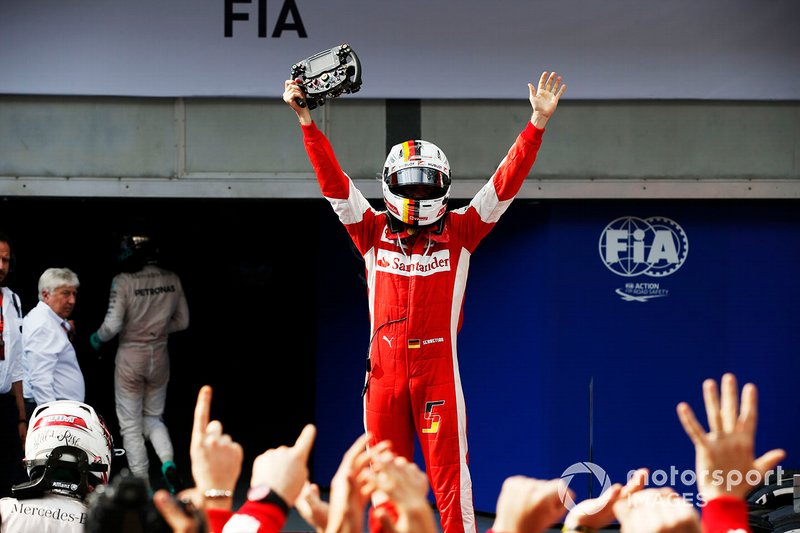
Vettel got off the mark with Ferrari in only his second race in Malaysia 2015, although Mercedes domination continued for the next two seasons
Photo by: Glenn Dunbar / Motorsport Images
During the course of a difficult 2016, hindered by inefficient aerodynamics and poor gearbox reliability, Vettel was the perfect team player even as the frustrated Italian media began to take aim at the Scuderia again. There were no wins and the results were disappointing but never did Vettel bang the table with his fists at debriefs. From mid-season in Maranello it was evident the 2017 car project would facilitate a return to the top, and perhaps this also helped Vettel come to terms with what all believed were short-term difficulties.
The SF70H was indeed innovative and quick. During the Barcelona winter tests of 2017, Ferrari asked Vettel not to push too hard in the third sector of the track, and he was happy not to reveal the car’s full potential. It was no bluff, because in the first six races Vettel took three wins and three second places, leading the tifosi to dare to dream of a brilliant season.
What extinguished those dreams was the need to push everything to the limit as Mercedes tamed its initially difficult car, a situation that brought out reliability problems within the SF70H. It was details, such as spark plugs and connecting pipes, or unfortunate race circumstances such as the accident at the start of the Singapore GP, which derailed Ferrari’s championship challenge.
Nevertheless, victory in the penultimate round of the season, in Brazil, brought back humour and confidence. At the end of 2017 Vettel enjoyed the Scuderia’s full support. Nobody could have expected what was to come in 2018, how in a few months his circumstances would change from potentially winning the world championship to fractures developing with management – and, within two years, a definitive divorce.
The 2018 season got off to a good start with two consecutive victories, followed by further successes in Canada and Great Britain. The car was fast and reliable, with no clear deficit to Mercedes. Two weeks after the triumph at Silverstone came the watershed moment.
Vettel was leading the German Grand Prix from pole position when it began to rain and, on lap 52, he lost control in the stadium section and embedded his car in the barrier. His frustration was writ large as he slammed his fists against the steering wheel: the anger of a driver who had made a mistake and knew it was his fault. The unexpected death of Marchionne, announced that weekend, contributed to a funereal atmosphere within the team.
There had been another significant development which undermined Vettel’s certainties. From the beginning of summer it was clear Charles Leclerc would drive for Ferrari in 2019, having only needed a few races with Alfa Romeo to convince Maranello’s top management of his potential. This news was a real cold shower for Vettel.
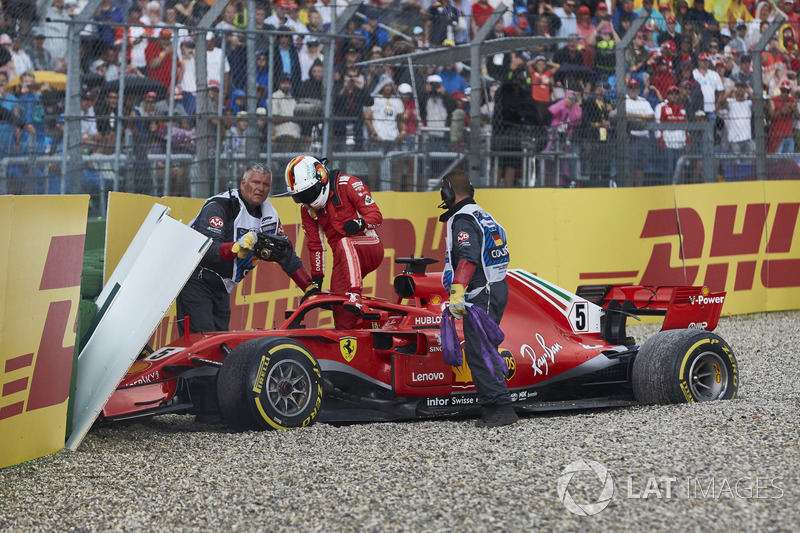
Crashing out of the lead at Hockenheim in 2018 was a clear turning point in Vettel's Ferrari career and arguably cost him his best shot at a title with the Scuderia
Photo by: Steve Etherington / Motorsport Images
Not only would Leclerc be a less ‘comfortable’ team-mate than Kimi Raikkonen, but also Vettel knew a team which makes such a decision clearly doesn’t have 100% confidence in its current number one driver and is evaluating a replacement. It was this sense that time was running out which likely caused him to push too hard and make this mistake – and the others which followed.
At Monza the Ferraris started on the front row with Raikkonen ahead, but the Finn assured the team he would give way to Vettel if they were running 1-2. It was decided in the pre-race briefing this would happen on lap 10. But by that point in the race Vettel was already out of contention, having made a poor start and then collided with Lewis Hamilton at the Roggia chicane on the opening lap.
More mistakes followed in Japan, USA and Brazil. He had lost his grip as team leader, a decline which would be exacerbated as Leclerc and new team principal Binotto took up their places.
By Canada 2019 Vettel was painfully aware time was running out before Leclerc flowered and asserted himself within the team. That point came when the Monegasque took consecutive victories in Belgium and Italy
From the moment of Vettel’s arrival at Ferrari Marchionne was struck by his emotional nature, a different personality compared with the cool and stereotypically Germanic demeanour of Schumacher. Indeed, Vettel is much more Latin in temperament; after the 2018 Mexican GP, for instance, when Hamilton put the championship beyond reach, Vettel had an emotional breakdown, managing to speak to the media only after half an hour of brooding silence in private. It had been clear for a long time what the verdict of that season would be, but for Vettel that Sunday was still a blow he found difficult to take.
Ditto the following season in the Canadian GP, when he received a (fair) five-second penalty for cutting the chicane – a sanction which handed victory to Hamilton. The scene of Vettel moving the ‘P1’ sign from in front of Hamilton’s Mercedes to his own car was another example of emotion fuelling a display of petulance.
By Canada 2019 Vettel was painfully aware time was running out before Leclerc flowered and asserted himself within the team. That point came when the Monegasque took consecutive victories in Belgium and Italy, and Vettel once again made a very messy mistake in the opening laps. No one was more aware than Vettel that the cost of his errors had exceeded the value of his palmares.
At one of the final races of that season he arrived in his garage on the Thursday to find his car missing. Vettel well knew this was because it was being scrutineered, but didn’t shy away from quipping to one of his most trusted mechanics: “Well, you can see they won’t renew my contract – my car isn’t even there anymore.”
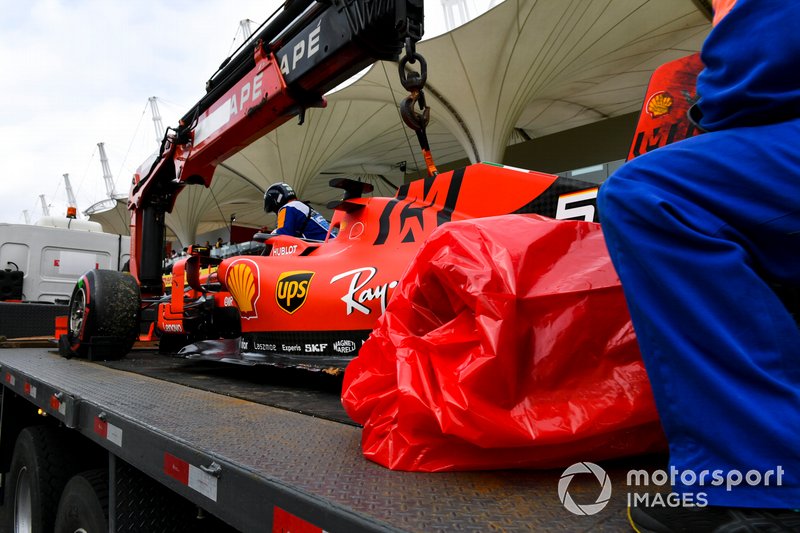
Clash with Leclerc in Brazil 2019, which put both out, came as Vettel attempted unsuccessfully to protect his status as Ferrari number one
Photo by: Mark Sutton / Motorsport Images
Vettel had smelled the air correctly. It was only a matter of time before he received the call confirming he would no longer be Ferrari’s team leader – or a Ferrari driver at all. A bitter ending for Vettel and undoubtedly one of the biggest disappointments of his sporting career.
He had imagined his story at Ferrari differently, along the lines of the renaissance his idol Schumacher had orchestrated. It could have been a remarkable tale but, above all, results were lacking – and in racing, beyond all the romantic aspects, great loves are certified by results.
If the final act of this story is one of disappointment rather than triumph, it does at least have an uplifting coda. When Vettel returned to Imola and Monza at the wheel of an Aston Martin he found the fans’ support for him undimmed. The memory he left of himself among the tifosi is of a great driver and above all of a passionate individual, who loved the Scuderia beyond how his adventure in red ended.

It was somehow apt that Vettel's final Ferrari podium should come as runner-up to Hamilton in the 2020 Turkish GP
Photo by: Charles Coates / Motorsport Images

How Ratzenberger beat the odds to realise his cruelly short-lived F1 dream

F1 uncovered: A weekend behind the scenes with a chief mechanic

When McLaren was pipped by Red Bull in a modern F1 classic

The big opportunity Sainz’s Williams switch affords to F1’s latest centurion

Inside the science of F1 fuel

How F1’s plan for rotating races could look in practice

The early decisions that set Sauber’s rookie for success

How F1 media coverage has evolved in line with its subject

FIA expects F1 races in Qatar and Abu Dhabi to run as planned

Top five roles on Motorsport Jobs this week

Champions crowned at incident-filled Donington Park 750 Motor Club meeting

Why Toyota’s 2026 WEC triumphs have put it into the all-time greatest endurance racing team debate
Subscribe and access Autosport.com with your ad-blocker.
From Formula 1 to MotoGP we report straight from the paddock because we love our sport, just like you. In order to keep delivering our expert journalism, our website uses advertising. Still, we want to give you the opportunity to enjoy an ad-free and tracker-free website and to continue using your adblocker.


Top Comments