


The battle-hardened figurehead at the heart of Williams' F1 revival
With a long career encompassing engineering and management roles with the likes of BMW, Porsche, Sauber, Ford and Volkswagen, Jost Capito knows better than most what it takes to build a successful organisation in the automotive and motorsport worlds. Now, as MARK GALLAGHER discovers, Capito is applying his vast experience to a major rebuild of the Williams Formula 1 team
Young people in their twenties and thirties are trooping through reception, products of the talent pipeline that is the UK’s motorsport valley. Most will have been born after Williams won its first drivers’ and constructors’ world championships in 1980. Some might yet have a been a twinkle in their parents’ eyes when the team scored its last such success in 1997.
Jost Capito, 63 years young, the team’s CEO and team principal, is sitting upstairs in a large open plan office, sharing a joke with a colleague. Relaxed and smiling, the German executive charged with turning around the fortunes of the iconic British team is less than a year into the role.
He is clearly enjoying the opportunity to apply 40 years of experience working on motorsport programmes for BMW, Sauber and Porsche, not to mention those multiple World Rally Championships for Ford and Volkswagen. It’s a track record which proved irresistible to Williams’ new owners, Dorilton Capital…
GP Racing: You have said you were considering slowing down prior to taking on this role at Williams. How has the experience been?
Jost Capito: For me retirement wouldn’t have meant that I’m not doing anything anymore and staying at home. I got my enduro motorbikes ready, including my old enduro bike from 1978 that I own, to do the classic enduro championships. So I would have been pretty active. Also some people wanted to work with me – a bit here, a bit there – so I had some really good ideas what to do that would have kept me more than busy. And I was really fine to do that.
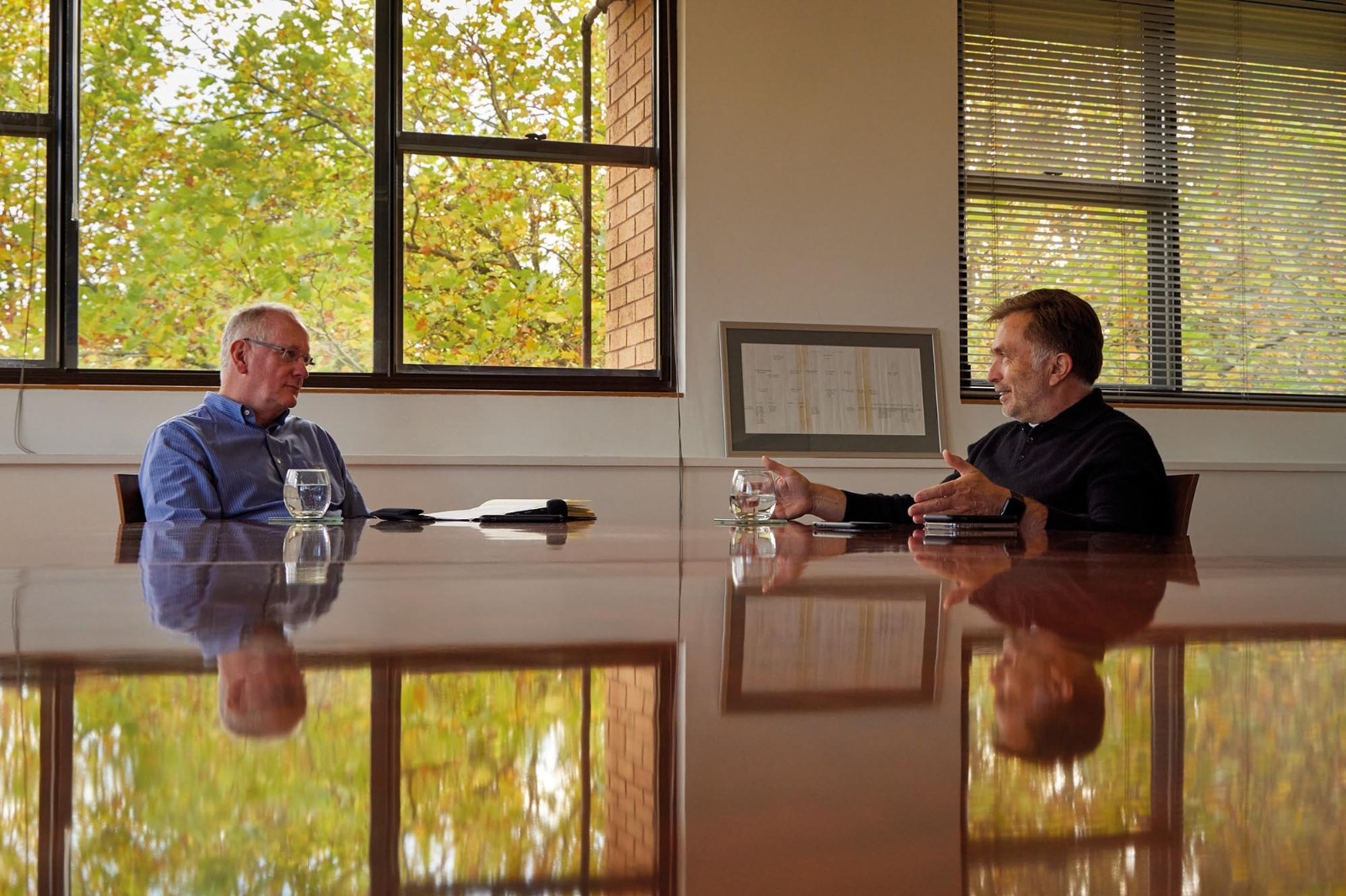
Capito sits down for an audience with GPR's Gallagher
Photo by: Alister Thorpe/GP Racing
But then when I got the call and was asked ‘can you talk about the CEO role at Williams?’ First of all you cannot say no. As a kid you have never ever dreamt that you could be in that position. I first went with my father to the Nurburgring to the Formula 1 race – it must have been the mid-60s when there was still the old paddock and you could go everywhere – and I remember watching the Ferrari mechanics.
I watched the F2 race in 1968 when Jim Clark crashed. I was in front of the TV, and I was the biggest fan of him. So then when you go racing you always follow F1. It’s every young boy’s dream and it doesn’t come true for many. So I said yes [to Dorilton], we should discuss it. Then I met the new owners and was very impressed. I think they had a lot of applicants and did a lot of interviews, so I was really honoured when they asked me, ‘if you want to do that, you can do it.’
GPR: You have spent your life in senior roles in motorsport, so you must have recognised the challenge of taking on a team which has had a difficult few years?
JC: It’s not an easy challenge but then the Volkswagen challenge was also not easy. When they say you’ve got to get into WRC [World Rally Championship] and they have never done WRC, and you take it on half a year before the season starts, it’s very much jumping straight into cold water [at the deep end], as you say. And it’s been very much the same [here]. When you know the team is 10th three years in a row, there must be a reason why. So you know that if you take this job it is most likely the most difficult job you can have in F1.
"If we do what everybody does, we have the ninth fastest car, last year the 10th fastest car. That’s where we are, so you have to do things differently. [They] now enjoy doing things differently, taking some risks, getting the support and not having the blame culture" Jost Capito
GPR: Are you here to participate, or win?
JC: I never go anywhere to participate.
GPR: You’ve changed the leadership structure at Williams. Why has that led to such an improvement in performance – currently eighth in the constructors’ championship?
JC: I think that is a couple of things. Maybe one is my management style – open communication, having clear roles and responsibilities. A big step was getting the technical director in (Francois-Xavier Demaison) to align all the technical departments under one head. Not having a separate home team and a race team, an aero team and a design team, but having one technical team that works together and talks to each other, communicates properly and respects each other.

Capito has got the old band back together by bringing in Demaison, formerly the technical director on VW's WRC project
Photo by: Williams
[Also we] started to take risks again. If you are 10th for three years, you start not taking risks. To convince the team you say, “look the only fun we have now is taking risks because if you are at the top you can’t take these risks”. So enjoy it, take risks and do things others wouldn’t do. Because if we do what everybody does, we have the ninth fastest car, last year the 10th fastest car. That’s where we are, so you have to do things differently. [They] now enjoy doing things differently, taking some risks, getting the support and not having the blame culture [if it goes wrong].
GPR: Most organisations want to avoid risk, so to what extent is taking risk essential for innovation – and performance?
JC: I think it’s essential for everybody nowadays, for every business. I think business [has] changed to be more agile and it’s very much the software companies that have changed it. They do releases before they are proven 100% perfect. You don’t have to be perfect if you produce a product, but you have to be innovative, try some stuff and develop it over time and not be conservative. I think that is the approach to take.
PLUS: The jubilation and sorrow Williams experienced in its 2021 F1 recovery
But you have to know what you do. The risk has to be calculated and the risk has to be based on data so that then you can justify the risk. It’s not ‘let’s try something different’, it might just be stupid, so that’s not what we mean by risk taking!
GPR: Having taken on ‘FX’ Demaison and created a much more coherent structure with clear roles and responsibilities, how would you characterise the team of people you inherited?
JC: I think the capabilities and the talents are there. Lots of young engineers as well, and a good mix with experienced engineers. What I found is that a lot would say, “oh, this is the Williams way, this is how we always did it” and that had to be overcome. I think we are in a good way to overcome this so that young people coming in, people from other teams coming in, have a voice and have a chance to speak up and have a healthy discussion about how you can change things.
Sven Smeets (former VW Motorsport Director) started yesterday [November 1] as the sporting director, so with that the race team itself is represented on the management committee, which was not the case before. I believe it is very important that the guys who travel all year are represented in the management. That is the next big step – to have the technical side and the sporting side very close.

Capito congratulates Russell on his remarkable lap to qualify second at Spa. He says taking risks has been key to the team's upturn in fortunes
Photo by: Glenn Dunbar / Motorsport Images
GPR: How have George Russell and Nicolas Latifi responded to the changes this year?
JC: Both are really good drivers. It’s obvious George is an outstanding talent and for every driver beside him it’s difficult. But Nicky took this challenge on well, many times in the races he has been faster than George.
George just gets a miracle out in qualifying, again and again… and he’s happy to take the risk. I think George is one of the most complete race drivers I ever met. In many respects. It’s difficult to run beside George. [Lewis] Hamilton will notice that next year.
"In the sport, you can never put a date on when you believe you can win – it can be earlier, it can be later – but you have to consistently see an improvement and catch up. Go a step up, go a position further" Jost Capito
GPR: Your decision to sign Alex Albon surprised a few people. What was behind that move?
JC: I think Alex was, for us, the logical choice because you have always to look at what situation the team is in. I think if we had Max Verstappen it would have been the right driver at the wrong time. You need a driver who is still not yet at the peak of his career but has a certain experience so that he gets the respect from the team, yet has to have the speed and to fit into the mentality of the team. Even if the choice would have been bigger, Alex would have been the number one choice.
PLUS: The impressive attitude that earned Albon his second F1 chance
GPR: Given the new Concorde Agreement, budget cap and recent changes to Formula 1’s structure, what’s your opinion on the current health of Formula 1?
JC: I think F1 is in a very good phase right now. When you see in Austin 400,000 spectators over the weekend, it’s massive. When I got the job and knew Stefano [Domenicali] was taking over I knew he will take F1 in the right direction. He understands the business – he has been a team manager, team principal, and ran a car manufacturer. He is the guy with the best credentials.
I really understand him. I worked with him, we became friends, so I thought I can also be of support to him to develop F1 in that direction by working closely with him, by having one team where he can really know exactly who he is talking to and what kind of mindset he is talking to.

Capito says he has confidence in the future direction F1 is taking
Photo by: Alister Thorpe/GP Racing
GPR: What’s your opinion of Liberty’s ownership of F1? When they came in four years ago they seemed to take a very ‘American’ approach, but that has changed…
JC: I think they learned pretty quickly. In Stefano they brought the right person in, so that shows they have learned. They did not bring in another American who has no idea about F1. Also having Ross [Brawn] and Steve Nielsen in there, they have the right team now who can drive F1 forward.
GPR: The 2022 regulations mark a new chapter. What’s your view of it from a Williams perspective?
JC: I think it’s exciting and worrying! It can’t get much worse with the car so that means more exciting than worrying. We have defined the objectives of the car, we are pretty close to delivering these objectives, but [whether] these objectives were set rightly and high enough nobody knows. I think that’s the same situation for everybody. Normally, I think the teams will be much closer together because they start from the same level. It’s not like making a fast car faster and a slower car faster – everyone is on the same level – but we will see. There can be surprises both ways.
GPR: What does success look like for Williams between now and 2025?
JC: To constantly improve in the direction of winning. You can’t put a timing on when you want to win or want to be world champion because you are not on your own.
You know, if we say we want to be climate-positive by 2030 this is up to us to do. We are not competing with anything. We are competing not with a competitor, we are competing with facts, we are competing with what we are doing, so you can put a date on it.

Williams took double points finish at the Hungarian Grand Prix to lift itself off the summit of the constructors' table
Photo by: Williams
But in the sport, you can never put a date on when you believe you can win – it can be earlier, it can be later – but you have to consistently see an improvement and catch up. Go a step up, go a position further. On the way you might fall back a bit and this is also not a nightmare, but you have to see the consistent improvement. How we improve on the infrastructure, how we improve the team, how you improve your car so that you get towards it.
GPR: To what extent is McLaren a template for turning things around in four years – from nowhere to winning a GP. Is that what you aspire to?
JC: You can’t compare and again I wouldn’t say in what kind of time frame it is. McLaren could have won the championship two years ago with Honda engines, so you cannot compare the past to what it is now, and you have different bases where you come from. McLaren came from a different base than Williams came from – it was a team that was run completely differently, you can’t compare it one-to-one. I am sure that here we have all the infrastructure, we have the talent, and we have the chances to win races and win championships in the future.
"You have to be more aggressive than others – motorsport has to be – on the technical side, the engineering side, it’s more aggressive than standard businesses so why should you not put this on sustainability issues?" Jost Capito
GPR: The automotive industry is going through a profound change and you have spent most of your career working with car manufacturers, so what’s your opinion on Formula 1’s ability to remain relevant to the car industry?
JC: There are different aspects. Formula 1 still has a huge marketing impact, so it’s a good marketing tool, and I think [in terms of] road relevance let’s see where it goes. The industry is going very much on electric because this is the solution that you can implement right now. The technology is there because you can use it. But I believe in [technical] diversity on that as well. There are many technologies and I don’t believe that full electric vehicles will serve [every kind] of mobility in the future.
Formula 1 engines are now the most efficient hybrid engines around. The combustion system that Formula 1 developed in recent years will make it into production and will be another huge step in making combustion engines cleaner. You will have hydrogen cars and fuel cell cars in Le Mans for example, you will have a different hybrid concept in the Dakar with Audi, you have Formula E with full electric and in Formula 1 you have the hybrid which is going in the direction of e-fuels.
I think these e-fuels, combined with hybrid electric, has huge potential for the future. Formula 1 going in that direction is a one-off chance to speed up the technology [through] motorsport competition. So I am fully convinced that this technology will be for road vehicles in the future and it will be highly influenced by the Formula 1 technology.

McLaren got back to winning ways in 2021, but Capito says it can't be compared directly with Williams
Photo by: Mark Sutton / Motorsport Images
GPR: We have recently seen Red Bull establish its own powertrain division in the wake of Honda’s withdrawal, essentially following the in-house model that Mercedes and Ferrari enjoy. Do you see that as a possible route for Williams to follow, or is manufacturer supply a better model?
JC: I wouldn’t say a better model. There is not only one model that can lead to winning the championship. You have seen that in the past with Cosworth engines winning the world championship and Ferrari having its own engines [in-house]. You have seen both models. Every team has to look at what is the right thing to do at the right time. I think for Red Bull it’s the right thing to do right now where they are with the team.
For Williams I don’t think it would be the right time, but you can never say never. You have to have a plan as a team, but you have to keep an open mind and change if there are better options. Whatever comes up in the future, again there is more than one solution.
GPR: Perhaps for obvious reasons, Williams has tended to lead the way on diversity and inclusion, and now you have also set out to become climate positive by 2030. Explain the background to why those programmes are important?
JC: I think diversity and inclusion are very important, to be competitive now and in the future. You need different kinds of views, you need all these kinds of cultural discussions. The more diverse a team or company I had, the better it performed.
You can manage crises much better if you have different views, and the same is true for inclusion. I think the more you do on that the more happy workforce you have and the more happy people are working there. You get better results. To have the sustainability strategy – first of all, I want to see motorsport survive. If motorsport does not do these things and lead the way, motorsport will die. I am absolutely convinced.
I would say that you have to be more aggressive than others – motorsport has to be – on the technical side, the engineering side, it’s more aggressive than standard businesses so why should you not put this on sustainability issues?

Capito believes aggressive focus on sustainability will be key for motorsport's survival
Photo by: Alister Thorpe/GP Racing
GPR: Is leading the way in some of these technologies a business opportunity for Williams?
JC: Yes I think it is a business opportunity. It is a part of the business, it’s also applying F1 technologies, thinking and mentality into other areas… like when the [COVID] crisis came along last year and a lot of Formula 1 teams developed technology for the health sector.
[I have had] quite a lot of comments, does a sustainability strategy win races? I think one has nothing to do with the other – but we are not less focused on winning races because we are also looking into the sustainability strategy and actions as well. I think they are complementary.
"We are still not there, we are far away from being there, and a lot still has to be done, but you have to take the team with you on that journey" Jost Capito
GPR: How does Williams Racing work with Williams Advanced Engineering, following the sale of a majority stake in the Williams Advanced Engineering side of the business two years ago?
JC: It is still quite a good relationship between us and we have a couple of projects ongoing. WAE runs the Formula E team for Jaguar so they use our simulator, windtunnel and our development of batteries. [It works] the other way round as well – we work with them on advanced solutions for other industries. We have regular meetings with them, it is a close business relationship and Dorilton Capital owns 25% of it, so we are involved.
GPR: You said it was a dream come true when you were offered the job and took it. Are you happy with your first-year report?
JC: Yes, especially when you see how the team moved forward in the last months. We are still not there, we are far away from being there, and a lot still has to be done, but you have to take the team with you on that journey.

Capito is pleased with the progress the team has made so far, but knows there is still a long way to go to achieve its lofty aims
Photo by: Mark Sutton / Motorsport Images

How Ratzenberger beat the odds to realise his cruelly short-lived F1 dream

F1 uncovered: A weekend behind the scenes with a chief mechanic

When McLaren was pipped by Red Bull in a modern F1 classic

The big opportunity Sainz’s Williams switch affords to F1’s latest centurion

Inside the science of F1 fuel

How F1’s plan for rotating races could look in practice

The early decisions that set Sauber’s rookie for success

How F1 media coverage has evolved in line with its subject

Acosta's long road to his maiden MotoGP win

MotoGP Austrian GP: Acosta finally claims maiden win

Great debate: Which circuit should host the F1 2026 finale if the calendar has to change?

Live: MotoGP Austrian Grand Prix updates as it happens
Subscribe and access Autosport.com with your ad-blocker.
From Formula 1 to MotoGP we report straight from the paddock because we love our sport, just like you. In order to keep delivering our expert journalism, our website uses advertising. Still, we want to give you the opportunity to enjoy an ad-free and tracker-free website and to continue using your adblocker.


Top Comments