


The Barcelona practice times that prove Red Bull's title credentials, and heap pressure on Verstappen
Lewis Hamilton and Mercedes led the way in Friday practice for the 2021 Spanish Grand Prix, but there was one big encouraging sign for Red Bull. The trouble is, it looks like making good on that gain will require its superstar driver to avoid repeating a mistake made today that left him well down the FP2 order

“I've always said it's going to take probably three or four races to get a true reflection of form.”
That was Red Bull team boss Christian Horner’s assertion after Max Verstappen had won the Emilia Romagna Grand Prix and evened the score against Lewis Hamilton and his Mercedes squad.
After the Portuguese Grand Prix, where Hamilton nipped back in front by a win, Formula 1 has arrived at Horner’s critical point in the season: race four, the Spanish GP.
The Barcelona track is F1’s equivalent of a laboratory setting. Although it can be windy – as witnessed today in FP2 – conditions are much more consistent compared to the how the unpredictable unseen element influenced proceedings at Portimao. It can snow at Barcelona during its traditional pre-season testing event, which is the other reason why it’s considered such a benchmark for the teams to prove their challengers against – they simply know it so well and know what it takes to be fast here.
Bearing all that in mind, Friday practice for the 2021 race at Barcelona was two hours of running really worth paying attention to – in the context of F1’s super tight title fight if nothing else.
If Red Bull could lead Mercedes at a track where it has not suffered a genuine defeat since the start of the turbo hybrid era in 2014, then its championship credentials with the tamed and firing RB16B would be proved.
But after the two one-hour sessions today, things aren’t so neatly clear cut. They are however, still looking very good for Red Bull. And, at the same time, good for Mercedes – albeit a different kind of good to the all-conquering success it has enjoyed over the last seven years.
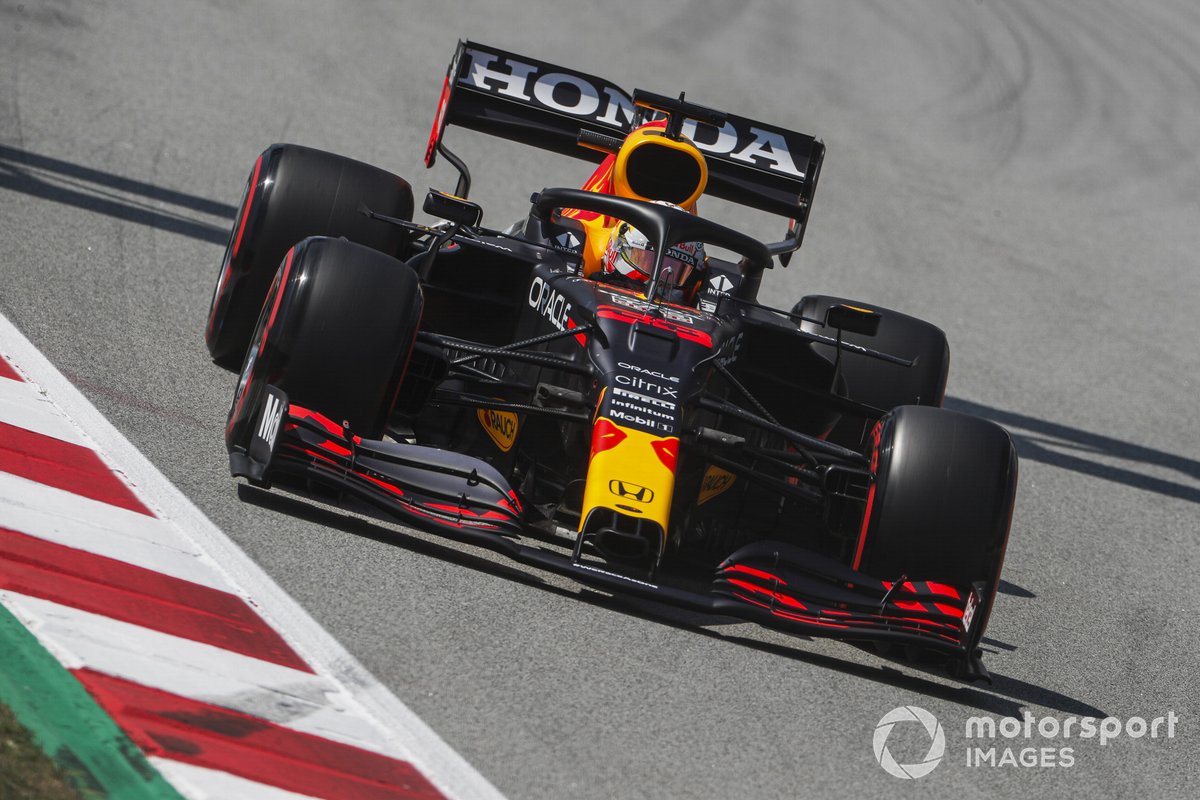
Max Verstappen, Red Bull Racing RB16B
Photo by: Steven Tee / Motorsport Images
Overall FP2 order
| 1 | Hamilton | Mercedes | 1m18.170s | |
| 2 | Leclerc | Ferrari | 1m18.335s | +0.165s |
| 3 | Ocon | Alpine | 1m18.466s | +0.296s |
| 4 | Gasly | AlphaTauri | 1m18.593s | +0.423s |
| 5 | Verstappen | Red Bull | 1m18.785s | +0.615s |
| 6 | Vettel | Aston Martin | 1m18.947s | +0.777s |
| 7 | Norris | McLaren | 1m19.092s | +0.922s |
| 8 | Giovinazzi | Alfa Romeo | 1m19.122s | +0.952s |
| 9 | Russell | Williams | 1m19.957s | +1.787s |
| 10 | Schumacher | Haas | 1m20.326s | +2.156s |
Simply put, Red Bull is right with Mercedes – even if the headline times (above) don’t show it.
Hamilton led the way in FP2 to set the fastest time of the day, while Verstappen languished in ninth after messing up his qualifying simulation run in that session – with a moment at the reprofiled, long Turn 10 left. Verstappen got “just a little bit wide in Turn 10”, which meant he “got into the dirt” on the outside and ended up sliding completely off the track, having to gather up his car and losing momentum before aborting the run.
But there’s evidence that had he continued at the same rate before the mistake, then Verstappen would’ve been right with the Mercedes pair, who were separated by just 0.165s at the head of the FP2 times on the softs used for the flying runs.
For a start, Verstappen was having to deal with traffic they were not, and was just 0.134s adrift at the sector two timing line a few metres before Turn 10. Plus, Autosport understands that GPS data gathered from the teams backs up how close Hamilton and Verstappen’s laps were up to that point.
- Mercedes is adamant that F1 did not see anything close to Red Bull’s best today – particularly from Verstappen, as evidenced from his FP2 Turn 10 mistake
The Red Bull cars were tracked being consistently quicker through the high-speed corners of Turn 1 and Turn 9, and Verstappen was also gaining at the Turn 4 right on his aborted fastest run, although he was slower at the Turn 7 left.
Intriguingly, Autosport understands that while Verstappen was generally tracked as slower compared to the Mercedes cars on the straights, his power unit was likely turned up for his aborted lap on the softs – with the speed difference between the two cars on the straights thought to be down to Red Bull running a bigger rear wing to pack on downforce. This is borne out of Verstappen being tracked as running slower through the famous long Turn 3 right – when his power mode was apparently turned up, but he was still slightly adrift of Hamilton at this point.

Max Verstappen, Red Bull Racing RB16B
Photo by: Steven Tee / Motorsport Images
Perhaps to further re-emphasise why all this is good for Red Bull – although perhaps not as good as some, including Mercedes, were expecting – we need to look back to the 2020 Spanish GP qualifying result.
Here, with all the practice caveats about power modes and fuel loads removed (of course they still apply to today’s times!), Red Bull was a massive 0.7s off pole. So, if Verstappen was on course to effectively match Hamilton before his mistake, then that is a massive gain – and shows that the multi-team 2021 title fight the testing form suggested is bearing out.
But there’s further confusing factors to consider. Mercedes is adamant that F1 did not see anything close to Red Bull’s best today – particularly from Verstappen, as evidenced from his FP2 Turn 10 mistake (he also lost time on his first flyer in FP1 at the very same spot). So, it remains entirely possible that Red Bull will edge ahead come qualifying.
At the same time, while both Mercedes drivers were apparently pretty happy with their car balance in the opening sessions, there’s always more to come. Autosport understands that neither driver was totally happy – they rarely are at this point in the weekend – and that both Hamilton and Valtteri Bottas were having difficulties at the rear and front of their respective W12s at different moments. But critically, they weren’t finding the rear tyre overheating issues Mercedes had feared Barcelona’s abrasive asphalt would produce.
Plus, neither Black Arrows driver nailed their soft tyre qualifying simulation run, particularly in the first sector. This helps to explain why the time gap moving on from the mediums wasn’t greater (it’s expected to be 0.8s soft-medium, but the Mercedes drivers were only 0.249s quicker on their soft tyre runs than their best on the mediums early in FP2).
“First day in Barcelona, we seem to have done more right than wrong,” reckoned Toto Wolff.
“It never comes out easy and I don't think with this car it is ever going to be the case,” was Hamilton’s post-FP2 assessment. “But we understand the car, we know which direction we need to go balance-wise. And so, we've made some tweaks along the way. I don't know if it got better for [FP2] necessarily, but there are some findings. I'm hoping to, once we can analyse these two sessions, hopefully have a better set up for tomorrow.”

Lewis Hamilton, Mercedes W12
Photo by: Mark Sutton / Motorsport Images
Returning to Verstappen, the Dutchman reckoned: “Overall I think we actually had quite a good day and the car seems pretty competitive. I was a little bit wide at Turn 10 on my push lap in FP2, but there is nothing shocking to report from either session.”
He’s right of course, the moment wasn’t shocking, or that dramatic in the grand scheme of things. Robert Kubica showed what can happen if you really get the new Turn 10 wrong, spinning into the gravel and out of FP1 while standing in for Kimi Raikkonen in that session.
The thing is for Verstappen, though, is that the prevailing theme of his season up to this point is that tiny errors have cost him. Those made in Bahrain, Imola and Portugal are well known, but he must make sure that come qualifying he’s left them in his wake – and he absolutely has the supreme skill to do so.
Everyone knows qualifying is key to winning at Barcelona, so perfection, or getting as close to it as possible, in Q3 is the aim.
- “Overall I think we actually had quite a good day and the car seems pretty competitive. I was a little bit wide at Turn 10 on my push lap in FP2, but there is nothing shocking to report from either session" Max Verstappen
If things are as close as Friday’s running suggests (and remembering that isn’t guaranteed!) this heaps pressure on those competing for the crucial pole. The difference for Verstappen is that he’s yet to prove he can deliver an F1 title – not his fault considering Mercedes’ car advantages in recent years – and so that just naturally ratchets things up a bit further for him when going up against Hamilton and the generally rapid Bottas.
Medium tyre averages
| Pos. | Team | Time | Laps |
| 1 | Red Bull | 1m22.549s | 3 |
| 2 | Mercedes | 1m22.735s | 9 |
| 3 | AlphaTauri | 1m23.104s | 3 |
| 4 | Ferrari | 1m23.133s | 3 |
| 5 | McLaren | 1m23.786s | 13 |
| 6 | Alpine | 1m24.040s | 16 |
| 7 | Aston Martin | 1m24.568s | 17 |
| 8 | Alfa Romeo | 1m25.034s | 13 |
| 9 | Williams | 1m25.208s | 13 |
| 10 | Haas | 1m25.301s | 8 |
And so, to the FP2 race run data. Things also look encouraging yet confusing for Red Bull based on its place in the medium tyre averages. It heads the times, but is tracked over a very short stint, which gives Mercedes a boost too considering it was just 0.186s adrift in comparison, but over a three-times longer run.
On the soft tyre averages (below), it swings about, with Mercedes ahead over a shorter run (and Aston Martin topping the averages with the same stint length as Red Bull did on the mediums).

Max Verstappen, Red Bull Racing RB16B, Sebastian Vettel, Aston Martin AMR21
Photo by: Steven Tee / Motorsport Images
Interestingly, no teams did a long run on the hard tyres in FP2. This gives an indication on what they are thinking regarding race strategy. Because the pitlane time loss is much less than in Portugal and at Imola, shorter stint lengths become more of an option, plus the time gap when switching medium-hard is thought to be around a second.
It’s therefore not too hard to imagine that the winning strategy Mercedes used in 2020 – soft-medium-medium – is the route the leading teams are eying. But, both Mercedes and Red Bull like to get through Q2 on the mediums to start the race on that rubber if they can, as it gives them greater flexibility in when to stop first in the race. But, with the top eight teams covered by just 0.9s in overall pace in FP2 today, that may not be feasibly this time.
So, much like in the battle for pole, the race run data gathered on Friday suggests things are still too close to call once again. And, again, this is a big net gain for Red Bull. Now it and Verstappen need to make good on that promise.
Soft tyre averages
| Pos | Team | Time | Laps |
| 1 | Aston Martin | 1m22.809s | 3 |
| 2 | Mercedes | 1m23.207s | 9 |
| 3 | Ferrari | 1m23.231s | 5 |
| 4 | Red Bull | 1m23.322s | 12 |
| 5 | Alpine | 1m23.775s | 16 |
| 6 | AlphaTauri | 1m24.000s | 14 |
| 7 | McLaren | 1m24.165s | 4 |
| 8 | Williams | 1m24.705s | 14 |
| 9 | Alfa Romeo | 1m24.781s | 13 |
| 10 | Haas | 1m25.234s | 8 |
Behind the leading teams, Ferrari and Alpine were the standout midfield runners on Friday.
Charles Leclerc slotted his Ferrari into the P3 usually occupied by a Mercedes or Red Bull thanks to Verstappen’s aborted lap and Sergio Perez, who delivered Red Bull’s very competitive soft tyre long run versus Mercedes, being well adrift on one lap pace.
Leclerc also aced the classic ‘Barcelona compromise’ best today – by setting the fastest time in the final sector in FP2. The conundrum is essentially: push hard enough to be in the mix early in the lap, but keep enough tyre life in hand for the slow final turns to avoid falling away with oversteer late-on. And Leclerc nailed that to wind up just 0.165s slower than Hamilton overall.
“Last year I think we were struggling quite a lot, and this year the car just feels in a much better place,” said Leclerc.

Charles Leclerc, Ferrari SF21
Photo by: Motorsport Images
Ferrari delivered competitive times in the long run averages, but did so over shorter stints compared to some of its rivals. This is good news for Alpine, which should already be buoyed by backing up its strong Portugal form so far this weekend. The electric-blue liveried team was also testing a few little updates across the opening sessions.
“Overall, I am pleased with our two sessions and I think the car balance feels good, so it gives me confidence for tomorrow,” said Fernando Alonso, who is targeting an improved qualifying performance this weekend after somewhat slumping in Portimao Q2.
AlphaTauri looks to be back to its early-season form after an off-colour Portimao weekend, although Pierre Gasly suggested it still had work to do to find a better car balance overall. Compared to Ferrari and Alpine, the team is adrift in the soft long run averages, but did complete healthy stint lengths and looked good on the mediums.
- Leclerc also aced the classic ‘Barcelona compromise’ best today – by setting the fastest time in the final sector in FP2. The conundrum is essentially: push hard enough to be in the mix early in the lap, but keep enough tyre life in hand for the slow final turns
McLaren is further down the overall order and the long run averages than might be expected given its strong form from the off in 2021. But the team felt it struggled slightly as the temperatures climbed in FP2. Plus, it looked to be behind at this stage in the last two events before coming on strong for qualifying, so a similar step can’t be ruled out.
Aston Martin had its “best Friday of the year so far”, per Sebastian Vettel. The German driver was pleased with the updated parts that have been fitted to his car after Lance Stroll alone had them in Portugal, and he slotted in ahead of Lando Norris in the overall order. As has usually been the case with Aston since testing, the team is harder to place in the long-run pecking order – it was fast on the softs but with the short stint caveat, then gave up significant time to its usual rivals on the mediums.
Alfa Romeo was very pleased with Antonio Giovinazzi’s gap to top 10 runners on overall pace in FP2, where he ended up 13th, while things look slightly less good for the squad on the race runs. Kubica’s FP1 off was because he "misjudged the grip levels on my first run on soft tyres [and] spun mid-corner".
Williams’s Friday practice was essentially the reverse of its Portugal form, with weak overall pace but encouraging race runs. Haas was bottom of all metrics again, but the team was pleased to rack up over 100 laps in total today.

Robert Kubica, Alfa Romeo Racing C41, brings out the red flags in FP1 by beaching his car in the gravel
Photo by: Steven Tee / Motorsport Images
Concluding with a specific consideration for the race, let’s look at the reprofiled Turn 10.
It seems as if the changes actually help the drivers with tyre management, as they enter it faster with much less braking, and so need to put less stress through the tyre when firing back up to speed on the exit. Essentially, they’re sliding less and so that helps keep the critical surface temperatures in check.
But there’s a split in how it might impact overtaking – rarely a big feature of a Barcelona race. Essentially, the changes have removed the small chance of getting by at the old Turn 10, which had a bigger stop. But they might mean the cars can now follow closer through the final sector overall and that therefore may increase overtaking into Turn 1.
“It's a lot faster, but I've not been in a racing scenario with it, so I can't tell you if it's gonna be better for racing or not,” Hamilton summed up.
“[But] the one before obviously was dead stop. That was one other spot [as well as Turn 1] that you could potentially overtake, but the straight was too short. So, I don't know. Hopefully maybe it'll allow you to follow closer, maybe through that last section. And if it does, that means we can race better down the main straight.”
All this speculation on overtaking in a Spanish GP really highlights again how critical qualifying will be tomorrow. There, the pressure is on at both of F1’s leading teams – to nail the ‘to close to call’ ‘fine margins’ and seize a key advantage heading into Sunday’s race.

Lando Norris, McLaren MCL35M
Photo by: Steven Tee / Motorsport Images


Why Britain’s role in Formula 1 endured a troubled start

Why Bottas believes his F1 reserve driver role is the fastest route back to a race seat

Why Norris is now ready for his final exam

The key advantage for Bottas vs Perez in the 2026 F1 return race

Why Ferrari's management is under pressure after its bad start to F1 2025, not Hamilton or Leclerc

Why Red Bull can’t solve its second F1 car problem with a simple paint job

Hirakawa replaces Doohan at Alpine for Japanese GP FP1 outing

How Alonso and Bortoleto can be F1 rivals in a unique driver management deal

WEC Barcelona: Toyota scores dominant 1-2 to clinch manufacturers’ title

When Can-Am made its controversial comeback

Mercedes explains why its upgrade made its F1 car harder to drive

How levelling the playing field isn’t antithetical to the principles of F1
Subscribe and access Autosport.com with your ad-blocker.
From Formula 1 to MotoGP we report straight from the paddock because we love our sport, just like you. In order to keep delivering our expert journalism, our website uses advertising. Still, we want to give you the opportunity to enjoy an ad-free and tracker-free website and to continue using your adblocker.


Top Comments