


Ten years of Baku: Can F1 2026 bring back the fear factor?
The Azerbaijan Grand Prix has lived off a reputation for producing chaotic races, although its most recent contests have somewhat dulled its edge. But it might suit F1's new era more than its ground-effect days...

Has it really been 10 years? Actually, it feels longer than that. The presence of Baku on the Formula 1 calendar has been consistent (excluding the COVID year) to the point where it's seen as part of the furniture, rather than the bizarre outlier it was viewed as back in its 2016 debut year. "A fast street circuit?" we all scoffed, our perception of inner-city courses defined by the likes of Monaco, Singapore, et al. The additions of Jeddah and Las Vegas makes it seem relatively humdrum by today's standards.
Run for its debut year as the European Grand Prix for whatever reason (presumably then-ringmaster Bernie Ecclestone had decreed that nobody had the faintest idea where Azerbaijan was), the self-congratulatory signage around the circuit - "Well Done Baku" and "Baku Welcomed Us All" starkly printed in Arial on a purple background - quickly entered the F1-flavoured meme lexicon, although it hasn't lingered perhaps in the same way as the longer-lived "GP2 engine" or "Leave me alone, I know what I'm doing (sic)" lines. Maybe the race should bring them back, just for fun's sake.
And it was a novel locale. Beyond the massive acceleration zone out of Turn 16, Baku also offered F1's first venture into the Caucasus, and was not shy to include its myriad landmarks. The paddock backs onto the ornate government house, while the tight Turn 9 leads the cars past the Icherisheher - or Old Town - and around before looping back onto the main stretch of road along the waterfront boulevard. Fun fact: the Turn 13-14 sweepers are the only part of the circuit above sea level.
It's easy to forget the first Baku race itself, simply because it was incredibly sedate compared to those that would follow. There were the usual new-street-course issues in practice: loose kerbs, drain covers not welded down correctly, drivers getting too close to the walls, but the madness had all but subsided by the time qualifying came around. That being said, that weekend also birthed Sergio Perez's inexplicable affinity for the Baku course, as he dragged his Force India to second in qualifying - which became seventh following a gearbox change sustained after clouting the wall at Turn 15 in FP3.
The other noteworthy aspect of that weekend had been in Nico Rosberg's coldly efficient domination of the weekend, helped by Lewis Hamilton's pair of mis-steps in qualifying: a lock-up on the first flying lap, and a crash in the second. Hamilton recovered to fifth in the race, but spent too long in the race being stuck in the wrong engine mode - and the rules at the time decreed that the driver could not receive in-race coaching from the engineers.
Yet, there were no real interruptions to the grand prix. The GP2 races had been safety car-laden affairs, perhaps raising expectations of an error-strewn F1 race, but it was not to be as proceedings continued without incident. Thankfully, the circuit delivered in the following couple of seasons, but recent editions of the Azerbaijan Grand Prix have been remarkably... sensible. It felt as though Baku had lost its edge, and penchant for the unexpected.
In many regards, I think we can put that down to the regulations.

Well done Baku! The Azeri street track marks 10 years of welcoming F1 this weekend
Photo by: Red Bull Content Pool
Last year's race was one such example. Most of the excitement was generated in qualifying, when a litany of incidents and drizzle coalesced to produce a two-hour qualifying session and a jumbled grid: few would have had their money on a Max Verstappen-Carlos Sainz-Liam Lawson top three.
And sure, there was some degree of jeopardy in the opening stages when Oscar Piastri suffered the worst opening lap of his life, after jump-starting, hitting anti-stall, falling back, then crashing out to open the decline of his championship aspirations. But this was largely as "good" as it got; even with the 2.2km stretch from Turn 16 to Turn 1, DRS trains began to form as the overtaking aid was almost inert.
There was a simple reason for this: the ground-effect cars had become increasingly efficient in a straight line by the latter half of 2025. Since an increasing level of downforce was being produced by the floor, the rear wings - particularly at the high-speed circuits - could get away with being even lower profile.
"You really don't want to be deploying any of those electrical energy at a certain point of the track. But if you accidentally do that, go on the throttle a little bit too much, and then deploy MGU-K to engage the turbo, then by the time you go to the main straight" Ayao Komatsu
As Mercedes' Andrew Shovlin explained at the time: "People are putting smaller wings on, they create less disturbance so the tow effects are smaller, and then also with a smaller wing you've got less DRS effect. That's one of the things in Monza [and Baku], there's barely any DRS effect because the wing is so efficient in its high-downforce state that there's very little drag to get rid of."
With a reduced cumulative tow effect, the races certainly took on a different complexion. Piastri's stellar defensive effort in 2024, where he kept Charles Leclerc at bay for the majority of the race (until Sainz and Perez decided to close out the race with a clash) was certainly aided by the reduced tow effect, even if McLaren's "mini-DRS" - the partial flex of the rear wing to open the slot gap very slightly - also played its part.
None of that will be a concern this year with straight line mode. In theory, the overtake mode should reintroduce the strength of the push-to-pass functionality to a pre-2022 level, and the decreased level of downforce produced by the 2026 machines may reinstate some of the peril of getting it wrong at Baku. That's not to say that it didn't exist between 2022-25, and it'll be particularly taxing across the Thursday practice sessions when the circuit grip is at its lowest, but the combination of track grip and aero load was usually enough for drivers to feel relatively comfortable during the race itself.
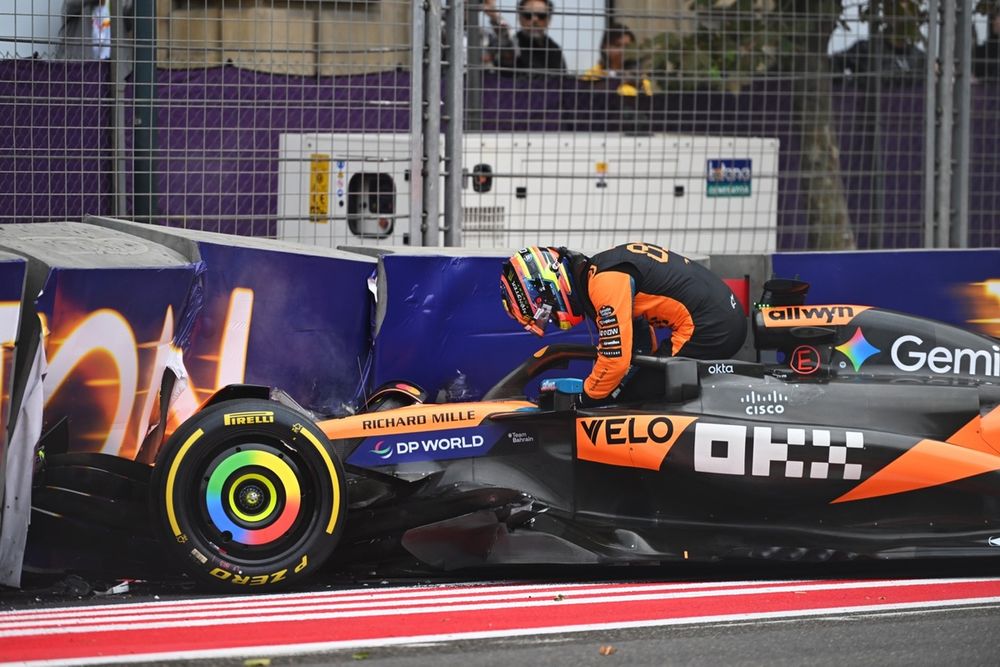
Piastri's horror show was the only interruption to last year's Baku round
Photo by: Rudy Carezzevoli / Getty Images
Without some of that load, plus the reduced width of the tyres, the cars might feel a touch more skittish - particularly in the traction zones where the engine torque demands a lot of rear-end stability from the car. If a driver is too early on the throttle, the tyre takes on more lateral loading, breaks traction, and can result in a driver going sideways and possibly into a spin.
Unsurprisingly, deployment will be the mitigating factor. In the early season, back when the F1 fraternity and fandom was getting their heads around the demands of the 2026 engine regulations, Haas' Ayao Komatsu used Baku as an example of how difficult it would be to balance the demands of energy use around a lap, stating that "the castle section, the low speed section, there's no point deploying electrical energy in between corners".
"That's going to do nothing in terms of straightline speed," he added. "So you really don't want to be deploying any of those electrical energy at a certain point of the track. But if you accidentally do that, go on the throttle a little bit too much, and then deploy MGU-K to engage the turbo, then by the time you go to the main straight, you haven't got the necessary electrical energy available. So then you pay a big price."
That outline comes with the caveat that the early-season regulations were still in play, and there were fewer restrictions on energy usage outside of the straight-mode zones, but the general theory still applies. Everyone will want to concentrate their deployment on the straight, although picking the ideal "point" of deployment along the 2.2km Neftchilar Avenue stretch will be key once exiting Turn 16.
Once you're through the series of kinks, straight mode opens at the notional Turn 19 and all the way through to the Turn 1 braking zone, which is when you can use the full 350kW power limit from the electrical components. Keeping a full battery will be key, especially assuming the energy will run out if you engage the deployment as soon as the wings open.
The complexion of the race, then, should be different to the previous four years. Pirelli nonetheless predicts a one-stopper, given the low levels of wear expected through the race, but the skittishness of the 2026 cars themselves might lend themselves to more driver errors - particularly in the braking zones. And if that's the case, and if the drivers can't keep the cars planted through the corners, the walls might sense a chance to sate their hunger with crunchy, crunchy carbon fibre.


The old town "castle" remains the centrepiece of Baku's layout
Photo by: James Sutton / LAT Images via Getty Images


F1 approves shorter races for 2027 to fit revised power unit plan

Haas confident of getting 2027 F1 budget closer to cap with new partner talks

F1 doesn't need to change its VSC rules despite Norris' Spain loss

Spanish Grand Prix Driver Ratings 2026

How Norris unfurled a surprising - and "unrepeatable" - Spanish GP pole lap

Audi’s long road back to the top of grand prix racing

What we learned from Friday practice at the 2026 F1 Spanish GP

Leclerc accepts blame for Italian GP clash with Hamilton: "I went too far"

Ten years of Baku: Can F1 2026 bring back the fear factor?

WRC rally winning co-driver Harryman passes away

Hadjar set to make Red Bull return at Azerbaijan GP after injury recovery

Mir to miss Japanese and Indonesian grands prix for Honda
Subscribe and access Autosport.com with your ad-blocker.
From Formula 1 to MotoGP we report straight from the paddock because we love our sport, just like you. In order to keep delivering our expert journalism, our website uses advertising. Still, we want to give you the opportunity to enjoy an ad-free and tracker-free website and to continue using your adblocker.


Top Comments