



Rwanda turns to F1 as it moves forward from a chequered past
Rwanda's Formula 1 dream comes with bold ambition and uncomfortable questions as it accelerates away from its troubled past

Autosport was among the select media outlets invited to the launch of Formula 1's African Grand Prix in Rwanda. The announcement raised key questions, but also showcased a nation determined to be taken seriously on the world stage.
As a Belgian, visiting Rwanda started with an uncomfortable encounter with history. My hotel turned out to be a short walk away from Camp Kigali, where 10 Belgian UN Peacekeepers were murdered during the 1994 genocide while assigned to protect Rwandan Prime Minister Agathe Uwilingiyimana.
They were 10 of an estimated 800,000 to one million killed over a devastating 100-day period, trauma which helped shape the East African country's complicated rebirth and political system. It was a harrowing introduction to how Rwanda bounced back from its darkest period without fully being able to leave its past behind.
From a divided, war-torn nation, Rwanda grew into one of Sub-Saharan Africa’s fastest-growing economies, boasting an annual GDP growth nearing double digits in 2025. That economic transformation, anchored by its services industry, coexists with severe restrictions on political freedom, with Rwanda ranking among the bottom quarter of the Varieties of Democracy Institute's human rights index for 2025 due to the ruling party's far-reaching clampdown on dissent.
Surfing on that nation's economic growth, Rwanda has gained the confidence to launch an audacious bid for a place on the world's biggest stage. When organisers invited a handful of F1 journalists to capital Kigali to attend Tuesday's launch of its African Grand Prix, planned for the early 2030s, it was an opportunity to get a brief feel for the place and its people.
Coming off the plane, parked right at the front door of the tiny Kigali terminal, it's clear why a much bigger airport is needed to accommodate F1. The new Bugesera airport is expected to be ready in 2028, and is one of the key infrastructure projects pillars that will dictate when Rwanda is ready to host one of F1's 24 Superbowls.

Rwanda is set to host the first F1 grand prix in Africa since Kyalami in South Africa in 1993
Photo by: Motorsport Images
Battling dense yet surprisingly courteous and relaxed traffic on Kigali's small, undulating roads, we were ferried to the BK Arena, a large sports hall and convention centre where dignitaries and media gathered to hear from Kagame, as well as F1 and FIA chiefs Stefano Domenicali and Mohammed Ben Sulayem.
The presence of both underlined just how big a deal this is for motor racing as a whole. F1 is finally set to return to the African continent for the first time in three decades. Not to South Africa, but to the heart of the continent, a region that has been so often overlooked or taken advantage of.
Domenicali called Tuesday's announcement as "one of the most significant days in the history of Formula 1" as it can finally call itself a truly global championship again, answering a call by Lewis Hamilton and others to include Africa.
The sportswashing topic will continue to be brought up, and not without justification. Freedom House, which rates people’s access to political rights and civil liberties in 208 countries and territories through its annual Freedom in the World report, ranked Rwanda with a score of 21/100 in 2026
A follow-up press conference, including track designers Carsten Tilke and Alex Wurz as well as government officials, offered more granular detail on the bid. Rwandan sports minister Nelly Mukazayire and Rwanda Development Board CEO Jean-Guy Afrika explained how F1's arrival is a catalyst for a much broader plan to boost the economy.
Following on the heels of last year's UCI world cycling championships, the 10-year F1 deal intends to show young Rwandans that there is a place for them on the world stage, whether that be as an athlete, a promoter, an engineer or a mechanic, or just a sports fan.

There's an unstated lesson prospective F1 hosts can learn from how Rwanda has gone about its nascent bid. Rather than constantly using the media to claim a place, as other would-be promoters have done, Rwanda has largely operated in the background until Tuesday's launch, enlisting Wurz's company to design the track and holding private talks with Domenicali and his team. The only public acknowledgement came when Kigali officially launched its bid as it hosted the annual FIA Prize Giving Ceremony in 2024. Other interested parties on the continent and beyond may want to take note.
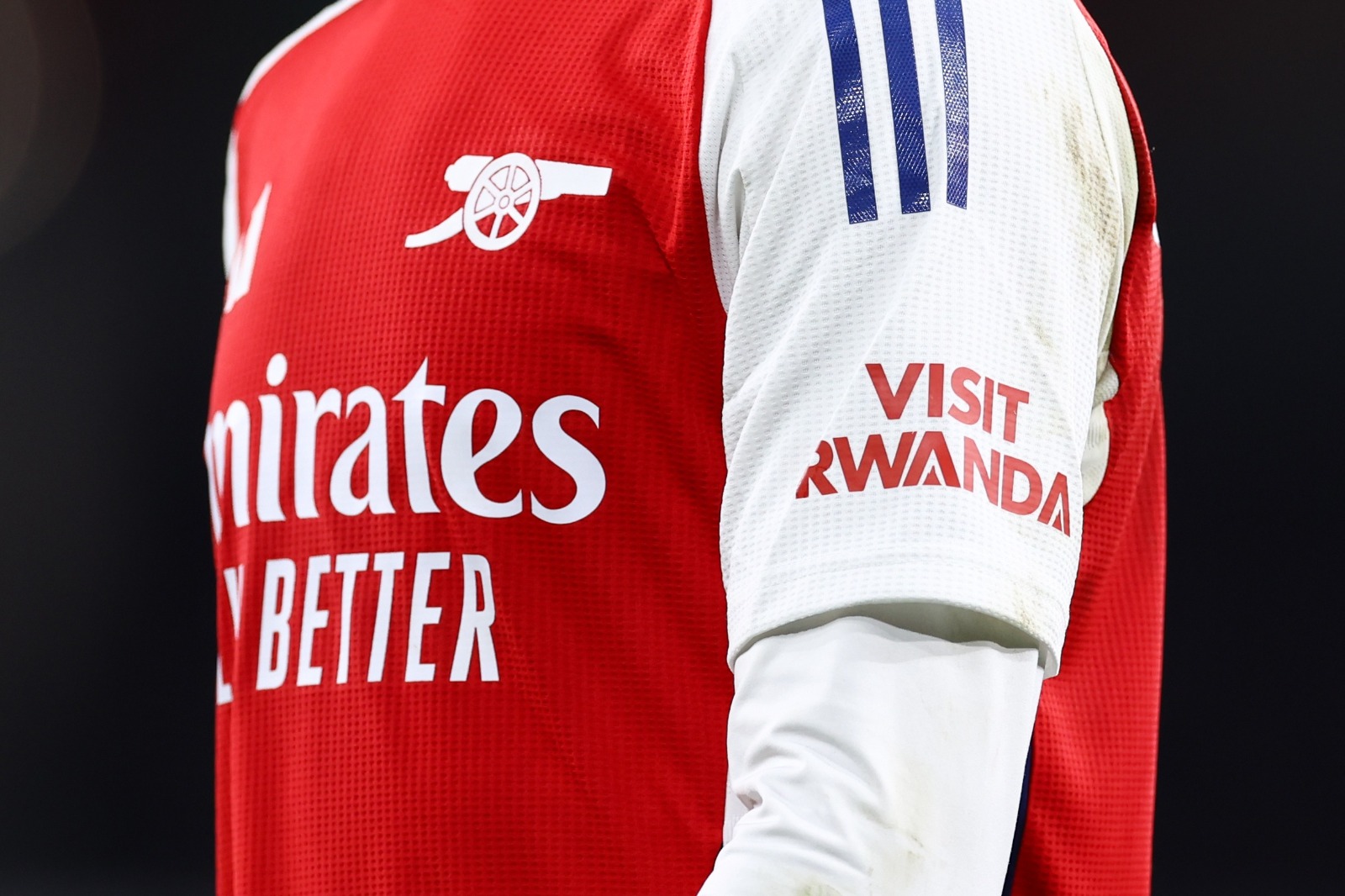
Rwanda is increasing its global presence, previously serving as a sleeve sponsor for Arsenal Football Club
Photo by: Getty Images
As the launch event concluded, we were whisked away to the airport for a helicopter tour of the Bugesera facility. Leaving Kigali's bustling streets behind, our Mi-17 transport helicopter crossed the river Nyabarongo delineating the city's southern limits as the many modest houses made way for lush greenery and the region's distinctive red, iron-rich soil. We touched down on the first concrete foundation of what will become Kigali's future airport, heading to a plateau which provides a vista of F1's future African home.
The 6km, anti-clockwise track features 17 corners and makes full use of the terrain's natural features. With a layout designed by Wurz and a venue engineered by TILKE and DAR, organisers are bullish the circuit can both cater to the drivers' wishes for a fast and challenging layout yet still come up with a design suitable for overtaking on the 1km back straight. What was striking was just how hilly the site is, featuring twice the elevation gain of Spa-Francorchamps's 102 metres, currently the most undulating circuit on the calendar.
As we eventually return to our hotel following a stop-start rush hour journey, it's crystal clear there is a huge amount of work ahead before F1 cars get to race around Bugesera. Not least finding a way to accommodate the projected 100,000 spectators per day and deliver an event that meets the championship's uniquely complex requirements in a country that has little experience. That also explains the flexible timeline for the inaugural event.
Meanwhile, the sportswashing topic will continue to be brought up, and not without justification. Freedom House, which rates people’s access to political rights and civil liberties in 208 countries and territories through its annual Freedom in the World report, ranked Rwanda with a score of 21/100 in 2026.
That's a slightly higher score than the following countries currently hosting an F1 race: China, Azerbaijan, the United Arab Emirates, Saudi Arabia and Bahrain. That doesn't settle any debate on which country does or doesn't deserve to host a grand prix, but it's useful context.
The idea of being able to separate sports and politics is an illusion. With or without sport, governments continue to do business with countries whose records they publicly criticise while turning a blind eye to elements they don't like. But while that's not F1's problem to solve, that doesn't absolve the series of the responsibility of wisely choosing its destinations from a growing list of interested parties.

Sports and politics go hand in hand, Russia had its contract terminated following the invasion of Ukraine
Photo by: Steve Etherington / Motorsport Images
Whether that means F1 and other sports must exclude the above countries, or whether it can be a force for good as the series claims it is, is a complicated debate. And not one that's going to be solved by a motor racing outlet.
I don't have all the answers. But during my fleeting, inevitably cherry-picked visit, I saw hospitable, ordinary people who are desperate to be part of the conversation and host world-class events they are otherwise relegated to watching on TV.
There was a sports minister whose eyes lit up when we asked what Hamilton's public backing for an African race meant to them.
I saw glimpses of a country with a dark past that continues to cast a shadow over the present.
I saw people who are serious about wanting to be taken seriously.

Rwanda is due to join F1 in the 2030s
Photo by: Formula 1


Five key takeaways from F1's big African Grand Prix reveal in Rwanda

F1 signs historic 10-year Rwanda deal to host African Grand Prix

Why McLaren considers Norris-Piastri Singapore clash so “serious”

McLaren to talk internally after "simply not acceptable" Norris-Piastri clash

Singapore sprint qualifying chaos leaves F1 teams furious

"It should be banned" - F1 drivers still divided over cooling vests

Why "crazy" power unit success is so meaningful for Red Bull - and for F1

McLaren targets Norris’ costly fuel system issue with Singapore F1 power unit fixes

Rwanda turns to F1 as it moves forward from a chequered past

Mekies extends contract as Red Bull's F1 team boss

What to expect from WEC's Barcelona debut

Acosta proposes new idea for monitoring tyre pressure in MotoGP
Subscribe and access Autosport.com with your ad-blocker.
From Formula 1 to MotoGP we report straight from the paddock because we love our sport, just like you. In order to keep delivering our expert journalism, our website uses advertising. Still, we want to give you the opportunity to enjoy an ad-free and tracker-free website and to continue using your adblocker.


Top Comments